


Role of women in agriculture and rural development: policy issues
Population Growth and Environmental Degradation
Pregnancy and spacing of births
Purpose :
* This Module contains a selection of reading materials which can enable facilitators to gain deeper insights into many of the issues this Manual adresses.
ROLE OF WOMEN IN AGRICULTURE AND RURAL DEVELOPMENT: POLICY ISSUES1
1 Excerpts from: Stephens, Alexandra. "Gender Issues in Agricultural and Rural Development Policy in Asia and the Pacific". Regional Consultation on Gender Issues in Agricultural and Rural Development Policy. Bangkok, 1-5 November 1993. FAO Regional Office for Asia and the Pacific (RAPA), Bangkok.
Women, Sex And Gender
Gender applies to one sex or the other, and relates to the way each behaves in a given situation. While sex is a biological given, and can not (nominally) be changed, gender is a result of a socialization into a male or a female role which ascribes certain behaviour according to norms for one's sex. Agricultural policy makers have for decades fumed a blind eye to farmers who are women because they think of farmers as men, thus denying women's claim to participation in farming and other activities which directly affect their lives. As a result, rural women have lagged visibly behind most social and economic criteria.
Policy-makers have recently been confronted with some startling revelations about women farmers, derived from alternative data sources:
- women are a majority of all farmers in Asia, although invisible because their work is uncounted;
- their work day is longer than men's, and most have reached the frontiers of endurance in stretching their day;
- women harbour specialized knowledge, represent a pool of highly skilled labour in many areas of agriculture and rural development which are not shared with men;
- women increasingly head rural households, and/or are chief economic providers for their families;
- women's productivity is severely constrained by the fragmentation of their time, their dual and triple responsibilities and their lack of access to essential inputs including knowledge;
- the gap between rural men and rural women is steadily widening, with a growing percentage of women among the absolutely poor and destitute;
- small farm production is increasingly unattractive to males who abandon agriculture in favour of better remunerated work in other sectors, leaving women to eke out a living on often degraded land;
- there is no biological imperative for men to maintain a stronghold on technology;
- agricultural research and extension largely ignore the major concerns of women farmers - nutritious food crops, hardy planting materials, household food security, home storage and small scale processing, for example.
Rights and Status of Women Farmers
The word "farmer" invariably implies a male farmer. When women farmers receive a rare mention they are usually disguised as "housewives" or farmers' wives. Policy statements which do not specifically include women farmers automatically exclude them, because of this kind of thinking on the part of both male and female policy analysts. An inclusive policy statement has therefore to be explicit in saying "men and women, or male and female farmers" if the planners are going to address the needs of each, and if implementers are going to see that both are reached directly
In most countries legislative changes have been made to facilitate women's rights to inheritance and ownership of land, but in practice they still have difficulty in realizing the benefits which should flow from this. Similarly in credit programmes. Where women's direct access to agricultural credit was barred, many women found the dejure lifting of barriers did little to change their de facto situation, and further, that many bankers themselves were party to these infringements by commission or omission.
In Thailand for example it was necessary to change the legal term from a "housewife" to "women farmer" to allow access to agricultural credit, but even so, it remains rare for women to independently take official loans. Among a potential clientele of proven, bankable clients, little has been done by mainstream financial institutions to create an environment in which rural women feel welcome in agricultural and development bank credit departments.
Technology
No agriculture technology is gender neutral. Whether a hand tool, a machine, a storage bin or biotechnology, all carry different implications for men and women. Technologies are made by men and women for use by women and men, or specifically for one sex or the other. Most are developed with a male or female user in mind, i.e., they respond to the demand created by those who want to use them, and can afford to buy them. That already results in a bias determined by culturally ascribed division of labour, and the limits placed on women's access to finance. Thus we find farm women concentrated around the most menial, boring, low-paid, "low tech" activities, while men clamber aboard tractors and combine harvesters for their work.
In a market-economy, technology will address the needs of monied clientele first. Men have the money. In a centrally planned economy, social norms of patriarchy will dictate that the machines are for men; that girls and women are "incapable by reason of their sex, to understand, operate and maintain machines". In very few countries has this stereotype been fully challenged.
Conservation and Sustainability
In relation to conservation issues and sustainability, gender differentials are most obvious in rural areas when the environment is degraded. Women in most developing countries are adversely affected by this more than men, because they are responsible for many of the tasks which demand more inputs from them as degradation and depletion occur. One of the first demands is increasing time inputs. As degradation forces women to walk further in search of potable water and household fuel supplies, their workday becomes longer. As soils are degraded women find access to technologies for restoration and increasing yields barred or constrained by a multitude of social and economic hurdles which affect men less, or not at all. These include knowledge and information, and the whole range of technologies, credit and services.
Vicious circles of discrimination against women emerge as men leave polluted, degraded or depleted environments for greener pastures. Women are often less free to leave because of social responsibilities, and because they are ill-equipped by inferior education and less access to capital, to relocate. Left in a poor environment in the countryside, they are then forced for the very survival of their family, into unsustainable practices which further pollute, neglect, degrade and deplete the natural resource base. Females are often unable to cover all the tasks, particularly the heavy ones related to land preparation and conservation, formerly done by men.
POPULATION GROWTH AND ENVIRONMENTAL DEGRADATION2
2 Excerpts from: FAO. "Sustainable Agriculture and Rural Development in Asia and the Pacific", Regional Document No. 2., FAO/Netherlands Conference in Agriculture and Environment. 'S-Hertogenbosh, The Netherlands, 15-19 April 1991.
The Region has already reached the safe limits of horizontal expansion of agriculture, meaning future needs can only be met by intensification, an option which will not be easy due to widespread land degradation. A major cause of degradation is erosion due to water and wind. Only a very limited area is free from soil-related constraints on agricultural production. These constraints include steeply sloping land, severe fertility limitations, and mining of soil nutrients. Probably the most serious environmental threat is the rapid loss of forest cover. In general, the higher the population growth and density, the more severe the deforestation.
Population growth combined with other factors is causing widespread environmental deterioration. The other factors include: the breakdown of traditional systems of resource management which used to be kept in balance by social regulation of fertility, mortality, marriage and migration; the impact of commercial demand on traditional cultural attitudes of indigenous populations; and unequal access to land and other resources, as well a fragmentation of holdings. Policies to slow down population growth, and enhance alternative employment opportunities are a necessary component to strategies to attain sustainable agricultural development.
PREGNANCY AND SPACING OF BIRTHS3
3 Taken from Facts for Life (UNICEF), 1988.
1. Becoming pregnant before the age of 18, or after the age of 35, increases the health risks for both mother and child.
* Every year over half a million women die from problems linked to pregnancy and childbirth, leaving behind over one million motherless children. Most of these deaths could be prevented by acting on today's knowledge about the importance of planning pregnancies.
* For health reasons alone, no girl should become pregnant before the age of 18. A woman is not physically ready to begin bearing children until she is about 18 years of age. Babies born to women younger than 18 are more likely to be born too early and to weigh too little at birth. Such babies are much more likely to die in the first year of life. The risks to the mother's own health are also greater.
All girls should be allowed time to become women before becoming mothers. In societies where many girls marry at an early age, couples should use family planning to delay the -first pregnancy until at least the age of 18.
* After the age of 35, the health risks of pregnancy and childbirth begin to increase again. If a woman is over the age of 35 and has had four or more previous pregnancies, then another pregnancy is a serious risk to her health and that of her unborn child.
2. The risk of death for young children increases by about 50% if the space between births is less than two years.
* For the health of both mothers and children, parents should wait until their youngest child is at least two years old before having another baby.
* Children born too close together do not usually develop as well, physically or mentally, as children born at least two years apart.
* One of the greatest threats to the health and growth of a child under the age of two is the birth of a new baby. Breastfeeding stops too suddenly, and the mother has less time to prepare the special foods a young child needs. Also, she may not be able to give the older child the care and attention he or she needs, especially during illness. As a result, the child often fails to grow and develop properly.
The Perpetuation of Poor Health Among Women and Girls4
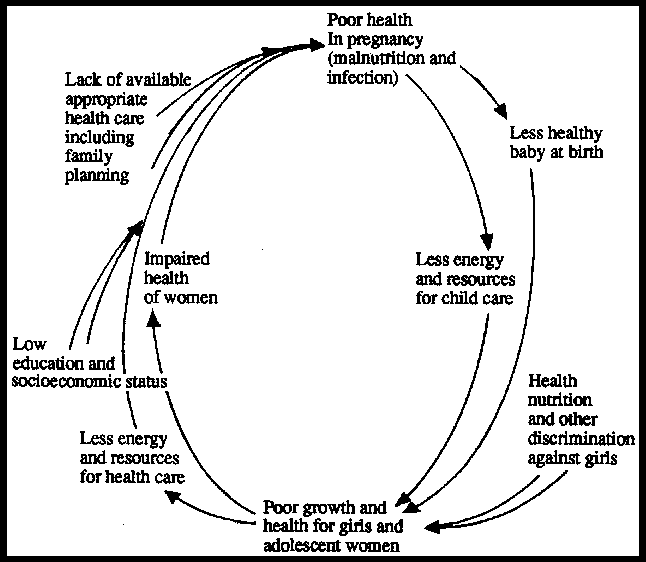
4 Winicoff B. "Women's Health in Developing Countries". Wallace, H. M. et. al. Health Care of Women and Children in Developing Countries, Third Party Publishing Company, California, 1990.
* A mother's body needs two years to recover fully from pregnancy and childbirth. The risk to the mother's health is therefore greater if the next birth follows too closely upon the last. The mother needs to give herself time to get her strength and energy back before she becomes pregnant again.
* If a woman becomes pregnant before she is fully recovered from bearing a previous child, there is a higher chance that her new baby will be born too early and too light in weight. Low birth-weight babies are less likely to grow well, more likely to fall ill, and four times more likely to die in the first year of life than babies of normal weight.
3. Having more than four children increases the health risks of pregnancy and childbirth.
* After a woman has had four children, further pregnancies bring greater risks to the life and health of both mother and child.
Especially if the previous births have not been spaced more than two years apart, a woman's body can easily become exhausted by repeated pregnancy, childbirth, breastfeeding, and looking after small children. Further pregnancies usually mean that her own health begins to suffer.
* After four pregnancies, there is an increased risk of serious health problems such as anaemia ('thin blood') and hemorrhage (heavy loss of blood). The risk of giving birth to babies with disabilities, or with low birth-weight, also increases after four pregnancies and after the mother reaches the age of 35.
4. Family planning gives couples the choice of when to begin having children, how many to have, how far apart to have them, and when to stop.
* Most health services can provide several methods of safe, effective family planning. No one method of timing birth is suitable for, or acceptable to, every individual. Couples should ask advice about the most suitable means of family planning from the nearest trained health worker or family planning clinic.
* Spacing births at least two years apart, and avoiding pregnancies before the age of 18 and after the age of 35, can help to ensure that each baby is born healthy and strong.
In many villages, the main problem is the growing pressure on land resources. There are more people, yet less land on which to grow food. This provides a logical approach for pointing out the benefits of having few children.
The small farmers and his wife usually have only about two hectares of land or even less from which they have to provide the food, clothing and other needs of the family. They get very little money, just one third of what the average workers in the country get. As the number of their children increases, it becomes more difficult to support them. It is even more difficult for those who have no land and depend on farm labour for income.
As you talk to the women and men in the cooperatives and other agricultural programmes, you can present the following ideas:
- If the farm is small and there are many children, it will be further divided into smaller portions with each succeeding generation.
- If there are many children on a small farm, there will not be enough work for all the members of the family.
- Many men and grown-up children cannot get work in the fields or elsewhere because each year, more children become old enough to look for jobs. So they leave the villages to look for work in the towns or cities.
- When the men or the older sons leave for other places, the women are left as heads of the household. This means increased work and responsibilities for them.
- The women have to take care of the family farm without improved agricultural skills, attend to the children and all other matters regarding the household. They cannot depend on their husbands to send money regularly because it is sometimes a problem to find work in the urban areas.
- If the land they farm is in their husband's names, the women may not be permitted to make legal decisions. Neither can they make decisions on what crops to plant or whether to hire workers.
Some points for discussion: 1. What are the reasons why the fathers or the older boys leave the village for towns and cities? 2. How are women affected? 3. How is village life affected when men leave for towns and cities? 4. When the husband leaves for the town, how does the woman cope economically, socially, politically and in terms of time as the head of the household? 5. List the advantages and disadvantages when a rural family moves to a town or city. 6. If land is fragmented among many sons and/or daughters, what agricultural food production practices can they follow for economic gains? |
Figure
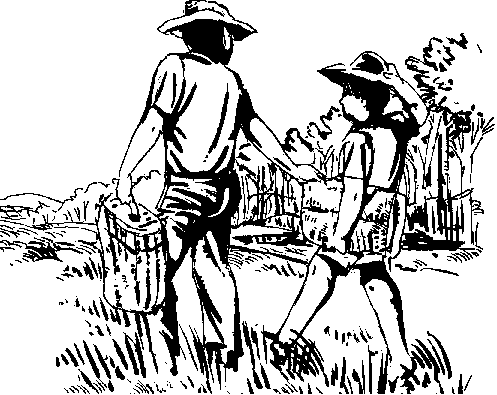
In many countries, especially in regions of shifting cultivation, women do about 60-80% of agricultural production work. This usually means that women are not only the primary food producers for household consumption but are also actively involved in assisting men in the production of the major or cash crops. Some women often contribute to more than half of the income of households through subsistence farming, food sales, processing and trade.
These women will likely be interested in ways to increase their production, especially if they have many children to feed. You might meet them through agricultural cooperatives or through resettlement. You could then start them thinking about having smaller families by showing them what they will need to make their farms produce more food.
Ideas to Consider:
To improve production, what do rural women need?
- Farmers need access to better seeds, pesticides, fertilizers and modern equipment. But these things cost money. If they have many children to feed, clothe and care for, where would they get extra income to improve food production?
- They need to learn skills for improved agricultural operations, for post-harvest practices and storage. But technical training and information on agriculture are usually given by the extension services to men because it is assumed that only the men are farmers. And because women are too busy with their work in the home and on the farm, they do not have time to attend training courses and demonstrations and try out improved packages of agricultural practices. They therefore, do not get the chance to increase their competence and efficiency.
- They also require access to credit for investment in production and other needs such as small machines that will save them hours of labour. But often they do not have the right to borrow money because of the laws. Land reform acts in some cases make conditions even more difficult for women. When the farmers are made owners of lands, the titles are given to men as heads of families. And because the women cannot own land, they cannot be members of agricultural credit associations nor take advantage of rural credit programmes.
- Women need knowledge on health and good nutrition so that they will be strong enough to carry out the back-breaking tasks in farming. If a woman gives birth frequently and at close intervals, she will become weak. She will not be able to work efficiently on the farm.
- Women need rural organizations to break their isolation and to provide them with access to outside ideas, information and services. Such organizations also provide group solidarity for collective action that individuals alone cannot take.
You know that most of the villager have many children. Having many children is important to them because:
- They do not know how many of their children will survive, so they keep on having them.
- Most parents want a son, so they will keep having children until they have one or two sons.
- Children provide additional hands to work on the farm.
a. The girls help their mothers take care of the younger children and help carry water and firewood.
b. They assist in gathering and processing food and in selling this in the market. They also take care of the animals.
c. The boys help in irrigation, fishing and harvesting,
- Children are expected to take care of their parents in their old age.
- For the mother, childbearing is a sign of womanhood. It is her means of getting approval from her husband and from the community and of gaining influence in he household. For a man, having children is a sign of virility and manhood.
- Children give women the love and affection that they often do not get from their husbands, especially in societies where women have a very low position or where husbands are away much of the time. Children are a means of continuing the family line and carrying on customs and traditions.
- In some cultures, children are a sign of God's blessing and also a sign that the parents are doing what God wants them to do.
- They give the family social status.
Children have different values in different cultures. In some countries, they are valued more as a source of love and companionship. In other countries they may be more important as a source of help and old-age security.
Here are some ideas to start women and men thinking about smaller families. These ideas can easily be part of your extension education programmes.
- More children now live longer because health services in the rural areas are much better.
- These days, raising a child costs a lot. Each one will need food, clothing, school supplies, medicines and other things.
- It will take many years before a child can earn any income. Generally, children below the age of 11 cannot contribute much to productive activities in the villages.
- Children who go to school (as they should) can not be much help at home.
- The farmer will probably not need so many children to work on the farm as the land available becomes smaller and she or he learns improved methods of farming.
- At present, it is not just having money but also having well-educated and healthy children that gives social status to a family. This would be difficult to get if there are too many children in the family.
Some points for discussion:
1. How much does it cost to raise a child before he or she contributes economically and becomes productive?
List the items that are usually needed by children. You could include the following:
- nutritious foods
- clothing, school fees and school supplies
- costs of illness such as medicines
- marriage celebrations, gifts, dowry
- other religious ceremonies
- a piece of land.
2. What do you consider a sign of success in your village?
3. What are the advantages of having fewer children? What are the disadvantages?
4. What are the feelings in your village about having a few children?
Some ideas to consider:
- Even if schooling is free, it entails many other expenses - for clothing, books and other supplies. If the family is large, some of the children may not be able to go to school; or the family may have to give up buying other needs for the home and the farm so that they can send their children to school.
- It is easier to educate fewer children who are spaced some years apart. They would not reach school age all at the same time and the parents would not be overburdened with school fees and expenses.
- If the mother has time to rest before another birth, she can attend to each of her children and give them a better start in their schooling.
- These days, children without education will find it difficult to look after their parents because it is usually the educated ones who get good jobs.
- She may understand and better accept new ideas which help her to improve her family and also help her acquire status in the community.
- She gains confidence and can take part in village organizations. She might even organize and lead groups to increase family income or increase efficiency of women's work or conserve resources.
These activities could take the place of childbearing in helping her gain status in her village.
In one village, although the people believed in the importance of having large families, a young woman with only one child was selected by the other village women to head the local women's organization because she was the most highly educated among them. This woman had the chance to get higher education because she had only one child.
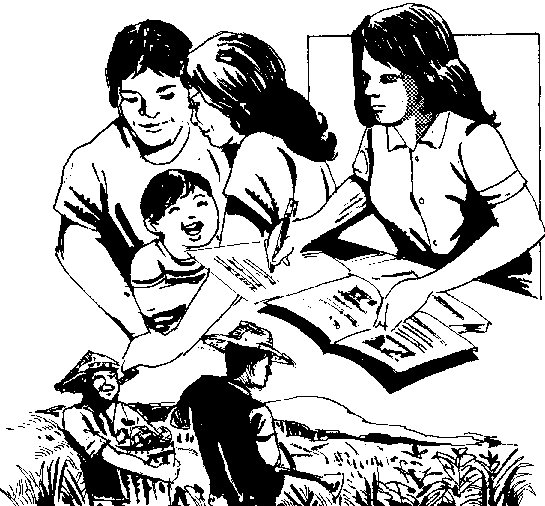
- When a young girl has the opportunity of going to school, she usually gets married at a later age. She then starts having a family perhaps at 18 or past 20 rather than at 13. An educated girl could talk with her husband on an equal basis about the home and the farm and could, therefore, take a more active part in making decisions. Then, perhaps, she could also decide with her husband on the number of children they should have.
Figure
Some points for discussion:
1. Ask the women to give examples of village women who have improved their conditions because of education and having fewer children.
2. Ask the women their ideas on how girl’s education can help them, their children and their lives.
