


Module 5 - Learning principles and technologies
Purpose:
* The in conducting effective learning sessions are discussed in this module.
* Also discussed are some methods in conducting non-formal population education, as well as guidelines for setting objectives.
The people that we work with have special needs. Thus, for the sessions to be effective, it would help if we kept the following principles in mind:
Make the presentation simple.
- Before starting the activity, decide on your central message.
- Enumerate the details that you would like to discuss to support your central message.
- You can ask yourself the questions below to check if you are saying or putting in just the right amount of information:
* What information does the audience NEED to know?
* What information is INTERESTING to know but is not that vital? You can weed out the latter if you do not have enough time.
Learning methods should be problem-posing.
- The learning sessions should address the concrete problems that women face in the family and in the community.
- As facilitator, you should be familiar with these problems/concerns before a session starts. At the beginning of a session you should confirm with the participants whether the right problems/concerns will be addressed.
- As part of the reaming process, the participants shall then be asked to express their perceived solutions to the problems.
- The illustration on page 56 is an example of why poor health is perpetuated among women and girls in some developing countries.
ALWAYS ASK QUESTIONS.
THIS WILL ENABLE YOU TO
BETTER UNDERSTAND THE PROBLEMS.
As much as possible, select learning methods that are active and participatory.
- Participants remember and absorb the lessons faster if they take an active part in the learning process, that is, they do not just sit there and listen to lectures or observe what's going on but are involved in actual learning activities. Learning methods should have the following features:
* Participants should be provided with opportunities to ask questions at certain points of the lecture/discussion.
* They must be made part of certain activities which will serve as reaming venues such as games, actual testing of instruments/ gadgets) machines if they are being taught how to use them, group work where they all contribute towards an output, etc.
Figure
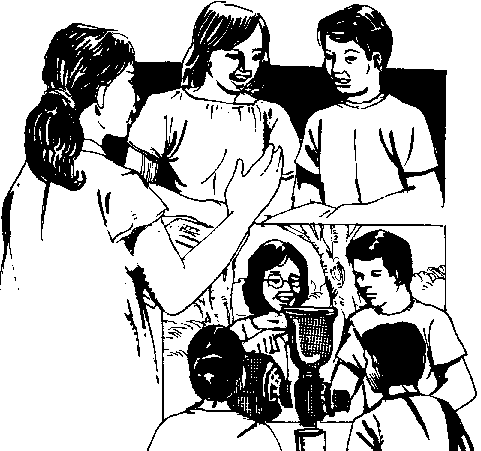
Draw lessons from the participants, as they are the richest source for learning.
- The reamers have a bank of experiences that are the best sources of lessons most applicable to their situation.
- As facilitators, we can encourage the participants to share these experiences. From these we can draw out lessons that can be applied to the day-to-day life of the reamers
Figure
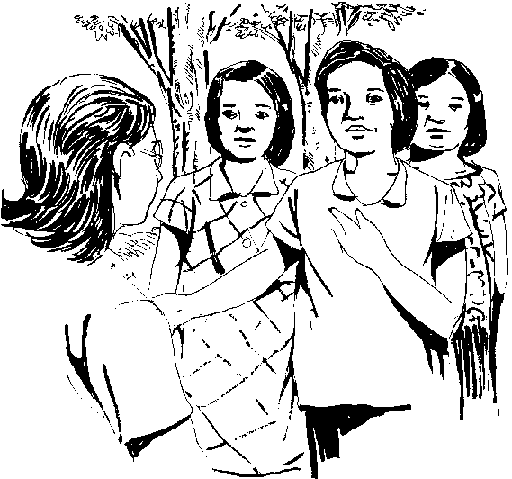
Avoid "women only" presentations, unless the sessions call for a special women's action.
- Experience in development efforts have shown that advocacy programs on women's development work better if the men are involved. After all, the men are part of the decision-making process at home and in the community.
- In most cases, the tasks of cooking and washing have still to be done by the women even if they are supposed to be participating full time in education sessions. Often, the women will come in late because these tasks have still to be done before they leave the house.
- Men and boys should share household chores with women and girls. This will allow women and girls to take more active role in activities outside the home.
Figure
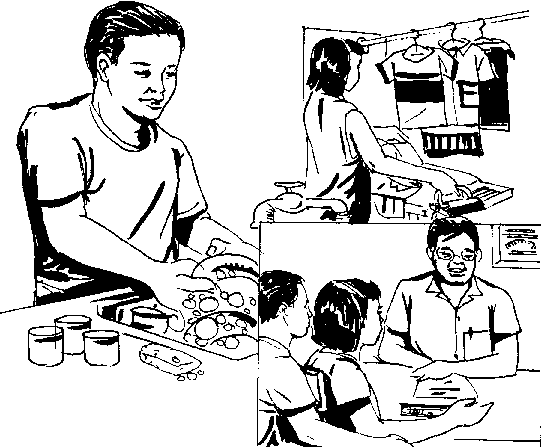
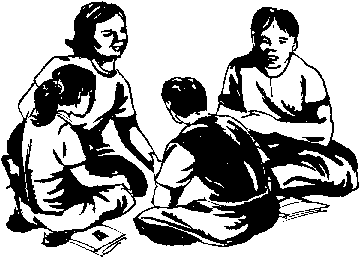
There is strength in learning together.
- If learning is done with peers, there is constant reinforcement. There is also more encouragement to attend the sessions because of group pressure and fun.
Figure
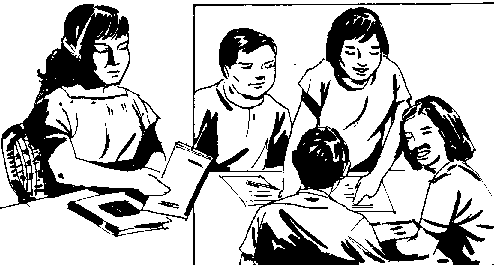
We learn best when we are not under stress.
- Learning occurs best in a relaxed atmosphere. When we are tense, we find it hard to concentrate on the lesson.
- Help your participants to unburden themselves of stressful matters before the start of the session.
- You can ask them to share with the group (and write down) their most urgent concerns. For example, some of them might have problems with sick farm animals, or there is no water coming out from the irrigation, etc. You can ask them to make a resolution to forget temporarily those problems that cannot be immediately solved so they can attend to the most urgent ones.
- The facilitator makes a lot of difference in creating a relaxed atmosphere. If you are tense, the participants can sense it, and they will start to get tense, too. This is especially true in rural areas, where people are very sensitive to one's moods and predisposition.
Figure
Success reinforces learning.
- Learning sessions should build upon one successful activity after another, no matter how small.
Figure
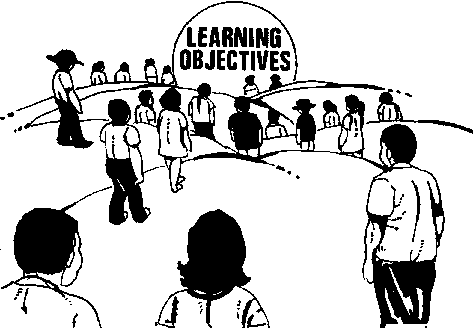
- Every so often, you can stop to assess together with the participants, the progress that has been achieved (you can refer to the questions below).
- You can also refer regularly to the learning objectives as a way of measuring group success.
Figure
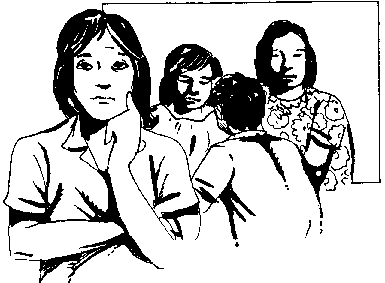
Some questions you can ask the group after each session:
1. What are our objectives for this session?
2. Were we able to meet the above objectives?
3. If yes, what are the factors that contributed to our success?
4. If no, why not?
5. How then should we improve our sessions so we can meet our objectives?
House-to-house sessions
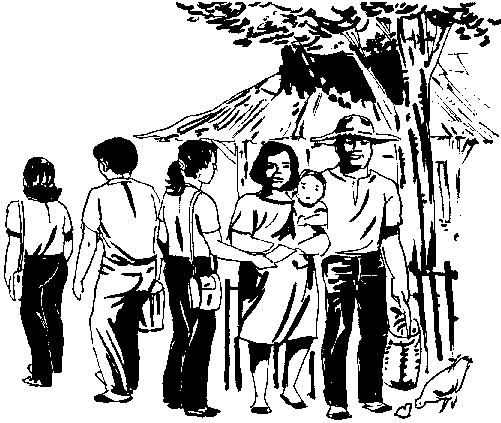
* We can schedule regular home visits to families in our area of coverage.
* However, it is important that we set the learning objectives clearly before each visit.
* As much as possible we should stick to the rules for home visiting as shown on the next page.
Figure
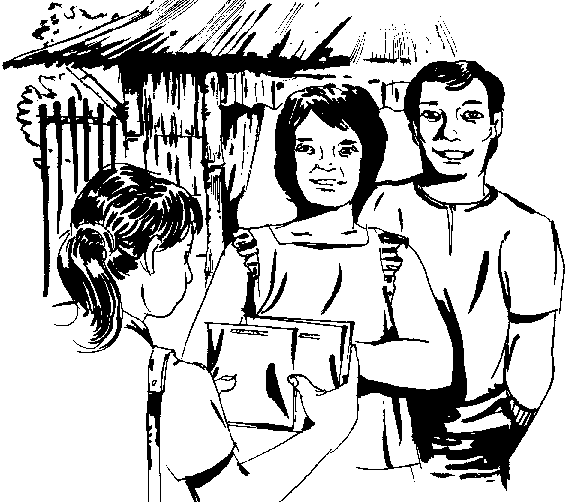
Guidelines for Home Visiting
1. Always be courteous. Even if you are familiar with the people in the household, always obey common laws of courtesy, i.e., greet them good morning, ask their permission to enter the house, etc.
2. Be sensitive to what is going on in the household. If you sense that they are busy, or perhaps resolving a family conflict, defer the visit, or make an appointment to return at a more convenient time (preferably within the same day). Then go and see another family.
3. Go straight to the point. Small talk is okay to make the people being visited at ease, but this should not fall into a rumor-mongering/gossip session.
4. If you have to use household resources like water, see to it that you use them sparingly.
5. Pack your own food if you expect your schedule to extend after meal time. This way, you avoid being a burden on the people. However, if you are invited to partake of the food, make sure that everybody has eaten and there is enough to share.
6. Transform your negative observations into opportunities for improvement. For example, if you see garbage all over the place, you can ask them if they have any problems in garbage disposal. Then, you can help them from there.
7. Be familiar with rural customs and belief systems. This way, you can avoid offending some people, who put much importance on customs/ traditions.
Song/Poem Writing Contest and Song/Poem Analysis
* Songs are one of the most common ways of expressing ideas and sentiments among the rural folk
* Song analysis is also an excellent method of clarifying and emphasizing ideas.
* Popular songs can be adapted to impart population messages. These can be easily recalled by the audience and even the children can sing them.
* The same mechanics can apply to poem writing, in areas where the people prefer this type of expressing.
(Below is an example of a song that emphasizes family planning)
Responsible Parenthood
Ito ang Responsible Parenthood
Magplano ng pamilya
Sa inyo ang ginhawa
Sa anak ang biyaya.
("This is Responsible Parenthood
Plan your family
For you, there will be comfort
For the children, blessing")
Taken from the Responsible Parenthood Program of the Philippine Center for Population and Development.
Organizing a Song-Writing Contest
A song-writing contest is an effective culminating activity. This way, you can also assess whether the participants have absorbed the messages or lessons you wanted to impart.
Mechanics:
1. Divide the participants into groups of three.
2. Ask them to think of a melody they already know, and to write lyrics based on a particular topic in population (e.g., ideal number of children). For those who are more creative, they can compose their own melody to suit the lyrics.
3. You can then ask each group to sing their song.
4. The participants themselves can agree on the criteria for the best song. These criteria can include:
- originality
- correctness of ideas/concepts
5. You may invite somebody who is good in song-writing to be a judge in the contest.
6. During community programs, encourage the winners to sing their songs as entertainment numbers.
Story-telling Sessions
* Small community gatherings lend themselves well to story telling/reading sessions, where lessons in population education can be incorporated.
* Most villages have skilled storytellers. These are usually old folks who have much experience to share. We can tap these folks, or we can make our own folk-tales which incorporate moral lessons in responsible parenthood, gender-sensitivity and environmental conservation.
Figure
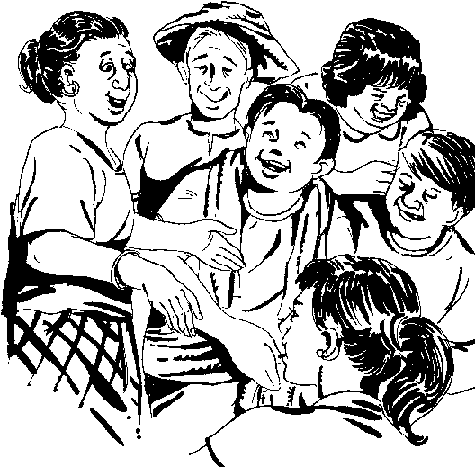
Organizing a Story-telling Session
If you have already organized a study group, story-telling can be a method to introduce a concept or lesson.
For example, if you want to introduce the concept that having too many children is detrimental to family life, you can start with a story (see sample on next page). You can ask the participants to read the story, or you can narrate it yourself. At the end of the story, you can ask questions that will lead to the topic:
Sample questions:
1. What happened to the mother/father? Why?
2. What happened to the children? Why?
3. If you were in the parents' place, what would you have done?
The Story of Dolores
Dolores Perez was nineteen years old when she married Delfin. (A picture of Dolores shows she is a pretty girl).
In the same year, she gave birth to Daisy.
Then, she gave birth to Carmela, Tony, Carlos, Maria, Emma, Cynthia and Jose.... eight children in eight years of marriage.
Carlos did not even reach his third birthday when he fell ill and died.
And this is Dolores now. (A picture of Dolores shows that she is now haggard and looks much older than her real age).
How many more women are like Dolores who do not know that a two-year spacing between births is necessary to ensure the health of both mother and child?
Field Visits
* Nothing is more convincing than seeing a success story with your own eyes and interviewing the people who made success possible.
* Community members can visit nearby villages who have successfully launched a development program or any project related to responsible parenthood/ population.
* Taking out the participants from their day-to-day environment will help in broadening their knowledge. The field visits can also provide a respite to the participants from their heavy work load.
* It would be helpful to prepare guide questions for the participants. This way, all the information needed can be gathered during the trip so that there is no overlapping of activities.
Figure
Poster Making
* Poster-making contests on specific population themes can be organized Since the contestants will need to know more about the theme, they will be forced to do research on it
* Posters will have multiplier effects since there will be many who will read the messages
Figure

Puppet Shows
* This is another method that appears to work well with younger audiences.
* Puppets can be made from recycled materials like old socks, brown paper bags and plastic disposable cups.
* Community members can be trained to make the puppets and to draw up the script
Figure
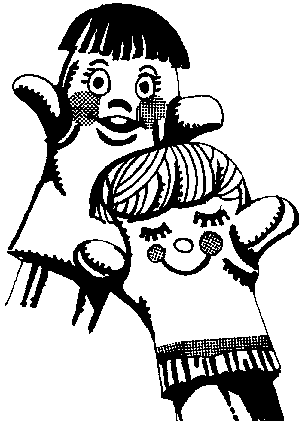
How to Make Low-Cost Puppets
Materials needed: old socks or brown paper bags, crayons/felt tip pens
Directions:
1. Fit the sock or brown paper bag into your hand so you can mark where the eyes, ears, nose, etc. will be.
2. Draw the face of the character you want to show on the sock/brown paper bag using crayons/felt tip pen. You can improve on the appearance like putting yarn for the hair, etc.
3. Since these are hand puppets, you can design your show in such a way that only the faces of the puppets are seen.
4. You can also make full figures from old clothes/socks and other materials that you can recycle. If you have pillows that are no longer used, you can use the pillow stuffing to fill up the puppet. Then you can attach strings at the arms and legs to make the puppets move.
Folk Drama
* This method works well with big crowds especially during community festivals or celebrations.
* Community members can be trained to re-enact true-to-life stories related to population, environment, women and development.
* The group members identify a problem and enact a skit or play on it in the presence of others. It is then discussed with the audience to stimulate further analysis, reflection and action.
* Simple and low-cost props and costumes can be designed. The community members can even take part in the development of the script.
Figure
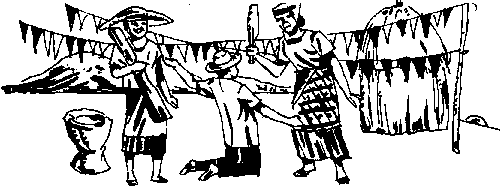
Organizing a Folk Drama
1. First, decide on your message/s. What concepts would you want to put across in the folk drama?
2. Draw up the script, or ask somebody to do it.
3. Select the cast of characters.
4. Practice drama with characters either as a group interacting, or as individual characters.
Development Theater/Role Plays
* This is a simplified version of the folk drama/theater. This requires little or even no props, and no costumes, unlike the folk drama.
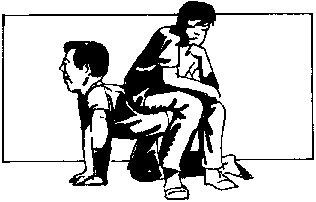
* Performances can be set anywhere. Often, community members can even serve as props (i.e., if a chair is needed, one community member poses as a chair and provides suggestive behavior).
Figure
Adaptation of Common Games
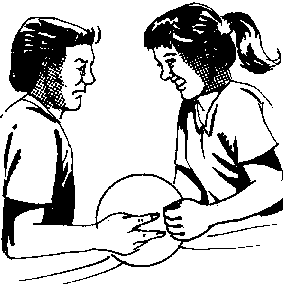
* Games provide good opportunities for mixing physical and mental activities in one method. The following are examples of games that have been adapted to community use:
- Rumor Clinic (a version of message relay)
- Tic -tac -toe
- Snakes and Ladders
- Family Feud
A complete description of how each game is conducted is found in the Appendix B.
Figure
Quiz Shows
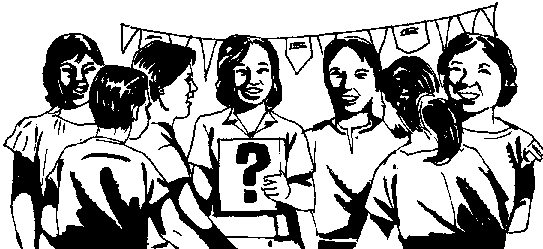
* This method works best among representatives of community groups.
* You can organize the quiz shows together with other facilitators, or in coordination with existing organizations in the community (e.g., Community Development Council).
Figure
Organizing a Population and Development Quiz Show
1. Select your contestants. They can either be individuals or teams, depending on your preference.
2. The quiz show is best scheduled to coincide with an activity in the village (e.g., village fiesta, end of harvest season, etc.)
3. In the actual show, the person/group that signifies to answer the question first is called first. If the answer is wrong, the other group/contestant will be given the chance to answer the question.
4. The group/contestant who correctly answers the most number of questions wins the contest.
Below are samples of questions and answers:
1. What is the best or ideal number of years between pregnancies? 2 years.
2. At what ages should pregnancy be discouraged among women? below 18 and above 35 years of age.
3. A pregnant mother should have a tetanus toxoid vaccine.
4. The first outflow of milk from the mother, which is yellowish and sticky, should be given to the baby. True or False.
5. Children who have diarrhea should not be fed. True or False.
Use of audio-visual materials like slide-tape presentation/movies
* Slide-tape-presentations and movies can be used in areas where there is electricity or where a small generator is available.
* Most movies/slide-tape presentations have already built-in messages in the story.
* Appendix D shows slide-tape presentations/movies that can be used for community education programmes.
Group Discussions
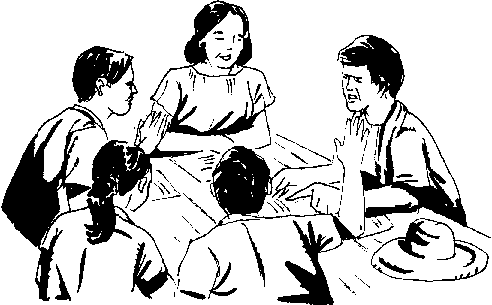
* Group discussions are effective means of clarifying and weighing the pros and cons of a problem or an issue.
* The atmosphere for discussion should be conducive for expressing one's thoughts/ ideas to maximize the outputs of group discussions.
* The facilitator should see to it that the guidelines on group discussion are used to provide a logical and progressive framework for developing the courses.
Figure
Conducting Group Discussions
1. Prepare an introduction to guide you at first. A facilitator who is confused or lacking in self-confidence will not hold the attention of the participants.
2. Clarify with the participants the objectives of the discussion.
3. Create a friendly atmosphere for frank discussion.
4. Let each person have a chance to speak. See to it that the request to speak is signified, and that you, in turn, acknowledge the person before he/she can speak.
5. Encourage the timid to join in, but politely restrain the most talkative.
6. Take care that the discussion does not become a dialogue between two members.
7. Do not let technical jargon go unchecked. Always simplify or explain terms which may be unfamiliar.
8. Prepare questions to steer the discussion. If the subject runs dry, or people stray from the point, it is time to bring out those questions.
9. Do not argue with the group. You are not an opponent but a mediator.
10. Make a summary/synthesis of what has been discussed and if possible, display this for all to see and endorse.
Adapted from How Groups Can make Themselves Come Alive, Asian Social Institute, 1987.
Reviewing the Technology for Designing Population Education Activities
Setting Learning
* It is important that for each population education session, the learning objectives should be clear.
* We can follow the guidelines below in setting learning objectives:
Learning objectives must be:
Specific
Measurable
Acceptable
Realistic
Time-bound
S - pecific
We must be clear about the change we want to achieve. Action words must be used to describe the desired outcome in terms of what the learner should be able to do as a result of learning.
Examples:
* At the end of the 30-minute exercise, the participants shall be able to enumerate the effects of rapid population growth on the availability of rural resources such as fuel and water.
* After the group discussion, the participants must be able to explain the importance of giving production loans to women even without the consent of their husbands.
M - easurable
The changes in knowledge, attitudes and skills must be easily seen and determined.
The post-test scores of women on management of rural resources must show a significant change in knowledge before and after an education program has been conducted.
A - acceptable
The behavior, attitude or knowledge expected of the participants must be culturally acceptable.
Example:
In some Muslim countries such as in Southern Philippines and parts of Indonesia and Malaysia, and in Roman Catholic communities, the use of contraceptives such as the pill for family planning is not acceptable. Therefore, this may not be accepted as a valid objective.
R - ealistic
The reaming objectives can be achieved.
It is useless, for instance, to set an objective where rural women, after attending some sessions in food preservation (and where the concept of responsible parenthood was discussed), are expected to discuss comprehensively the effects of population growth on rural transmigration.
The objective is simply not realistic because there were no adequate inputs for the women!
T - ime bound
The time for the objective to be achieved must be stated.
Sample reaming objective:
By the end of the one-hour session, the participants shall be able to explain the advantages/disadvantages of using a condom for family planning.
"If you are not certain of where you are going, you may very well end somewhere else (and not even know it!)"
