


Annex III: A report of the workshop on gender sensitive PRA
1.1. Background of the workshop
1.2. Objectives of the workshop
1.3. Methodology applied during the workshop
2. Proceedings of the workshop on gender sensitive PRA
2.1. Women's role in development
2.3. Social conditioning of gender and the impact of development
2.4. Gender analysis: what is it?
2.5. Why is gender analysis important?
2.6. Gender analysis framework
2.7. Participatory rural appraisal
2.9. Practical application of the framework in the field
2 - 5 May 1995
Submitted HILLS LEASEHOLD FORESTRY & FORAGE DEVELOPMENT PROJECT
Submitted by
Mrs Kanchan Verma Lama
Consultant
Kathmandu
A four day workshop on Gender Sensitive PRA was organized in Kathmandu by the Hills Leasehold Forestry and Forage Development Project for the staff involved with this project. The participants came from the districts of Sindhupalchowk, Makawanpur, Kavrepalanchowk and Rammechhap. They represented three sectors, agriculture/livestock, credit and forestry.
This report is based on the workshop and the outcome therefrom. Thus the credit for this report goes to everyone who attended the workshop.
It may be mentioned that any kind of training, workshop or seminar becomes meaningful only when it is translated into action. Thus the lessons learnt from this workshop will he fruitful only if these are implemented and a follow up of the same is done. It is hoped that the report will be found useful by the Hills Leasehold Forestry and Forage Development Project and for all those who, are involved in the process of development.
Out of the total population of Nepal about eighty lakhs live in the hill region with a large number of them having less than ten ropanis of land thereby categorized as living below the poverty line. Being highly dependent on the forest for their survival, degradation of the environment has been caused by them at an alarming rate. In order to prevent this the Hills Leasehold Forestry and Forage Development Project has been under implementation since 1993 through the participation of the people living below the povery line in different development activities. The project is being funded by the FAO, IFAD and the government of the Netherland and is being implemented through the coordination of the Forestry Department, the Department of Agriculture and Livestock as well as the Small Farmers Development Project of the Agriculture Development Bank.
Different types of training programmes and workshops are being organized for the farmers as well as for the project staff to provide information on adopting successful methods for implementing this project. The Gender Sensitive PRA Workshop conducted during 2 - 5 May 1995 was a part of this training programme.
The workshop was conducted according to the following objectives:
to build up conceptual clarity on gender issues
to introduce gender analysis and its importance in development
to introduce a practical framework for applying gender analysis into practice
to introduce the concept of Participatory Rural Appraisal from a gender specific
perspective to introduce the tools of PRA applied in the process of information
collection in a gender sensitive manner from the communities
Thus the workshop was divided into two main parts - gender and PRA.
The workshop was conducted by applying a participatory methodology. The participants were encouraged to involve themselves in group discussions and group exercises. Likewise they also participated in floor discussions and floor exercises. Thus the theoretical aspects of the different topics were made comprehensible for them. At the same time a few handouts in simple Nepali language were distributed to them for reference. The appropriate materials used during the workshop consisted of overhead projector, transparencies, flip charts, marker pens, metacards, etc. which made the topics easy to understand.
The participants who attended the workshop were 43 in total representing the four districts of Sindhupalchowk, Kavrepalanchowk, Ramechhap and Makwanpur. Similarly they were involved in the sectors of agriculture and livestock, credit and forestry.
In order to conduct the workshop in a convenient manner the participants were divided into two groups with representatives from Sindhupalchowk and Makwanpur in one group and those from Kaverpalanchowk and Ramechhap in the other. It was seen that all the three sectors were represented in each of the two groups.
With due approval from the Training Advisor the Consultant included two more facilitators besides herself in delivering the workshop. These facilitators were hired from Utthan (Gender and Development Centre) which is an NGO working for the promotion of gender issues in development efforts through training, workshop, advocay, research, monitoring and evaluation.
The two hired facilitators were Ms. Suchismita Nath and Ms. Gita Puri. The Consultant focussed on the gender sensitization, gender analysis and the Gender Analysis Framework whereas Ms Nath concentrated on PRA and its different tools and their proper application within the community.
Ms. Puri facilitated the drawing up of the action plan by the participants.
The objective of this session was to enable the participants to understand the differences in the major aspects between the two trends of development Women In Development (WID) and Gender And Development (GAD) - addressing the development of women.
After the declaration of the Women's Decade in 1975, development professionals had given special consideration towards women in general and various attempts had been made to improve the condition of women all over the world. Thus the concept of Women in Development (WID) emerged to bring about development specifically through women. Likewise in Nepal a Women Development Division had been established under the Ministry of Local Development. However the development of women in the actual sense had been found lacking in spite of all the efforts made worldwide.
In spite of women's involvement in all these activities they were being isolated and marginalized from the mainstream of development, which caused the emergence of the gender approach in development known as Gender and Development (GAD) concept. According to this concept women were not considered in isolation but in terms of the relationship between women and women, women and men as well as men and men and the overall impact with regard to development throughout all sectors of development efforts and at all levels.
The objective of this session was to enable the participants to understand the underlying differences between sex and gender.
The participants were divided into two groups A and B for a small group exercise on the following two questions:
Group A |
What are the physical characteristics of men and women? |
Group B |
What are the behavioral characteristics of men and women? |
In response to these questions, the group members of both the groups conducted small group discussions and presented their findings on flip charts.
The next question for discussion in the plenary was:
Which of these characteristics can be changed under normal conditions ?
From the responses received it was very clear that everything that is biological cannot be normally changed but the behavioral characteristics can be changed through the influence of external factors. Moreover these kind of changes take place differently (in terms of degree and nature) in different communities, according to their specific social condition.
Sex is biological, natural whereas gender is socially constructed. Sex cannot be changed under normal conditions whereas gender being a socio-cultural role gets changed under various circumstances like war, famine, economic crisis, education, development efforts, age, the, place, etc. Sex is predetermined whereas gender is shaped under the social and cultural norms and values of a given specific society. People normally accept the socially constructed gender role as equivalent to the biological sex and often tend to deny the fact that it can be changed.
There is again the missing link; therefore, the realization that the social role is not static and that it can be designed according to the need of development initiatives whether it is male or female is very important to be identified by the development practitioners, planners and policy makers.
The objective of this session was to enable the participants to analyze the existing linkage between the social conditioning of gender roles in the Nepalese society and its impact on the development process and the results thereof.
The participants were divided into three groups A, B and C of equal number. Each group was given a different question. The question given to a particular group was not known by the other two groups. Thus the questions were confidential. They were as follows:
Group A |
Write down the existing differential norms, values and attitudes towards men and women in our society. |
Group B |
Write down the names of the institutions which help the existing norms, values and attitudes towards men and women to strengthen systematically. |
Croup C |
Write down the differential impact on women and men as an effect of the existing development efforts in all the sectoral fields. |
The result of the group discussions were presented through colourful metacards by writing one expression on one card and these were presented in the plenary. The presentation was reflected in the shape of a tree with the findings of Group A at the roots, the findings of Group B as the trunk and the findings of Group C as the leaves, flowers and fruit.
The tree represented the social construction of gender and its differential implications on men and women in terms of benefits derived from the present trend or process of development which reflected an unjust, unequitable system of distribution of benefits between the two sections of human beings although there is maximum contribution of women in the informal sectors.
The objective of this session was to enable the participants to understand what is actually meant by gender analysis.
The session started with a small group exercise among the participants. They were divided into four groups A, B. C and D and each group was asked to answer one of the following questions:
Group A |
Assume yourself as a girl of 10 to 14 years of age. You live in a village near a town. List your activities from morning till night. |
Group B |
Assume yourself as a male farmer of a village. Your age falls between 25 to SO years. List your daily activities from dawn till night. |
Group C |
You are a rural female farmer of the age group of 25 to 50 years. List your daily activities from dawn till night. |
Group D |
Assume yourself as a male of 25 to 50 years of age. You have migrated from the village in search of work. You work as a wage labourer and you stay alone. What activities do you perform during a normal day from morning till night ? |
When the presentation of the activities of the different persons was done by each group, it was revealed that the activities and, therefore, the roles differ between men and men of the same age group living in different places, between men and women of the same age group due to the social conditioning of different genders, between women and girls because of their difference in the age group and also time. Thus the activities may differ between different genders as well as between the same gender under different conditions.
Gender roles are not set roles; these roles are changeable as an effect of time, age, space and other external factors as education, economic crisis, war, famine, various seen and unseen factors and above all, development efforts.
Gender analysis is a systematic effort to document and understand the role of both women and men in a given context. Gender analysis addresses facts and not assumptions.
The objective of this session was to enable the participants to understand the purpose and importance of gender analysis in planning, implementation, monitoring and evaluation of development programmes.
Gender analysis is necessary because women's contribution is not counted in the development efforts. Their working hours are higher than that of men, but when asked, the reply is always that she does only the household work and she does not work at all. That means what is counted is only the exposed productive activities and the role based on that.
Thus, when the actual contributor remains unnoticed, uncounted and far away from getting any real benefits from the development efforts, one day the process of development will cease to continue. The dried up drinking water taps constructed by many development agencies in Nepal is a common example of this. The actual user party is not asked about their needs, their choices, their problems, their potentialities, their decision in the development planning process. They are usually used as the recipient and not as the subject of development. They cannot feel ownership when the whole process is dominated by the powerful section of the community. And as soon as the project phases out, the condition of the local development activities undertaken by the project goes into a deteriorated condition and gradually everything phases out. There is no sustainability nor effectiveness nor continuity, because there had been no creation of equity. Gender analysis attempts to highlight the role of the actual contributors.
Two general purposes are served by applying gender analysis to development policies, programmes and projects.
1. Gender analysis helps to predict how different members of the community or household will be affected by development activities; and to what degree women and men will be able to participate as well as benefit from them.
2. The information derived from gender analysis can help planners and project staff to anticipate whether or not the development effort will be sustainable, effective and equitable.
At the same time gender analysis aims at the closing up of the gaps between contribution and benefits; and also between the present contribution and the potential contribution.
The objective of this session was to enable the participants to learn about the tool for applying gender analysis into practice.
The resource person led the session towards Gender Analysis Framework, which is the tool required for the application of gender analysis in the practical field. Gender analysis performed through the application of this framework can provide a very carefully collected gender disaggregated data about the community life-system as a base for correct planning. However there must be administrative, personal and managerial commitment for the realisation of the application of gender analysis in the practical field.
The framework consists of four interrelated profiles:
Development Context Profile,
Activity Profile,
Resources Profile and
Project Action Profile.
The first three profiles provide the information base that can lead to effective design and successful strategic implementation of projects that will increase male and female participation and benefits thereby maximizing the potential for sustainable development. The fourth profile helps the planners/implementors to develop gender sensitive action strategies.
A. Development Context Profile
The objective of this session was to elaborate on the Development Context Profile.
It helps to broaden our consideration of the context of development in terms of environmental, institutional, economic, social, demographic and political norms, trends and changes as well as the interrelationship among these. Moreover it also helps to identify the constraints and supports to development in the project context.
Development Context Profile
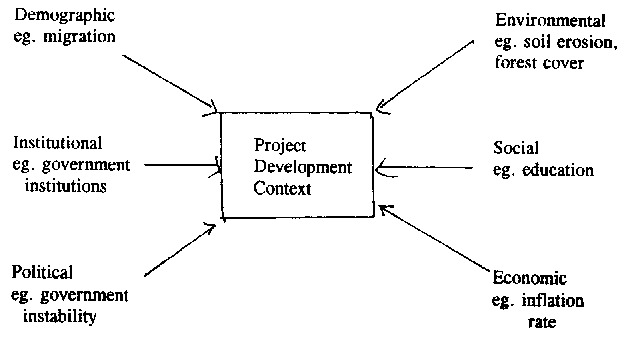
The above figure explains the different factors that act as constraints or supports to the project context. Constraints and supports are relevant to a particular development effort.
In order to apply this profile, the following worksheet can be used:
WORKSHEET 1: DEVELOPMENT CONTEXT PROFILE
Area |
Constraints |
Supports |
Environmental |
||
Social |
||
Demographic |
||
Economic |
||
Institutional |
||
Political |
Certain questions that must be asked in connection with this profile are as follows:
Q. What has been changing in the context of the specific area ? What is improving and what is deteriorating ?
Q. What is constraining and what is supporting development in this context ?
In the first column the constraints are recorded and in the second column the supports are recorded.
B. Activity Profile
The objective of this session was to enable the participants to understand the varied nature of activities performed by men and women of different age groups within a given specific context.
Three types of activities were analyzed - productive, reproductive and community activities. It was also explained that the roles of men and women of any community is normally determined by the roles they play within their community.
Productive Activity
It includes those activities which get paid in cash or kind directly.
Reproductive Activity
This includes all those activities which are done as normal routine work in the form of childcare, care and nursing of elderly members of the families, maintenance of domestic activities, bearing and rearing of children, etc. These kinds of activities are not seen or counted as bringing direct income in cash or kind but if these kinds of activities are done for others (except in case of social assistance) these get directly paid in cash or in kind. These activities are mostly performed by women within the household and are generally left unnoticed, uncounted and unrecorded. Without counting these activities in terms of time and labour involvement the development efforts have become impractical and unsuccessful in integrating women into the mainstream of development. All the home maintenance and subsistence activities that support the family and the community fall under this category.
Community Activity
It includes all the activities which are performed by the community in groups, e.g., community forestry, community drinking water projects, school building construction, religious or traditional rituals and all such other activities which involve community efforts.
Community activities can be categorized into two types - community management and community politics. Managing social activities through community efforts falls under community management activities whereas taking decisions collectively by the community people is termed as the community politics activity. In the latter, women are not found active; rather they are not considered as important enough to participate in these kinds of activities. Although some efforts are being made by development workers to improve the situation yet in most cases women are not directly approached for playing the role of decision makers in comparison to men.
Activity Profile is a tool for recording the gender based division of labour in the community. The main purpose of this profile is to produce a clear picture of "who does what" (by gender), "where" and "when". This profile serves a number of purposes for our work as development planners and implementators, including the following points:
a. the activities of both women and men in the project area will become visible, and thus, each can be targeted for training and technologies, as found appropriate to their respective role;
b. the inclusion of both productive and reproductive activities of women and men in the profile will help us to identify labour bottlenecks, showing the activities and time periods where the introduction of improved methods or appropriate technologies would be most beneficial to overall productivity;
c. the identification of those activities that serve both productive and reproductive/subsistence needs highlights those activities that may be most important for the well being of the rural households from an overall point of view, therefore these activities may be those that we need to exercise care so as not to undermine or those that may boost development most if we target them for training and inputs;
d. time constraints can be identified, both over the day and across the seasons, and mobility constraints can be identified in terms of where the activities of women and men are concentrated, both of which have implications for project delivery methods.
Worksheet 2 is for summarising the Activity Profile information. In the first column the productive and reproductive activities are listed along with the community activities. Whether the activity is the primary responsibility of the females, males or both is recorded in the second column. The third column, used for documenting the time for each activity, can be used in either of the two ways depending on the information available. It can be used to summarise the activity calendar information and highlighting the intensity of the time required. In the final column of the Activity Profile the location of each activity is noted ea. field, forest or homestead. The profile is left blank wherever additional information may be needed.
WORKSHEET 2: ACTIVITY PROFILE
Activities |
Gender |
Time |
Location |
Productive |
|||
Reproductive |
|||
Community |
|||
M - exclusively male F - exclusively female M/F - equally male and female M/f - predominantly female |
eg. daily, weekly, seasonal, etc. eg. 3 hrs daily 7 hrs weekly, etc. |
eg. field, forest, homestead, city, etc. |
C. Resources Profile
The session was conducted with the objective of enabling the participants to learn about the access to and control over resources and benefits by gender in an analytical way.
This profile helps us to identify:
a. the resource base of both women and men in the project area, especially with respect to land, trees, credit, equipment, information and inputs;
b. the relative benefits derived by women and men from their work and their utilization of resources, such as income and food, and therefore their incentives for participation in project activities;
c. the resource needs and constraints of both women and men so that they can be incorporated into the project design.
Worksheet 3 is used for summarizing the Resources Profile information. In the first column, the resources utilized by women and men in the project area are listed ea. land, trees, employment, etc. The benefits derived from the use of these resources is listed in the second column ea. food, fuel wood, income, etc. In the third column, the access to the resources and benefits by the genders - whether female, male or both - is indicated. Finally, the gender or entity that exercises control or decision making power over the resources is noted in the last column.
WORKSHEET 3: RESOURCES PROFILE
Resources |
Benefits |
Access to |
Control over | |
Resource |
Benefit |
|||
eg. land, trees, labour, technology, time, capital, extension training, indigenous knowledge, etc.. |
eg. food, fuel, income, skill, status, etc. |
M - exclusively male F - exclusively female M/F - equally male and female M/f - predominantly male F/m - predominantly female |
eg. husband wife, state, forestry department, etc. | |
D. Project Action Profile
The objective of this session was to impart to the participants the skill of developing an action plan incorporating gender sensitive strategies.
The final component of the Gender Analysis Framework is the Project Action Profile. It is here that the findings from the Context, Activity and Resources profiles are pulled together and examined in terms of the project objectives and activities. Strategic issues include the assessment of the importance of gender issues to achieving project objectives and an evaluation of whether it is important to incorporate women, men or both in specific project activities.
It assists us to analyze:
a. whether the project objectives support the priorities and needs of both women and men in the project area;
b. if the project activities are presently targeted to the appropriate beneficiaries, be it women, men or both;
c. appropriate and pragmatic actions for enhancing the success of the project in terms of gender analysis.
Worksheet 4 provides a structure for organising the Project Action Profile information. In the first column are listed the project objectives and activities that are considered to be relevant in terms of gender analysis findings. The objectives and activities are those given in the project document. The gender considerations for each of the objectives are noted in the second column and these are based on the findings from the Activity Profile and the Resources Profile as well as on consideration of the gender of the project's beneficiaries and staff. The third column is used for listing the recommendations for project action. Taking into consideration the constraints and supports identified in the Development Context Profile, these recommendations are based on the gender considerations of the project activities. In other words, if it is determined that some adjustment or change is required in the project, then the specific recommendations for doing so are listed here. Wherever possible, the persons to he made responsible for the implementation of the recommended project actions are identified.
WORKSHEET 4: PROJECT ACTION PROFILE
Project Objectives and Activities |
Gender Considerations |
Recommendations for Project Action |
objectives and activities selected from the project document seen as strategic in terms of gender analysis |
- consider the findings in the Activity and Resources Profiles - consider the gender of the project beneficiaries - consider the gender of the project staff |
- aim for success both in terms of achieving project objectives and in terms of enhancing the well being of women and men in the project area - take into consideration the constraints and supports - wherever possible specify who will have responsibility for each project action recommendation |
The relationship between development, participation and people is an important one that must be understood and built up if development is to be achieved. The differing and overlapping activities, resources and constraints of women and men have important implications on the objectives and activities of any kind of development effort. But as these roles and responsibilities vary greatly, it is essential to take a situation specific approach to look at what is the reality in a specific context rather than to operate on the basis of generalisations or assumptions. Assumptions cannot always be real. It is important to recognise that no standard gender sensitive design is available. Each situation is unique and will require specific responses.
The Gender Analysis Framework is a logical but flexible tool. The use of the Development Context, Activity and Resources Profiles provides the information base for a good project design and implementation. In the Project Action Profile a structure is provided for linking gender issues to the specific project tasks and for developing appropriate strategies for gender sensitive changes as necessary.
The participants were divided into three groups according to their sectoral responsibilities and given the task to develop action plans. The group action plans are provided in the following pages.
ACTION PLAN - AGRlCULTURE AND LIVESTOCK SECTOR
Project Objectives and Activities |
Gender Considerations |
Recommendations for Project Action |
1. Grass development |
involving both men | |
a. ground grass |
M/F |
and women in training |
b. daale grass |
M/f |
and making them work equally |
2. Animal health programmes miscellaneous) |
M |
|
M |
giving more priority to women in future training | |
3. Improving species |
||
M/f |
as per the present trend | |
4. Exposure trips, training, workshops, etc. |
representing women and men equally |
ACTION PLAN - CREDIT SECTOR
Project Objectives- and Activities |
Gender Considerations |
Recommendations for Project Action |
1. Pre-survey of the families |
greater involvement of men in family business (a) M; (b) M+F; (c) F |
emphasizing on women's groups |
2. Group division |
||
3. Group meetings a. b. loan requisitions, |
greater involvement of men M women not having land saving in their own name |
loan to be provided without assets in future; increase of loan limits |
M |
women to be involved actively; men to be encouraged | |
4. Saving |
M+F |
to be informed orally by letters |
5. Loan return |
||
6. Others - social development |
active involvement of women and men |
ACTION PLAN - FORESTRY SECTOR (Rangers Group)
Project Objectives and Activities |
Gender Considerations |
Recommendations for Project Action |
1. Site selection |
greater involvement of men with very few women; only men in decision making role |
the fact that the project activities are not only for men but women also have an important role in it should be emphasized within the community through different types of communication systems, education and motivation; women technicians should be involved |
2. Recorded agreement of the community members |
separate group meetings for the women belonging to the lower class and those of the higher class to be organized both groups should be motivated to conduct mass meetings; women should be motivated to take part in decision making role | |
3. Survey and demarkation |
only men involved in demarkation |
|
4. Land development |
equal participation of men and women |
not found necessary but if in possession of land it should be informed to the concerned authorities |
The objective of this session was to provide basic information regarding Participatory Rural Appraisal including its objectives and fundamentals to the participants.
Participatory Rural Appraisal can be termed as a research process having the following criteria
* participation of the community members in all the aspects of the research process
* collaboration of the researchers and the community people
* semi structural but systematic tearing experience within the community
* multidisciplinary research covering every sector of development
The key issues in the process of PRA can be identified as
Who performs the activities (men, women, old, young, etc)?
What are the activities performed within the division of labour?
When are the activities performed (related to the context of activities)?
Where are the activities performed (related to the context of activities)?
Why are the activities performed (constraints and opportunities)?
How does the activities affect each other and the research/project agenda?
Objectives of PRA
PRA aims to make the beneficiaries capable to participate as the main actors in all the stages of the project cycle beginning with information collection, site selection, group formation, making action plan and implementation of the same along with monitoring and evaluation.
By involving the beneficiary groups as actors from the very early stage of the projects the sustinability of the development process is guaranteed.
Fundamentals of PRA
Basically PRA has 2 Fundamental aspects as follows:
a. The community The members of the community have greater knowledge about their surroundings than any external researchers. The local people may not posses literacy or numerary skills but are rich in the knowledge of their specific living system and their everyday surroundings. Hence they should be given appropriate significance and their knowledge should be acknowledged and recorded by the researchers.
b. The PRA team The other aspect of PRA is the team itself which should be multidisciplinary in nature. The team members should be representing different sectors of development and each should be an expert in his/her own field. This will enable them to facilitate the research towards procuring maximum information from the community without direct intervention on the part of the team.
The objective of this session was to introduce the different tools of PRA that can be applied during the period of collecting information from the community.
PRA consists of a large number of tools and techniques that can be utilized at all the stages of the project cycle. These tools are varied in nature and each of these tools has its specific purpose in the course of information collection from the community. The most significant fact about these tools is that they are to be used by the community members with facilitation from the research team.
2.8.1. Tools for Site Selection - Participatory Mapping
In order to select the proper place for the specific project, different tools related to participatory mapping are usually applied. The mapping provides information on the area/community, its geographical, location, physical layout of the area, the resources available and the different communities living within the area.
Procedure of Mapping
1. The mapping should be performed on the ground by the community members
2. The mountains, rivers, hills, streams, houses, forest, etc should be indicated using stones, leaves, twigs, charcoal, etc. Alternative use of coloured paper is adopted in some cases but application of local materials should be encouraged.
3. The flow of products from the forest, field, etc. to the household, market, etc should be indicated by pieces of thread.
4. The specific product collected should be indicated using local material, ea. a piece of wood to indicate fuel wood, a grain of corn to indicate maize, etc.
Points to Remember
- During the period of participatory mapping the main focus of the exercise should be geared towards the objective of achieving the required information on the pattern of use of the different products of the specific area though intensive discussion.
- Ample time should be allotted the completion of the mapping and discussion (being at least half a day).
- Limited number of community members should be involved in the process of mapping (being maximum ten persons).
- It may be necessary to performed this exercise with different groups within the community as per the objective of the project. The groups may be:
women's group,
men's group,
landowners' group,
landless' group, etc.
- The mapping should be performed at a mass meeting.
- At the end of the mapping exercise discussion should be facilitated among the community members focusing on the following question:
"What coca the map tell us about forest use pattern?"
Types of Participatory Mapping
Participatory mapping consists of 3 specific types as shown below:
a. Transect Walk
The research team accompanied by a few members of the community walk along the main pathway diagonally across the chosen area from one end of the area to the other. During this walk the community members are facilitated to talk on all the objects on either side of the road. ea. trees species, grass, soil content, altitude, shops, houses, water taps, etc.
Later the information is recorded in the form of a map. This helps to gain information about the existing condition around the particular area that is being widely used by all the people of the community.
b. Social Map
The community members are asked performed this exercise or the ground where they first locate the boundary of their area. Next they indicate field, forest, kitchen garden, orchards, houses, temples, rivers, streams, water taps, VDC building, health post, etc. on the map. This map offers a picture of the physical structure of the village as a whole.
c. Resource Map
The resource map provides a clear idea regarding all the available resources within and around the particular community. It can also be done at the household level. It indicates the flow of resources to and from the household/community and also the particular gender benefiting from the resources.
Similar to the other maps this exercise is also done on the ground by the members of the community using local resources and materials and with facilitation by the research team members.
Group Exercise at the Participants
The participants were divided into three groups and each group was asked to perform one of the three participatory mappings. These were then presented in the plenary followed by floor discussion.
2.8.2. Tools for Group Formation
In order to identify the actual target group with regard to the project objectives, some other tools are used. Among these the following are widely accepted.
Wealth Ranking
This exercise helps to identify the actual target group through the process of social stratification. This being a very sensitive issue in any community, a direct approach is not acceptable by the people. Hence facilitation by the research team should be done in a very careful manner.
Floor Exercise with Participants
A very simplified process for wealth ranking was performed among the participants. The resource person asked the following questions in the given sequence to initiate a discussion on the indicators for wealth ranking and for grading the participants accordingly. Each question was followed by a short discussion among the participants and the indicators for identifying the different strata in society were recorded on different flip charts. The questions were as follows
Are all the people within your community similar to you?
How can you say that some are better than you?
How do you select the people who are average?
How can you say that some people worst off in the community?
Then the resource person placed the flip charts on three different walls of the training room and asked the participants to stand in front of the chart which they think is the most suitable one for them. At first majority of the participants tended to gather in front of the chart representing the worst off in the community but disagreements occurred and some were forced to stand in front of the average group and a few were sent to the most well off group.
It was mentioned by the resource person that in the actual field, the pictures will be drawn by the members of the community in separate places on the ground and the community members will be asked to stand near the appropriate pictures. A member of the research team should record the whole activity.
It was also mentioned that a household having a lot of resources and many daughters may be coinsidered lower in the social strata since a greater part of the resources will be given away as dowry. Similarly a rich widow may be considered lower since she is found lacking in social prestige.
Venn Diagram
This tool is used to identify all the organization and institutions within the community ea. school, VDC building, tea shop, etc. It also indicates the relationship and importance of these institutions as regarded by the community members.
Points to Remember
1. The household/community is indicated by a circle at the centre.
2. All the institutional/organizations are indicated by circles.
3. The size of the circle indicates its importance. A bigger circle shows great importance.
4. The distance of the different circles from the centre indicates the degree of interaction between the organization and the household/community. Circles nearer to the centre show greater interaction.
5. Extreme interaction can be shown by overlapping circles.
Group Exercise among Participants
The participants were divided into two groups representing a women's group and a men's group and they were provided with cardboard circles of different sizes and were asked to write the names of different organizations. They were told to choose the correct size to show the exact degree of importance. Next they were asked to paste the circles on a flip chart with the household/community at the centre. The degree of interaction between the specific organization and the household was indicated by the distance between the circles.
The two groups were then asked to present their findings at the plenary and a discussion followed. The resource person mentioned that in the actual field the circles will be drawn on the ground and a member of the research team should record it simultaneously.
2.8.3. Tools for Preparing Action Plan
A different set of tools are used for developing action plan for the project. The ones most commonly used are mentioned below.
Participatory Mapping
This type of mapping is different from the mapping done at the time of site selection. In this case three different maps are drawn by the community members. The first one represents the past condition of the area, the second one depicts the existing condition whereas the third one displays an imaginary picture of the future developed conditions. Thus a clear picture can be obtained regarding the needs of the community and appropriate action plans can be developed accordingly.
Seasonal Calendar
The year round activities performed by the community is represented through this tools. The community members record each activity performed by them during the whole year, which is broken down into months. The activities can be categorize as productive, reproductive, community, expenditure, income, etc.
Points to remember
1. The community members should determine from which month they would begin the calender, eg. from Baishakh, from the month of land preparation, etc.
2. The division of labour may be indicated by symbols, ea. a grain of rice may represent rice cultivation, a dry twig may represent fuel wood collection, etc.
3. The particular gender that performs a specific activity must be indicated.
eg. male = |
M or ž |
female = |
F or O |
girl child = |
gc or • |
boy child = |
bc or l |
4. The nature of activities should also be indicated as follows:
continuous = |
-------------------------- |
sporadic = |
- - - - - - - - - - - - - - - |
intensive = |
-------------------------- |
The format for seasonal calender was then displayed and explained to the participants.
Floor Exercise with Participants
In order to enable the participants to apply this tool properly in the field a floor exercise was performed with a few activities as examples. A citrus fruit cultivation was taken as an example of productive activity. The different stages involved in this cultivation was recorded according to the specific month on the format. The particular gender at each stage was also indicated. Next water collection was taken as an example of reproductive activity performed throughout the year. Intensive collection during the summer months were duly indicated along with the particular gender involved. Another reproductive activity - collection of fuel wood - was also properly displayed on the calender. The examples for income generation included basket weaving and mat making which were also recorded with the respective gender involved. The expenses incurred during the major festivals with its intensity and by the particular gender was then recorded. Finally the health condition of the community was considered and the diseases, ea. diarrhoea, influenza, etc. were displayed on the format.
It was emphasized that the seasonal calender helps to determine the best time for initiation a particular activity in the process of development. Likewise it helps to determine the appropriate person for the same. For example if women are involved in the application of chemical fertilizers, training should be provided to them.
Ranking
This tool helps to determine which activities are the most essential for a particular community. The procedure for ranking is performed by the community members themselves They select the most urgent needs and draw up their action plans accordingly. Two specific types of ranking are commonly in use.
a. Pairwise Ranking
The community members identify a number of needs. Each need is then paired with another one and a comparative analysis is performed by the community as to which of the two needs is of greater importance. This pairing exercise is then performed with all the needs suggested by the community. Finally the need that occurs the maximum number of times is given first preference and the others are graded second, third and so on.
Floor Exercise with the Participants
The participants were asked to mentioned their needs and they suggested school, road and electricity. The pairing exercise was performed and it was found that road was considered the most important of all.
School |
Road |
Electricity | |
School |
School |
School | |
Road |
Road | ||
Electricity |
School = 2 Road = 1 Electricity = 0
Hence the construction of school was considered as the most essential activity.
b. Matrix Ranking
Here the community members identify a number of needs, ea. fodder, fuel wood, etc. and the resources that can fulfil the needs, ea. daale. The needs are recorded along the left hand column and the resources along the top row. The particular resource that can fulfil best the need under consideration is then ranked the highest by the community and the other resources are graded accordingly. When all the needs are considered and the resources are ranked, the total number achieved by each resource is recorded. The one that has attained the highest number is given preference.
Floor Exercise with the Participants
The participants were asked to mention few needs in relation to forestry and the resources that can fulfil those needs. They were asked to rank the resources that may fulfil a particular need in the best possible way. This exercise was repeated for each need and finally totalling was done to find out which resource was most essential for them. The findings were recorded as follows:
Criteria/ Items |
Shishoo |
Uttis |
Daale |
Fuel wood |
2 |
3 |
1 |
Fodder |
1 |
2 |
3 |
Timber 3 |
2 |
1 |
Shisoo = 6 Uttis = 7 Daale = 5
Hence uttis was selected for plantation.
After the theoretical aspects of gender and PRA were covered, the participants were encouraged to take part in a two hours practical exercise on the application of a specific tool of PRA in a gender sensitive manner. The field visit at a village in Godavari was performed to examine the feasibility of applying gender sensitive PRA techniques in the actual work.
The main objective of the field work was to motivate the participants to adopt a gender perspective in community information collection, based on who does what (male/female), who has what, who has access to what resources and what benefits, who controls what resources and what benefits.
Two groups were formed with the participants from Makwanpur and Sindhupalchowk forming Group A and those from Ramechaap and Kavrepalanchowk forming Group B. The tasks given to the two groups were to develop a social map and a seasonal calendar respectively. These were performed satisfactorily from a gender sensitive perspective by the participants.
On return from the field exercise performed in a village in Godavari, the participants were given certificates and they were asked to utilize the knowledge gained from the training in their practical field in all their future activities so as to attain maximum benefits from the process of development.
An overall evaluation was carried out on the workshop regarding the following areas: Content. process, facilitation and participation, the ranking of which came out as:
Excellent |
Good |
Fair | |
Content |
33 |
10 |
1 |
Process |
31 |
11 |
1 |
Facilitation |
30 |
13 |
|
Participation |
29 |
13 |
1 |
The participants were requested to suggest for the improvement in the workshop. As a result of their suggestions and from the feedback discussion that was done among the facilitators, the Consultant would like to present the following recommendations for consideration by the project in conducting trainings/workshops in future:
(a). Further trainings and workshops on Gender Analysis should be conducted at the district level for the staff, members of the line agencies and NGOs together.
(b). The participants' list must include the staff members of the line agencies of one district from all levels which can help in the closing of the gap of understanding and facilitate a democratic working environment. Otherwise there will be an understanding gap hampering the smooth functioning of the programme in the implementation aspect.
(c). Gender Analysis trainings must be conducted for the grassroot groups. One external trainer should conduct it with the help of trained project staff.
(d). A trainers' training can be organised by the project for the mobile team staff and other NGO, GO staff members to impart the skill of participatory training.
(e). A follow up of the impact of this workshop has to be done by the same group of trainers in the field after six months.
(f). The number of trainees should be limited to twenty only.
(g). Techniques on Participatory Monitoring by applying Gender Analysis
Framework has to be imparted through a proper training course to the project staff and the community leaders.
