


During the 70-ties, the country suffered many years of political and social turmoil, following Idi Amin's coup of 1971. He was ousted from power in 1979, but the succeeding governments were unable to restore the security situation in the country to normal and many people continued to lose their lives. The democratisation process in Uganda only started when the National Resistance Movement (NRM), led by Yoweri Museveni, came to power in 1986.
The NRM government introduced a ten-point recovery programme and measures to increase the participation of all citizens in creating a democratic society. Significant among these measures was the establishment of Resistance Councils (RCS), whose main purpose was to facilitate peoples' participation in national development, through ensuring sound local levels of politics.
Another significant measure the NRM government started, was the introduction of affirmative action in favour of marginalised groups in society, particularly women. Their involvement in political decision making through representation on RCs was stressed.
One of the most important components of the democratisation process was the drafting of a national constitution. Preparations hereto began in 1989 and culminated in its promulgation in 1995. As the word "resistance" was no longer relevant, the constitution re-named RCs to Local Councils (LCs).
For the first time, women in Uganda found that there were structures they could use to their advantage. A Constitutional Commission was established to collect people's views for incorporation in the draft constitution. The Ministry of Women in Development and NGOs organised seminars on women's issues in each of the 760 sub-counties in Uganda. Women became so well organised, that they produced more memoranda than any other social interest group. One of the greatest successes for women in this drafting process was that their submissions emphasised similar issues without any marked difference between educated and illiterate, urban and rural, rich and poor women. This contributed greatly to the overall success.
Furthermore, women realised the necessity to integrate the principles of equality in the supreme law of the country. During debates of the Constituent Assembly, they fought hard to ensure that their issues were adequately addressed. "They did not simply let their voices be heard, they cried aloud for everyone to hear. They refused to be ignored by anyone". (Waligo J.M. - Arise Magazine No.7 1996.)
Women left their own circles to network effectively with all other interest groups. They worked with the youth, people with disabilities, organisations for children's rights and the rural poor. The women delegates to the Constituent Assembly created a strong caucus. They met regularly to get views from fellow women. There was a fully established desk to co-ordinate their activities during the debates. Women utilised every opportunity to articulate their interests in the Constitution.
The most obvious victory is that there is no discrimination in any way against women anywhere in the Preamble, the National Objectives, the nineteen chapters and seven schedules of the Constitution. There is only positive 'discrimination' in the form of affirmative action in favour of women. Apart from the provision for affirmative action, every Chapter and provision in the Constitution applies equally to both women and men. "This means that women should never try to concentrate solely on those sections of the constitution which deal exclusively with women, but regard the entire Constitution as guaranteeing them all their dignity, equality, social justice and development." (Waligo J.M. - Arise magazine No.7 1996.)
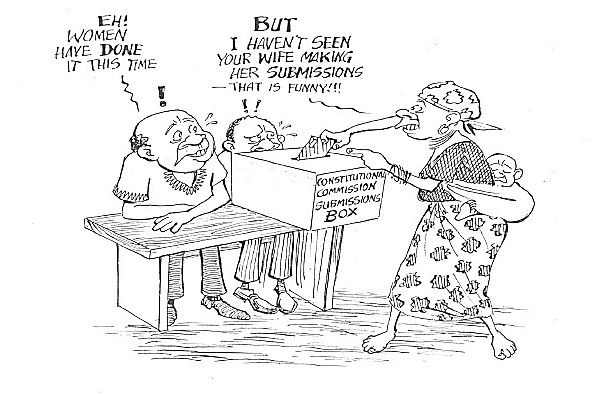
Another achievement is the use of non-sexist, all-inclusive language throughout the Constitution. Many men and even women had become accustomed to the word 'man' to include women as well. However, women insisted that this was not correct and they demanded that the language in the Constitution include both genders - women and men.
It still remains a challenge to alter all Uganda's laws written in an all inclusive, non-sexist language. The same challenge is extended to the country's mass media, books, constitutions of associations at all levels, and above all, in books used in schools. The use of inclusive and non-sexist language has become an example for all to follow.
Article 3 paragraph VI of the Constitution of the Republic of Uganda states that:
"The state shall ensure gender balance and fair representation of marginalised groups on all constitutional and other bodies".
This means that it is unconstitutional to have any public body where women are not fairly represented. Women have insisted that fair representation mean at least 30% of women for the time being. The goal is to attain gender parity in the long run.
This is a very important objective. It challenges women to identify all the Constitutional and other bodies on which gender balance and fair representation must be realised and to hold appointing authorities accountable on their representation. The Constitution itself identifies 19 Constitutional bodies and many other bodies are to be established by Parliament.
This has been recognised as a general and all embracing principle. It demands due recognition of the role of women as house managers, mothers, caretakers of children and other dependants, providers of food, the backbone of agriculture and the national economy. This principle is to create positive attitudes in society, for it to become fully considerate and just in the treatment of women.
The Constitution also addresses the protection and promotion of fundamental and other human rights and freedoms. It affirms the equality of all persons, women and men, before and under the law in all spheres of political, economic, social and cultural life and in every other respect. It specifically prohibits any discrimination in the enjoyment of these rights and freedoms based on sex or other considerations.
On the basis of this principle, Article 78 (b) allows one woman district representative in Parliament1 while Article 180 (b) ensures that one third of the members of each local government council be women. Both concessions were achieved through a strong women's lobby and support of gender sensitive men during the Constituent Assembly debates.
The Ugandan Constitution provides unique opportunities for women. The achievements are still in theory and the real test of what women have achieved will be in the implementation of the various legislations and policies. For example, the Local Governments Act of 1997 provides for the operationalisation of decentralisation and local governance. One of its objectives is:
"To establish a democratic, political and 'gender sensitive' administrative set up in local government"
1. Each District contains several constituencies, each providing one District representative for Parliament. One of the District Representative seats for Parliament is reserved for a woman, for which only women can contest. The remaining District representative seats are open to men and women.
