


The gender study implemented in 1996/1997, in support of the Lira District Development Plan 1996 - 2000, noted as major constraints women face in public positions: their overall work load and the moral pressures and negative attitudes of both men and women towards women in leadership. As a result, many women were not willing to accept nominations for leadership positions. The study showed that for women to be able to participate meaningfully in democratic processes, including local politics, more support would be required for candidates for political positions at household as well as community levels. At the household level, women would need support and assistance with domestic chores in order to release time to participate in local politics and leadership. At community level, Local Councillors be they men or women, would need to better understand the existence of gender biases against women's participation in local participation processes and their role and responsibilities to counter such biases.
The study recommended gender support for the local council elections, which were scheduled for 1997 but were held early 1998. It proposed a 'Gender and Decentralisation Sensitisation' campaign, focussing on:
The specific objectives of the Gender and Decentralisation Programme of Lira district were to:

Two-day workshops were held at each of the 24 sub-counties of Lira district and the 4 divisions of Lira municipality. Participants included leaders from local councils, clans, religious groups, women's groups, youth and other small groups. Special emphasis was put on the attendance of women. Participatory approaches were used, with small group discussions and role-plays as the major techniques.
Gender roles are distinct in any society. In each society, there are definitions of what women and men of that society are expected to do in their adult life. Children are socialised to internalise these roles. Girls and boys are prepared for their different but specific roles. Most times when a man is seen doing women's tasks, other members of society regard him as a coward, docile, or stupid. When a woman does what is presumed a man's task, such a woman is regarded as too tough or being "more than a woman."
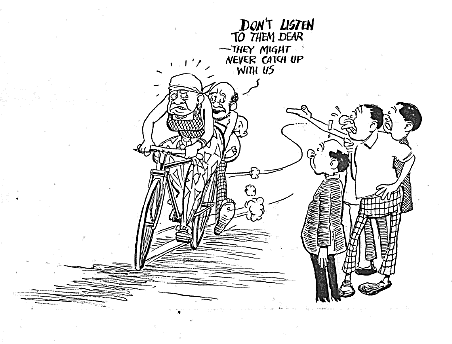
The discussion on gender roles focused on household and community roles. While there was agreement by both men and women on what women are supposed to do, men's roles were disputed by women and some men. They insisted that even when men undertake certain roles, they do as little as possible. It was pointed out that men work only 2 - 3 hours a day. The discussions revealed that women do all the reproductive work as well as most of the productive work. Women have a bigger share of community roles. Women are continuously taking up roles that were traditionally considered men's. Some of these include hunting and building. This was discussed at length to explore the reasons why women take up these roles. Both men and women agreed that some men are not taking sufficient responsibility in the homes and that this is one of the reasons why women take up such responsibilities in view of the well being of their families.
"If a man does not care about building or repairing the family house, the woman has to do so because she cannot continue living under a leaking house, which is unsafe for the family." (Woman participant - Abako Sub-County, Lira District)
Tasks women are unable to do, they engage paid labour for. Women are hunting and fishing to improve the nutrition standards of their families, yet traditionally in the Lango society, these were exclusively men's roles.
Men and women gave different reasons why women work more than men did:
Men's perceptions |
Women's perceptions |
|
|
When further examining men and women's tasks it was discovered that very few tasks were exclusively done by women or men. It was agreed that, apart from giving birth, men and women perform all other tasks. Roles specific to men were identified as: - digging graves, fathering a child, digging pit latrines, paying bride prices, marrying women and `disciplining' women.
Disciplining women Disciplining women as a role for men generated a lot of heated debate. Men were pressed hard to explain what they meant by "disciplining." The men argued that women need to be guided when they make mistakes. They punish them by beating. Apart from disciplining women, the issue of domestic violence and the treatment of women as minors was also discussed. Reasons were explored why men batter their wives. The male participants explained that women provoked men to beat them. One man said that: "Langi women have a sharp tongue and since men do not want to answer back, they beat them". The discussion revealed that women are full human beings with the same abilities and weaknesses as men. It was pointed out that women do not beat men when they make mistakes. Why then, should the men beat them? It was observed that most men were guilty of battering women. They kept on murmuring that when women make mistakes they should be punished. It was surprising to note that some women especially the older women felt that some women who go "out of hand" should be "disciplined". However, after long discussions, there was consensus that wife beating is wrong and that family disputes can be resolved through dialogue rather than violence. It was agreed that local leaders should address the issue of domestic violence because it was a serious problem in the communities. |
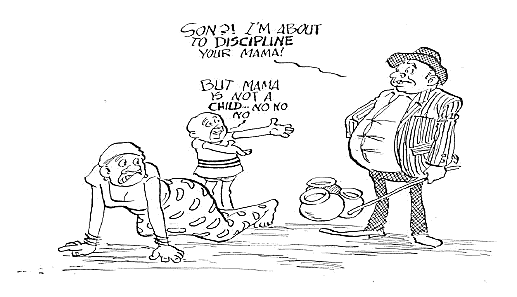
A comparison was made between a home where there is co-operation and sharing of work between spouses and another where there is no such co-operation. They pointed out that in a household where there is no co-operation and sharing of work, there is: famine, poverty, quarrels and fighting, children not attending school, sickness, poor clothing, separation or divorce and stealing. Whereas a home with co-operation is characterised by: abundant food with many granaries in the compound, love, respect, wealth (e.g. more cows), children going to school, good health, good housing, and better clothing.
The participants pointed out that a home with co-operation is more desirable. However, they recognised that the majority of households in the communities were characterised by some of the elements of lack of co-operation. They knew very few men who helped their wives with household chores. It was pointed out that such men are usually called names and sometimes they cannot mix freely with others for fear of being ridiculed by their colleagues.
Both men and women agreed that men need to take up more responsibilities in the home. Some of the tasks that men could assist with in the home include: collecting water, taking care of themselves, collecting fire-wood, pounding sesame, bathing the children, caring for children, doing more farming - putting in more hours per day, weeding, harvesting, and cooking. In order to reduce the stigma of men helping their wives with domestic chores, women groups and Local Councils should sensitise women not to gossip about it but welcome it. Men also complained that women are very quarrelsome. They said that some men want to discuss certain issues with their wives, but the women become hostile and do not want to discuss anything with them.
Women said that they would like to be assisted with household chores. They said that sometimes they quarrel because they are tired. They mentioned that if the men were willing to help, they would take the responsibility of sensitising other women to encourage the men.
At the end of the first day, men were asked to try doing some work at home, which they do not normally do. The reports the following day were interesting. A few of the responses are quoted here:
The men reported their experiences with excitement. They said they felt happy about being able to help. Some of them said they were surprised by the way their wives reacted, because they were positive and happy that their husbands, had assisted them. One of them said that he saw a smile from his wife, which he had not seen in a long time.
They said their wives were surprised but grateful. Nobody reported that their wives were unhappy about what they had done. Some of them asked their husbands about the sudden change of attitude towards household work. The men explained what they had discussed it during the seminar. The women wanted to come to attend the seminar and to hear for themselves what was being discussed. Women and men who had come with their spouses to the seminars reported that they enjoyed working together.
A plenary session was held on the usefulness of the dialogue on gender issues in which all participants expressed appreciation of these discussions. They said it had helped them to understand that it is important for all family members to cooperate. Some of the men said that they had realised that they were not doing much while their wives had too much responsibility in the home. They said they would try to change and do some of the things they were not doing before.
The leaders said they would try to organise similar seminars at village level. In a few sub-counties, participants drew up a programme to sensitise the communities about gender roles and the need for co-operation at household level.
Men said they had not been socialised to help with household work. They said they had never realised that there is a need to share responsibilities; such as cooking and caring for the children. They mentioned that men cook when they are young boys and teenagers but when they marry, they are not expected to cook. Some of the men said they had realised that there is a lot they could do to assist their wives and to improve their homes. They said that both men and women should be sensitised on the importance of shared responsibilities. The group felt that part of the poverty in their area was because men do not cooperate and assist in the home. If everybody did their part, there would be remarkable improvement in the welfare of the families. They recommended that such messages should be put on radio and in newspapers so that many more people receive the information.
This topic was discussed in the context of leadership in a community. Qualities of a good and a bad leader were identified and discussions were held on whether or not women have such qualities. The discussions were aimed at what can be done to help women take up leadership positions in their communities and society in general. They were linked to the discussion on gender
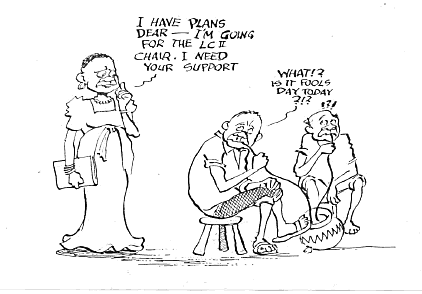
The discussion revealed that people recognised the lack of good leadership qualities among the majority of leaders in their community. There was in-depth discussions on each of the qualities to explore what the people meant. A good leader should:
It was further pointed out that some leaders were sickly and not able to perform their duties. An issue was raised that some leaders may have diseases like AIDS which makes them too weak to work and yet they do not relinquish their leadership roles. This was raised in a few places but seemed to be a sensitive issue - whether people who are already suffering from AIDS should be elected to leadership positions or not.
The discussions further explored whether or not women have the desired leadership qualities. In most cases participants agreed that women possess most of the good leadership qualities. However the participants identified a certain number of constraints to women's participation in leadership:
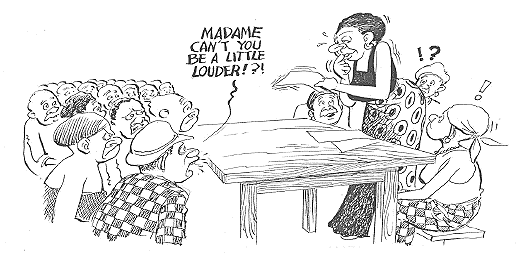
These constraints were discussed at length. Especially the observation that women are being lured into extra marital relationships created a heated debate. After discussion it was generally agreed that the issue of sexual relationships among women and men leaders were actually not common but that a few isolated cases were used by some men to refuse their wives to take up responsibilities or participate even in women groups. It was agreed that for both men and women, such relationships are not good, and that leaders, both men and women, should avoid such temptations.
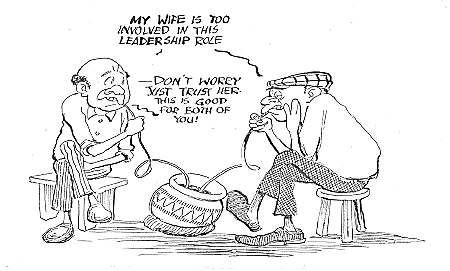
Men were challenged on the allegation that women are poor time managers. They argued that because of women's workload at home and in the gardens, they couldn't possibly keep time at meetings when they are leaders. The women also had similar explanations. Discussions revealed that if men were helping with household chores, this would release time for women to participate in leadership in their communities. It was noted that the issue of time keeping is not a problem among women only but men as well.
Problems associated with polygamy were discussed. Participants agreed that having many wives and many children was one of the causes of poverty in the area. One elderly man with three wives talked at length against polygamy. He said that their generation acted in ignorance and that such mistakes should not be repeated. He appealed with passion to young men to avoid marrying more than one wife.
The following solutions were proposed to these constraints:
The programme also aimed at improving the quality of female and male candidates for the Local Council elections by helping them to better articulate their political agenda and setting ethical standards for themselves and the communities. After the elections, the Council Members were to be trained to understand their roles in public office in order to carry out their responsibilities more effectively.
Participants were given tips on how to prepare for their campaigns. How to package their messages in the form of manifestos or workplans of what they would do if elected. The strategies were discussed and participants were able to add their views.
The workshops looked into the following issues:
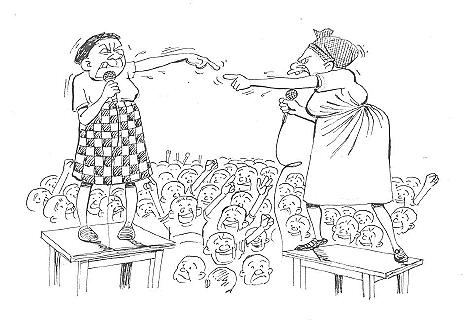
Use of abusive language: both the candidates and the electorate/audience should avoid using abusive language, as it divides people and hurts those being abused. This was characteristic of the 1996 parliamentary elections and people in Lira district felt it was very bad. Many examples were given where candidates used abusive language in their campaigns during the parliamentary elections.
Attacking opponents: this practice was discouraged. One should always focus on his/her contribution and avoid attacking the personality and character of the opponent. After the campaigns and the elections, people need to work together for the development of their specific areas of interest. Candidates attacking each other divide the people they want to serve. Those who do not go through the elections, remain members of the community after all. It would be more beneficial to the community if the "losers" worked together with the "winners" to bring about development in the area. Campaigns that are characterised by bad language and demeaning of each other cause bad feelings amongst candidates and their supporters and such feelings remain even after elections.
Role-plays were organised on mock campaigns to help the participants to better understand the roles of a Local Council member and to prepare themselves for the election campaign. The mock campaigns were based on the new structure of the Local Councils at district and village levels. Each Council has an Executive body, appointed by the Chairperson from among the elected Council Members. The mock campaigns were intended to highlight the roles of officials on these Executive bodies.
Participants went into groups, selected their candidates for specific posts of the Executives bodies and prepared their presentations in the form of a campaign. The objectives of the mock campaigns were:
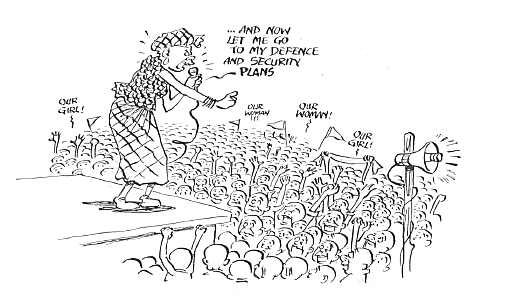
Each group appointed a campaign manager and planned their campaigns. After the "campaigns", the "electorate" asked questions, challenging the group on issues raised in their campaign. The exercise revealed that there was a reasonable degree of understanding of leadership issues by women who formed the bigger number of candidates in the mock campaigns.
Especially male participants were surprised that women were able to eloquently discuss issues like security, defence and finances. They were impressed by the amount of information women had, as expressed in the following observations:
