4. SUCCESSES AND CHALLENGES/CONSTRAINTS OF THE PROGRAMME
4.1 - SUCCESSES
Local Council elections were held in early 1998. Interviews held in May/June1999 for the preparation of this publication allowed for a review of the impact of the "Gender and Decentralisation Programme" in Lira District. Eight of Lira District's 24 sub-counties included in the programme were re-visited
Outstanding results
- Great numbers of women candidates - one third of all Local Council seats are reserved for women candidates by Local Government Act. Lira District easily met these criteria, with more than one woman contesting for almost every local council position, especially those reserved for affirmative action.
This renewed assertiveness and confidence among women was not reflected in many other parts of the country. In Arua district, for instance, some local councils were not able to raise the one-third women's representation because there were not enough women candidates available to stand for election. Those who stood were unopposed.
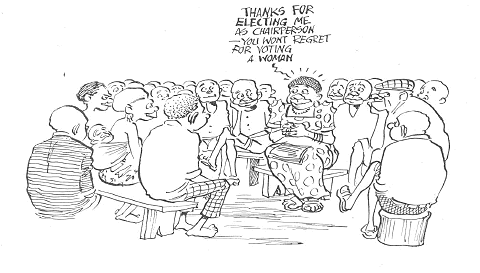
- Women candidates show confidence and assertiveness - women candidates in Lira District stood out for their confidence and assertiveness demonstrated during the campaigns. This was attributed to the sensitisation seminars held in the communities, as one sub-county chief commented:
"The Seminars on campaigns lit the fire. The woman are now prepared to tackle the visible and invisible barriers to be politicians in their own right"
Another one commented that even in other types of elections, such as the Parents - Teachers Associations (PTAs). He asserted:
"Women want to grab all the positions. They want to lead in everything".
- Important backing from clan leaders - clan leaders were instrumental in convincing men to allow their spouses to stand for elections. Some men even provided financial support to their spouses to enable them to campaign and stand for elections. In one of the sub-counties, some of the women who contested mentioned that their spouses trusted them more after having participated in the discussions of the programme's seminars.
- Abundant community support for women candidates - the 'Gender and Decentralisation Programme' created considerable community support for women's participation in politics and other positions of decision making. In the sub-counties where the impact of the Programme was evaluated, women had reportedly received more support from community leaders than before the seminars. There was evidence of positive change of attitudes among both men and women in support of women's participation in leadership. During the Local Council campaigns, women were reportedly more assertive -sometimes more aggressive - than men and most women candidates received support by both women and men during the campaigns.
- Increased solidarity among women - the seminars proved to have been instrumental in encouraging women to be more supportive of each other. Many women candidates had women as their campaign managers. One woman commented that the solidarity exhibited by women during the campaigns and elections demonstrated that they can work together, contrary to the negative belief that women are their own enemies.
- Increased number of women Local Council members - in some sub-counties and municipal divisions, women got elected for more than the required 33% of the Local Council seats. For example, Lira District Local Council V has a total of 49 Council Members, 21 (42%) of whom are women.
- Increased number of women in Executive bodies of Local Councils - the Local Governments Act states that at least two positions of each executive body of ten Council Members should be filled by women. In Lira district, this requirement was surpassed in most of the cases:
- in one of the municipal divisions, 5 of the 10 Executive body members 5 women;
- in Lira District Local Council III, all the vice-chairpersons of standing women
- in six of the eight sub-counties visited for the evaluation, women occupied the positions of secretary for production
Other spin-offs
- Changes in corruptive behaviour - the issue of the electorate demanding material rewards from candidates and candidates' offering material things and money to entice voters was discussed during the seminars. This practise was strongly discouraged. There seemed to be a positive change of attitude towards this form of corruption. In Adyel and Adekokwok sub-counties, for example, it was reported that some candidates attempted to bribe the electorate but that they rejected the bribes. Those who tried to bribe voters were embarrassed. In most cases, they were voted against during the Local Council elections.
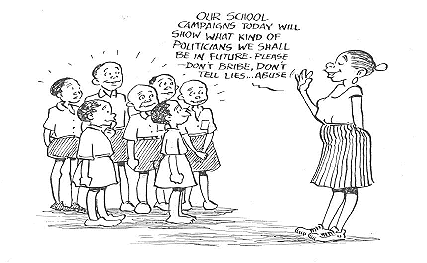
- Introduction of mock campaigns in schools - teachers who attended the seminars had introduced the idea of mock campaigns in schools. Candidates for leadership positions among the students were helped to prepare their campaigns and how to present issues to canvass for support in an election. This in view of preparing the youth to become good leaders in the future.
Most of the people interviewed during the evaluation said that they still remembered sharing household and community tasks with their spouses. Although the majority of them admitted that it was still difficult for men to take up certain tasks like fetching water and collecting firewood.
4.2 - CHALLENGES AND CONSTRAINTS
Current challenges remaining for any initiative aiming to encourage and promote women's participation are:
- The need to build the capacity of leaders - the speaker of Lira District Local Council V observed that although this Council has a large number of women Members (42%), many of them do not speak during meetings. They do not take the time to educate themselves about Council procedures and issues handled at this level. He observed that women were not yet confident politicians as compared to men. This lack of confidence was attributed to:
- culture, in which women are not expected to talk before men,
- lack of exposure to public offices,
- heavy household and farm work which makes that women are come to meetings when they are tired, and
- lack of encouragement and support from male leaders.
- Improvement of the lack of access to information - another constraint local administrators in Uganda face is the lack of access to information on development processes and politics. Sometimes when information is recorded, it is neither analysed nor properly kept. This was also the case in Lira district, where most of the information regarding the number of men and women having voted in or being candidates for the 1998. Local Council elections was discarded soon after the elections. It was not easy for the evaluation team to establish how many people had voted, desegregated by men and women. Available information was often general and only verbal. When asked about voter turn out, Local Council leaders and chiefs would reply: "people turned up in big numbers" or "many women stood for different positions". There were no records to show how local communities voted. This lack of documented information is a constraint to development programmes.
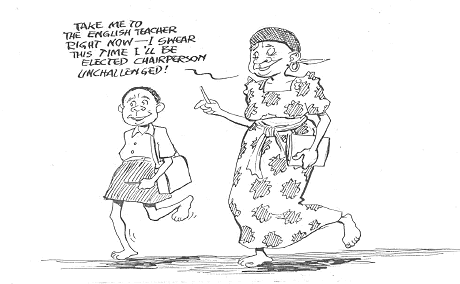
- Low participation of women at higher levels of local councils - many women stood for different positions at village and parish levels. However, it was reported that at Local Council III and V,2 there were very few women competing with men. The low participation of women at higher levels of Local Councils was attributed to the low literacy rate among women and a resulting lower self-esteem. Meetings at these levels are held in English and women mentioned that they do not want to be members of Local Council V because they cannot express themselves in English.
- Different election procedures used for affirmative action seats - elections were organised separately for the 33% seats reserved for women candidates and the remaining 67% accessible to all at Local Council III and V. It appeared as though there were women's elections, with the female electorate electing women candidates and general elections, where the whole electorate elected men candidates. Very few men turned up for the election of the 33% of the seats reserved for women candidates. Secondly, the mode of voting was different. The election of the general seats was organised by secret ballot, whereas the election of seats reserved for women candidates was done by lining up behind the candidates. This type of arrangement was criticised by women's organisations and other civil society groups, but the Electoral Commission was very adamant and did not give it due consideration only to be alarmed at the very low turn up during local council elections for women.
During the Local Council elections, very few women contested for the different positions available. In most cases it was only men contesting against each other. In the few cases where a woman stood against men, no other woman would contest that position. They had the mentality that once there is a woman then it was alright. There was need for another woman to stand. The idea was that when there are too many women, then the "women's votes" would be divided. However, women missed out on the opportunity to contest and gain experience and confidence even if they did not win the elections.