


INFORMATION SYSTEMS

EMPRES-i (information, intelligence, intervention)
... designed to support national veterinary epidemiologists and facilitate regional and global information sharing and collaboration on the progressive control and eradication of major TADs |
The newly developed EMPRES Global Animal Disease Information System (EMPRES-i) is a Web-based application that has been designed to support national veterinary epidemiologists and facilitate regional and global information sharing and collaboration on the progressive control and eradication of major TADs. EMPRES-i provides updated information on global animal disease distribution, current threats and response to emergencies. It also provides access to training materials and resources for veterinary epidemiologists.
The EMPRES-i concept is an EMPRES initiative, conceived in response to the growing demand of users for a model, one-touch disease information gathering and sharing formula. The system is currently under development and when fully operational will accommodate the following features:
- A gateway to animal health information systems throughout the world. EMPRES-i will enable end-users easy access and retrieval of information on animal diseases throughout the world. It will offer a gateway to international, regional and national information and early warning systems, and also provide access to other sites of interest.
- Risk mapping for EMPRES priority diseases. In close collaboration with FAO geographic information systems (GIS) and remote sensing units and other collaborative centres specialized in GIS applied to veterinary epidemiology, EMPRES-i will provide disease prediction models and disease risk maps that will be useful tools for epidemiologists and decision-makers in the management of disease surveillance activities and the definition of disease control programmes. This mapping component will focus on those diseases identified by international or regional consensus as high priority and will be more specifically targeted on diseases for which EMPRES coordinates a specific programme, such as the GREP, or other priority diseases. Relevant links to other GIS applications dealing with animal health will also be included.
- Disease alerts and response. Although EMPRES already uses official and unofficial sources of information (such as in-country assistance projects and personal contacts with NGOs and other institutions) to maintain a good level of awareness on priority diseases, a specific disease intelligence system will be developed within EMPRES-i to enhance EMPRES capacity to deal with early warning. It will be used to generate and disseminate early warning messages and to adopt appropriate response actions.
- Forecastings major epizootics. While the possibility of developing models for specific diseases will be investigated, a more general approach to prevent the occurrence of disease disaster will be adopted. This will be done through the collection and analysis of risk indicators identified against their potential impact (direct or indirect) on disease occurrence and spread. As an example, the monitoring of climatic parameters indicative of drought, floods or other natural or human-induced disasters could help to understand the movement of animals and people with a subsequent impact on the spread of animal diseases. Once prioritized according to their relevance and impact on specific diseases, the following parameters could be monitored at a global level:
- climatic indicators
- displacement of people/refugees in areas of civil unrest
- livestock trade routes/patterns and changes; transhumance patterns
- human-induced changes to the environment (irrigation schemes, dam construction, deforestation)
- location of check-points/quarantine points/holding grounds
- livestock and commodity market price fluctuations
- major feast periods (e.g. the Hadj in Saudi Arabia)
The main objective of such a system would not necessarily be to provide an accurate prediction of disease epizootics but rather to highlight areas or regions where targeted surveillance should be implemented.
- Disease recognition. Effective control of an outbreak is often directly proportional to the speed with which it is reported. Hence it is critical to be able to recognize and diagnose major TADs. To help in disease recognition, training materials produced by EMPRES and other centres of excellence will be available online under the disease recognition module of EMPRES-i for veterinarians and technicians who wish to improve their knowledge and understanding of the epidemiology of TADs.
Further information on EMPRES-i is available at the new EMPRES Web site at www.fao.org/empres
TADinfo deployment in Amman, Jordan
TADinfo has been deployed in the Animal Health and Epidemiology Section of the Veterinary Service in Amman, Jordan. Four veterinarians and three technicians participated in training on the TADinfo Animal Disease Information System, covering demonstrations and training on the TADinfo modules of disease, survey and abattoir observations; vaccinations; livestock census and system configuration.
Disease data from the daily clinic book, derived from passive surveillance, were entered into the TADinfo database. The veterinarians expressed interest in the use of TADinfo for storing and managing animal health information. TADinfo and GIS training manuals, together with a CD-ROM of presentations on animal health information systems, disease surveillance and examples of disease report forms, were given to the Epidemiology Unit. Data entry and data analysis officers, and a computer company that will deal with computer trouble-shooting, were identified.
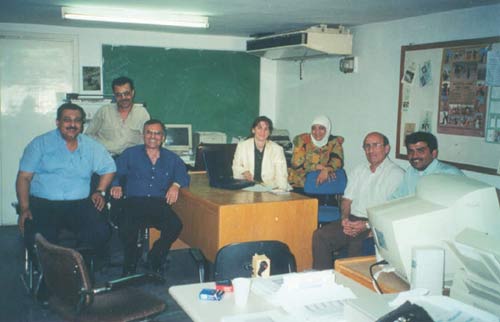
Veterinarians during TADinfo training in Amman
PHOTO COURTESY OF Ledi Pite/EMPRES
