


The Balkan countries are situated in a strategically important region of Southern/Eastern Europe. They are in the first line of defence against transboundary animal disease that may invade Western Europe from the Middle East and Asia. During the last decade, political changes, several wars, civil strife and natural disasters such as floods, earthquakes and TAD epidemics have heavily affected the area. Alarming outbreaks of TADs have recently occurred in the region, including outbreaks of FMD, classical swine fever and bluetongue.
The control of major infectious animal diseases is a high priority for the veterinary services of those countries, although the impact of economic reform has left most of the veterinary services weakened and struggling with regard to disease control and other animal health issues. The project "Emergency Control of Transboundary Diseases of Livestock in Southern and Eastern Europe" (TCP/RER/0066) is contributing to strengthening the national and regional capacities to respond to TAD emergencies through technology transfer in the fields of diagnostics, epidemiology and emergency preparedness. However, the application of modern diagnostic methods for disease surveillance, early warning, early reaction and research are only possible if veterinary services and other relevant parties are conversant with modern veterinary epidemiology and data management principles.
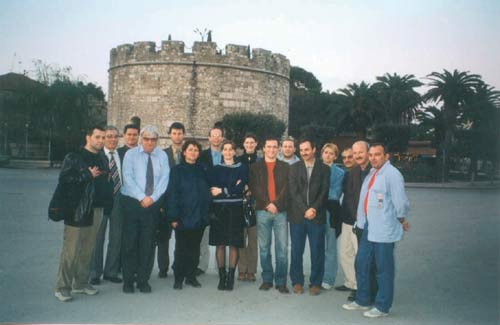
Participants of the epidemiology workshop in Tirana
Photo COURTESY OF Ledi Pite/EMPRES
Consequently, from 11 to 15 March 2002, FAO organized in Tirana, the capital city, a training workshop on epidemiology and TADinfo. Prof. Kris Wojciechowski, Drs Valdir Welte and Sinan Aktas jointly chaired the workshop, with input for the technical sessions by Drs Rupert Holmes, Ledi Pite and John Ryan. Two representatives from countries participating in the project attended the workshop.
An introduction to the FAO-EMPRES programme was presented to participants with emphasis on early warning and good emergency management practices (GEMP). Technical sessions, focusing primarily on disease surveillance, animal health information systems, applied epidemiology and data analysis were held, and the need for more active methods of disease surveillance was stressed. The activities of the European Commission for the Control of Foot-and-Mouth Disease (EUFMD) and an overview of the global FMD situation were presented. In addition, the recent activities of the Joint FAO/IAEA Division (Animal Production and Health Subprogramme) were presented and discussed, and a presentation on behalf of OIE was also given, highlighting new activities with regard to animal disease information. An intensive practical training session in TADinfo software was given to the participants, covering data entry, data analysis, basic GIS skills and customization for all modules within the software.
The activities and functions of the Veterinary Biotechnology and Epidemiology Network for Central and Eastern Europe (CENTAUR - http://centaur.vri.cz/), established by FAO, were addressed. The network has proved to be an important forum for the exchange of information on surveillance and the control of the major diseases in the region. The Centaur Newsflash electronic bulletin continues to be distributed on a regular basis to all subscribers.
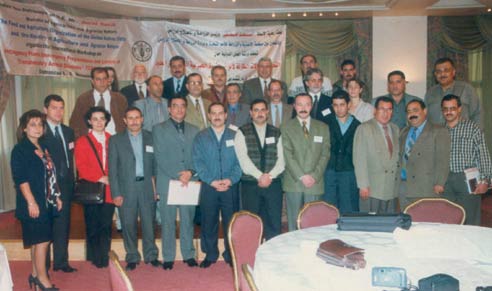
The workshop participants from Iraq, Jordan, the Syrian Arab Republic
and Turkey and the FAO facilitators
Photo COURTESY OF Ledi Pite/EMPRES
An international workshop on contingency plans, emergency preparedness and control of transboundary animal diseases was held in Damascus, Syrian Arab Republic, from 4 to 8 November 2001, under the aegis of the technical cooperation project TCP/SYR/0065. Participants were drawn from Iraq, Jordan, the Syrian Arab Republic and Turkey. The major component of the workshop was to assess and strengthen emergency preparedness against the introduction of an exotic disease into one of the countries in the region.
The lecture topics were concentrated on the needs, structures and creation of realistic, workable and sustainable contingency plans in the region. The workshop facilitated the preparation of a draft "Contingency Plan for Rinderpest" for each country.
