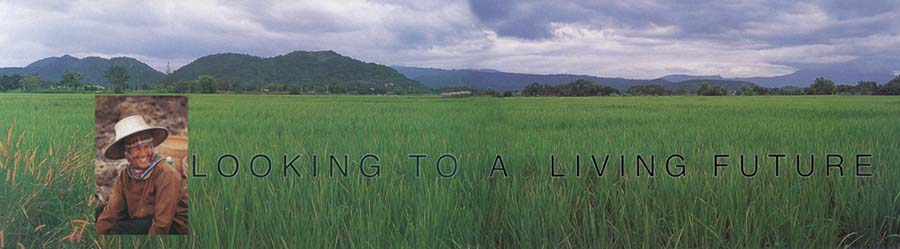
The first orange rays of the sun touch the crescent shaped headworks of the Pa Sak Jolasid Dam, a new dawn on the rippling waters of a reservoir nestled between green rolling hills, collecting the waters of a now peaceful river. Far into the distance, new velvets of croplands and patchworks of rice paddies emerge, zigzagged by canals and streams. Herds of cattle graze on lush grassland, making tiny spotted islands in the sea of green. Farmers bend over their rich, wet land, planting rice, knee-deep in gooey black mud.
The beauty of the panorama idealizes the need to work hard to feed families. Farmers struggle to produce food. Beneath the complicated structure of modern life, business and industry, agriculture remains the basis of everything. Manual labour - and tradition - provides food and sustains the nation.
Because of the Pa Sak Jolasid Dam, a portion of the Pa Sak River Basin has been filled with water. A much wider area is now filling with hope, and the understanding that, despite the continuing need to labour for daily rice, there is increased likelihood that farmers and their families will reap the reward of their labours.
Green fields sway in a gentle wind. On a farm in the Khlong Priew-Sao Hai Irrigation Project, rice stands emerald green and a metre high - immature grains fill with milky fluid. In other fields they are already ripe, a golden beige and full of nutrients. Some nearby fields are still unplanted, but with the coming of weirs, the land is filled with the promise of new crops. A local farmer, after years of hard earned harvests, expresses his own confidence, shared by many others, that “Water holds the key. Pa Sak Jolasid water promises good yields, and a better life.”
Providing increased food-security and flood protection to improve the quality of life for many is an appropriate goal for the Pa Sak Region. At the close of one millennium and at the beginning of another, Thailand is poised, balancing development of the well-being of its people, resources and ecology, to achieve secure food supplies. The Pa Sak Jolasid Dam has been completed despite financial constraints and economic crisis - and its people are prepared to enter the new millennium with new opportunities.
The completion of the Pa Sak River Basin Development Project marks a new opportunity. It promises effective control of floods and reliable irrigation, securing agriculture and developing the potential of the land to its full capacity. The reservoir is full and in the coming years an expanded irrigation system will increase the productive capacity of formerly rain-fed lands.
Thailand, as an essentially agricultural country, moved under the guidance of His Majesty the King to demonstrate the effective and appropriate integration of science, technology and tradition in development with a human face, development toward a more abundant life for all. Under His compassionate leadership, Thailand has become an example for other nations in the region.
In the tradition of his illustrious predecessor in the monarchy, King Chulalongkorn the Great, King Rama V, who ushered in the railroads and Asia's first electric tram system a century ago, His Majesty King Bhumibol Adulyadej has focused much of his concern on the questions of flood and drought, and to resolve in an equitable and appropriate manner the challenges of providing infrastructure to benefit His people. His Majesty the King has led His people to fully benefit from water resources development.
His Majesty celebrates His 72nd birthday on 5 December 1999, but for generations to come, there will be respectful memories and gratitude for His Majesty's gracious presence at the inauguration today, 25 November 1999, of the Pa Sak Jolasid Dam.
His Majesty has had a lifelong commitment to the development of His Kingdom. He has always maintained love and a compassionate concern for the well-being of His people, a concern which has extended far beyond the mere requirements of office, a concern that opportunities for His people be extended in every part of the Kingdom to improved quality of living. His compassion and concern, combined with a powerful intellect, resulted in His Majesty's New Theory of Efficient Land and Water Management, which reaches beyond the bounds of ordinary government policy.
Today, on the occasion of the inauguration of the Pa Sak Jolasid Dam, His Majesty presides over the integration of a development project which links provinces in the whole basin and their hinterland with metropolitan Bangkok, fully integrating new technologies yet reaffirming and building on traditional culture and values.
At a time when too many countries are experiencing political instability and economic turmoil, religious and communal strife, and a difficult future, Thailand is blessed with a Monarch who not only restored the traditional dignity of the monarchy but re-established the prestige of the Kingdom.
Pa Sak River Basin Development Project
Center for Agricultural Information (1996). Agricultural Statistics of Thailand Crop Year 1995/96. Office of Agricultural Economics, Ministry of Agriculture and Cooperatives, Bangkok. p. 272.
Japan International Cooperation Agency (JICA)/Royal Irrigation Department, Study on the Kok-Ing-Nan Water Diversion Project in the Kingdom of Thailand: Draft Summary Report (Feasibility Study), Bangkok. p. 36.
Ministry of Agriculture and Cooperatives (1996). HM King Bhumibol Adulyadej and Agricultural Development in Thailand. Amarin Printing and Publishing (Public) Co. Ltd., Bangkok. p. 476.
Office of Archaeology and National Museum Bangkok/Office of Archaeology and National Museum Ayutthaya (1993). Pa Sak Museum. Smaphun Publishing Ltd., Bangkok. p. 128.
Office of the National Water Resources Committee, HM King Bhumibol Adulyadej and Water Resource Management, Office of the Secretariat of the Prime Minister, Bangkok. p. 279.
Office of the Royal Development Projects Board (undated). Efficient Land and Water Management According to the Royally-initiated New Theory. Offset Creation Co. Ltd., Bangkok.
Phra Dhamma Pidok (P.O. Payutto) (1998). Sustainable Development. Komol Keamthong Foundation Publishing Ltd., Bangkok. p. 280.
Phuthorn Bhumadhon (undated). Thai-Beung Cultural Heritage: Pa Sak River Basin Areas affected by the Pa Sak Jolasid Dam Construction, P.A. Living Co. Ltd., Bangkok. p. 481.
Royal Irrigation Department (RID) (1993). Feasibility Study and Environmental Impact Assessment, Pa Sak River Basin Development Project: Saraburi and Lop Buri provinces, (Executive Summary, Main Report and Appendices), Ministry of Agriculture and Cooperatives, Bangkok.
Royal Irrigation Department (RID) (1996). Royal Irrigation Department 96th Annual Report, Agricultural Cooperatives of Thailand Printing, Bangkok. p. 113.
Royal Irrigation Department (RID) (1997). Royal Irrigation Department 97th Annual Report, Agricultural Cooperatives of Thailand Printing, Bangkok. p. 67.
Royal Speech given to the audience of well-wishers on the occasion of the Royal Birthday at the Dusidalai Hall, Chitralada Villa, Dusit Palace, Saturday 4 December 1993, Bangkok. p. 107.
Royal Speech given to the audience of well-wishers on the occasion of the Royal Birthday at the Dusidalai Hall, Chitralada Villa, Dusit Palace, Thursday 4 December 1997, Bangkok. p. 76.
Saraburi Development Committee Secretariat (undated). Five-year Development Plan for the Pa Sak River Basin Development Project (1998–2002). Thai Siri Printing, Bangkok. p. 82.
RAP Publication 1999/40
Co-published by Food and Agriculture Organization of the United Nations, Regional Office for Asia and the Pacific (FAORAP) and the Royal Irrigation Department (RID), Ministry of Agriculture and Cooperatives, Royal Thai Government.
Produced by Daoreuk Publishing Ltd.
Tel./Fax: (662) 509-9091-2
The designations employed and the presentation of material in this publication do 0not imply the expression of any opinion whatsoever on the part of the Food and Agriculture Organization of the United Nations concerning the legal status of any country, territory, city or area or of its authorities, or concerning the delimitation of its frontiers or boundaries.
ISBN 974-87215-0-7
All rights reserved. No part of this publication may be reproduced, stored in a retrieval system, or transmitted in any form or by any means, electronic, mechanical, photocopying or otherwise, without the prior permission of the copyright owner. Applications for such permission, with a statement of the purpose and extent of the reproduction, should be addressed to the Food and Agriculture Organization of the United Nations, Regional Office for Asia and the Pacific, Maliwan Mansion, 39 Phra Athit Road, Bangkok 10200, Thailand.
© FAO 1999