


In this Section, the various aspects of the hatchery at the Vanuatu Fisheries Department in Port Vila (the equipment, water quality and personnel) are reviewed, and recommendations made on the changes necessary for successful rearing of trochus.
The aquarium system that is intended for use as a trochus mariculture facility is situated at the Vanuatu Fisheries Department in Port Vila (Figure 1). It consists of an intake line of 100 mm diameter PVC tubing extending about 30 m into the sea, a centrifugal pump, four circular 1,130-l concrete tanks and a 5,700-l rectangular concrete tank (raceway), 5m × 1.5m × 0.67m deep. The intake is 3–4 m below the surface and about 0.8 m above the bottom. The present flow rate of the pump is 15 litres per minute. There is also an air blower for aerating the water in the tanks when required.
Other facilities include an air-conditioned, single-roomed laboratory/office containing desks, shelves, two old microscopes that are virtually unuseable, and limited microscope accessories.
It became apparent soon after this study began that there were some major problems with the present facility: adult trochus began to die within three or four days of being placed in the tanks.
An experiment set up to determine the cause of death is described in Appendix III. The experiment showed conclusively that the primary cause of trochus mortality was not the quality of the water. The problem lay with the pump, the plumbing or tanks. Possible causes are the pump housing, the brass gate valves used to regulate the flow of water into the tanks, and iron oxide (rust) leaching from cracks in the concrete wall of the tank.
Lack of oxygen was ruled out as a cause of death, because trochus died even though kept in a tank subjected to vigorous aeration.
Trochus died most rapidly in a tank with extensive rust leaching from a crack in the wall. However, trochus also died in a tank with no rust, indicating that more than one factor was involved. It is likely that the various factors are additive or synergistic.
The Vanuatu Fisheries Department in Éfaté is situated at Port Vila, remote from the seaward side of the island, where trochus usually occur. The site is more or less enclosed by islands (Figure 1), and tidal exchange of water would appear to be low. Oxygen content therefore may be less than that in normal trochus habitat.
A serious problem with this site is the leakage and discharge of pollutants from merchant and naval vessels moored within 10 m of the intake line. Within 20 m there is a floating pontoon, to which vessels tie up to transfer diesel fuel to Fisheries Department tanks, during which spillage of fuel may occur. Diesel oil slicks were seen on the water over the intake line most afternoons, sometimes lasting for several hours. Discharge of bilge water by some of these vessels was also observed.
Figure 1. (A) The Vanuatu archipelago; (B) Éfaté; (C) Detail of south-west Éfaté, with sites mentioned in the text shown. Reef margins are denoted by the broken line. + Site of Fisheries Department, Port Vila. x approximate site of Macrobrachium farm near the village of Mélé.
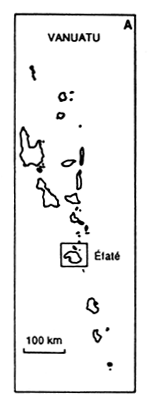 | 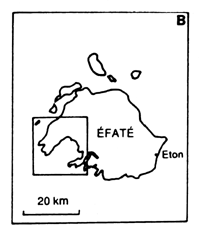 |
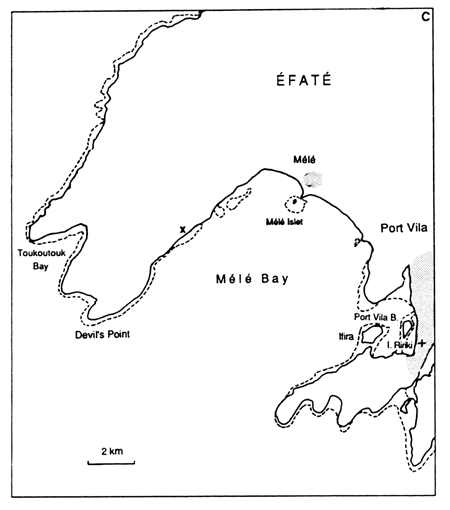
Figure 1. (A) The Vanuatu archipelago; (B) Éfaté; (C) Detail of south-west Éfaté, with sites mentioned in the text shown. Reef margins are denoted by the broken line. + Site of Fisheries Department, Port Vila. x approximate site of Macrobrachium farm near the village of Mélé.
A further problem is that the waters of the Port Vila lagoon and harbour are polluted by seepage of nutrient-enriched groundwaters from the lagoon (Chambers and Bain 1988). The situation will almost certainly worsen as human use of the Port Vila lagoon and harbour increases.
Although it was shown that poor quality of the water entering the intake line was not the primary cause of death of the trochus in the tanks (see Appendix III), there may be a train of sub-lethal factors which, when combined, result in high mortality.
I therefore recommend that, if a trochus hatchery is to be established in Vanuatu, it be situated outside Port Vila harbour at a site where water quality is high, and where future urban or industrial development is unlikely, at least in the short to medium term.
The flow rate of 15 litres per minute is barely adequate for the large raceway alone. If the present number and size of tanks are used at a more suitable site, as recommended in Section 4.3 above, flow rates must be improved.
The pump was dismantled and inspected for wear to the impeller. This could not be ascertained, although it appeared to be the case (very narrow surface). It was noted, however, that the metal components (the impeller and the impeller housing) were coated in grease. This may be detrimental to water quality.
In addition, dark brown water (it looks like rust) appears from the outlet when the pump is turned on after having been idle for a few days. This appears to come from the pump rather than the pipes downstream from the pump because, once the water has come clean after having run for a few minutes from one outlet, it is clean at all other outlets as well. It is not caused by anoxic material lying stagnant in the line, as this is black with a characteristic odour.
A second pump was originally in place beside the one now in operation; however, it was damaged in Cyclone Uma in February 1987 and has not been repaired.
It is recommended that the present pumps be replaced with two centrifugal pumps with non-metallic impeller and pump housing. Further details are given in Section 5.1.5 below.
The tanks presently in place at the Vanuatu Fisheries Station in Port Vila are adequate, in both size and number, for a pilot programme such as the one that is proposed.
A potentially serious problem is the leaching of rust from the iron reinforcing material of the concrete through cracks in the tank walls into the seawater in the tank. Since it is recommended that the hatchery be re-located to a cleaner site (Section 4.3), it will not be possible to use the large concrete raceway, which is too big to be moved. The smaller circular concrete tanks may be used if they are repaired. The difficulty of sealing badly rusted reinforcing iron indicates that a preferable solution would be to replace these tanks with new ones. Recommended tank design and construction are given in Section 5 below.
The seawater intake line extends about 30 m into the sea. It consists of 100 mm diameter PVC tubing, on the outer end of which is attached a coarse strainer to prevent the intake of large (>5 mm) particles. The strainer is constructed of metal, either stainless steel or aluminium (this was not determined).
The PVC tubing is joined to an arrangement of galvanized metal pipes which feed into the pump. Water is then pumped into the tanks via 37 mm-diameter PVC pipes. Flow rate is regulated by a brass gate valve on the end of each line into the tanks. The circular tanks are drained back into the sea by a centrally-placed 25 mm diameter PVC pipe. The raceway is drained from one end by a 100 mm-diameter PVC pipe.
It is recommended that all plumbing (pipes, valves and fittings) be of non-metallic materials (PVC or polypropylene). The brass gate valves are a likely source of toxic contamination by heavy metals (copper and zinc), and may have been the main cause of death of trochus in the tanks during this study. Further recommendations are given in Section 5 below.
Aeration of the tanks is provided by an air blower with a capacity of 40 m3/hour, which is ample for the proposed hatchery.
The success of an aquaculture venture, in both developed and developing countries, depends on the quality of the personnel responsible for the project. Culture of even easily-reared species - and Trochus niloticus belongs in this category, as noted in the Introduction - can be successful only if due care and attention is paid to all aspects of the project.
It is essential, therefore, that one Fisheries Officer experienced in aquarium management and marine organism culture techniques be responsible for the project, and that none of his other duties interfere with these responsibilities. Without this, there is little chance of success.
None of the current personnel of the Vanuatu Fisheries Department in Port Vila has the necessary expertise to take charge of a trochus culture programme. If it is decided that the proposed trochus mariculture and ranching project should proceed in Vanuatu, it is considered essential that someone with training and experience in mariculture (preferably of invertebrates) and in related fields be employed to head it.
