


The contents of this Section are necessarily limited to relatively basic aspects, because the detail into which this subject could be entered would be sufficient to fill a small book. The phases into which trochus culture may be divided are listed in Section 2, and discussed at length in Appendix I. This Section addresses the on-shore components; that is, the spawning, hatchery, nursery no. 1 and nursery no. 2 phases.
The four on-shore culture components are shown diagrammatically in Figure 2. In addition there is a small laboratory, pumps and an air blower. The requirements of each of these components are now listed. The size and number of tanks given should be considered as a guide only; these may be altered according to availability and individual preference. If the project proves to be a success, the number and the size of the tanks may be increased to allow large-scale production of juvenile trochus.
Unless it is intended to induce spawning in the trochus by mechanical, chemical or irradiation means, the spawning system will consist of two or three 120-litre glass tanks or one or two 500-litre fibreglass tanks. Continuous-flow seawater will be supplied via the pumps. Flow rates should be sufficient to exchange the volume of water in each tank several times a day.
These should be enclosed in a building to protect from the weather and to provide some degree of sanitary control. Two 500-litre tanks and one 1000-litre tank, constructed of fibreglass, should be used. Although these will have static seawater for most of the time, a seawater line should be supplied for filling and cleaning the tanks, as well as to allow for daily exchange of the water if sieving methods are to be adopted.
These may be outdoor tanks, but it is advised that a roof be constructed over them to prevent foreign matter from blowing into them. Partial shading is also recommended to reduce the incident light levels, so that algal growth rates are inhibited. Walls of a light material, such as plastic sheeting, may be sufficient if securely attached to the frame of the shelter.
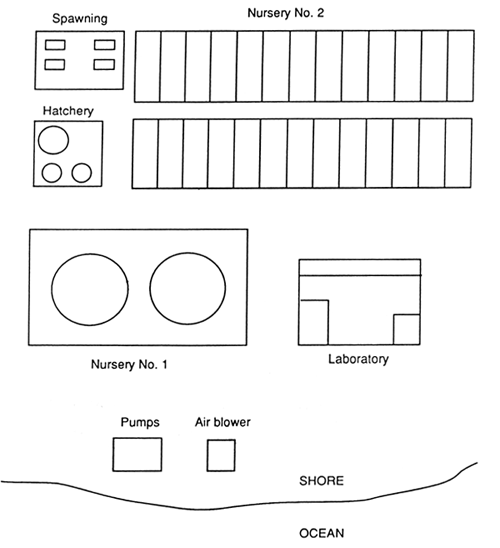
Figure 2. Suggested layout of the trochus hatchery. (Diagrammatic only)
Two circular fibreglass tanks, each of 3 000 litres capacity, should be used. These should have a centre drain and standpipe and continuous flow seawater sufficient to replace the water in each tank at least twice daily - preferably three or four.
Aeration should be supplied from the air blower via perforated PVC or polypropylene pipes on the bottom of the tank.
Rectangular tanks are preferable to circular ones here because the algal plates may be stacked more efficiently. (See Appendix I for further details of algal plates.) These tanks may be constructed of fibreglass, but concrete is preferable because of the greater strength of the walls necessary in rectangular tanks.
Two tanks, each 5 m long by 1.2 m wide by 0.8 m deep, are recommended.
A bottom drain should be installed at one end of each tank, with a standpipe attached to it to regulate the height of the water in the tank. Inflow of seawater should be from the opposite end of the tank, and circulation of water promoted by aeration via PVC or polypropylene pipes laid on the bottom. Aeration of these tanks is important because the algal plates will greatly inhibit water movement.
Flow rates should be sufficient to replace the water at least twice daily.
The total volume of the tanks listed above is about 95 000 litres. With a minimum of two water exchanges daily, pumping capacity of 8 000 l/hr (133 l/min) would be required.
Two centrifugal pumps should be used. These should be located in a low-lying position close to the sea so that intake loss is minimized. The two pumps should be connected in parallel so that they may be used simultaneously to approximately double the flow rate. Each pump should have its own intake line.
An added advantage of having a second pump is that it may serve as a backup in case of failure of the first. This is considered essential, as survival of the trochus (both adult and juvenile) in the tanks is dependent on continuous water flow. If the pump fails, and there is no pump in reserve, the trochus larvae or juveniles are likely to die, and any project underway will suffer.
The 40 m3/hr air blower currently installed at the Fisheries Department site in Port Vila is adequate for the proposed culture facility.
The laboratory need not be large, but it should have the following facilities:
assorted laboratory apparatus.
It is not appropriate to compile a comprehensive list of equipment here; this would best be done by the hatchery manager, who would be experienced in this area.
