

Giant clams have been cultured at a semi-commercial level in Palau for some years. Outlet for the cultured products has been found in providing broodstock for reef reseeding to countries where the animal is becoming extinct.
Recently, export trials have started with live Tridacna derasa to Okinawa, Japan. There, they are used raw in sushi restaurants or sold brined in jars. The demand seems to be slowly increasing.
Some applications of Giant Clam in Japanese cuisine are described by Cowan (1988).
Traditionally, the meat of the giant clam is consumed by the islanders in the Pacific. Especially the gonads are considered a delicacy in Palau where they are laughingly referred to as “Palauan Mayonnaise”.
Apart from this, a well established export market exists for the adductor muscle, frozen or dried, in Taiwan and East Asia, catering for the ethnic Chinese population (Dawson, 1986). The product commands high prices and this is probably one of the main reasons for the decline of the stocks in the Pacific and Southeast Asia, up to extinction in some areas.
The problem with the present product utilization is that the other parts of the animal such as mantle and guts, accounting for about 75% of the live weight, are discarded in the process or consumed only locally. The main reason for the low demand for those parts could be the unshapely appearance and particular algal smell and taste associated with the mantle. These drawbacks would possibly be overcome by value-added processing.
At the Tropical Development and Research Institute (TDRI, now ODNRI) in London, research was done on alternative product forms of Tridacna derasa (Saunders, Undated). Boiled salted dried clam (after a Japanese recipe) and frozen chopped clam meat (as for a U.S. surf clam product) were tried.
In order to look at other valuable products which could be made from the whole animal or at least the parts discarded in the export trade, The Fishery Programme Officer was asked by the FAO Regional South Pacific Aquaculture Development Project to travel to Palau and undertake smoking trials with giant clam in cooperation with the MMDC. Development of products should in the first place be aimed at satisfying the demand of the Japanese tourists in Palau.
Seven experiments were conducted using different size samples of live and frozen clams of different age. They can be listed as follows:
Experiment 1: six year old clams: “Japanese” style smoking
Experiment 2: six year old clams: “European” style smoking
Experiment 3: six year old clams: “Japanese” style smoking, adapted.
Experiment 4: whole two year old clams: “Japanese” style smoking
Experiment 5: six year old clams: “Japanese” style, large sample.
Experiment 6: frozen adductor muscle: plain vinegar marinade.
Experiment 7: six year olds: smoking trial for video production.
All experiments were carried out on the premises of the MMDC, Koror, Palau. Use was made of the kitchen of the dormitory, which is air-conditioned and suitably equipped with running chlorinated water, electrical stove and oven, two well functioning kitchen refrigerators with freezer compartment and all other necessary equipment. A laboratory scale (3000g per 1g) was made available from the MMDC laboratory. The only piece of equipment missing was a probe thermometer for measuring smoking temperatures so no exact values are available on this parameter.
Giant clams (Tridacna derasa) were harvested and stored in a nursery raceway close to the processing site. They were opened and the meat extracted immediately prior to processing. As the whole extracted animal contains a large volume of water, weights were recorded after butchering and discarding the kidney (5–10 g in six year old animals). The parts where then drained in a large colander for 5 minutes before weighing. Small animals (2 year olds) were treated differently.
The meat was divided in three parts as follows:
1: the mantle was cut open through the inflow and outflow apertures to lay bare the adductor muscle and guts.
2: the adductor muscle and guts were cut loose from the mantle leaving as much white tissue as possible to the mantle.
3: the adductor muscle and gusts were separated, leaving as much solid white tissue as possible to the muscle, but avoiding pieces of kidney to remain on the muscle meat. The muscle was then sliced open to reduce its thickness.
4: the dark brown kidney was scraped from the visceral mass and discarded, while trying not to damage the gonads.
5: All pieces were rinsed under tap water to wash off slime and remains of kidney, and drained in a large colander.
The kidney has to be removed as it not only has a bitter taste, but is also known to contain appreciable amounts of heavy metals such as arsenic. It was said that the consumption of an entire kidney could kill an adult man (Heslinga, pers.comm.).
Composition analyses of the meat are found in Saunders (Undated) and Heslinga (1985).
Yields after butchering for all experiments involving six year old clams are listed in Table 1.
| Table 1: Butchering yields for Giant Clam (six year old) | ||||||||
| Exp. | # | Mantle | % | Adduct. | % | Guts | % | Total |
| 1 | 4 | 1410g | 54.8% | 490g | 19% | 673g | 26.8% | 2573g |
| 2 | 4 | 1332g | 58.2% | 511g | 22.3% | 447g | 19.5% | 2290g |
| 3 | 4 | 1801g | 63.6% | 612g | 21.6% | 420g | 14.8% | 2835g |
| 5 | 12 | 6920g | 56.5% | 2240g | 18.3% | 3090g | 25.2% | 12250g |
| 7 | 7 | 2865g | 55.3% | 902g | 17.4% | 1415g | 27.3% | 5182g |
| 30 | 14328g | 57.0% | 4755g | 18.9% | 6045g | 24.1% | 25128g | |
| Legend: Exp. = experiment number; | # = number of individuals used. | |||||||
A recipe for smoking squid from Kreuzer (1984) was adapted to suit giant clam. It was tried in 4 experiments (Nos. 1, 3, 5 and 7).
After butchering the clams as described above, the different parts were immersed in a boiling brine consisting of 70 g salt per litre of water (six litres of brine were used in most cases). Boiling time was counted from the moment the mixture was brought back to a boil after immersion of the meat. After 10 minutes, the liquid was drained and the meat allowed to cool completely in a colander. Weights of the different parts was then recorded.
When gonads are being boiled, it is important the mixture is barely simmering, as otherwise, the roe will spill and be lost as happened in experiment 1. Mantle and adductor muscle can withstand more intense boiling.
A dry seasoning marinade was prepared according to Kreuzer (1984) but later modified in the following way:
were thoroughly mixed together for every kilogram of cooked product. This mixture was then worked with the cooked meat and layered in a plastic tub, covered with a loose fitting plate and put under pressure with heavy weights. This was left to stand overnight in an air-conditioned room (from approximately 5.00 PM till 8.00 AM). Before smoking, the marinated meat was allowed to drip for 5 minutes, the excess crystals were shaken off and the weight recorded.
A similar small drum smoker as used in experiments in Kiribati (Trachet, 1989) was constructed at the MMDC workshop. Details on the construction are given in Appendix 2.
The meat was hung or skewered on steel rods and pre-dried in this smoker over a small fire with the smoker lifted on stones (5–10 cm off the ground) for greater air intake and with the top open. It took 45 minutes to 1 hour to get a dripfree dried product. As a rule for temperature control (in absence of a thermometer) it was taken that the metal rods should never feel hot to the touch.
The product was further smoked for 4 to 5 hours with all air intake reduced and with the smoker covered with a plywood sheet, the fire being subdued with sawdust, and not allowed to burst into flame. At the end of the smoking time, the temperature was allowed to rise. The product was then allowed to cool in an air-conditioned room, and the weight recorded. The product was further stored in the kitchen refrigerator.
A more detailed account of the whole process is given in Appendix 1.
The product was given to staff and visitors of the MMDC, comprising Palauans, Americans and Japanese, to taste. It was appreciated by all.
The end product had a matt, dark amber to woody colour, the texture being chewy but not unpleasantly so. The taste being only slightly salty, with a light sweetness and a clear clam taste.
The smoked mantle took up the shape of a ring. This product being considered more tasty, although more chewy than the adductor muscle.
The adductor muscle, although more appealing in appearance, had a blander taste and a more outspoken “grain” in the structure. The colour of the cut is of a more opaque white.
After trials, the panel found the smoked guts to be a less valuable product, although the taste was considered good. These were therefore not utilised in later experiments.
Product yields at the different processing stages are given in Table 2.
The limited weight loss after marinating in experiment 3 is due to the inability to apply pressure on the mixture (no cover of suitable size was found for the marinating bucket).
| Table 2: Japanese style smoking: yields at different processing stages. | |||||||||||||
| (Total yield is smoked adductor + mantle weights as compared to raw adductor + mantle weights. Each other percentage is as compared to the previous processing step) | |||||||||||||
| Exp. | FRESH | COOKED | MARINATED | SMOKED | TOTALYIELD | ||||||||
| M | A | G | M | A | G | M | A | G | M | A | G | ||
| 1 | 1410g | 490g | 673g | 465g | 304g | - | 421g | 285g | - | 322g | 227g | - | |
| 32% | 62% | - | 90% | 93% | - | 76.5% | 79.6% | - | 28.9% | ||||
| 3 | 1801g | 612g | 420g | 563g | 389g | 171g | 549g | 386g | 165g | 411g | 302g | 127g | |
| 31% | 63.5% | 40.7% | 97% | 99% | 96.5% | 75% | 78.2% | 77% | 29.5% | ||||
| 5 | 6920g | 2240g | 3090g | 1683g | 1192g | - | 1536g | 1094g | - | 1324g | 981g | ||
| 24.3% | 53.2% | - | 91% | 92% | - | 86.2% | 89.7% | - | 25.2% | ||||
| 7 | 2865g | 902g | 1415g | 752g | 473g | - | 679g | 441g | - | 531g | 364g | - | |
| 26.2% | 52.4% | - | 90.3 | 92.2% | - | 78.2% | 82.2% | 23.8% | |||||
| Legend: Exp. = experiment number; M= mantle; A= adductor muscle; G= guts. | |||||||||||||
The lower yields after cooking in the two latter experiments (5 and 7) are due to overestimation of the fresh weight. The larger size of the sample did not allow an equal efficient dripping before fresh weights were recorded.
From the yields during smoking, it can be seen that substantial differences occur. In the future therefore, the weight change of the product during smoking should be the prime indicator for establishing the smoking time (colour being the second one), this is the only way to obtain a consistent product under artisanal conditions as described here.
Samples were kept in a domestic refrigerator in open containers (to prevent problems with condensation) and were still organoleptically acceptable after a week. Under these conditions (+5°C), further drying of the product occurred and taste became more bland.
A small sample was taken back to Fiji (packed in sealed Freezer bags) and, after a 36 hour delay in cooling, re-stored in a domestic refrigerator where they were kept another week. During the transport, formation of condensation droplets could not be avoided. At the end of the period, clam odour had become stronger, and it can be considered the product was near the end of its shelf life.
A sample of both adductor muscle and mantle meat were brought to the Institute of Natural Resources of the University of the South Pacific in Suva on the first of December 1989 for analysis of moisture and salt content (Mr. William Dixon). The analyses were done on the 21st December.
Salt content was analysed through titration of the extract against silver nitrate (FAO 1982, appendix 4) and expressed as weight percents NaCl for sample weight. Moisture percentage (against wet weight) was measured after 48 hours drying at 105 °C. The results can be seen in Table 3.
| Table 3: Moisture and salt content of Japanese style smoked product. | ||
| Moisture % | Salt (NaCl) content (%) | |
| Adductor Muscle: | 41.0 | 4.4 |
| Mantle Meat: | 35.9 | 7.1 |
For smoked finfish products it has been established that the salt concentration in the water of the finished product should be minimum 3 % in order to inhibit the growth of most of the food poisoning organisms present, particularly Clostridium botulinum (Bannerman, Undated). If this rule can be applied to smoked giant clam, these conditions are here fulfilled, indicating the product could be vacuum packed without major health risks.
The results in Table 3 indicate that the product has only a limited shelf-life, as the measured water and salt levels will not inhibit the growth of moulds. Refrigeration and/or vacuum packing will therefore be necessary to give the product a better keeping quality.
It must be pointed out that the moisture content in the analysis is probably underestimated with regards to the fresh finished product due to the further drying in the domestic refrigerator.
Although the pieces could be sold without further processing, the product can best be presented to the consumer in 2mm thick slices. The slices can be made longer by cutting at an angle to the axis of the meat.
There are many types of Japanese dried and smoked products on the market in Koror. Most are thin slices and typically they come in 30g vacuum packed pouches with a price tag between US$ 2 and US$ 3 per packet.
As the production in this early stage should be sold at a stand at MMDC, for the benefit of Japanese tourists visiting the centre, a small kitchen type vacuum packer might be purchased. On the other hand it was found that the sliced product packed in a small clam shell and covered with plastic foil (Klingwrap) was very attractive. A half clam shell (2 year old) was found to contain 16 grams of the sliced product. This way of packing would be less time consuming than vacuum-packing and the cosmetic value would be enhanced.
Although requested in the terms of reference for this study, no marketing trials were undertaken. This was omitted upon request from the clam farm manager, who considered it too soon to raise hopes for such a product in the local marketplace.
As no estimates exist on the production costs for 6 year old giant clam and as there is no sufficient stock to sustain even a small production unit continuously at this stage, it would have been impossible to give the potential client an idea of price or available quantity, which is the type of information they do require before considering buying a product like this.
During the first days, as an example of a more heavily cured smoked product, a batch was smoked in a simple “European” way, in other words, only brining and smoking were involved, without any form of boiling or marinating.
Six year old clams were used, butchered in the same way as above.
As there was no brinometer available and the salt was very high in moisture content during the first days, a saturated brine was prepared instead of the more traditional 80° brine.
The meat was plunged in the brine for 20 minutes and then left dripping while the smoking kiln was being prepared. This brining time was known to be excessive, but with the purpose of showing a safe salted product in a first trial. During later trials, the brining could be reduced to establish an ideal brining time.
Pre drying was done under the same conditions as described for the “Japanese” style. but required much more time (2h and 10 mins. in this experiment)
Smoking was done for the first 4h and 30 mins in the way described earlier. Then the temperature was raised by allowing a small fire and more air intake for another 1h and 30 mins.
The product turned out rather light in colour, so longer smoking time might be considered.
Due to the heavy brining, salt crystals had formed on the surface. The product was stored in an air-conditioned room for the following two weeks and no deterioration except further drying could be observed.
As the taste panel was served the Japanese style product during the same session, the merits of this product could not compete overall in taste and appearance with the Japanese type. Some people however preferred this product over the more sweet “Japanese” style.
It should not be forgotten that this kind of product, even lighter brined can form a practical solution for processing clam in remote areas without refrigeration infrastructure. The product can then, at the consumer end, be desalted by soaking in water for some time (overnight is suggested) prior to utilization.
Yields can be read from Table 4. The moisture content was calculated based on Saunders. The resulting calculated moisture content of the guts is surprising compared to the apparent moisture of the observed product. It is possible that the samples studied by Saunders were considerably dehydrated by lenghty frozen storage.
| Table 4: European style smoking - yields | |||||
| FRESH | BRINED | SMOKED | YIELD | MOISTURE CONTENT | |
| Mantle | 1332g | 824g | 453g | 34% | 18% |
| Adductor | 511g | 479g | 319g | 62% | 43% |
| Guts | 447g | 383g | 250g | 55% | 41.5% |
| Total | 2290g | 1686g | 1022g | 45% | |
On request, an experiment was set up to smoke whole small clams (2 year olds). At this age, the shells measure about 10 cm across.
Twenty four clams were prepared, first attempts were made to open the shells by hand but this was very time consuming. It proved much more easy to open them by boiling for 5 minutes in 4 litres of brine containing 80g salt per litre. The stronger brine was used to make up for the additional water contained in the shells.
Twenty four animals yielded 190 g of cooked meat (or 8 g/shell).
The animals, when cooled, were sliced through the apertures to obtain one piece of opened clam but it was impossible to extract the kidneys successfully from such small pieces without ruining its appearance.
The batch was further treated in the same way as described for the “Japanese style”. Drying was completed in 30 minutes, and sufficient colouring was obtained in 4 hours of smoking.
The overall appearance was not very appealing and the remaining pieces of kidney imparted a bitter flavour to the product.
| Table 5: Smoking small clams - yields | |||
| 24 small clams (2 year old): | |||
| cooked weight: | 190g | 7.9g / shell | |
| marinated: | 172g | 7.2g / shell | |
| final product: | 117g | 4.9g / shell | |
2.1 Conclusion:
Unless another way is found to prepare the clams (especially removing the kidney), it will not be possible to prepare this kind of product with two year old clams.
This is unfortunate, as the shorter culturing time would give a cheaper and more readily available raw material.
As an example of other possibilities, a vinegar marinade was prepared using adductor muscle stored in the center's freezer. Two fresh clams were added to find out the effect on the mantle meat.
The recipe used was adapted from Kreuzer (1984, page 77).
Clam meat was boiled in fresh water for 30 minutes and then cooled rapidly under the tap.
One litre of white vinegar (5% acid strength, commercially available) was brought to a boil with 50g salt and some chili pepper and left boiling for some minutes.
Meanwhile, the cooked clam meat was cut in 0.5 cm thick slices and packed in clean glass jars.
The boiling vinegar mixture was poured over the meat and allowed to cool a little. The jars were shaken to exclude air bubbles and topped with more vinegar as necessary to cover the meat completely.
The jars were closed warm, left to cool and then stored in a domestic refrigerator to mature for several days.
No weights could be recorded as there happened to be a general power failure at the start of the experiment. No attempts where therefore made to analyse the results of this experiment.
The product was well received by those who tasted it. It is a product certainly worth investigating further.
Note: Herbs and spices can be added to taste, the clams can be cooked in a stock or “court bouillon” instead of plain water, vegetables could be added. A similar product could also be made from smoked clam.
Warning: This is a house recipe and should not be used for commercial production without further experimentation. It was not checked if the pH is low enough in the matured product and certainly there would be a need for pasteurising the jars for safety. For further information, reference is made to the processing techniques for marinated mussels as given in McLay.
Bannerman, A. McK. (Undated). Hot Smoking of Fish. Torry Advisory Note No. 82, Torry Research Station, Ministry of Agriculture, Fisheries and Food. Aberdeen, UK, 11 pages.
Cowan, L (1988). Use of Giant Clam in Japanese Cuisine. p.256–257 in: Giant Clams in Asia and the Pacific. J.W. Copland & J.S. Lucas (Eds.). Australian Centre for International Agricultural Research, Canberra, 1988. 274 pages.
Dawson, B. (1986). Report on a Study of the Market for Giant Clam Products in Taiwan, Japan, Hong Kong and Singapore. FFA Report No. 86/37, South Pacific Forum Fisheries Agency, Honiara, Solomon Islands. September 1986, 34 pages.
FAO (1982). Improvement of Salted Dried Fish Production and Storage in the Maldives. (Based on the work of B. Dagbjartson). FAO, Rome, FI:TCP:MDV:0104. February 1982, 25 pages.
Heslinga, G.A. & T.C. Watson (1985). Recent Advances in Giant Clam Mariculture. Proceedings of the Fifth International Coral Reef Congress, Tahiti, 1985, Vol.5, 531–537.
Kreuzer, R. (1984). Cephalopods: Handling, Processing and Products. FAO Fish. Tech. Pap. 254: 108 pages.
McLay, R. (Undated). Marinades. Torry Advisory Note No. 56, Torry Research Station, Ministry of Agriculture, Fisheries and Food. Aberdeen, UK, 7 pages.
Saunders, T. (Undated). Investigation into the Production of Marketable Products from Giant Clam. TDRI, Overseas Development Administration, London. 7 pages.
Trachet, N. (1989). Study Report on Milkfish Smoking in Tarawa, Kiribati. FAO South Pacific Aquaculture Development Project, Suva, Fiji, May 1989, 12 pages (part 2 of this publication).
1. GETTING THE MEAT
Extract the meat immediately before you will start processing it (boiling etc.). Do not let it stand for hours. The fresher the clams (they should be still alive when starting to prepare them), the better the end product.
Open the giant clams by cutting the muscle. Try not to damage the mantle or the muscle more than necessary or your product will look less attractive.
Gather all the animals in a clean bucket or basket and bring them indoors without delay, out of the sun and away from flies and dust. It is preferable to process in an air-conditioned room.
2. MAKING THE RIGHT PIECES OF CLAM MEAT
When working with food products, work always with clean materials. The table, cutting board, knife, pots and colanders in which you store the meat should be washed before and after every processing. Otherwise bacteria will gather and infect your product, causing it to spoil more quickly.
Take a clam and cut through the holes of the coloured sides so you can easily see and reach the insides.
Cut the adductor muscle loose from the mantle.
Lift the guts and muscle out of the mantle and cut loose the remaining attachments.
Separate the muscle from the guts and scrub off all the remains of the kidney.
Split the muscle lengthwise in two without separating the pieces.
The mantle and the muscle is now ready for boiling. You can smoke the guts as well (remove the kidney and scrub well) but there should be no holes in the guts. Otherwise, eat them for dinner or give them to your friends.
Rinse the pieces under tap water and allow to drain.
3. BOILING
In a large pot, bring plenty of water to a boil with 70 grams of salt per liter of water.
When it boils, put in the pieces of clam meat and watch the water.
When boiling bubbles appear again, lower the fire (especially if you are using the guts as well) and count ten minutes.
After ten minutes of boiling, drain through a colander (or clean basket) and leave to cool.
3. MARINATING
Make a sufficient stock of dry seasoning mixture. Mix together the ingredients in the following proportions: for every kilogram of sugar, add 360 grams of salt and 40 grams of Ajinomoto (or Ve-Tsin powder). Mix well and store for further use.
When the meat is cool, weigh it. For every kilogram of cooked clam meat, add 350 grams of the dry seasoning mixture. Mix well with the clam meat until all sides of the meat are covered with the mixture.
In a bucket or basin, stack the pieces of clam, layer by layer. Sprinkle the rest of the mixture that didn't stick to the clam meat between the layers.
Cover the meat with a plate or lid that does not touch the sides of the bucket and put heavy weights on top of it (pack the weights in plastic bags for cleanliness and safety. Lead for example is poisonous and should never come in contact with the meat).
Leave overnight in a cool place. The next morning, liquid should have formed in the bucket. Shake of the remains of the mixture, drain for five minutes and weigh the meat again. You should have lost around 10% of the weight. If it's less, you didn't have enough pressure on the meat, if it's more, you had too much weight on it. Adjust it the next time.
3. DRYING
Hang the mantle rings over the tenter rods which you will have cleaned beforehand. Skewer the adductor muscle on the rods.
Now you need to have your smoker ready. For the construction of this, see Appendix 2.
You will need small dry wood. Pay attention not to use wood which has been treated, varnished or painted, also, do not use softwood such as pine or some species of tree that are toxic. Casuarina, coconut, mangrove tree or fruit trees are generally suitable types of wood.
Make a small fire. When the first intense fire has subdued, you can put the smoker on top, raised about 5 to 10 cm from the ground on stones and start drying.
Hang the rods in the smoker, paying attention that the pieces do not touch each other or the side of the smoker. Where they touch, they will not colour well.
The top of the smoker must remain open at this stage. The bit of smoke which will occur will sufficiently deter the flies from sitting on the meat.
Control the temperature: the sides of the smoker should not become hot. Feel the rods inside the smoker at regular intervals, they should never feel hot. If so, reduce the fire.
To test for dryness, take the rods out and feel the underside of the meat. It should feel dry, with no drops moistening your fingers.
This should take up to 45 minutes to 1 hour.
4. SMOKING
When the meat is sufficiently dry, remove the stones from under the smoker to reduce air intake.
Now cover the smoker with the plywood plate or a mat or sack.
Make smoke: sprinkle sawdust over the burning wood until you don't see any fire. Only sawdust from untreated non-toxic hardwoods should be used. Ask the sawmill where you get the sawdust! When in doubt, use sawdust which has been laying outside for some months, any harmful products will have leached out by that time. The sawdust can be moist, but not soaked, as this would put out the fire.
Close the opening in the side of the smoker with a plate.
There should be no fire at the beginning. At the end of the smoking process, the temperature can be higher.
Monitor the smoke every 20–30 minutes. If there is fire visible, add sawdust, if the fire is going out, do not waste time but build another fire next to the smoker and when well smoking, put the smoker over the new fire.
Smoke for 4 to 5 hours, there should always be plenty smoke. If the meat colours unevenly, change the position of the meat now and then.
After smoking take the meat inside an air-conditioned room to cool.
Weigh the product. You should have lost around 25% of the weight.
5. PACKING AND STORING THE PRODUCT
You can keep the smoked clam in a cool room for some time but, of course, it will keep longer when kept in the refrigerator.
Cool the unpacked meat in the refrigerator, and when cold, put it in plastic bags or wrap it. Do not pack before cooling, as there will form condensation water inside the plastic, and a wet product will spoil quicker.
The product can probably be frozen and thawed without too many problems.
6. PRESENTATION
To serve the product, make long slices at an angle to the grain of the meat. Slice as thinly as possible, about 2 mm thick.
Do not slice the product a long time before serving as it will dry out and loose its taste.
Construction
| Materials needed: | one 55 gallon oil drum two iron rods about 50 cm long a hessian bag, pandanus mat or plywood board to cover the top Some lengths of galvanised steel rod (2–3 mm diameter) for tenter rods. |
Knock out top and bottom of the oil drum (with a hammer and chisel), keep one of them.
Make a square hole (the fire opening), around 30 cm by 30 cm in the side of the drum at one of the ends, keep the panel you removed. It will serve as an air inlet control for the fire.
Drill four holes (the diameter of the iron rods) in the side of the drum, above the fire opening.
Introduce the two rods through these holes parallel to each other. This will be the support for the smoke divider. The ends sticking out can be used to lift and carry the smoker.
Drill as many holes as possible in the spare top (or bottom) of the drum which you kept, this will become the smoke divider.
Put the smoke divider on its supports.
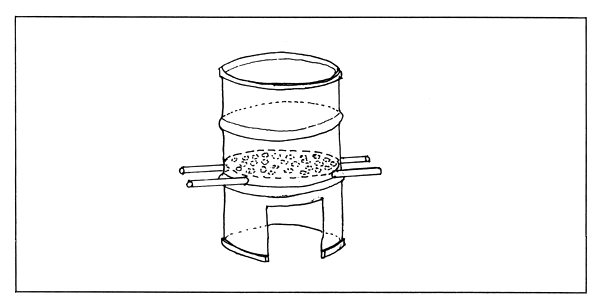
If the drum is new, make a large fire inside in order to burn all remaining oil and paint inside, remove the ashes when finished.
With a bag or mat on top of it, you can now smoke any kind of product.
You can hang the fish you want to smoke on rods in the smoker, or construct trays (grills) from thin metal rods and chicken wire to hang inside.
You can build supports for your tenter rods by cutting two iron bars to fit inside the smoker and hanging them inside with 4 hooks made of galvanised wire.
Use
by enhancing or reducing the airflow through the drum.
Happy smoking!
