

The population of FSM is rapidly growing with little potential for productive employment. However, most of the islands have extensive coral reefs and lagoons which might be suitable for mariculture purposes. Low technology and low capital required mariculture may be one of the alternatives for development.
There have been many aquaculture development projects in the region. At present, no sustained commercial or subsistence aquaculture operation has resulted. Many factors are responsible for this lack of progress in aquaculture. A few important ones are listed below:
Lack of a long term aquaculture development plan;
Many projects were recommended or evaluated by experts or consultants for their technical feasibility but ignored the social and economic viability;
Lack of well trained technical and extension personal in aquaculture;
The experimental operations have not been demonstrated to the point to convince the potential farmer about the feasibility of the operation;
Lack of seed of some potential species;
In a traditional and subsistence society, people are not motivated by profit making. It is not easy to convince them to undertake new ventures, especially when there is food available from their yards and from the sea, as well as from cheap imported canned fish;
Lack of legal right to use coastal areas in some states.
The future strategy for aquaculture development should be focused on very few promising species which have high potential for success. These would be the species with low technology, low capital requirement, a ready market, a reasonable profit, and easy acceptability by the traditional communities. Among the species investigated during this short assignment, sponge and seaweed (Eucheuma) culture in this region seem to fit most of the criteria mentioned above. Giant clam re-seeding will have potential for development if a market exists for one and/or two year old clams, and/or if the production cost of nursery phase in the ocean can be substantially reduced. Trochus re-seeding also appears promising but additional research is needed.
It is recommended that government agencies in this region put their resources on a few promising species for future development by providing demonstration, extension and practical training. Incentive measures should also be provided at the initial stage of development, e.g. free seed, marketing service, low interest loan, etc. Most of the species mentioned above thrive in the reef/lagoon areas. The legal right to use the submerged land and the management schemes for stocks in the open water need to be worked out before industry development.
The Federated States of Micronesia (FSM) consists of over 600 high islands and atolls, and is politically divided into four states: Pohnpei, Kosrae, Truk and Yap.
All the Islands have extensive coral reefs and lagoons suitable for mariculture purposes. The large islands have perennial streams while the smaller islands are limited in freshwater resources.
The population of FSM is about 85,000. They retain some of their traditional lifestyles. Market economy is not prevalent in most of the villages. A majority of them grow their own food and catch their own fish. Women and children catch their own fish in the reef areas during low tides. Subsistence harvests continue to make a major contribution to their daily diet even in the most urbanized islands.
Aquaculture in FSM had some traditional antecedents, such as holding fish in enclosures. The first modern aquaculture practices were Japanese trials of sponge, pearl and turtle culture before World War II.
The population of the FSM is rapidly growing (over 3% annually) with little potential for productive employment. Therefore, mariculture has been the government's priority for development due to low capital requirement and simple culture technology. Government attempts at aquaculture have involved seaweed, sponge, giant clam, pearl shell, Trochus, mullet, milkfish and turtles. But, at present, there is no sustained commercial or subsistence aquaculture operation in FSM, except the experimental cultivation of sponge, seaweed and giant clams. These species appear more promising for development due to simple culture technology, low capital requirement and available market. The main purpose of this study is to conduct a preliminary economic evaluation of these species in each state.
Three species are under experimental cultivation in the state: sponge (private operation), seaweed (state agency and private groups) and giant clams (government agency). The economic status of these operations are assessed based on the available data.
Sponges are well suited for cultivation since small cut species will regenerate. Commercial sponges can be found around most of the islands of FSM. The Japanese experimented with sponge culture before World War II and had some success.
Recently, a private sponge pilot farm was opened in the coastal area of Pohnpei. The species being cultured is Spongia officinalis and a submerged culture method is used (Figure 1). Each culture unit consists of 20 to 30 lines. Each line can carry about 50 sponges. The culture unit is placed in the 12 to 15 m deep water and 1 to 2 m above the ocean bottom. It takes about 2 years from seeding to harvest. The survival rate is estimated about 95%.
Sponge culture is a lower labor operation than seaweed and giant clam culture. Labor is needed mainly for seeding, harvesting and cleaning. Two people can take care of about 50,000 sponges or 40 culture units. Initial capital cost is also low, which is estimated about US$ 105.00 per culture unit (Table 1). The operating cost is estimated about US$ 269.00 per unit (Table 2). At 95% of survival, one culture unit can produce about 1,188 sponges. The cost of production per sponge averages about US$ 0.23, excluding the labor cost for cleaning. This sponge farm has not harvested its sponges yet and does not know how many labor hours will be required for cleaning.
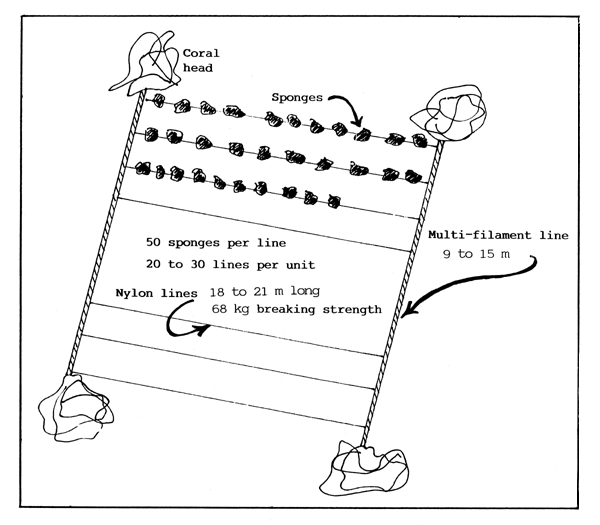
Figure 1. A Unit of Sponge Culture System
Table 1. Estimated initial investment per unit of sponge culture.
| Material | Cost | Useful life | Annual depreciation | ||
| Coral head | US$ | 0 | - | US$ | 0 |
| Nylon lines | 8 | 2 | 4 | ||
| Multi filament lines | 2 | 2 | 1 | ||
| Small boat & motor(*) | 45 | 10 | 4 | ||
| Scuba gears (2 sets) (**) | 50 | 10 | 5 | ||
| Total | US$ | 105 | US$ | 14. |
(*) Total of US$ 1,800 shared by 40 units
(**) Total of US$ 2,000 shared by 40 units
Source: Mr. R. Croft, sponge farm owner
Table 2. Estimated operating cost per unit of sponge culture.
| Labour (excluding cleaning) | US$ | 240 |
| Depreciation for 2 yrs | 29 | |
| Total | US$ | 269 |
Source: Mr. R. Croft
Since 1980, the world catch of wild sponges has a declining trend due to heavy exploitation and diseases. Tunisia is currently the major producer accounting for about half of the world's production of sponges, followed by Cuba, Greece, Philippines, and Turkey (Table 3). A major portion of the world sponge production enters international trade either in raw or processed form. The processing is mostly done in developed countries such as France, Italy, Germany and Greece. The primary markets for sponges are in France, the U.S, Japan, Italy, and Spain (Table 4).
Table 3. World production of sponge (mt).
| 1982 | 1983 | 1984 | 1985 | 1986 | |
| Tunisia | 129 | 100 | 95 | 100 | 100 |
| Cuba | 49 | 45 | 51 | 53 | 53 |
| Greece | 38 | 30 | 31 | 35 | 35 |
| Philippines | 48 | 36 | 21 | 10 | 10 |
| Turkey | 9 | 2 | 3 | 4 | 4 |
| Total | 273 | 217 | 206 | 207 | 207 |
Source : Sponges: World Production and Markets. H. Josupeit, FAO, draft report, 1989
Table 4. Sponge importer (mt).
| 1982 | 1983 | 1984 | 1985 | 1986 | |
| France | 100 | 139 | 111 | 107 | 103 |
| U.S.A. | 42 | 45 | 80 | 93 | 74 |
| Japan | 36 | 24 | 15 | 22 | 29 |
| Italy | 28 | 24 | 23 | 29 | 24 |
| Spain | 22 | 14 | 19 | 21 | 22 |
| Germany F.R. | 13 | 18 | 16 | 18 | 18 |
| Greece | 21 | 13 | 14 | 9 | 11 |
| Total | 262 | 277 | 278 | 299 | 281 |
Source : H. Josupeit, draft 1989
Price of sponges vary greatly by size, shape, quality, species and country of origin. In France for instance, the species sold at the highest price is Spongia officinalis, followed by Hippospongia communis. A small sponge (5 to 6 cm diameter) sells at below US$ 2, while a nicely cut sponge of 20 cm diameter may exceed US$ 30. In the U.S market, the unit value of imported sponge differs from country to country and fluctuates from year to year. The prices of Bahamas sponges, for instance, are fluctuated between US$ 5 to US$ 25 per kg. The retail price varies with the size: a small sponge (below 10 cm diameter) sells at about US$ 5.00 to US$ 6.00, a medium size US$ 10 to US$ 15, and the larger ones exceed US$ 20. In Japan, the price of the Philippines sponge is the lowest selling at about 1,500 to 2,500 Yen per kg, while the Greek sponge in processed form sells at about 14,000 to 16,000 Yen per kg. Other Mediterranean sponges sell at about 10,000 to 12,000 Yen per kg. In Japan, synthetic products are taking over the market, especially for low quality sponges.
The cost of production per sponge in Pohnpei was previously estimated at about US$ 0.23. About 13 sponges weigh 1 kg. Therefore, the cost of production per kg of sponges is about US$ 3.00. At the market price range of US$ 5 to US$ 25 per kg in the U.S, the profit of sponge culture is quite attractive from an investment view point. However, it is important to mention again that this sponge farm has not harvested its product yet. The quality of the product and the success of this pilot operation waits to be proven.
For future development, more work is needed to identify the value of cultured sponges and suitable sites for commercial sponge culture, to provide information on culture techniques, and to provide an extension (or short training) service.
Eucheuma farming in the State started in the early 1980's under the assistance from the University of Hawaii Sea Grant programme. The State Economic Development Authority (EDA) has assisted several private groups to establish seaweed farms but all failed once the government stop paying the salary of the farm workers. Recently, seaweed farming was again initiated by EDA and is shifted from the stake and line method to raft culture.
Each raft measures 6 m by 6 m. It consists of a framework of bamboo and mangrove posts supported by 4 to 8 floats. On the framework are nylon ropes carrying seaweed.
The investment cost is estimated at about US$ 149 per raft with an annual depreciation of about US$ 104 (Table 5). The other operating cost is labor for repair, harvesting and drying. A raft can produce about 0.7 metric tonnes (mt) of dry seaweed (personal communication, with Mr. Harris, Executive Director, EDA) valued at about US$ 280 (US$ 400 per mt F.O.B.). The1 return to labor and management is estimated about US$ 176.
After checking on the conditions of seaweed rafts near the Lengar Island, it was discovered that many of them were damaged and floats missing. The raft culture system seems more costly and less manageable than the stake and line method. The cost of production by using the stake and line method was estimated about US$ 50 per dry mt seaweed (1986 data), excluding labor cost (personal communication with Mr. Croft).
There is a seaweed buyer from Denmark wanting to purchase 10,000 mt (dry weight) of seaweed per year from the FSM at the price of US$ 400 per mt (F.O.B.). The State sold only 14 mt in 1988, the rest of the production was used as seeds for additional seaweed farms.
The increasing production of seaweed from many tropical countries may reduce its price in the world market. When the price drops, the profit of seaweed farming will be reduced. If seaweed farming expands, a regional marketing service or processing plant may be necessary. Another problem of seaweed farming in this region is predation by rabbitfish. It seems too costly and labor consuming to fence the seaweed farm.
Table 5. Estimated initial capital cost (per raft) of seaweed farming.
| Material | Cost | Useful life (yrs) | Annual Depreciation | ||
| Bamboo and mangrove post | US$ | 20 | 0.5 | US$ | 40 |
| Ropes | 40 | 3 | 13 | ||
| Floats (6) | 36 | 3 | 12 | ||
| Fiberglass boat (*) | 30 | 10 | 3 | ||
| Labor for raft making | 13 | 0.5 | 26 | ||
| Total | US$ | 149 | US$ | 104 |
(*) Total cost of US$ 1,800.00 shared by 60 rafts
Source : Mr. Harris, EDA
One way to deal with the predation problem may be to develop a large farm so that only a small proportion of the seaweed will be eaten by fish. At the same time, a rabbitfish fishery may be developed near the seaweed farm. Rabbitfish is a high price species in this region due to a shortage of supply.
A government operated hatchery for giant clam and Trochus shell is located at Lengar Island, approximately 15 minutes by boat from the town of Kolonia. The hatchery has a prefabricated house for laboratory and pumping, a Yanmar diesel pump and 5 fabricated raceway tanks with the capacity of producing 25,000 seed clams annually. Two giant clam species are being reared in the raceway: Tridacna derasa and Hippopus hippopus. There is no broodstock of T. derasa available locally and the nursery stocks were received from the Micronesia Mariculture Demonstration Center (MMDC) in Palau. In 1985, 1,000 nursery stocks were received from the MMDC, out of which 50 seeds were distributed to each outer island However all of them were lost, mainly due to predation. There are less than 200 left in the ocean outside of the hatchery. It is expected that some of them will soon reach maturity and spawn. The other species Hippopus hippopus is available locally but is not a preferable candidate for culture due to its slow growth and small size.
The initial capital cost of the clam hatchery is estimated at about US$ 11,000 (Table 6). It costs about US$ 11,160 annually for operation (Table 7). The cost of the production per seed averages about US$ 0.45 at the capacity of producing 25,000 seeds.
The hatchery technician was trained at the MMDC and is capable of spawning T. derasa if broodstock are available. This hatchery can be easily expanded by adding a few tanks without much capital cost. With increased production, the cost of production per seed would be much less than previously estimated (US$ 0.45 per seed). The disadvantage of the existing hatchery site however, is that it seems a bit far from the town requiring daily boat travel, thus increasing the cost of gasoline.
Table 6. Estimated capital cost of the state giant clam hatchery in Pohnpei.
| Material | Cost | Useful Life | Annual depreciation | ||
| House | US$ | 2,000 | 15 | US$ | 133 |
| Tanks | 1,000 | 10 | 100 | ||
| Fence | 3,000 | 15 | 200 | ||
| PVC pipes | 500 | 10 | 50 | ||
| Pumps | 4,000 | 10 | 400 | ||
| Total | US$ | 10,500 | US$ | 880 | |
Source : Mr. R. Philip, Clam hatchery technician
Table 7. Estimated operating cost of the hatchery.
| Expense | Cost | |
| Diesel fuel | US$ | 200 |
| Gasoline for boat | 876 | |
| Wages | 9000 | |
| Depreciation | 883 | |
| Misc. | 200 | |
| Total | US$ | 11,159 |
Source : Mr. R. Philip
There are some inquiries by those interested in giant clam culture in the State. At present, there is no commercial or subsistence giant clam re-seeding in the State. This may be attributed to some of the following constraints:
The experimental operation has not demonstrated to and convinced the potential farmers that it is a feasible operation;
Lack of clam seeds;
Lack of legal right to use submerged land;
It takes too long for giant clams to reach the market size (about 5 years);
In a traditional and subsistence society, people are not motivated by profit making and it is not easy to convince them to undertake new ventures, especially when there is food available from their yards and from the sea.
The coral reef snail Trochus niloticus was introduced by the Japanese to the region in the 1930's and it has become an important species in the region. The shells of Trochus are used for button manufacturing. Prices of raw Trochus shell have increased from about US$ 0.62 per kg in 1978 to over US$ 1.00 in 1988. The natural stock of Trochus in the FSM region is over- fished, and a close season policy has been adopted in all of the states for Trochus.
In 1986, there was a total of 89 mt of Trochus shell collected in the state of Pohnpei and most of it was purchased by two corporations. 32 mt were exported to Japan and 52 mt were used for button manufacturing in Pohnpei.
There seems to be potential for Trochus re-seeding and a ready market exists for Trochus shells and meat. The reproduction of Trochus is being experimented with at the Lengar Island hatchery but is not ready for mass production yet. Additional research is needed in areas such as larval rearing and feeding, best release size, survival rate under different conditions, management schemes, etc., before the industry develops.
Giant clams are extinct in Kosrae due to centuries of subsistence harvesting. In September 1986, the Marine Resources Division of the State received 1,000 giant clam seeds from the MMDC. They were placed in nursery trays (0.6 m by 0.6 m) at the nursery ground in Yenaser. One tray holds 15 seeds. The trays were covered with plastic mesh to keep out predators. They were then removed from the trays and stocked on the ocean floor. Up to June 1987, the survival rate was 60%.
The estimated initial capital costs and operating expenses of the giant clam nursery phase will be provided in Tables 9 and 10 under the State of Yap. There is a local demand for giant clam products but the potential of the local market is unknown. There is a need for a marketing study.
There is no traditional fishing right in Kosrae. It is important that legal right be assured for the use of the submerged land in order to protect the clam farm from poaching.
At present, there is also no commercial or subsistence giant clam farming in the State. Several people have indicated interest in clam farming as a part-time activity if seeds are available. The hiring of an extension agent for giant clam farming within the next few months (sponsored by the Center for Tropic and Subtropic Aquaculture) would certainly promote the clam farming in Kosrae and the rest of the FSM.
A national giant clam hatchery for FSM was designed in 1987 by an expert from the MMDC and is to be built in Kosrae. The rationales for establishing such a hatchery are: (1) the natural stocks of giant clam have become rare or extinct through over-exploitation. There is a widely recognized need to re-establish this species and to promote community or family-scale cultivation of giant clam on shallow waters, near shore reefs; (2) acceptance of the clam cultivation has been good at state and community levels. There is an increasing interest in giant clam culture if seeds are available; (3) at present, the seed supply in the FSM is wholly dependent on Palau's MMDC. However, Palau's hatchery faces a chronic supply shortage and has sold out of seed during the past two years. Therefore, a need is recognized for the establishment of a national hatchery in the FSM to make it self-sufficient in clam seed for all of the four states.
The proposed national hatchery is designed to produce 10 larval clam batches per year. At 5 months of age, the seed clams will be transferred to land based nursery tanks for 3 months. Then, they will be planted in ocean nursery trays for approximately 2 years, after which they will be out planted for grow out to maturity at the age of 5 years. The hatchery is composed of six 20,000 liter fiberglass raceway tanks with seawater supplies by diesel and electric pumps.
The total initial capital for the national hatchery is estimated at about US$ 100,000. It costs about US$ 53,155 to operate annually (Table 8). With the capacity of producing 100,000 clam seeds, the average cost of production per clam seed is calculated to be US$ 0.53. If clam seed can be sold at US$ 1.00 each as MMDC is doing, this national hatchery can not only be self-supporting but also generate high profit for research and improvement. However, the market for 100,000 clam seed at US$ 1.00 per piece within FSM awaits to be developed.
A national clam hatchery may benefit from the economies of sale. However, the four states of FSM are far apart, and seed produced at the national hatchery would have to be shipped to each state by air. The distance between Kosrae and Yap is large and there is no direct flight between these two islands (through Guam). In addition, the hatchery technology for giant clam is relatively simple and is well established, and one state hatchery is already in Pohnpei. The benefits and costs of having one national clam hatchery for all states of FSM or one small hatchery for each state should be carefully assessed and is worthy of further study.
The MMDC is expanding its hatchery capacity which may be able to supply the clam seeds required by FSM. Again, the economic feasibility of having its own hatchery in FSM or to rely on MMDC for clam seed need to be studied in the future.
There is no commercial or subsistence aquaculture activity in the State, except for the pilot operation of giant clams. The first shipment of clam seeds received from the MMDC was destroyed by typhoon in 1987. In July 1988, an additional 800 clam seeds were received and placed in the nursery trays in the reef area. So far the survival rate is about 90%.
One technician was trained at the MMDC for giant clam culture but is now in Japan for other training not in aquaculture. The Truk Maritime Authority (TMA) has just sent another trainee to the MMDC for giant clam culture.
The private sector is getting interested in giant clam culture and TMA plans to establish a state hatchery for giant clams.
The State has a high population density and their main job opportunities are in copra production and government employment. Copra production has encountered competition with low priced synthetic product at the market. Therefore, the future of copra production in FSM is not bright. Mariculture may be one of the alternatives for development due to simple culture technology and low capital requirement.
Compared to the States of Pohnpei and Kosrae, Truk has two disadvantages in aquaculture development. Firstly, the State is located in the typhoon belt and is occasionally hit by typhoons. Secondly, the traditional fishing and use rights belong to particular families in many of the coastal areas. Unless these families are interested and involved in aquaculture, it is very difficult for others to obtain a use right for coastal aquaculture development.
Table 8. Estimated cost of seed production from a national giant clam hatchery.
| Materials | Cost | Useful life | Annual depreciation | |||
| 1. | Capital Costs | |||||
| - | 6 fiberglass raceway tanks (10m × 2m × 1m) } | US$ | 22,280 | 15 yrs | US$ | 1,485 |
| - | 2 fiberglass spawning tanks (4m × 1m × 0.6m) } | |||||
| - | 2 diesel pumps(7 HP) | 4,000 | 10 | 400 | ||
| - | 2 electric seawater pumps | 4,000 | 10 | 400 | ||
| - | PVC pipe and fittings(3-inch) | 11,168 | 10 | 1,117 | ||
| - | PVC pipe and fittings(2-inch) | 1,170 | 10 | 117 | ||
| - | PVC pipe and fittings(4-inch) | 618 | 10 | 62 | ||
| - | PVC fittings (4-inch) | 243 | 10 | 24 | ||
| - | 1,000 culture trays | 2,759 | 5 | 552 | ||
| - | 1,000 square meter plastic mesh | 3,285 | 5 | 657 | ||
| - | Mesh cutters | 320 | 10 | 32 | ||
| - | Compound microscope | 1,302 | 10 | 130 | ||
| - | Refractometer | 189 | 10 | 19 | ||
| - | Basic laboratory supplies | 532 | 10 | 53 | ||
| - | Pickup truck | 12,000 | 10 | 120 | ||
| - | Security fence | 8,000 | 15 | 533 | ||
| - | Office/laboratory building | 20,000 | 20 (*) | 1,000 | ||
| - | Hatchery tools | 1,500 | 10 | 150 | ||
| - | Diving gears | 1,875 | 10 | 188 | ||
| - | Computer system | 5,361 | 10 | 536 | ||
| Total | US$ | 100,600 | US$ | 8,655 | ||
| 2. | Annual Operating Costs | |||||
| - | Salary: | |||||
| Hatchery manager | 25,000 | |||||
| Hatchery manager housing | 6,000 | |||||
| Hatchery technician | 6,000 | |||||
| - | Diesel fuel & oil | 1,500 | ||||
| - | Gasoline & oil | 600 | ||||
| - | Hatchery supplies | 2,400 | ||||
| - | Electricity | 600 | ||||
| - | Phone, Telex, Fax | 1,200 | ||||
| - | Office supplies | 1,200 | ||||
| - | Depreciation | 8,655 | ||||
| Total | US$ | 53,155 | ||||
| 3. | Production | 100,000 seeds | ||||
| 4. | Cost of production/seed | US$ | 0.53 | |||
(*) The tanks and building are expected to be covered by foreign aid from Japan
Source : Federated States of Micronesia Giant Clam Hatchery Plan, Gerald Heslinga, MMDC, 1988
The natural population of giant clam in the State is almost extinct due to over harvesting. In an attempt to re-establish the clam population, the Yap State Marine Resources Management Division (MRMD) began a long-term giant clam reintroduction project in 1984. The project is supported by the Pacific Fisheries Development Foundation (PFDF) and the State government. The project has three phases. In Phase I, 1,000 15-month old clam seeds received from the MMDC in January 1984 were reared in nursery trays for 2 years and then were distributed (unprotected) to 31 villages of the Yap Proper. The overall survival rate of these Phase I clams as of May 1988 was 47.6%. In Phase II, 1,000 21-month old clam seeds purchased in December 1985, were reared in an ocean nursery in the Yap Proper for about a year. Then, a total of 674 clam seeds were transported to 22 sites in the outer islands. Each outer island received about 30 clams. Overall survival as of April 1988 was 44.8%. Locals attribute rough weather and crushing predator as causes of high mortality. In Phase III, 6,000 18–24 month old clam seeds were purchased in December 1986 to 1987 from MMDC. Clams were grown in ocean nursery trays until July 1987, and then distributed to 53 sites around the Yap Proper and 26 sites in outer islands. The average survival rate of those clams in the Yap Proper as of April 1988 was 96% and those in outer islands 63%.
The clams stocked in both Phase I and II are almost mature (more than 5 years old), but no spawning has been observed. Now, it is time to consider how to manage these clams: to let them multiply in the ocean without protection? or to have a simple hatchery and nursery facilities? In 1987, the PFDF granted US$ 8,000 to the Yap State to conduct a feasibility study of constructing a clam/Trochus hatchery. The MMDC advised that a more productive way to use the funds is to purchase more seeds from them in order to continue the village re-seeding programme.
The expenses of rearing juvenile clams during the nursery phase in Yap have been paid by the PFDF and the Yap State Government so far. The detailed cost break-down based on most recent data is listed in Tables 9 and 10. The initial capital cost is estimated about US$ 34.67 per nursery tray, while the annual operating cost is estimated at about US$ 79.43 per tray. The production cost per post nursery clam averages to about US$ 3.60 at a 80% survival rate (one tray holds 27 seeds). Since the post nursery clam were distributed free to the villagers, the only input needed from the villager is labor.
Table 9. Estimated initial cost per tray during the nursery phase (one year).
| Cost | Useful life | Annual depreciation | |||
| Tray (7 × 7 CM) & lids | US$ | 7.50 | 5 | US$ | 1.50 |
| Boat & motor (*) | 10.00 | 10 | 1.60 | ||
| Scuba(**) | 16.67 | 10 | 1.67 | ||
| Gravel | 0.50 | 5 | 0.10 | ||
| Total | US$ | 34.67 | US$ | 4.27 | |
(*) Total cost of US$ 1800, ⅓ time used for clam, shared by 60 trays
(**) Total cost of US$ 1000 shared by 60 trays
Source: Marine Resources Division, State of Yap
Table 10. Estimated operating costs per tray (hold 25 to 30 clams) for nursery phase.
| Inputs | Cost | |
| Seeds (US$1.50 each) | US$ | 40.50(*) |
| Fuel | 17.33(**) | |
| Labour (Nursery Phase only) | 17.33(***) | |
| Depreciation | 4.27 | |
| Total | US$ | 79.43 |
(*) 1.5 × 27 clams
(**) 10 × 104 trips shared by 60 trays
(***) 4 hrs × 2 people × US$ 1.25/hr × 104 trips shared by 60 trays
Source: Marine Resources Division, State of Yap
Three people in Yap were trained at MMDC on giant clam culture. They, in turn have trained 24 local people, two from each municipality and four from each outer island.
The traditional fishing rights in Yap belong to the villages in the coastal areas. The inshore waters are divided by each village boundary, which extends directly from the village through the lagoon and reef to the open ocean. Outsiders are strictly prohibited from exploiting the resources of this area. The right to use inshore waters is sub-divided. The fishing right in the reef flat areas is controlled by particular families. Since giant clams have been distributed to villages and many of the clams are managed by assigned families, poaching would not be a major problem in Yap.
Local people are used to eating clams, so to preserve the nearly extinct clam stock in the ocean, selling clam products is illegal in Yap at the present. Trochus meat is regarded as a close substitute for giant clam meat. The current price of Trochus meat is about US$ 1.10. per kg.
Based upon the pilot operations of the giant clam re-seeding programme in all of the four States, the cost of re-seeding can be summarized into three categories: hatchery, nursery and grow-out.
Hatchery: Giant clam seed can be purchased from MMDC at US$ 1.50 per seed (including shipping cost) or can be produced in a state or national hatchery at the estimated cost of about US$ 0.53 per seed (see section 3.2).
Nursery: This is the most expensive phase of the giant clam re-seeding. The cost to produce one post nursery clam is estimated at about US$ 3.60 at a 80% survival rate (including the seed cost of US$ 1.50, see section 5). The higher the survival rate the lower the cost of the production per clam. The opposite is also true. At present, the cost of the nursery phase is either paid by grant and/or by the local government. The commercialization of giant clam farming in the future depends on the reduction of production cost during this nursery phase.
Grow-out: Since the post nursery clams are given free to the villages at present, the only cost during this phase is labor for occasional checking of the clams in the ocean. The villagers are benefiting from this government subsidy programme. The questions to be answered, then, are: how long and to what extent should the government subsidize in the future? and what would be the long-run strategy for giant clam re-seeding and management?
There are basically two management systems for giant clam re-seeding: (1) stock post juvenile clams initially and let them multiply in the ocean without protection; and (2) stock post juvenile clams regularly, which are supplied from a clam hatchery after the nursery phase. The economic feasibility of the first system depends mainly on the survival rate of the juvenile clams in the ocean without protection, while the economic feasibility of the second system relies on whether the market value (or social benefit) of a clam is higher than its production cost. The cost of the production for nursery phase seems high at present, but it is expected to reduce in the future with the improvement in culture technology. Locally available materials may be used to replace the expensive nursery trays and mesh lids.
In order to reduce the cost of the seed production and to bring hatchery protocols within the technical and economics reach of developing countries in the Indo-Pacific region, another experiment to start soon at the MMDC will use low cost plastic-lined swimming pools for culturing clam larvae and juveniles. Marketed as children's swimming pools (10,000 1), they cost only about US$ 250 with a lifespan of about 2 years. This is sufficient to permit production of 2 to 4 batches of clam seed. The low cost and portability of the tank seems suitable for small-scale projects, start-up ventures or pilot studies.
