Dft 4/91
1.1 The Kigezi Highlands
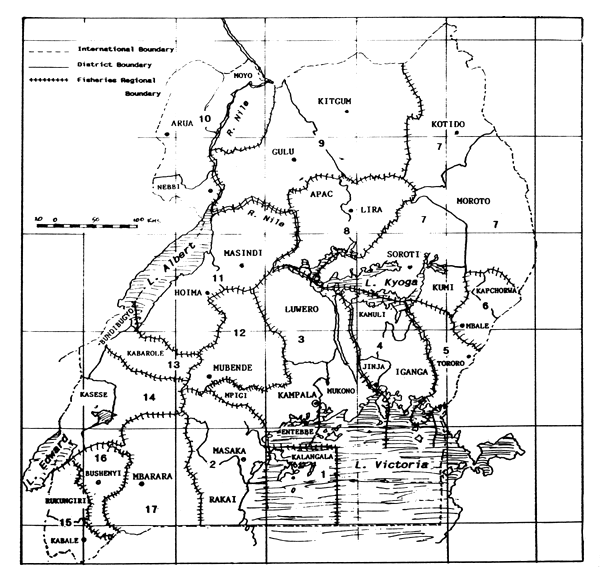
Kabale and Rukungiri Districts lie in the southwestern corner of Uganda along the borders with Rwanda and Zaire (map, Fig. 1). Their combined population is now likely to be approaching three-quarters of a million people, comprised mostly of ethnic Bakiga. Kabale District (formerly South Kigezi) is characterised by very hilly and mountainous terrain lying at a relatively high altitude (1200 – 2400+ metres). Rukungiri (formerly North Kigezi) is generally lower (1200 metres and below) and takes in the foothills and escarpment to the east of the Zaire border and Lake Edward, extending north to the boundary of Queen Elizabeth National Park.
1.2 Patterns of Socio-Economic Adaptation1
The population density of Kabale District is one of the highest in rural Uganda, and pressure on ever-dwindling land resources has been an acute problem since the 1940s (Purseglove 1946). One result of this has been an extreme fragmentation in land holdings, as family plots have been continuously sub-divided through the traditional Kiga system of equal allocation and inheritance to all sons (Edel 1957). The combination of population pressure and land scarcity has also given rise to a tradition of male labour migration and a tendency to allow wives and children to support themselves on the home parcels (Yeld 1969). Another result has been migration and resettlement, both programmed and spontaneous, into neighbouring areas over the years.
The first official resettlement schemes got underway in the late 1940s, and involved the transfer of people from South Kigezi into North Kigezi, the present Rukungiri District (Belshaw et al. 1966). An interesting point noticed by observers of the resettlement communities was that intrafamily cooperation in farming activities was much more pronounced in the new areas than in the old Kiga core area of South Kigezi. In the new areas, husbands and wives tended to make management decisions and carry out work in the fields on a joint basis, indicating that the Kiga gender division of labour was far less rigid and more adaptable than was apparent under the stress conditions of severe land fragmentation and male out-migration common to the core homeland area (van der Meeren, pers.comm. 1991).
These days resettlement is no longer such a viable option for land hungry families of Kabale, at least insofar as neighbouring areas are concerned. Rukungiri, the old North Kigezi area which hosted the original resettlement schemes, is now facing problems of population pressure and land shortages of its own. Toro and Ankole, nearby districts which formerly absorbed many settlers, are less accessible as destinations for Kiga people. At the same time, outside employment opportunities are increasingly scarce and no longer provide ready alternative sources of livelihood.
The present situation within the food production sector of Kabale and Rukungiri can generally be characterised as one of serious stagnation and decline. A privileged few took advantage of their positions and the disruptions brought on by the period of strife and maladministration of the 1970s and the early 1980s to acquire large tracts of land carved out from former common property areas in the valley marshes. These marshes had provided valuable subsistence resources in the form of dry season grazing areas, thatching and mat-making materials, and a limited supply of fish. Many have now been drained and fenced off in order to raise herds of exotic dairy cattle.
For most Kiga peasants, however, livestock raising is at best a marginal enterprise because farm plots provide insufficient grazing and fodder production. Common grazing areas are no longer available, either because of progressive agricultural encroachment up the hillsides or because of enclosure of valley bottoms by rich land appropriators. Plot sizes tend to be minimal, ranging from next to nothing up to a hectare or so. Under these circumstances, farming is largely a subsistence and stopgap operation, a question of trying to produce at least enough to feed the family, with perhaps a little surplus to sell for cash requirements. Basic crops consist of sorghum, sweet potatoes, Irish potatoes, and beans. Matoke, the banana staple common to many other food-growing areas of Uganda, does not do so well in the southwest region and therefore generally does not figure as a main crop. The variety of banana known locally as embire, which is used mostly in brewing, was formerly quite common in the Rukungiri area but has largely been destroyed over the past ten to fifteen years due to an outbreak of weevil pest.
2.1 Relevance of Fish Farming
It is within this overall context of high population densities and limited resources in land, food production potential, and alternative employment opportunities that small-scale fish farming offers attractive possibilities for Kabale/Rukungiri. In many parts of Uganda fish constitute the most important source of animal protein in people's diets. It is relatively cheap in relation to meat and poultry products, and very abundant in localities that lie within the fringe areas of the major lakes and rivers, or within the distribution network maintained by local traders (Orach-Meza et al. 1989).
Fish has always been a popular food in the Kigezi region but supplies have never been adequate to meet demand. Local lakes such as Bunyonyi, Mutanda, Mulehe, Chahafi, and Kayumbu tend to have a low natural productivity and efforts at supplemental stocking, though reportedly yielding some successes (UFD 1971; Walyamboga, pers.comm. 1991), have never been able to overcome this deficiency. Supplies of fresh and smoked fish brought in by traders from landings on Lake Edward and Lake Victoria cater for local demand to some extent, but are far below requirements. Long distances have to be traversed over sometimes difficult roads, and only limited quantities of fish can be transported. Supplies were insufficient even in the past, when road communications were somewhat better (Crutchfield 1959). The situation has become much worse in recent years due to the severe deterioration of access roads (Reynolds 1990; Reynolds and Kirema-Mukasa 1989). If a steady local supply of fresh fish could be established through fish farming, substantial benefits would accrue in terms of nutritional welfare and income generation.
Fish farming is in fact nothing new to the people of Kabale and Rukungiri Districts. A programme involving the establishment of fish nursery centres and numerous fish ponds on local smallholdings supported by Fisheries Department field extension services was developed in the area during the 1950s and 1960s (Balarin 1985). This programme was based exactly on the same rationale that applies, albeit now with all the more force, at the present time. Then as now, fish farming was seen as an effective way of enhancing productivity and protein availability in a setting where overpopulation and limited land resources imposed severe constraints on development options.
By the late 1960s, the fish farming programme in Kigezi involved three breeding/fry centres which served as: (a) breeding and rearing stations for the supply of stock to private fish farmers; (b) experimental and educational centres; and, to a limited extent, (c) public buying points for fresh fish raised and harvested directly on station. The fry centre at Kyanamira in Kabale comprised 5 ponds, whilst the one at Kisiizi in Rukungiri had 9 ponds and the one at Kihihi, also in Rukungiri, had 9 ponds. In addition, a fish demonstration at Kitanga near Kabale had 14 ponds. This brought the number of fish ponds operated by the Department to 37. The rearing stock they supplied provided for the needs of over 700 private ponds then in production across the two districts. Mature fish produced for direct sale to the public provided an additional source of revenue to Government (UFD 1971; Walyamboga, pers.comm. 1991).
The main species of fish stocked at this time were tilapia and the mirror carp Cyprinus carpio. Local preference was for the carp, owing to the comparatively larger size it attained under artificial rearing conditions within the tropical highland environment of Kigezi. Most of the fish produced from the private ponds was used on a subsistence basis, although some farmers were able to produce a surplus for sale. Predators in the form of otters and birds proved to be a nuisance in some localities, and it was recognised that fencing and other protective measures were called for in order to sustain productivity (UFD 1971; Male 1970).
Unfortunately, the good foundation that had been established for small-scale aquaculture enterprise was almost completely eroded during the long period of political chaos to which Uganda was subjected from the mid-1970s. Fish farming countrywide has deteriorated so drastically that at present it is virtually moribund (Balarin 1985). The Kabale/Rukungiri fry centres have suffered from repeated episodes of looting, and are now missing such essential items as fencing, iron roofing sheets, and all manner of maintenance tools and materials. Maintenance work has been further curtailed because of cutbacks in operating budgets and staff establishments imposed by Government in a bid to reduce expenditure. The fry centres are at present in a much deteriorated state and most of the ponds have reverted to bush. The Regional Fisheries Office is unable to offer any services to farmers in the way of rearing stock or demonstration sites. Extension services have also come to a virtual standstill because of transport difficulties for field staff and equipment shortages. Because of the breakdown in support services, private fish ponds have been widely abandoned. It is reckoned that less than 100 are still serviceable, and that of these, only a few continue in production (Walyamboga, pers.comm. 1991).
Now that the political situation within the country has stabilised and Government has embarked on wide-ranging efforts to rehabilitate the economy, public services, and its own administrative and technical machinery, it is appropriate to consider ways and means to restore small-scale aquaculture in Kabale/Rukungiri so that the enterprise may once again become a valuable source of employment and nutritional well being for the local population. This would be entirely in keeping with present Government policy, which places strong emphasis on fisheries development generally and, for suitable localities, aquaculture development particularly (Reynolds 1989).
The contemporary relevance of fish farming within the general context of urgent need for income-generating projects and enhanced food production in southwestern Uganda is greatly strengthened by the fact that it is not a new venture. It is relatively well-tried and has a proven record of success. The reasons behind the setbacks to the earlier programme of fish farming were largely exogenous in nature. They certainly cannot be attributed to a lack of local interest in the enterprise nor to poor demand for fish in local diets. Both interest and demand were high in the past and continue to be so at present (van der Meeren, pers.comm. 1991; Walyamboga, pers.comm. 1991).
Fish farming is an appealing development option for Kabale/Rukungiri in other respects as well. It would require a comparatively small capital input and short start-up time before reaching a point where it could be managed as a self-sustaining community programme. Also, as already demonstrated to some extent through the Kigezi fish farming experiences of the 1950s and 1960s, the enterprise is not strictly associated with traditional gender divisions of agricultural labour (van der Meeren, pers.comm. 1991). Husbands and wives would be likely to assume joint responsibility in the management and exploitation of fish ponds. Small-scale aquaculture could thus serve as something of a model for other forms of income-generating projects in the agricultural sector. In the long term, systems of family enterprise wherein labour input and resource management responsibilities are shared and co-ordinated between men and women would do much to counter the disequilibria created by the old pattern of adaptation to conditions of land and gainful employment shortages. This entailed male migration to outside areas for purposes of cash employment, but without a return flow of sufficient remittances to support families back home. Wives and children thus tended to be left to cope on their own with problems of subsistence under increasingly marginal circumstances of land availability and productive capabilities.
Balarin, J.D., 1985. National reviews for aquaculture development in Africa. 10. Uganda. FAO Fish.Circ., (770.10):109p.
Belshaw, D., S. Charsley, E. Katarikawe, and E.R. Yeld, 1966. Agricultural development and resettlement schemes in Kigezi, Western Uganda. A report to the World Bank, Washington, D.C.
Crutchfield, J.A., 1959. Fish marketing in Uganda. Report to the Government of Uganda. Rome: FAO (FAO/59/3/1614).
Edel, M.M., 1938. Property among the Kiga in Uganda. In Africa. Vol. II, No. 3.
Edel, M.M., 1957. The Chiga of Western Uganda. Oxford: University Press.
Male, M.M., 1970. Kigezi local otter trap. In Occasional Paper No. 3, Fisheries Department, Ministry of Animal Industry, Game and Fisheries. Entebbe: Government Printer.
Orach-Meza, F.L., E.J. Coenen, and J.E. Reynolds, 1989. Past and recent trends in the exploitation of the Great Lakes fisheries of Uganda. Occasional Paper No. 1, FISHIN Notes and Records. Fisheries Statistics and Information Systems, FAO/UNDP Project UGA/87/007. Paper presented at the International Symposium on Resource Use and Conservation of the Great Lakes. Bujumbura, 29/11 – 2/12/89.
Purseglove, J.W., 1946. Land use in the overpopulated areas of Kabale, Kigezi District, Uganda. In East African Agricultural Journal. Vol. XII, No. 1.
Purseglove, J.W., 1950. Kigezi resettlement. In The Uganda Journal. Vol. 14, No. 1.
Purseglove, J.W., 1951. Resettlement in Kigezi, Uganda. In Journal of African Administration. Vol. III, No. 1.
Reynolds, J.E., 1989. Fisheries development in Uganda: sectoral background and draft project profiles. Project Profiles 1, FISHIN Notes and Records. Fisheries Statistics and Information Systems, FAO/UNDP Project UGA/87/007.
Reynolds, J.E., 1990. Continuity or crisis? Management challenges for the shared fisheries of the Western Ugandan Great Lakes. Socio-Economic Field Reports, No. 15. FISHIN Notes and Records. Fisheries Statistics and Information Systems, FAO/UNDP Project UGA/87/007.
Reynolds, J.E. and C.T. Kirema-Mukasa, 1989. Notes on Kichwamba Region. SEC Field Report No. 6, FISHIN Notes and Records. Fisheries Statistics and Information Systems, FAO/UNDP Project UGA/87/007.
UFD (Uganda Fisheries Department), 1971. Annual Report. Entebbe: Government Printer.
van der Meeren, E.R., 1991. The family in social change: a preliminary report to OXFAM on social and economic problems in Kabale and Rukungiri Districts.
Yeld, E.R. (= E.R. van der Meeren), 1969. The family in social change: a study among the Kiga of Kigezi District, South-West Uganda. Ph. D. Thesis, Makerere University.
FIGURE 1. FISHERIES REGIONS OF UGANDA
FISHERIES REGIONS
|  |
Title: RESTORATION OF FISH FARMING IN SOUTHWESTERN UGANDA: PILOT PHASE
Sector: Agriculture, Forestry, and Fisheries (04)
Sub-Sector: Fisheries (0440) -- Fish Production Support
Primary Function: Direct Support
Secondary Function: Institution Building
Funding Agency: To Be Determined.
Executing Agency: FAO/UN
Govt. Implementing Agency: Fisheries Department, Ministry of Animal Industry and Fisheries
Project Location: Kabale and Rukungiri Districts, Uganda.
Duration: 1 Year
Proposed Starting Date: ASAP
Est. Govt. Contribution: UShs 30 million.
Est. Donor Contribution: US$ 150–250,000.
Background and Present Situation:
Small-scale fish farming used to be a popular and successful food producing and income-generating enterprise in the Kabale and Rukungiri Districts of southwestern Uganda, home to some three-quarter million people of the Kiga ethnic group. This region is one of extremely high population densities and fragmented land holdings, and the possibilities for families to engage in crop and livestock production above a subsistence level are seriously limited. The combination of population pressure and shortages of land and gainful employment in many localities gave rise to a pattern of resettlement and male labour out-migration beginning as early as the 1940s. The resettlement option is not so readily available these days as nearby districts cannot absorb more land-hungry migrants from the Kiga homeland. Outside employment opportunities likewise have become ever more restricted. Male labour migration in any case has brought little in the way of benefits to the wives and children left to cope with the marginal subsistence circumstances at home, since remittances from those working outside rarely suffice to cover family needs.
The programme mounted by the Fisheries Department in the 1950s and 1960s, promoting small-scale fish farming as a combined subsistence/commercial enterprise, was entirely appropriate to a setting where overpopulation and limited land resources imposed severe constraints on development options. Fish has always been a popular food in the region but supplies have never been adequate to meet demand. Local lakes tend to have a low natural productivity and efforts at supplemental stocking have never been able to overcome this deficiency. Supplies of fresh and smoked fish brought in by traders from outside districts met local demand only to a very minor extent. Long distances had to be traversed over sometimes difficult roads, and only limited quantities of fish could be transported.
The early efforts to encourage fish farming in Kabale/Rukungiri thus sought to ensure a steady local supply of fresh fish which would in turn bring benefits in terms of nutritional welfare and income generation. By the late 1960s, three fry centres and one fish demonstration farm were being operated by the Fisheries Department, producing rearing stock for over 700 private ponds and also some fish for direct sale to the consuming public.
Development Constraints and Needs:
Unfortunately, the substantial accomplishments in fish farming development realised in Kabale/Rukungiri up to the late 1960s fell victim to the events of political turmoil, maladministration, and economic disruption which overtook Uganda during the 1970s. The end result is that at present fish farming in the region has virtually collapsed. The fry centres and demonstration farm are in total disrepair and are lacking all manner of basic equipment owing to repeated episodes of looting by marauding soldiers and armed bandits. The local Regional Fisheries Office lacks the facilities and finance to correct the situation, and nearly all of the private fish ponds have fallen into disuse or have reverted to bush due to the prolonged absence of technical support and supply of rearing stock.
With the re-establishment of political stability in the country and the massive effort at national rehabilitation and reconstruction now being mounted by Government, it is time to address the need to restore the role of small-scale fish farming in the region as an important source of animal protein and rural income generation.
Description of Project:
A pilot effort is proposed for the Kabale/Rukungiri region of southwestern Uganda which would promote the restoration of small-scale fish farming to its former level of importance as a source of protein and income for local families. Funding is sought for an initial phase to extend over a period of one year, during which the major fry centre at Kyanamira just outside of Kabale Town would be restored to full operational status. The Centre would serve as a base of rearing stock supply for a limited number of rehabilitated privately owned fish ponds located in two project target areas. Subject to further assessment of the local situation, it is proposed that one target area would be close to the Kyanamira centre, whilst the other would be a suitable neighbourhood in Rukungiri District, preferably one with a high concentration of ponds fit for rehabilitation. Again subject to further assessment, it is proposed that the rearing stock should be comprised of the mirror carp, Cyprinus carpio, at least initially, since this species performed well under artificial rearing conditions in the former aquaculture programme in the region, and is popular with local farmers and consumers. The emphasis throughout the project would be on local community participation and initiative. Regional Fisheries Department and project management staff would serve primarily a catalytic role, providing limited start-up funds, necessary gear and materials, and field extension support. Participating farm families would be encouraged to join together in self-governing co-operative groups. The groups, each comprising about fifty families from the respective pilot areas, would be equipped with a central store of tools and gear to be lent out on a rotational basis to members for fish pond restoration and maintenance activity. They would also operate a simple revolving credit-in-kind scheme to provide member families with the basic fish farming start-up requirements of rearing stock, fencing materials, and a modest assortment of pond maintenance and feeding items. Past experience has shown that the growing-out times for pond-reared fish in Kabale/Rukungiri only involve six to eight months. It should be feasible therefore for individual farm families to repay any loans they take out from their society within a relatively short period, commencing with the first pond harvests.
Justification and Expected Impact:
The rationale underlying orignal efforts to promote fish farming in Kabale/Rukungiri in the 1950s and 1960s is today all the more compelling. Population pressure on very limited arable land resources has mounted, and the old modes of adaptation, resettlement and male labour migration, offer little if any meaningful solution to the Kiga predicament. To compound matters, fish from outside areas is now even more difficult to obtain because of the severe deterioration of access roads.
Fish farming warrants priority attention for other reasons as well. Under conditions of proper management and revolving fund organisation supported by full local community participation, a restoration effort would require a relatively low level of capital input and a short start-up time before becoming a self-sustaining affair. Also, because fish farming is not associated with stereotyped gender roles common to other forms of agricultural labour in the Kiga homeland, the enterpise could serve as a model for the development of family farm projects wherein labour input and resource management responsibilities are shared and co-ordinated more equitably between husbands and wives.
In summary, the expected development impact of the proposed project can be noted as follows. In the short term, the project should establish a foundation upon which the full restoration of fish farming in Kabale/Rukingiri may be built. In the long term, this should in turn result in considerably enhanced nutritional status and employment situation in a region where widespread socio-economic marginalisation now prevails. Certain demonstration effects may also be anticipated with regard to the possibilities of gender-integrated family farm-based enterprises within Kabale/Rukungiri.
Objectives and Outputs:
Primary or ultimate project objectives are to increase the contribution of the small-scale fish farming enterprises to the regional food supply and to foster the general improvement of the quality of life within Kabale/Rukingiri.
Immediate objectives are to restore one fish fry centre in the region so that it may serve as a source of rearing stock and technical backstopping for pilot fish pond restoration work in two communities of Kabale/Rukungiri. In addition, assistance will be provided in the form of advice and material to encourage local community project participants to form co-operative groups.
Project outputs will include (a) a fully functioning and properly equipped fry centre (b) staffed by a small team of Fisheries Department personnel capable of delivering advice and technical support to (c) a network of about 100 private fish ponds operated by families linked with one another through (d) self-governing co-operative groups that cater for the needs of their members in terms of pond restoration and maintenance work requirements, including the availability of credit on a revolving basis. These initial outputs would actually represent components of a derivative output, being (e) a model upon which the further restoration of small-scale family fish farming enterprises throughout Kabale/Rukungiri could be based. A final output of the project would in fact be (f) an evaluation of the accomplishments and suitability of the pilot effort and a set of recommendations concerning its expansion and/or replication through a follow-on activity.
Donor Budget Summary (Estimated):
| Personnel | |||
| Chief Technical Advisor/Team Leader (12 months)* | US$ | -- | |
| Administrative Support (12 months) | 5,000. | ||
| Counterpart and Participant Training | |||
| Field/In-Service Allowances | 10,000. | ||
| Workshops/Field Days | 10,000. | ||
| Equipment, Supplies, & Services | |||
| 1 4WD Vehicle & 5 Motorcycles | 30,000. | ||
| Fishing Gear | 10,000. | ||
| Construction Materials & Labour for Kyanamira Fry Centre Rehabilitation | 10,000. | ||
| Office Equipment & Supplies | 10,000. | ||
| Miscellaneous | |||
| Operation & Maintenance | 35,000 | ||
| Sundry, Contingency | 25,000 | ||
| EST. PROJECT TOTAL: | US$ | 150,000 | |