


A presentation of the background to the South Africa Forest Resource Information System was made by Sebueng Kelatwang, see Appendix 5.
The structure and contents of FAO's forestry country profile system was presented by Peter Holmgren, FAO, with special emphasis on the various functions provided to logged in users, including text editing and translation, adding links, managing page publication and feedback functions.
The process of system development was elaborated, emphasizing that the system is a FAO corporate system and that the Forestry Department is the system owner.
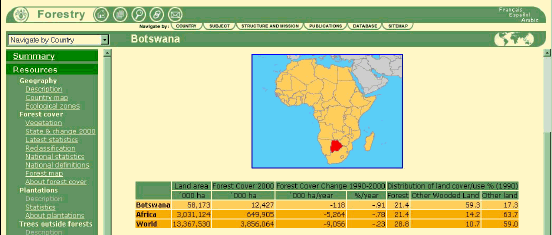
The presentation was made as a background to the below discussion of national forestry information systems, and FAO's facilitating role in the devlopment of these. The FAO forestry country profiles are illustrated in Figure 1.
Figure 1. FAO's forestry country profiles as available on the world wide web. (www.fao.org/forestry/fo/country/nav_world.jsp).
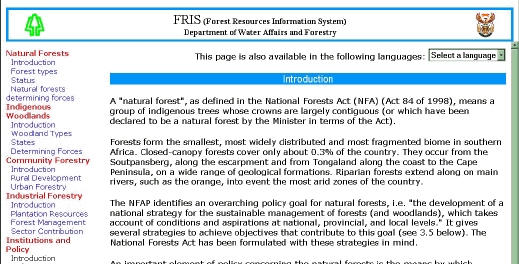
Based on the existing FAO country profile system, and the known information requirements from South Africa, a prototype system for national forestry information, named "Forest Resources Information Service" (FRIS), had been developed by FAO to serve as input and example in the workshop (Figure 2).
The prototype represents a new possibility for FAO to support member countries in their efforts towards sustainable forest management. Building on the FAO Forestry Information System platform, it is possible to clone the country profile approach into a national forestry information system for interested countries. Data ownership for these clones remain with the countries, and a range of functions available in the FAO system can be made available with little or no effort. The technological solution can in itself provide a low-cost solution for national forestry departments that want to estabish a web presence for forest policy related information, as the only requirement is a computer with internet connection.
In addition, working closely with member countries with forest policy information provides excellent opportunities for FAO to fulfil its role to facilitate and support activities for advancing sustainable forest management. Sharing the information system platform will lead to increased and improved communication between FAO and member countries, and perhaps also between member countries. The experiences gained and information maintained would be a step forward in forestry knowledge management.
The concept is thus that FAO provides an empty web presence for the country (in the prototype case South Africa) together with user login accounts for the country. The country then develops and enter the information structure (i.e. a table of contents of web pages) based on its requirements for forest policy development or monitoring, and continues to feed the identified web pages with contents. FAO would take no responsibility for the contents, however the information would be stored on the FAO servers, taking advantage of FAO's information infrastructure and data security. This concept is under development and the current workshop was a first opportunity to test the ideas on member countries.
Figure 2. Web screenshot from the FRIS prototype developed by FAO after specifications from South Africa. The prototype was used for group exercises during the workshop.
Group work was carried out in four groups, each with computers connected to the Internet. Practical exercises were held in which the participants were trained in the various functionalities in the FRIS prototype. The exercises covered:
- feedback functionality
- login to FRIS
- text entry and translation
- entering contacts information
- managing the publication status of the web pages
- adding links to the pages
- editing table contents
The groups were also asked to report back on the following items:
Group reporting were made as informal discussions, and the following Impressions on suitability of FRIS in participating countries were formulated:
1. Forest(ry) information systems with web access are useful for national forest policy development and for other stakeholders, e.g. NGO's and the private sector, but do not provide universal access to the information;
2. There are existing information systems on various aspects of forestry in all countries;
3. FAO-FRIS can be a potential "Integrating Portal", providing visibility and linkages, see Scenarios 1 and 2 below;
4. (Sub-)System / Data ownership can be managed to country needs, including full control of contents and user-friendliness;
5. Developing the Table of Contents is a major exercise, which also reflects the information requirements for SFM reporting;
6. Collaboration between countries in the region and with FAO will speed the distribution of experience and systems and in this way help everyone to climb the learning curve quicker.
7. FAO - FRIS offers system memory and long-term stability;
8. Opportunity for good cost-efficiency for the system platform, including benefiting from system upgrades;
9. Although Fao systems and supprot would be available for as long as the country may require this, choosing to use the FAO platform would not lock any country into a situation of dependence upon FAO; any country would be able to transport the system to an alternative platform at any time.
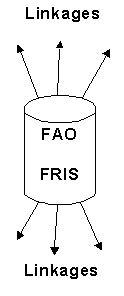
SCENARIO 1: No web-based national information system exists. "FRIS" could be a first national web-presence with linkages to other information sources.
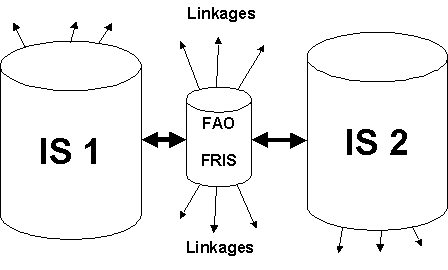
SCENARIO 2: Forestry systems with web-interface exist, with or without national coverage, with lesser or greater relevance to policy development and implementation. "FRIS"can be a portal that integrates access to existing systems and provides visibility and stability. A policy-relevant information structure can put existing system into a context.
SCENARIO 3: Facilities for forestry information services are available within the country, and no arrangement with FAO is desirable for this purpose.
The discussion concluded the following regarding the possible roles of FAO and the countries:
What would FAO provide?
- Server function;
- Storage space;
- Web page template, including user interface functions;
- Information backups, security and access;
- Facilitation of development and learning.
What would countries do?
- Provide and maintain information;
- Ownership control -responsibility for the contents;
- Design and maintain information structure.
How would FAO benefit?
- Greater recognition from member countries, who would put greater value on FAO's services;
- Better information sources;
- Improved relationship between FAO and countries;
- Reinforce service role.
How would countries benefit?
- Please refer to bullets 1-9 above for a list of possible country benefits
