


As an introduction to the topic, Mr Sebola presented the work done in South Africa on information requirements for forest policy development. The presentation is found with the other country presentations in Appendix 6.
A presentation of the FAO initiative to develop a Global Forest Survey was presented by Peter Holmgren. The presentation followed the two working papers developed for the purpose (FAO 2000, FAO 2001), which are available on the web, and were also distributed to the participants.
Highlights:
A systematic field sampling where data on biophysical as well as socio-economic factors is proposed to meet the information reqirements for sustainable management. A standard design is developed by FAO, that can be adapted to national conditions, where also local variables can be added.
The Global Forest Survey will be a tool to support national forestry programmes. The objectives will be:
1. National capacity building and Information for sustainable forest management;
2. Forestry knowledge management for international processes.
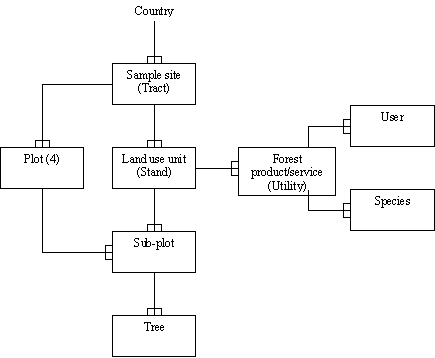
The proposed methodologies (field site sampling and variables to be collected) were described. As examples, the systematic sampling is illustrated in Figure 3 and the field site (or tract) is illustrated in Figure 4 and the data model in Figure 5.
Ongoing activities, including a pilot project in Costa Rica and agenda items at the forthcoming COFO 2001 were elaborated.
Figure 3. Schematic illustration of the primary sample grid for a country. The grid should tie in to existing national survey grids. It is tentatively estimated that 100 - 500 field sites will be needed depending on the size of the country.
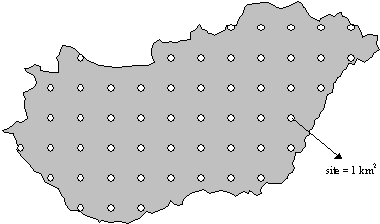
Figure 4. Illustration of 4 plots laid out within a site, in this case shaping 8 sub-plots for which detailed stand characteristics and tree-wise data are registered. Note that sub-plots 6 and 8 will be surveyed only if there are trees outside forests on the sub-plots. From FAO (2000)
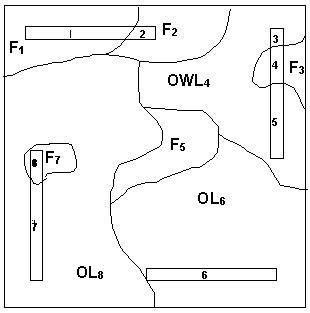
Figure 5. Core data model for the Global Forest Survey. Normal database annotations for relations apply (e.g. one-to-many relationships). From FAO(2001).
A group work session (4 groups) worked with the topics information requirements and relevance of the FAO initiatives on national forest(ry) information systems. Specifically, the groups identified indicators of relevance to policy, and developed an indicative table of contents for a "FRIS" system.
Findings:
1. "FRIS" information
Overall objective : to provide data and information on forestry resources to help the government, private sector, donors, civil society to:
- analyse and formulate policies;
- to adopt appropriate strategies for the sustainable use of the resource
- support multi-purpose use of the resources
2. Proposed "FRIS" Table of Contents
· Institutional policy & legislation: Institutional structure, Forest policy and act, International conventions & protocols, Interface with eg FAO and SADC-FSTCU, Human resources, Finances
· Environment: Forest types, Forest areas and location, Growth, standing stock, Biodiversity, Utilisation (licensing, timber/n on-timber), Deforestation afforestation and reforestation
· Socio-economic: Demography indicators, Trade in forest products and services including energy and employment
1. Principal objectives to be served by "FRIS"
Utlimate objective to improve socio-economic development and environmental conservation.
Immediate objectives:
-poverty alleviation
-job creation/enterprise development in forestry
-sustainable management/utilisation
-biodiversity conservation/protection
2. Performance indicators that should be reflected in the "FRIS":
- improved income earnings
- number of people employed and enterprises established
- management plans, forest policy, legislation, certification
- species diversity
3. Proposed "FRIS" Table of contents:
Immediate objective |
Activity |
Indicator |
Equitable distribution of forest resources (?) |
-dev of forest management plans to advance participation of previously disadvantaged communities benefiting from the forest |
-increase in numbers / individuals benefiting from forests |
Promote traditional access to forests |
Protect sites of cultural heritage and spiritual inportance |
increase in number of visitors |
Conservation of biodiversity |
development of management plans for different forest types |
... |
Health and vitality of forests |
- development of fire management plans - rehabilitation of forests - development of appropriate insecticides and pest managementq |
- improved forest productivity - eradication and control of diseases |
ToC
1. Proposed "FRIS" Table of Contents:
2. Identified immediate objectives that should be reflected in the information system:
Immediate objective |
Indicators |
Remarks |
Promotion and extension |
By Feb 2003: -50% of farmers, including women, have received pamphlets; -30% reached through public gathering and radio; -20% of total (rural?) population self-sufficient in wood and NWFP -10% of rural communities will be directly or indirectly employed (in the forestry sector?) |
Success factors: -Availability of infrastructure -Radio survey and gathering -Appropriate policy in place
|
Environmental protection and biodiversity conservation |
By 2020: -In 2020, 10% of the gullies and deforested areas will be rehabilitated -50% of endangered species will be out of danger |
Success factors: -Appropriate policy in place -Land tenure system is reviewed |
Forest management and people's participation |
By 2020: -50% of rural communities trained in forest management -20% will participate in forest management |
|
Forest research |
By 2020: -Proper research programme in place to meet stakeholder needs |
Success factor: -Adequately trained personnel in place |
Women empowerment and legislation |
By 2020: All women empowered through training and legislation, reviewed accordingly |
