The country profiles are stored and retrieved in a completely dynamic manner. This means that all information that is displayed on the website is drawn from database tables, and that no information is stored in static html files. All information is stored in the FAO corporate systems (database tables on Oracle servers at HQ) and retrieved by Javascript programs run on the FAO corporate web application servers. Besides drawing from the secure and competent management of the corporate systems, this also open possibilities for expansion and remote maintenance of the information.
Whereas static html files are typically stored on servers with very restricted access, the database tables can be updated through secure connections and custom-built applications. And whereas it is laborious to maintain complex html documents, the database tables can be structured and indexed for a much more efficient data management.
As an example, consider data about forest cover in a country. It is likely that this information should be published in several places such as the country summary page, the detailed pages on forest cover statistics, a regional statistics page, and so on. A static system would need to store the information several times. With a dynamic system, it is possible to store the data only once and then use it in many places which will greatly help maintenance and minimize the risk for conflicting information in different parts of the site.
The main information types in the country profiles are:
Only maintenance of texts is covered in this document.
The country texts are structured by sections (paragraphs). The headers to these sections are the same for all countries and are maintained separately. Adding a new country text therefore means that each section has to be entered separately. Maintenance is done on one section at a time.
The FRA2000 web pages have several forestry related topics for each country. These topics are listed in the menu. Non-wood forestry products and forest services are among these.
The NWFP (Non wood forest products) information in FRA website is divided into three different subcategories. These are description of NWFP, NWFP statistics and about NWFP & FS. Description part is usually most comprehensive one. An explanation of the country’s NWFP resources is given there. NWFP statistics lists countrys NWFPs, their importance, value, destination and reference for this information. About NWFP & FS explains what kind of information of non wood forest products and forest services web site is providing. It also lists countries that have NWFP information in this site.
In the NWFP description part texts are entered under titles (which are indicated in Italics, in the following box). These headers are already in the system and can be changed only by system administrator. The section that is named as “Quantitative data on NWFP” of the country can include a table of NWFP data. Headers for each page are already given in system. These headers are translated to official FAO languages. Headers will appear in the web if there is some text in database related to the specific header. In other words if someone enters new texts to the system and publishes these texts, then system will show the title of the text in correct language. Texts can be in database but not visible for external users, after publishing texts will be available for everyone. Chapter 7 discusses more about this issue of publishing.
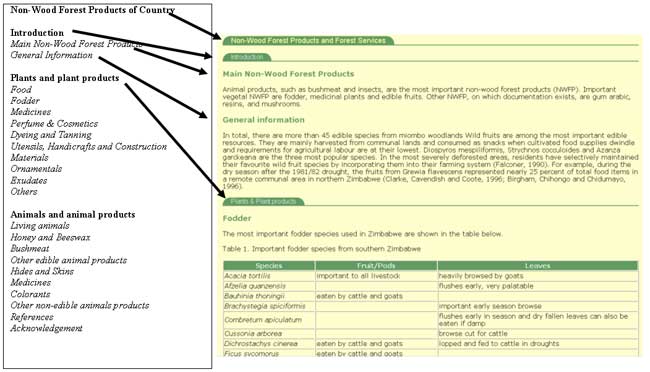
And this is the way that pages are build, one page have several items (see the following figure).
Following figure is the layout of the description part of Non-Wood Forest Products of a country in web site (in this case Zimbabwe). A content of pages is usually plain text and can contain also tables. Headers of different levels are separated with colours, font size and font type (see arrows on the following figure).
Figure 3. Example of a NWFP page with the list of Headers and sub headers.