The HTML abbreviation comes from the sentence: HyperText Markup Language. It defines the layout of web pages through the combination of text, graphics, tables etc. Therefore, it is basically a format that tells to web browser all the text and table data and all the formatting details of those.
To separate the HTML language parts from the rest of your document, the HTML functions are placed in angle brackets (<tag>), and are called tags. Whole document is an HTML file but these tags make the difference between original text file and HTML file. HTML uses tags to structure text into headings, paragraphs, lists, hypertext links etc. There are two types of tags: one that is opening a property and one that is closing it. For example <p> tag starts the paragraph and </p> closes it. For more information concerning tags, see Annex 3.
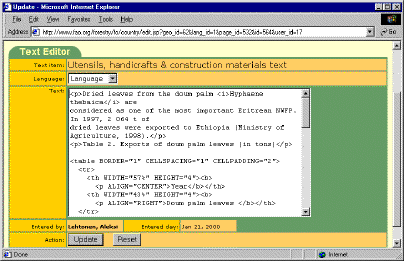
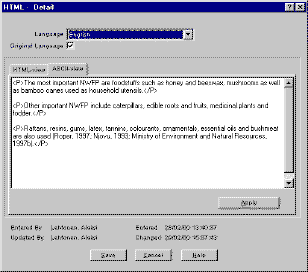
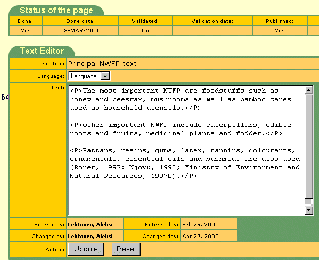
There is two ways to put texts into database, these are Foracle and web browser. Foracle is an Oracle based database tool that allows data entry by several users at the same time. Texts are stored into database in a simple HTML format (see following figure). Foracle can be used in Fao headquarters, but web browser can be used in any place if there is Internet access. For example Geneva office and Fao representatives will use web browser for text entry and for correcting possible mistakes.
Figure 4. User interface in text editor, Foracle and Web Browser.
|
Foracle |
Web Browser |
|
|
The texts are stored into database in a simple HTML format (see previous figure). Simple HTML means a format that has as less tags as possible. In the table below there is a NWFP text that has been saved into database. In this case, database texts has only very few tags. Paragraphs have been separated by using tags. In this example all the other formatting information is not needed (for example font, alignment, etc.).
Table 1. Original text before and after converting to the simple HTML.
Original text |
Text in database |
The most important NWFP are foodstuffs such as honey and beeswax, mushrooms as well as bamboo canes used as household utensils. Other important NWFP include caterpillars, edible roots and fruits, medicinal plants and fodder. Rattans, resins, gums, latex, tannins, colorants, ornamentals, essential oils and bushmeat are also used (Roper, 1997; Njovu, 1993; Ministry of Environment and Natural Resources, 1997b). |
<P>The most important NWFP are foodstuffs such as honey and beeswax, mushrooms as well as bamboo canes used as household utensils.</P><P>Other important NWFP include caterpillars, edible roots and fruits, medicinal plants and fodder.</P><P>Rattans, resins, gums, latex, tannins, colorants, ornamentals, essential oils and bushmeat are also used (Roper, 1997; Njovu, 1993; Ministry of Environment and Natural Resources, 1997b).</P> |
For studying more about HTML text and tags see following pages:
http://www.htmlhelp.com/reference/wilbur/overview.html
and
http://www.w3.org/MarkUp/Guide/Overview.html
In HTML, tables are much more complex way of presenting information than plain text. On the other hand tables can be much more informative and urgently needed in some cases. For example a list of species or production statistics are presented in tables.
Figure 5. A piece of the HTML code in database for producing a table.