


This Working Paper specifies the terms and definitions used in FRA 2005. The use of identical terms and definitions is essential for global monitoring across countries and for presenting FRA 2005 report that includes global tables, thematic assessment. The working paper should be regarded as an authoritative document on terms and definitions to FRA 2005.
The working paper aims at facilitating the country reporting process for the Global Forest Resources Assessment update 2005 (FRA 2005). For this purpose the paper serves as third and fourth annexure (Annex 3 and 4) to the “Guidelines to Country Reporting” (Working Paper No. xx).
This document also provides comparison of terms and definitions of FRA 2005 with previous two FRAs (1990 and 2000) to establish appropriate links and transparency between the FRA 2005 and past FRAs.
The paper is distributed as part of the communication process between the FAO, UNECE secretariat and all National Correspondents. It can be used in meetings and training at all levels aiming to build national capacity for assessment and reporting in general, and to improve country reports to FRA 2005 in particular. The set of terms and definition for FRA 2005 can also be found on the official web page of FRA 2005 (www.fao.org/forestry/fra2005) at Forestry website of FAO.
For more details FRA, please follow these links:
www.fao.org/forestry/fra Homepage for FRA
www.fao.org/forestry/kotka4 Kotka IV Expert consultation
www.fao.org/forestry/fra-ag FRA Advisory Group
www.fao.org/forestry/fra-nc FRA National Correspondents
www.fao.org/forestry/fra2005 FRA update 2005
Global forest resources assessments have been carried out by FAO since 1948, practically since FAO was formed. The mandate to carry out these assessments stems both from the basic statues of FAO (FAO 2003a), and by the Committee on Forestry (COFO) (e.g. FAO 2003b). Global assessment reports have been published at approximately ten year intervals. The latest of these reports, FRA 2000, was published in 2001 (FAO 2001).
The Global Forest Resources Assessment update for 2005, or FRA 2005, is specially mandated by the COFO 2001 and COFO 2003 that recommended a 5 year intervals to relate it to international forestry processes and implement it as a broad based assessment.
The FRA 2005 expert consultation in Kotka IV (1-5 July 2002), recommended that future FRA should be structured after the criteria (now called Thematic Areas) defined by the nine international processes on Criteria and Indicators for Sustainable Forest Management (C&I for SFM). This recommendation has been reinforced at several occasions, notably the international conference on C&I for SFM in Costa Rica in February 2003 (FAO 2003d) and COFO 2003 (FAO 2003b).
The FRA 2005 will provide information that is relevant for many other forest related international processes and agencies. It will contribute to the harmonization of information requirements of various international processes and agencies leading to reduction in reporting burden of countries.
As recommended by Kotka IV, and confirmed by COFO 2003, an Advisory Group (AG) has been established to support the FRA process. The AG consists of about twenty experts from all regions and partner organisations of global FRA programme of FAO. The primary role of Advisory Group is to advise the FRA secretariat on scope, methods, procedures and timing of the global assessment. This document takes into consideration the deliberations at the meetings of the AG. For further information on the FRA AG, please visit www.fao.org/forestry/fra-ag
The main components of FRA 2005 are outlined below to give an overview of the entire project and to put the country reporting process in a context. The following milestones are important to the FRA 2005:
Table1: Milestones for FRA 2005
Milestone |
Date |
Comment |
Global meeting of National Correspondents |
Nov 2003 |
End of the design and test phase for country reporting |
Deadline for input to State of the World’s Forests 2005 |
Oct 2004 |
SOFO 2005 is expected to contain papers and partial data from FRA 2005 |
COFO 2005 |
Mar 2005 |
Comprehensive progress report expected |
UNFF5 |
May 2005 |
Comprehensive input on reporting processes expected |
FRA 2005 launch |
Oct 2005 |
New global totals presented |
Figure 1 presents the three main phases of the country reporting process and planned target dates. It starts with design phase, followed by reporting, compilation and analytical phase, closing finally with the phase of delivery of assessment report.
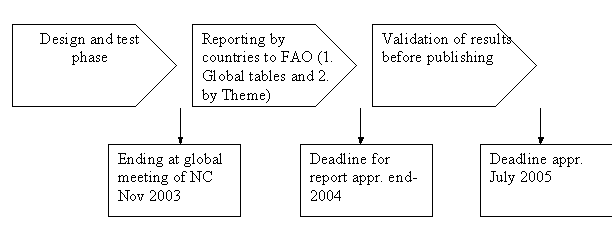
Figure 1. Main phases in the country reporting process to FRA 2005
The FRA 2005 is requesting National Correspondents to submit their report as a FRA Working Paper1 format that contains the relevant information for their country. National Correspondents will be provided with a preformatted FRA Working Paper to be used for the reporting. The country report will consist of two distinct elements (see Table 2). National Reporting Tables and Thematic Assessment. This document covers definitions of terms spanning both these elements.
Table 2: Two main elements or Steps in Country Reporting
Country Reporting |
Contents |
1. National Reporting Tables |
There are sixteen National Reporting Tables containing national data on 54 global variables including information on transformation of national data to global data. (See working paper on National Reporting Tables). These national tables correspond to sixteen Global Reporting Tables. |
2. Country report by Thematic Areas |
Short report following a predefined outline that builds on the defined Thematic Areas (Criteria) of SFM. The report can contain any additional (variables) information relevant in each country for each Theme. |
Each national reporting table have one to one correspondence with the sixteen Global Reporting tables. The global tables are simply compilation of national reporting tables of all countries. Most of these tables temporal data items relating to the three reference years 1990, 2000 and 2005.
Parallel to the country reporting process, the global FRA will continue to develop its monitoring of forest cover changes. Starting 2003, the monitoring will be expanded to cover all land, with a much higher number of samples (more than 10,000) than last time (117 sites). The approach is in two steps. First, an information framework will be established, mainly by attaching time series of satellite images to each sampled location. This framework can potentially be used for a variety of forest, land use or environmental monitoring. Secondly, an application tailored for the FRA will be applied to extract information on forest dynamics at regional and global level. Plans are to establish the framework during 2003 and to apply monitoring of forests in 2004 such that results are available for FRA 2005 report.
In addition to the information on sixteen global tables and thematic assessments the FRA 2005 plans to provide information on some special themes like “Mountain Forests” and “Forest and Water”, “Biological Diversity”, and “Planted Forests”.
The following main outputs are planned from FRA 2005:
• Country reports, summarizing findings by countries covering their information for the “Global Reporting Tables” and the “Thematic Report”. Effort will be made to provide these reports in electronic and printed versions in most of the official languages of FAO. The electronic versions will be available on FAO Forestry website and will contain details on source data.
• Special reports on key issues, such as “Mountain Forests”, “Forests and Water”, “Biological Diversity” and “Planted Forests” etc. mainly drawing from country information and other sources.
• A Main report that summarizes all findings and analyses trends since the previous assessment including results from latest time series analyses of satellite images through the proposed information framework.
• Contributions to SOFO 2005 (and following issues) will be important outputs from FRA 2005.
1 Note that this document is an example of a FRA Working Paper.
