


The number of threatened tree species has increased by 49% from 1990 to 2000 suggesting that either very little recovery plans are being implemented or the conservation status of these species is poor. The Criteria and Indicator System for Sustainable Forest Management that is currently being implemented require that forest management plans be drawn and recovery plans for species at risk of not maintaining viable breeding population be implemented. There has been no significant change in terms of protection and conservation of forests from 1986 to 2000. For example, the 1986/87 annual report by the Department of Environment Affairs indicates the area under protection by the state as 4 651 901 hectares (national parks, provincial reserves) as opposed to 4,986 114 ha in 2002, a minimal increase of 6.7% over 16 years. This seems to be the pattern even for the total area under any other formal protection where only 6.4% of the land was protected (e.g. conservation for multi-purpose 1 198 879 ha, Private conservation areas 2 067 574 and sate owned conservation area 4,651,905 ha) in 1987 and a similar percentage is being quoted in 2000.
Sixteen plots were established in nine forest area throughout the distribution range of mixed evergreen forest since 1987. In each area, one to four plots were established along local altitudinal or soil gradients. Each plot was subdivided into 10m x 10m sub-plots. The species and DBH of all stems greater than 5cm were recorded in all plots. Most plots were measured for the second time at 10 year interval. Data have been analysed for species richness, stand basal area, diameter and basal area growth, ingrowths from regeneration, mortality and growth of individual species.
National variables |
1.Standing stock assessment |
2.Level/rate of resources use |
3.Levels of multiple resources use from forest ecosystems |
4. Identification and developments of new alternative forests resources |
Regional indicators |
1. Degree of management of genetic resources |
2. Periodic balance between growth and removals of wood products |
3. Average annual consumption of wood for energy per capita |
4. Managed and sustainable extraction of non-wood forest products |
Variable |
Source |
Reliability |
year |
Ratio of resource use |
Forestry South Africa. 2002. Forest and Forest Products Facts. South Africa |
Reliable |
Table: Ratio of annual removals to annual increment of plantations
Years |
Removals |
Annual Increment |
Ratio |
1992 |
15,907,785 |
21,566,872 |
0.74 |
2000 |
16,606,878 |
22,387,970 |
0.74 |
It was difficult to draw conclusion with respect to growing stock as the growth data from different plots has not been synthesised at national level. But indications are South Africa’s indigenous forest grow continuously but at a very slow rate. Plantations are being managed sustainably and the ratio of annual removals to annual increment looks sustainable.
The ACRU model was used in conjunction with a decision support system to assist the user in preparing input information to stimulate water production from afforested areas. Values of simulated streamflow were compared with observed stream flow at three locations, one each in Kwa-Zulu Natal, Mpumalanga and Limpopo province on forested catchments with a range of catchments sizes, forest species and ages of plantations.
National |
1. Water quality |
2. Soil conservation |
3. Riparian zone and wetland management activities |
4. Pollution levels |
Regional |
1. Area and % of forests and other wooed areas managed mainly for the production of water, protection of watershed, riverine zones and for flood control |
2. Change in water yield and quality |
3. Areas of forests and other lands managed for scenic and amenity purpose |
Stream flow reduction activities |
Jewitt GPW., Schultze RE., 1999: Verification of the ACRU model for forest hydrology applications |
1999 |
State of environment of south Africa |
Table: Comparison of simulated and observed stream flow for monthly totals of daily values revision
Catchments Name |
% afforested |
Name of Species |
Total observed Flows (mm) |
Total simulated (mm) |
Observed flows variance |
Age |
Cedara (Midlands (KZN) 1977-1988 |
92% |
P.Patula |
1,664.834 |
1,687 |
724.266 |
young to mature |
P.radiata |
||||||
Marite( Sabie, Mpumalanga) 1980-1989 |
E. grandis |
|||||
85 |
Eucaluptus (Upper) |
1,857.944 |
1,869 |
246.331 |
12 | |
84 |
Pinus patula (Middle) |
20 | ||||
|
45 |
Mixed eucalyptus and pine (Lower) |
15 | |||
Mokubalaan 1963-1979 |
100 |
Eucalptus grandis |
1,992.271 |
1,724 |
201.879 |
0-12 |
( Drakensberg) 1969-1980 |
100 |
Pinus patula |
1,913.084 |
1,942 |
421.405 |
0-10 |
Table: Area (ha) affected by erosion
Problem |
Extent of soil degradation by cause |
Crusting |
Serious widespread problem of irrigated and dry land cultivated areas |
Compaction |
2 million |
Salination/W after Logging |
182,000 ha |
Pollution |
320 million ton/y |
Acidification |
5.04 million ha of high rainfall areas |
Fertility loss |
30,000 tonnes Nitrogen, 26 400 tonnes of Phosphorous and 363,000 tonnes of Potassium lost annually through erosion |
Biological and microbiological degradation |
3 million ha |
Questionnaires
National |
1. Forestry's contribution to local development |
2. Diversification within the forest industry |
3. Staff turnover in forest based businesses |
4. Opportunities for forest based activities |
5. Rights are understood and respected |
6. Control and enforcement of access and use |
7. Security of land tenure |
8. Level of satisfaction among users |
9. Identification and registration of significant sites |
10. Employment opportunities associated with forestry |
11. Employer compliance with labour legislation |
12. Remuneration of workers |
13. Negative impacts of forestry activities on people |
14. Conflict over distribution of costs |
15. Incidence of crime |
16. Absenteeism |
17. Implementation of outcomes of participation |
18. Capacity to participate |
19. Conflict Management |
Regional |
1. Share of forest sector in GDP |
2. Value from secondary industries |
3. Value from biomass energy |
4. Forest sector trade balance |
5. Investment in forests and forest industries including informal sector |
6. Contribution to food Security |
7. Degree to which social, cultural and spiritual needs are met |
8. Benefits accruing to local communities (with particular emphasis on women and youth |
Variable |
Source |
Reliability |
Years |
Contribution to the economy |
Forestry South Africa. Forest and Forest Products Facts, 2002. Forestry South Africa |
||
Access to wilderness areas |
Annual Report, 86/87. Department Of Environmental Affairs (DEAT) Government printers |
86/87 | |
Number of sites and visit |
Expert Opinion. 2001. Department of Water affairs and Forestry |
2002 | |
Contribution to food security |
The South Africa’s Forestry and Forest Product Industry, 2002. Forest South Africa |
Agricultural GDP |
2002 |
Employment Statistics estimation |
Appendix-the State of Forestry in South Africa Today. http://www.polity.org.za/html/govdocs/green_paoers/forest2.html |
Table: Value of sales from primary processing plants in Million Rand (Expressed in nominal terms)
PRODUCT |
1990 |
1995 |
2000 |
2001 |
Change on previous year |
Annual growth |
Sawn Timber |
724.4 |
903.9 |
2,078.7 |
1,867.7 |
-10% |
13% |
Pulp |
3,366.7 |
6,946.3 |
6,838.4 |
8,641.7 |
26% |
16% |
Mining Timber |
319.3 |
157 |
140.8 |
108.5 |
-23% |
3% |
Panel products |
662.9 |
476.9 |
626.4 |
594.7 |
-5% |
9% |
Poles |
89.2 |
87.5 |
246.8 |
164.4 |
-33% |
11% |
Charcoal |
43.9 |
24.3 |
64.7 |
101 |
56% |
15% |
Chips/Mill residues |
108.8 |
227 |
1,271.2 |
1,508.1 |
19% |
25% |
Other |
117.3 |
175.4 |
599.5 |
820.7 |
37% |
18% |
Total |
54,32.5 |
89,98.3 |
11,866.5 |
13,806.8 |
16% |
15% |
Regional variable: Resource use efficiency
No available information
Table 21: Contribution of forestry & forest products industry to GDP (in nominal terms)
Total R.S.A. G.D.P. |
1990 |
1995 |
2000 |
2001 |
Change on previous year |
Annual growth |
260,941 |
617,957 |
982,944 |
1,098,714 |
|||
Manufacturing G.D.P. |
65,784 |
114,125 |
166,415 |
188,182 |
13.1% |
13.7% |
Forestry G.D.P. |
1,071.5 |
1,797.9 |
2,712.4 |
3,266.2 |
20.4% |
14.5% |
Forest Products G.D.P. |
5,658.6 |
8,998.3 |
11,866.5 |
13,806.8 |
16.4% |
14.5% |
Forest Products as % to Manufacturing |
0.086018 |
0.078846 |
0.071307 |
0.073369 |
2.9% |
0.7% |
Forest Products as % to GDP |
0.021685 |
0.014561 |
0.012072 |
0.012566 |
4.1% |
-0.4% |
Source: FSA
Value from biomass energy:
No data available
Table: Forest sector trade balance in Million Rand
Forest Products |
1992 |
Trade |
2002 |
Trade |
Trade Compound annual increase 1992-2002 | ||||
Imports |
Exports |
Balance |
Imports |
Exports |
Balance |
Imports |
Exports |
Balance | |
Pulp |
41.7 |
1,001.6 |
959.9 |
291 |
2,894.4 |
2,603.4 |
21% |
11% |
10% |
Paper |
1,006.6 |
863.5 |
-143.1 |
3,682.3 |
4,254.2 |
571.9 |
14% |
17% |
n/a |
Solid Wood |
364.1 |
379 |
14.9 |
1,473.4 |
3,780.3 |
2,306.9 |
15% |
26% |
66% |
Other (matches & tannin extract) |
4 |
95.2 |
91.2 |
6.4 |
274.5 |
268.1 |
5% |
11% |
11% |
Sub Total |
1,416.4 |
2,339.3 |
922.9 |
5453.1 |
11203.4 |
5,750.3 |
14% |
17% |
20% |
Total all Products |
52,857.2 |
66,730 |
13,872.8 |
273,701.6 |
312,918.3 |
39,216.7 |
18% |
17% |
11% |
Gold Exports |
|
18,173 |
|
|
42,347.2 |
|
|
9% |
|
Exports Excl. Gold |
|
48,557 |
|
|
270,571.1 |
|
|
19% |
|
Gold as % of total exports |
|
0.27 |
|
|
0.14 |
|
|
|
|
Imports & Exports of Forest Products as % of total imports and Exports |
0.027 |
0.04 |
|
0.020 |
0.04 |
|
|
|
|
Exports of Forest Products as % of total exports excluding gold |
|
0.05 |
|
|
0.04 |
|
|
|
|
Source: FSA
Contribution to food Security:
Table: Land use comparison between forest plantations and agricultural products
Products |
Million Hectares | |
2001 |
2002 | |
Maize |
3.223 |
3.567 |
Forests Plantations |
1.352 |
1.351 |
Wheat |
0.959 |
0.941 |
Sugar |
0.432 |
0.435 |
Table: Contribution of forestry to food Security
1990 |
1995 |
2000 |
2001 |
Change on previous year |
Growth per annum | |
Agriculture, Forestry & Fisheries GDP |
12,984 |
23,721 |
31,060 |
37,674 |
21.3% |
11.1% |
Forest Products G.D.P. |
5,658.6 |
8,998.3 |
11,867 |
13,807 |
16.4% |
14.5% |
Forestry as % to Agricultural GDP |
0.08252 |
0.0758 |
0.087 |
0.0867 |
-0.7% |
3.1% |
Table: The range of direct benefits to stakeholders arising from the use of resource at National level
Resource |
Benefits |
Fuelwood |
cooking, lighting and heating |
Timber |
construction material and wood carving; |
Fruit |
dietary supplement, and sap for brewing of beer and wine |
Bark |
making ropes and weaving |
Bark, bulbs, leaves and roots |
bark, bulbs, leaves and roots |
Honey |
bark, bulbs, leaves and roots |
Insects, mushrooms and other edible plants |
Food |
Grass |
thatching and weaving, and for grazing cattle |
Non-consumptive use |
Recreation and tourism |
Table: Type and number of initiatives to develop new alternative
Type of initiative |
Number |
Participatory Forest management |
|
Forest Enterprise Development Opportunities |
|
Medicinal Plants Projects |
|
Out grower’s schemes |
|
Urban Greening |
Table: Type of forest user groups according to their resource needs/uses
Resource |
Benefits |
Domestic |
cooking, lighting and heating |
construction material and wood carving; | |
dietary supplement, and sap for brewing of beer and wine | |
making ropes and weaving | |
Commercial/domestic |
bark, bulbs, leaves and roots |
bark, bulbs, leaves and roots | |
Food | |
thatching and weaving, and for grazing cattle | |
Tourists |
Recreation |
Table: Number of people employed in forest and forest related activities
Forest Activity |
Estimated number employed |
Down stream activities |
80,000 |
Sawmilling |
36,000 |
Pulp and Paper Manufacturing |
48,000 |
Secondary Processing |
36,000 |
Working for Water |
Extrapolated |
Direct Employment |
8,386 |
Secondary jobs created |
714 |
Total employed |
209,100 |
Table: Average wage rates within the sector or industry
Skills Category |
Average wage/month |
Unskilled Workers |
570-600 |
Semi-skilled |
880-920 |
Skilled |
2,200-2,400 |
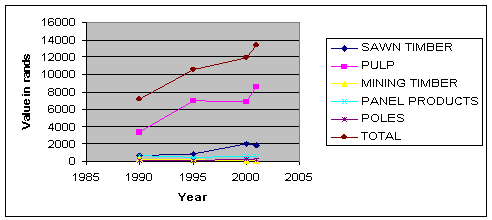
Fig. 5: Temporal changes in the value of forest products sold from primary
processing plants
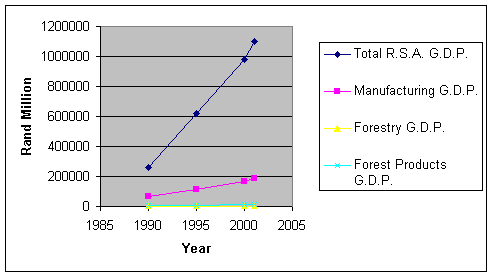
Fig. 6: Temporal changes in the GDP of South Africa, forestry, manufacturing,
agriculture, forestry and fisheries
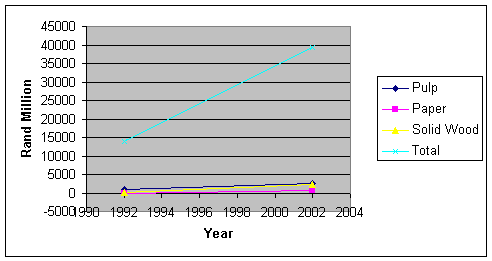
Fig. 7: Temporal changes in trade balance of Forest Products from 1992 to 2002
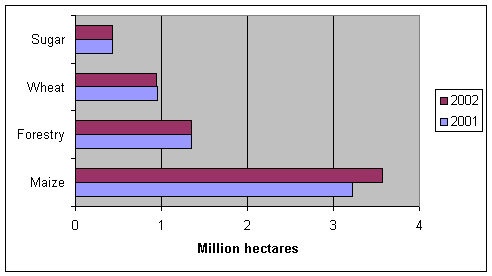
Fig. 8: Comparison between forestry plantations and different agricultural land
use products
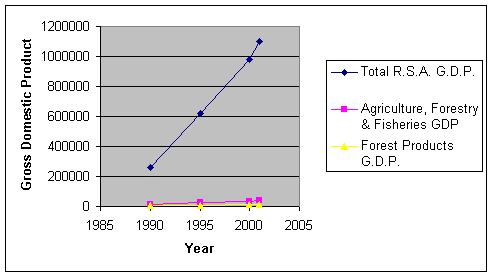
Fig. 9: Temporal changes in agriculture and forest and forest product GDP
The value of forest good and service grew by R514 million per annum (15%) from 1990 t0 2002 and trade balance by R2 534 annually (20%) from 1992 to 2002. This can be attributed to the depreciation of the currency since 1995. Forestry contribution to agricultural and manufacturing increased annually by 3.1% and 0.7% respectively from 1992 to 2002. However, the value of forest product as a percentage of the National GDP declined annually by 0.4% over the same period.
Although data in this report refers only to the formal sector, the informal sector makes an important contribution to the formal economy and the livelihoods of people, especially in rural areas. Processes are currently being undertaken or proposed to collect data from the informal sector: the South African Statistics Department and the proposed Regulatory Information Management System. There are still challenges of aligning methodologies to collect data on NWFP and other social benefits though. Generally, information on employment and other environmental benefits is scanty and mostly estimation
Overall assessment of forests in South Africa indicates that forest cover has not changed drastically over the past 13 years. This is evidenced by a slight change in percentage forest cover in terms of extent of indigenous forest and plantations. Woodland has however, declined over the same period due to degradation and conversion to other land use. The number of threatened tree species has increased by an estimated 49% over the past 12 years. Although no recovery plans have been reported on, programmes are in place to provide other incentives to encourage sustainable forest management in order to meet the obligation of the National Forest Act.
Forest growth studies from different plots in South Africa have not been synthesised at national level to provide an informed analysis of the overall growth patterns of South African forest however indications are that the growth pattern is slow but continuous. The majority of forests are protected although different kinds of threats remain a challenge to the government. The flow of environmental goods and services to communities especially with regard to NWFP seems evident although no national database exists to back-up these claims and programmes to allow community participation are in existence. The criteria and indicators of sustainable forest management provides the government with mechanisms to assess the state of the forests in South Africa, identify information gaps and promote and enforce sustainable forest management.
The purpose of this pilot report was to assess the status and trends of forests in South Africa, using thematic areas of the Global Forest Assessment 2005 in conjunction with national variables. It further highlighted information gaps and some regional variables that maybe unique to the country.
