


This section provides information first on the method and approach chosen to identify and assess the complementary national variables and then presents the national data and its assessment including the global variable.
The for identification and assessment of variables, India through FSI used the “Group Convergence Method” (Govil, 2002). Two workshops were organized one for briefing and explaining and second for implementation of Group Convergence Method to arrive the finalist of identified variables. Temporal trends were developed and GCM was used to assess the state and change in these variables with respect to sustainability of forest resources.
Following national variables in addition to global variables (“Wood Removal”, “NWFP Removal”, “Value of Wood Removal” and “Value of NWFP Removal” and “Employment in Forestry”) have been identified to explain the “Economic Functions” of forests in India.
a. Financial Investment in Forests
b. Revenue from Forests
c. Trade of Wood
d. Trade of NWFPs
e. Contribution of Forest Sector to GDP
Additional Variable |
Source |
Financial Investment in Forests |
Forestry Statistics, 1996. Indian Council Of Forestry Research and Education. Dehradun, India |
Forestry Statistics, 2000. Indian Council Of Forestry Research and Education. Dehradun, India | |
Forestry Statistics, 2001. Indian Council Of Forestry Research and Education. Dehradun, India | |
Revenue From Forests |
Same as above |
Trade of Wood |
‘Monthly Statistics of Foreign Trade of India,” Vol (I)-EXPORTS and Vol (II) - IMPORTS published by Directorate General f Commercial Intelligence & Statistics, Calcutta. |
Trade of NWFP |
Same as above |
Contribution of Forest Sector to GDP |
National Forest Action Plan. 1999. Ministry of Environment and Forests, Government of India |
Forestry Statistics, 2001. Indian Council Of Forestry Research and Education. Dehradun, India |
This section provides information on each of the identified additional variables. It contains relevant definitions, source and source data, temporal trends and its assessment.
Financial investment in forests demonstrates the commitment of society to develop and sustain forest resources. It also defines the economic activity and support to livelihood that results from this investment. All this makes it an important variable to monitor regularly.
Definition (There is no national standard definition)
Term |
Definition |
Financial Investment In Forests |
Use of current financial resources to accumulate forest capital assets and thereby expand productive capacity of forests for the future. |
Transformation Not needed
Data and Temporal Trends
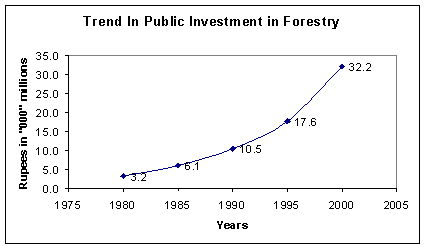
The following figure presents public investment in forestry activities. The investment represents the total of plan and non plan (revenue and capital) expenditure. The figure (32.2 billion rupees) for 1999 has been assumed for the year 2000.
Assessment
Increasing exponential trend in investment in forest resources is good for the country and indicate increase in commitment of the government to sustain forest resources in the country.
Revenue from forests an direct indicator of its economic function. More the revenue from the forest, the more is the economic contribution to or service of society by forests. It has a multiplier effect on the economic and social support system in a country.
Definition (There is no national standard definition)
Term |
Definition |
Revenue from Forests |
The gross inflow of cash, receivables or other consideration arising from the sale of goods, from the rendering of services, and from the use by others yielding interest, royalties and dividends. Revenue is measured by the charges made to users for goods supplied and services rendered to them and by the charges and rewards arising from the use of resources by them. |
Transformation Not needed
Data and Temporal Trend
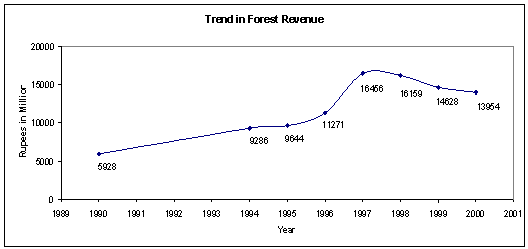
The revenue from forests indicate increasing trend till 1997 but shows declining trend since then.
Assessment
The recent declining trend in forest revenue suggests need of a detailed study to find reasons for this decline, if it indicates that this is due to allocation of more areas for protection or substitution of wood by some other products then this is a positive sign for sustainability otherwise it may not be the case.
The domestic and international trade of wood directly affects the demand and pressure on forest resources. It is very important to monitor this variable to monitor sustainability of forest resources.
Definition (There is no national standard definition)
Term |
Definition |
Trade |
Buying or selling of goods, services, securities or commodities |
Transformation Not Needed
Data and Temporal Variable
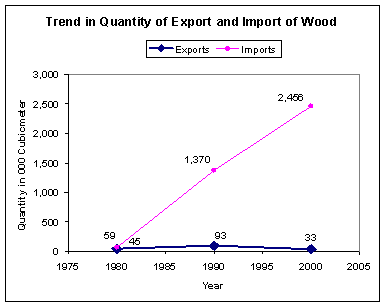
The total requirement timber has been estimated at 64 million cu.m in 1996, which will rise to 73 and 82 million cum in 2001 and 2006 respectively. Out of 64 million cu.m demand of timber, nearly twenty percent comes forests as recorded removal and the rest from trees outside forests and other sources. This large gap in unsatisfied requirement has led to unrecorded removals, increase in imports and decrease in exports. The following figure present this situation graphically.
Assessment
The situation is unsatisfactory, there is urgent need to increase productivity of forest and plantations (public and private) to address this situation.
The variable derives importance from the fact that many indigenous and local people depend on NWFP to meet their daily needs and to economic supplement through their trade.
Definition (There is no national standard definition)
Term |
Definition |
Trade |
Buying or selling of goods, services, securities or commodities |
NWFP |
Goods of biological origin, other than wood, as well as services, derived from forests and allied land uses.” |
Transformation Not needed
Data and Temporal Trend
Data on annual production is very weak and indicates very large variation that may be due to seasonal variation and due to missing information.
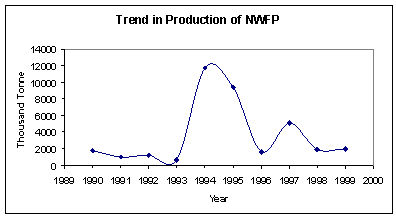
However, if outliers are excluded then it indicates an increasing trend.
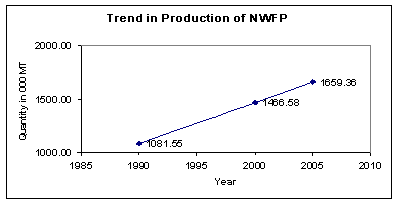
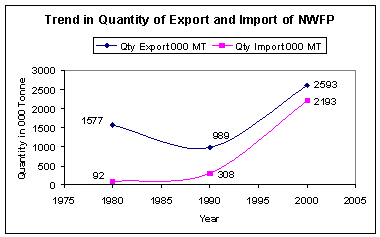
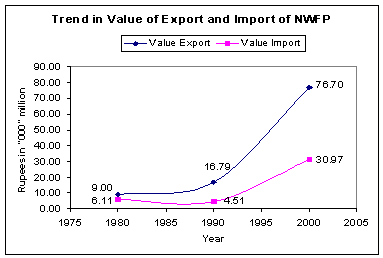
The quality of information on export and import of NWFP is better than on production. Following figures present trends in quantity and value of export and import of NWFP.
Assessment
The quantity, price and thus value of both imports and exports of NWFP has increased. The increase is more in exports than imports and is therefore a good sign. Benefit of such increase will be still more if these benefits trickle down to the local people. This is very important especially when a large section of people living near to forests derive economic support form these products and when India has a rich resource base of NWFP that includes 3,000 species of plants, 1800 medicinal plants, 250 essential oil yielding plants, 100 tans and dye yielding plants and 120 gums and resin yielding plants.
It is direct measure of contribution of forestry sector to national economy and can be used to estimate its multiplier effects on other sectors of economy. It provides one of the basis for allocation of resources in Indian national planning system and thus availability of for resources for forest development. Since it measures unduplicated value-added, the GDP is may be considered more useful to measure economic contribution than revenue or even employment.
Definition (There is no national standard definition)
Terms |
Definition |
Gross Domestic Product |
Gross domestic product (GDP), is the value of all goods and services produced in a year within national borders. |
Transformation Not Needed
Data and Temporal Trend
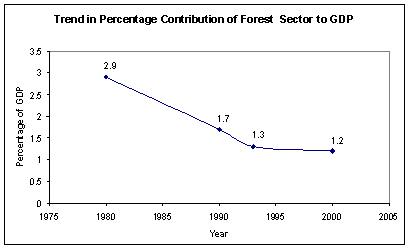
In India, the contribution of forestry sector in GDP includes value of “round wood” and “NWFP” but does not include contribution of forest-based industries which is included in the “manufacturing sector” and is difficult to isolate. The forestry contribution interestingly, includes additional 10% of the value of the recorded production to account for any unrecorded production. Similarly, for states of India, where data on production and price of “NWFP” is not available, it conservatively estimates the contribution of NWFP as ten times of the royalty amount received by the state.
Assessment
The declining trend demands detailed study of the estimates and to identify causes of decline and revise the estimates if necessary.
