


This section provides information first on the method and approach chosen to identify and assess the complementary national variables and then presents the data and its assessment.
The for identification and assessment of variables, India through FSI used the “Group Convergence Method” (Govil, 2002). Temporal trends were developed and GCM was used to assess the state and change in these variables with respect to sustainability of forest resources.
Following variables in addition to global variables (“Sites for Social Function”) have been identified as complementary national variables to explain the “Social Function” of Forests.
a. Use of Traditional Knowledge
b. Quality And Extent Of Privileges
c. Extent of Cultural/Sacred Forests
d. Energy From Wood Resources
e. Extent of Grazing (Cattle Population Dependent On Forest)
f. Number of Participatory Institutions & Area Under It
Additional Variable |
Source |
Use of Traditional Knowledge |
The Patents (2nd Amendment) Bill. 1999. Government of India, Ministry of Environment and Forests, Delhi |
The Biological Diversity Bill. 2000. Government of India, Ministry of Environment and Forests, Delhi | |
The Protection of Plant Varieties and Farmers' Rights Act. 2001. Government of India, Ministry of Environment and Forests, Delhi | |
World Intellectual Property Organization WIPO, 2002 | |
Extent of Cultural and Sacred Forests |
Induchoodan, N. C. 1996. Ecological Studies of Sacred Groves of Kerala. Ph. D. Thesis submitted to the Central University of Pondicherry. |
Ramakrishnan P. S. and Saxena K. G. and Chandrashekara U.M. 1998. Conserving the Sacred: For Biodiversity Management, UNESCO Vol., Oxford & IBH Publ, New Delhi. | |
Energy from Wood Resources |
National Forestry Action Programme. 1999. Government of India, Ministry of Environment and Forests, Delhi |
Extent of Grazing |
SFR, 1995. State of Forest Resources 1995. Forest Survey of India, Ministry of Environment and Forests, Government of India. |
Participatory Institutions |
Joint Forest Management: A Decade of Partnership, RUPFOR. 2002. Government of India, Ministry of Environment and Forests, New Delhi. |
This section provides information on each of the identified additional variables. It contains relevant definitions, source and source data, temporal trends and its assessment.
The local “Traditional knowledge” (TK) related with biological resource is an inseparable part of resource. India is making a determined effort to use TK for sustainable management of its forest resources and in addition to taking a major initiative of “Joint Forest Management” it has developed three laws in (the Protection of Plant Varieties and Farmers' Rights Act, 2001, the Biological Diversity Bill, 2000, and the Patents Bill, 1999) that also address protection and support to the traditional knowledge on biological resources. It is therefore necessary to monitor use of TK in enhancement of sustainability of forest resources.
Definition (There is no standard national definition)
Term |
Definition |
Traditional knowledge |
It is a multifaceted concept that encompasses several components. It refers to “tradition-based” literary, artistic or scientific works; performances; inventions; scientific discoveries; designs; marks, names and symbols; undisclosed information; and all other tradition-based innovations and creations resulting from intellectual activity in the industrial, scientific, literary or artistic fields. Explanation: 1. It is "traditional" only to the extent that its creation and use are part of the cultural traditions of communities. 2. "Traditional" does not necessarily mean that the knowledge is ancient. "Traditional" knowledge is being created every day, it is evolving as a response of individuals and communities to the challenges posed by their social environment. 3. The intellectual property, however, is not only about property. It is also about recognition of and respect for the contributions of identifiable, human creators. |
Tradition-based |
It refers to knowledge systems, creations, innovations and cultural expressions which: have generally been transmitted from generation to generation; are generally regarded as pertaining to a particular people or its territory; and are constantly evolving in response to a changing environment. |
Transformation Not necessary
Data and Temporal Trends
Data is not available for developing trend.
Assessment
It is political and contentious variable whose importance is steadily increasing. It has been recognised in India and world over which is a very positive sign.
This variable deals with the privilege (rights, concessions and free grants) given to local people with an social obligation to protect man maintain their sustainability. In many states of India, the forests are not unable to satisfy these privileges. For example, presently, out of about 445 million cattle, sheep and goats in the country about 270 million graze in the forest areas when the grazing capacity of these forests is about 30 millions cattle only.
Definition
Term |
Definition |
Privilege |
A right, advantage, or immunity granted to or enjoyed by a person or a class of people, beyond the usual rights or advantages of others. |
Transformation Not needed
Data and Temporal trend
Sufficient information is not available at national level to identify trends and to see the impact of rights and concessions on condition of forests.
Assessment
There is a general perception that quantity of rights and concessions exceed resiliency limits of forests at many places in India.\
The cultural and sacred forests are better protected than other forests due to social values attached to them. Their condition improves or decline with over their social values.
Definition Not standard national definition
Transformation Not needed
Data and Temporal Trend
The national data is weak but it indicates presence of such forests all over India with their area varying from less than one hectare to more than 5000 ha.
Assessment
The general impression supported with scattered studies in various parts of India indicate that there is a decline in the number and extent of the cultural and sacred forest. This indicates loss in social value of forests at the local and it is not a good sign for conservation of forests.
In India, fuelwood is the main source of household energy both in rural and urban areas and its share in per capita consumption is about 68.5 % and 45.5 % respectively, therefore, consumption of energy from wood resources is an important parameter to define the social functions performed by the forests.
Data and Temporal Trend
Most of the estimation on consumption of fuelwood are not compatible and thus containing ability to develop time series data.
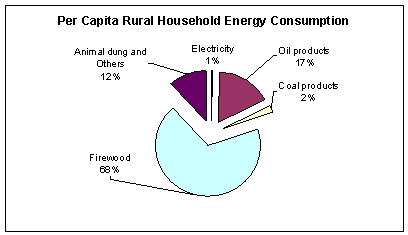
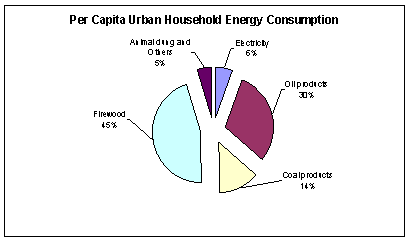
The total consumption of fuelwood far exceeds (about 3 times) the sustainable capacity of government forests (44 million tonnes) and private areas (35 million tones).
Assessment
There is no temporal data at the national level due to incompatible survey designs. Most of the time series estimation mimic annual increase of human population at the rate of 2.1%.
The “forests” in India meet about 30 percent of fodder requirements mostly through provision of grazing facilities in forests. This large extent of grazing, which is much more than the sustainable capacity of the forests, adversely affects forest and the conditions in which forest reside. The cattle, on the other hand, provide social and economic benefits and support mostly to the poor section of the society. The forest therefore serve a very important socials function by providing grazing facilities and its review is very important keeping in view its adverse impact on forests.
Definition (No standard national definition)
Transformation Not needed
A study at FSI (SFR, 1995) analysed the extent of grazing in the inventoried forest areas to assess the incidence of grazing in forests India. It indicates that 77.5 percent of the total forest areas are subject to various levels of grazing. Same areas have not been visited again to provide temporal information. However, temporal statistics indicates that number of cattle is increasing although slowly.
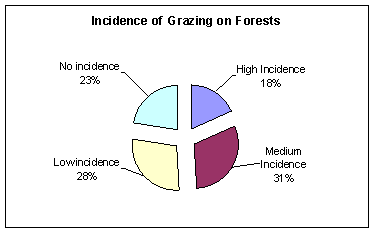
The increase trend of cattle population coupled with extensive are of forest vulnerable to grazing do not provide conditions that promote sustainability of forest resources.
Utility and efficiency of participation between the “state” (state government) and local institutions for promoting sustainable management of forest resources is now well recognized. Monitoring of number of participatory institutions and the extent of forest with them is a good indicator to monitor long-term sustainability of forest resources.
Definitions (Not standard national definition)
Term |
Definition |
Joint Forest Management |
It is a forest management strategy under which the government (represented by the Forest Department) and the village community enter into an agreement to jointly protect and manage forestlands adjoining villages and to share responsibilities and benefits. |
Transformation Not needed
Data and Temporal Trends
The government attaches great importance to this change (JFM) in management regime and directly monitors its progress. The following figures indicates past progress in this respect.
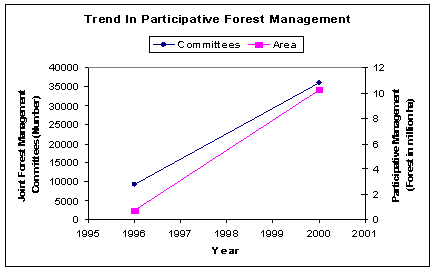
Assessment
The participative management of forests has increased at very fast rate during last decade and is a good sign for long term sustainability of forest resources.
