


par François Van Obregen
France
Je voudrais avant d'aborder “les critères de sélection d'un site de production” dire que le pessimisme dont j'ai fait part tout à l'heure est un peu de forme, parce que si j'étais véritablement pessimiste, je ne serais pas ici, je ne ferais pas de plans pour de nouvelles unités de production, je ne serais plus dans l'aquaculture. C'est un peu une question de philosophie et également d'expérience de ces dernières années où j'ai pu voir combien mes collègues et pas seulement en France ont et continueront déprouver des difficultés à s'entendre.
Une question de philosophie.
En partant du principe que ce que j'entreprends va fatalement échouer je fais ensuite tous les efforts nécessaires pour que ça n'échoue pas. Si jamais c'est un succès, je suis très content. Si e'est un échec, je l'avais prévu et je suis content aussi. J'essaie d'identifier toutes les difficultés pour mieux m'y attaquer et le problème que nous attaquons est, croyez-moi, compliqué.
Dernière parenthèse. Je voudrais attirer votre attention sur la plaquette qui vient d'être éditée par la CEE le mois dernier “L'agriculture européenne àl'horizon 1992”. Ce sont les minutes d'une réunion qui s'est tenue l'an dernier à Bruxelles. La DG 14 de la Commission avait invité les producteurs de tous les pays, les représentants des administrations, les scientifiques, etc. environ 4 à 500 personnes. Des vérités ont été dites dont la Communauté a parfaitement tenu compte. Le MEDRAP n'est pas vraiment dans la Communauté, mais nous savons tous que nous dépendons aussi de la politique européenne. Donc je vous en conseille la lecture. Et j'attaque maintenant le sujet.
Lorsque l'on parle de critères de sélection d'un site, la première question à se poser est:
critères pour qui? Effectivement, si je suis une grande holding internationale, ou si je suis un restaurant
à côté d'une lagune, ou un pêcheur avec sa petite barque, l'aquaculture, je ne vais pas l'aborder de
la même manière. Lorsque je suis Seafarm ou l'Ona, ou telle société importante, je vais l'aborder
encore d'une autre manière.
Lorsque je m'appelle Préfécture de Région Nord Pas de Calais, dans le Nord de la France, et que j'ai de
l'argent à dépenser en aquaculture, les critères de sélection d'un site, ne vont pas me permettre d'aller
m'installer en Grèce ni même en Aquitaine, ni sur la Côte d'Azur. Je vais être réduit à ma seule région
L'orsque je m'appelle FAO ou MEDRAP, mes buts vont être encore différents pour déterminer les
critères de choix de sites, il est vraisemblable que le meilleur site de production se trouve être à
Monaco, je n'irai pas m'installer à Monaco. Par conséquent, et on y reviendra tout à l'heure, il est certain
que le pêcheur qui comme il le fait en Norvège, en Islande, comme il peut le faire au Canada,
rentre de sa pêche en ayant pêché avec certaines précautions, des poissons immatures ne va pas
choisir son site, le site est à côté de sa maison, il va mettre les poissons dedans en attendant qu'ils
grossissent et il fera de l'argent avec. Lorsque j'ai un restaurant et qu'il s'agit de vendre à mes clients,
comme ce restaurant du côté de Casa et qui va sans doute le faire, il est intéressant de pouvoir sortir
le poisson directement de l'eau devant le client d'où une valeur ajoutée de fraîcheur incontestable
Alors, vous voyez que les critères de sélection auront une importance relative dépendant déjà de
“pour qui” on va choisir le site.
Venons en à des critères généraux; deux critères rédhibitoires l'eau et la sécurité. Je l'ai dit hier et je le répéte “le poisson vit dans l'eau”. Il lui faut de l'eau et pas un égout Il lui faut de l'eau en quantité importante et de manière constante, j'ai dit également que l'aquaculture est “une science économique” et quand nous allons choisir notre site, c'est avec le but de produire de la qualité à un prix compétitif pour vendre avec un bénéfice de manière pérenne.
Le premier critère, c'est la température de l'eau, la qualité et la quantité d'eau dont on peut disposer, ça ce sont les tout premiers critères. Avoir des températures létales une seule fois dans l'année, un seul jour dans l'année n'est grave, votre poisson ne mourra qu'une fois dans l'année. C'est dommage quand même parce que le lendemain, il ne va pas continuer à grossir. Les températures varient d'après les espèces qu'on va retenir. Important au moment de la décision peut-être cette température va être favorable au bar, au loup et à la daurade, et puis il y a l'espèce qui vient derrière, il faut toujours y penser, qui elle ne sera peut-être pas dans ces mêmes températures, dans cette même fourchette de températures et pourtant on sait qu'elle vient et que si le marché de la première espèce risque de baisser, il faut que ces températures soient aussi des températures où l'on puisse élever l'espèce que l'on sait déjà avoir de bonnes chances venir, et on a de bonnes idées là-dessus, la recherche nous les indique.
Le deuxième critère rédhibitoire, c'est la sécurité C'est un critère absolu. Premièrement, il est bien certain que si l'on est dans une région troublée, instable, on va difficilement y investir et on va difficilement y trouver des investisseurs surtout étrangers. On y trouvera plus facilement des locaux qui iront investir ailleurs où c'est sùr, s'ils ont de l'argent et s'ils sont intéressés par l'aquaculture, ça s'est vu.
Cela ne s'adresse pas à région particulière du MEDRAP, ça peut également s'adresser à la Corse d'où je viens, où techniquement c'est convenable, il y a des investisseurs intéressés mais qui, de préférance investissent ailleurs. La situation de l'Algérie fait qu'il y a sans doute assez peu d'investissements maintenant, etc.
Deuxièment, il y a la concurrence d'espace. Elle est due à un nombre de critères, un nombre de données, premièrement le corporatisme des pêcheurs. Il faut en tenir compte, souvent les pêcheurs pensent qu'on est en train de manger leur pain et font tout pour qu'effectivement on ne puisse pas travailler convenablement dans une région. Il y a le corporatisme des aquaculteurs installés qui parfois ne voient pas d'un bon oeil qu'une autre exploitation vienne s'installer D y a des situations de monopole qui dans certaines régions se sont créees. Ce sont des conditions défavorables.
Il y a des écologistes (je mets ce terme entre guillemets), les verts et les verts de gris. Les verts on peut les comprendre et on peut discuter avec eux. Nous avons tout intérêt à préserver l'écologie. Et nous ne survivrons et ne vendrons nos poissons qu'en ayant bien compris que l'écologie est et sera de plus en plus un argument de vente majeur, qu'il faut élever ses poissons dans de bonnes conditions, sans antibiotiques, sans staphilocoques dorés ou platinés, passons aux “verts de gris”.
Toujours dans ce chapitre de la concurrence d'espaces, les spéculateurs immobiliers. Il est évident que dans un certain nombre de régions, le tourisme ne va pas voir d'un bon oeil s'installer une aquaculture. Il y a eu un problème à Chypre l'an dernier où on a pu voir que dans pollution qui s'est déclarée dans une baie, la responsabilité de l'établissement Aquacole après des études faites par des universités étrangères était de l'ordre de 0,3% et que 99,7% de la pollution venait de hôtels et de l'agriculture, la solution dès était simple, on a demandé à l'aquaculteur responsable de 0.3% de la pollution de fermer. Heureusement, avec l'aide de la Direction Aquaculture du Minsitète des Pêches et de l'Agriculture, Mme Daphnée Stephanou ici présente, notre amie… a survécu. Dans un prochain exposé demain je dois vous parler de la coopération et des organisations de producteurs, Juste une parenthèse la lettre, que j'ai lait parvenir au Ministère concerné, en tant que représentant des aquaculteurs français, à Chypre, a paraît-il pu y aider, tout comme les articles publiés dans Aquarevue et celui de John Joyce, président de EAS dans Fish Farming.
En France, un armateur à pêche performant et dynamique, Adrien, a fait l'effort de croire et d'investir dans l'aquaculture du turbot sur la Côte Atlantique. Il a eu les pires difficultés et les a toujours. A cette occasion le mot “turboterie” très voisin de “porcherie” a été inventé. Il est clair qu'il allait “saloper” non seulement le voisinage mais tout l'océan d'où les poissons disparaîtraient. Un peu de sérieux s'il vous plaît. Sans doute ceci n'est-il basé que sur des considérations sentimentales, irrationnelles mais il faut aussi compter avec l'irrationnel surtout quand l'écologie est devenue un fromage politique. Dès lors les rats sont nombreux.
Il y a les vols, Dans certaines régions ils sont importants et l'on s'aperçoit que même sans mortalité,
les poissons disparaissent, mais on les retrouve au marché. Prédation de bipèdes. Plus habituelle que
celle des oiseaux dont on peut généralement mieux se protéger. La Sardaigne, autrement est une très
bonne région, j'y ai moi-même localisé des sites fort intéressants s'il n'y avait eu risque de vol. A 4
au 5 km à l'ouest de Cagliani, le fermier mitoyen d'une terre que je prospectais a eu la surprise de
s'être fait volé un ha d'artichauts dans la nuit
Toujours dans les critères de sécurité, l'insuffisance grave d'infrastructures générales. Aller s'installer
quelque part où il n'ya pas de route convenable pour arriver au site, où l'électricité est absente
ou ne fonctionne que de temps à autre avec de nombreuses coupures, ce qui fait que vous aurez de
la glace ou vous l'obtiendrez par un générateur plus un ou deux en stand-by, ce ne sont pas de bonnes
conditions. Si l'on est informatisé, des sautes de courant de 170 à 240 V comme j'en ai connu le cas,
sont autant d'insuffisances d'infrastructures graves qui auront des conséquences sur votre sécurité.
Vrai pour le téléphone et le fax.
Je citerai également le contenu des mots : Nous voulons produire de la qualité. La qualité est un
mot Que veut dire qualité? Une qualité suffisante pour le chef de l'exploitation peut ne pas être la
qualité suffisante pour le marché, Il est très difficile dans un pays où pour certains la norme qualitative
n'est pas élevée de produire une qualité plus éle véc. Je ne parle pas là seulement de pays sous-développés.
Le mot “immédiatement” dans certains pays veut dire “sans délai”, dans d'autres il ne
figure pas au dictionnaire.
Un poisson est trais, comment est if frais? est bien emballé, est-il vraiment bien emballe? Est-il
tué à la glace, à l'électricité, l'a-t-on laissé assez longtemps dans la glace? L'a-t-on rincé avant de
l'emballer et ceux qui le manipulent ont-ils les ongles propres ou en deuil? Tout cela n'est pas facile
à corriger s'il y a une insuffisance dans l'infrastructure d'éducation.
Il y a également l'insuffisance grave dans l'assistance vétérinaire. Il faut pouvoir identifier rapidement
une maladie pour pouvoir la traiter et la soigner. Si l'on n'a pas ces facilités toutes proches, on
peut toujours importer les spécialistes mais ce n'est pas suffisant car il faut également qu'il ait le support
local, si le support local n'existe pas on a des problèmes. Enfin, il y a l'impossibilité ou l'insuffisance
d'assurance du cheptel. Dans certains pays, on aura beaucoup de difficultés à assurer le cheptel
dans d'autres non. Or, on a vu que par prévention beaucoup plus que des moyens curatifs, on
peut arriver à éliminer un nombre considérable de risques. Aujourd'hui, presque tous, j'allais dire
95%, mais ces 5% sont suffisants pour faire disparaître l'entreprise. Par conséquent même dans les
sociétés les plus performantes, ce risque-la il faut le couvrir, si l'on n'a pas accès à une assurance
convenable, aller s'établir dans un site est extrêmement dangereux
Je passe aux critères d'environnement physique.
J'ai cité tout à l'heure que tout danger de températures létales doit être exclu. Mais il faut regarder ça
sur une période de 20 ou 30 ans. le me souviens qu'en décembre 1984 lorsque je suis rentré “en aquaculture”
sur l'lie de Ré, on m'a dit qu'il n'y avait jamais de grands gels et que les températures les
plus basses allaient être de l'ordre de 3 ou 4° dans les marais. C'est vrai. Sauf une fois tous les 30
ans ça s'est passé un mois plus tard. Tous les poissons sont morts. Statistiquement, j'étais tranquille
pour 30 ans. L'ennui, c'est que l'an d'après on a remis ça le cheptel est mort de nouveau.
Statistiquement, j'étais tranquille pour 60 ans. Il faut quand même faire très attention à ces accidents
naturels qui statistiquement sont peut importants, mais qui s'ils se produisent deux fois suite peuvent
tuer une entreprise. Il y avait donc intérêr à aller s'installer en Corse, ce que j'ai fait. Les températures
mensuelles doivent y permettre un bon taux de croissance.
Allons un peu plus loin. Dans le Nord de la Méditerranée, il n'y a pratiquement pas de croissance
hivernale. Vous avez une croissance au printemps, l'été est magnifique, l'automne est merveilleux, et
ensuite, Décembre, janvier, Février, souvent Avril, il n'y a pas de croissance ou pratiquement
pas. Par conséquent, vous perdrez 4 è 5 mois. En Méditerranéc du Sud, généralement, il continue à
y avoir une croissance l'hiver même si elle n'est pas maximale mais il y a une croissance. Critère
dont il faut tenir compte, ça joue dans les prix de revient donc sur la compétitive. Pour les sites en
mer, il faut également compter la hauteur des vagues.
Bien sûr on peut s'installer avec des vagues de 8 ou 9 mètres, ça ne pose aujourd'hui aucun problème
avec des cages Bridgstone ou Dunlop. Elever du loup et de daurade dans des cages de 5000
m3 dans des vagues de 9 mètres, il faut bien calculer combien ça coûte et il faut bien savoir si l'on
va pouvoir livrer les clients. On produit du poisson, mais accessoirement, il est bon de le vendre et
notamment de le vendre le jour où le client est là. Il semble préférable de s'installer dans des endroits
où l'on a accès de manière continue aux poissons. Si l'on devait aller dans des endroits en mer où
pendont quelques jours de l'année on n'a pas accès aux poissons parce qu'il y a trop de vagues, pourquoi
pas, mais à condition d'être associé à un autre aquaculteur qui par exemple élève en marais ou
en bassins et qui peur livrer à votre place. Donc pas rédhibitoire, mais il faut savoir qu'il y a des
conséquences lorsqu'on établit un site qui n'est dans un endroit en permanence accessible.
Autre critère, la quantité d'eau disponible. L'exemple des lagunes. Beaucoup ont la fâcheuse habitude d'ëtre mobiles au grau. Il y a du sable qui vient le fermer, puis il s'ouvre, puis il se referme et il faut l'entretenir. Donc ce n'est pas parce qu'il y a une grande lagune que tout va bien, il faut aussi savoir comment fonctionne le système d'ouverture et de fermeture de cette lagune et si on peut l'améliorer, la lagune étant l'endroit idéal pour faire de l'aquaculture si on a une bonne communication avec la mer. Si la lagune est fermée ou insuffisamment irriguée les accidents peuvent être mortels pas seulement pour le poisson mais aussi pour l'entreprise. Tout ça rentre dans les coûts. C'est facile d'ouvrir un grou, il est facile de faire des digues, mais cela coùt un certain prix qu'il faut intégrer au prix de revient, l'en ai terminé pour les conditions physiques et je passe au troisième point:
la proximité des marchés
On est là pour vendre, pas pour produire. Il faut produire pour vendre mais in fine c'est lorsqu'on a l'argent dans la poche, qu'on a terminé son boulot. Pas avant. Donc tout commence et finit par le marché.
Si on est loin des marchés electifs, des marchés qu'on choisi, on peut choisir de tout vendre sur
l'Italie, mais seuls les esprits un peu fragiles peuvent encore penser ne vendre qu'á l'Itslir. Il y a
moyen de vendre ailleurs, il y a moyens de vendre dans son propre pays.
A 15 km, à 20 km de chez soi, il y a sans doute des restaurants qu'il suffit d'aller voir, qu'il suffit
d'approvisionner à qui il faut peut-être payer une machine qui lui permette de conserver le poisson
à 2° ou 4° il faut peut-être payer l'aquarium pour montrer les poissons. Il y a du marketing à faire
et c'est l'affaire des producteurs, pas du grossiste, de telle manière à ce que l'on ait un marché électif
autre que celui de l'Italie, et peut-être ce marché est-il local et beaucoup plus stable. Là vous allez
vraiment pouvoir produire et vendre des produits frais là vous allez pouvoir surveiller votre marché,
au niveau même des consommateurs. Cest votre affaire ce n'est pas celle des grossistes. Toute chose
que vous ne pouvez pas faire en Italie.
Ainsi le choix du marché électif est-il un critère des plus importants pour déterminer le site de production. Si vous êtes installé en Mauritanie pour fournir la Norvège, ce n'est peut-être pas bon. Si vous vous trouvez ici pour fournir l'Espagne, c'est nettement meilleur. Il faut donc tenir compte des coúte d'approche des marchés électifs et contróler l'existence on non d'un marché local. Ce marché local va vous apprendre beaucoup que vous exploiterez ensuite lors de l'attaque d'un marché étranger, c'est un observatoire et une école de première classe.
En point quatre, je parlerai de la disponibilité et du coût de la main-d'oeuvre. Vous verrez que je
l'ai placé très loin parmi 8 critères de sélection, parce que c'est souvent un attrape nigaud. Nous
savons que les grandes fermes optent le plus souvent pour l'automatisation des opérations pour des
raisons de prix de revient, mais aussi pour des raisons de gestion et de sécurité. Notre ami anglais
nous a montré tout ce qu'on pouvait obtenir par l'informatique des paramètres dont il fallait tenir
compte pour mieux tenir sa ferme. Possible que si vous être équipé en informatique, que si vos cages
sont équipées pour des contrôles automatiques de l'air, de l'oxygène, de l'ammoniaque éventuellement,
de la salinité, etc. Tout ça ce n'est pas du manuel, ce n'est pas pour des manoeuvres à 600 F
par mois, vous êtes forcé d'avoir du personnel de qualité qui est capable de faire fonctionner ces
systèmes.
L'autre option, c'est-à-dire un personnel extrêmement bon marché requiert un encadrement intermédiaire
lourd et un management adaptés, mais il faut faire le bilan avant. C'est une chose d vouloir
créer de nombreux emplois, c'est une autre de rester compétitif. Or ces emplois ne seront pas permanents
si votre société ne reste pas compétitive. Il faut bien le savoir et en peser les conséquences
Il y a également la disponibilité de la main-d'oeuvre, la disponibilité de main-d'oeuvre qualifiée, Pas de qualification sans éducation. L'apprentissage à l'école, on peut le faire ici ou là en France, en Italie, en Espagne ou ailleurs mais ensuite il faut avoir assez longuement pratiqué sur le terrain dans un système performant pour être compétent dans son métier tout ne s'apprend pas à l'école. loin de là. La disponibilité d'une main-d'oeuvre qualifiée est un des critères clé.
Autres critères et un peu en vrac faute de temps.
D'abord, la facilité ou la difficulté de dialogue avec les administrations. Ce n'est pas rien, c'est
méme un critère clè, Dans certains pays, on va perdre un perdre un temps considérable surtout si on est étranger
à essayer de comprendre les mécanismes de l'administration, les mécanismes de l'administration, les mécanismes de pensée des
administrateurs et comme entretemps on ne comprendra pas de quoi l'on parle on risque de se tromper.
Il est donc indispensable d'avoir un manager local, un partenaire local qui ne soit pas là simplement
pour signer, mais qui véritablement soit un homme d'action á l'intérieur de l'entreprise pour
pouvoir dialoguer avec les administrations locale.
Il est souhaitable enfin, de démarrer l'exploitation avec une proportion de fonds propres locaux suffisants
réellement versés, afin de s'assurer le concours volontariste et non passif de partenaires. Des
opérations qui seraient basées sur une participation au capital de partenaires locaux par apport en
nature et la nature de l'apport étant, par exemple, la propriété d'une concession sur le domaine public
ont peu de chance de succès.
Certains pensent qu'avec une concession et de bonnes introductions locales éventuellement en mettant 50000 F, ils démarreront une entreprise de plusieurs millions très profitable, où ils seront majoritaire au capital et plus encore dans la distribution des profits, laissant à d'autres le soin de risquer et de financer, et en espérant de surcroît que cela resteront leurs obligés. En quelque sorte une faveur Dans ces conditions, quelle que soit la qualité du site oubliez-le.
Cette liste de critères n'est pas exhaustive. C'est avant tout en ouvrant les yeux, en réfléchissant à chacun des postes du bilan et du compte d'exploitation, en étant passé par l'excercice d'optimisation de plusieurs budgets prévisionnels concernant des sites différents que vous pourrez arriver à un choix aussi judicieux que possible. Des experts évidemment peuvent vous y aider mais il faut se rappeler que les conseilleurs ne sont pas les payeurs, et que le savoir théorique ne remplace pas le savoir faire, Aussi, le meilleur partenaire dans le choix d'un site est-il, sans doute, celui qui, par ailleurs, a déjà prouvé qu'il peut mener une entreprise aquacole à la profitabilité et qui est prêt à investir et à s'investir avec vous sur ce site.
Ceci n'exclut pas, bien au contraire, d'avoir recours aux experts des administrations, aux spécialistes des banques et autres établissements scientifiques.
Il y a les difficultés d'intégration du pays. Comment s'intégrer, non pas seulement quand on est étranger, mais quand on attaque une branche nouvelle comme l'aquaculture.
Il y a la disponibilité et le prix des espaces. Je suis intervenu la semaine dernière en France auprès du Ministre de la Mer pour l'un de nos amis, qui élève des crevettes du côté de Montpellier. Il a 70 ha sur le Domaine public maritime, et l'Etat lui demande soit 5574 F par an de location par ha. Or un terrain mitoyen de 30 ha s'est vendu, il y a 4 ans pour 400.000 F, Ceci veut dire que l'Etat demande un loyer 5 ou 6 fois supérieur à ce qu'il coùterait pour l'acheter.
Même sans frais de location la rentabilité d'une exploitation de crevettes en France n'est encore qu'un
objectif, pas une réalité.
De plus, chacun sait qu'il faut énormément d'espace pour élever des crevettes et qu'enfin cet élevage
sur des surfaces suffisantes peut être le complément indispensable d'une exploitation piscicole en
bassin et recyclage. Technique particulièrement recommandée pour la conservation sans frais du
paysage. Ce qui est un objectif prioritaire des Etats … Comprenne qui peut.
Parlons un peu du financement. En je citerai d'abord, Alain Parres, délégué général de l'Union des
Armateurs à la Pâche de l'rance, lors du forum organisé à Paris le 26 septembre 1991 par le Crédit
Coopératif: " Il est indispensable que conscience soit prise des réalités financières de l'aquaculture
où d'importants capitaux sont généralement à risquer, et, parfois, à perdre, L a reconversion du marin-pêcheur
dans l'Aquaculture (sauf au niveau d'un salarié de niveau modeste) relève du rêve ou de l'escroquerie
intellectuelle. Les disponibilités financières nécessaires - même renforcées par des aides
communautaires et nationales justifiées et qui devraient croître ne sont pas à la mesure du dirigeant
de PME (“petit” armateur, ou, capitaine ou patron de navire).
Les choix de l'Aquaculture et donc son large soutien financier doivent s'inscrire dans le haut de la
chaîne alimentaire, là où les espèces ont une forte valeur directe sur le marché ou sont valorisables
(…). Les soutiens financiers doivent viser les potentialités, pas les fantasmes…"
Aujourd'hui, et sauf de très rares exceptions et alors sans doute seulement pour un temps limité, de petites opérations artisanales ont en effet peu de chance de survie Le profit ne résultera plus d'une forte marge sur de petites quantités, mais d'une petite marge sur de grosses quantités. D'où des moyens financiers très importants.
Les aides et les subventions ne sont qu'un de moyens de financement, mais avant tout, c'est à l'entreprise elle-même d'apporter les fonds propres suffisants aux études préalables aux investissements de production et de commercialisation et pour assumer son fonds de roulement. Les subventions doivent être considérées comme des aides complèmentaires pour faciliter un démarrage ou un développement, pour compenser des difficultés particulières, et sont donc parfaitement légitimes. Tout baser sur les subventions, qui d'ailleurs sur un plan plus général comportent des effets pervers non négligeables, serait une grave erreur de gestion Néanmoins, l'accès des subventions, à des prêts bonifiés, à des prêts participatifs entre dans les critères de sélection.
Les emprunts. Les établissements financiers peuvent, tant sur les investissements, que sur le fonds de roulement, avancer de l'argent aux entreprises souvent pour ce qui concerne notre activité avec des garanties réduites et même dans certains pays et, dans certains cas, sans garantie. Ce sont des facilités qu'il faut examiner avec soin et comparer d'un endroit à un autre, d'un pays à l'autre, s'il y a des sites autrement comparables. Dans certains pays, les crédits peuvent être très ressérés, peu disponibles, très chers, ce qui sont des conditions peu favorables.
Dr. James F MUIR,
Scotland
1 INTRODUCTION
It is necessary in many circumstances to evaluate projects, or parts of them, to determine whether they are cost-effective, and whether changes need to be made to make them acceptable. Cost assessments are commonly used for;
- analysis; prior to establishing a project, in considering potential costs and returns; or in e.g. evaluating technical choice, scale, management aims
- forecasting, the consequences of particular policy, investment, or management decision;
- monitoring; the performance of businesses while they are in operation; defining e.g. pricing policy, considering management decisions;
The typical range of costing and assessment measures would include:
- Basic assessment of project approaches
- Evaluating alternative project approaches
- Carrying out ‘cost studies’ of specific components of a given project.
- Defining the rate of build-up of the project
- Describing ‘cash flow’ characteristics of the project.
- Defining the risks - technical and other, and balancing these risks with returns available.
- Defining the funds/financing required for the project
- Identifying tax liabilities, grants available, subsidies, etc, examining the implications for the project type, scale, etc.
- Looking at typical ‘what if’ question - such as defining ‘break-even’ prices, looking at consequence of stock losses, inflation of input resource prices, etc.
- Looking at specific additional investment to existing projects.
Some of the more commonly used definitions, methods and approaches are described in the following sections. These are generally from the fields of project studies, management accounting and business studies, and concern commercial business based decisions, though related concepts are used in more classical economic analysis. A wide range is available, and their cost, accuracy and usefulness varies equally widely. It is imported to know what is the purpose of any particular costing exercise, and what level of accuracy is required, and what level of risk is involved in imperfect knowledge.
We are rarely fortunate enough to be able to describe an exact physical entity or specific management method; in many circumstances, and particularly in project planning, we must deal with broad ideas and characteristics, and must piece together a reasonably good picture of what we expect to be developed, and how it might operate; in other words, we use models and simulations; we estimate the inputs, and the resulting performance of the project. Some fundamental considerations;
- Models are only as good as the quality of information used in them;
- They are usually base on assumptions; the relative importance of these assumptions needs to be assessed (this is frequently the basis of sensitivity analyses - see later);
- The internal structure of models should be effective; they need not replicate real life with complete exactitude, but should behave similarly in terms of inputs, processes and outputs;
- More information usually costs more; it is important to establish the balance between the information needed, the risks of inadequate information, and the costs, of perfection;
In practice, in many projects, a process is used of broad screening 'back of the envelope calculation in the initial stages; to define projects and commercial activities, moving successively to more careful analysis, finally reaching the stage of fully quoted, detailed description. Much of this work is no based on spreadsheets; computer software such as LOTUS 1–2–3, Supercale 5, Quattro, etc which are particularly useful for a range of financial and economic appraisals. These provide a matrix or tabular layout on which financial data can be entered, manipulated - e.g. by inserting formulae relating one value to others, such as sums of columns of figures, interest rate calculations, automatic discounting and NPV calculation. Once the structure of a particular spreadsheet is set, its formulae defined, etc. the individual values can be changed and the results of the changes automatically and quickly displayed by the system. Thus it is possible in examine quite quickly various project assumptions, changes in interest rate, changes in input costs, sales prices, etc, to consider the alternatives available.
2 Basic methods; capital and operating costs
The capital costs describe those cost required for established the system, constructing the project, purchasing the equipment, etc. They may, but bot always, include the initial developers costs, the ‘pre-establishment costs’. The capital costs usually occur during the initial phase of the project, but may be spread over some years. It is important therefore to specify the likely timing of capital costs, as these will in turn define the basic financing requirements. This is clearly an area where the design/cost relationship is very important.
These costs generally correspond to fixed physical items and material, and are normally accredited a specific life span. A further definition is that of fixed and variable capital costs. The former include those costs which are incurred regardless of the scale of the project, the latter are those which vary directly with the size of the operation. It is also possible to define semi-variable capital costs, which vary with the project size, but not proportionately.
These concepts are useful for defining the potential for economies of scale; the extent to which the
cost per capacity (e.g. $000 capital cost per tonne of stock held) decreases as the size of the project
increases.
Related to this is the marginal capital cost of additional output, defining the efficiency of expanding
production. This is affected basically by whether it is necessary to increase capacity by a discrete
amount, or whether additional production can be accommodated within existing capacity.
As well as the initial cost, some estimate is usually made for the replacement of capital equipment, either;
- by defining replacement costs, in which some or all of the capital material is replaced at specified intervals, or;
- by using depreciation, the reduction in value of the capital items overtime, usually related either to the project life span or the duration of the particular materials, etc.
Where materials are expected to last longer than the defined project life span, a residual value is
usually specified, i.e. the net value the materials would be expected to realise if sold off at the end
of the project.
Depreciation is commonly calculated either as;
- an average amount representing the difference between the initial cost and the residual value, divided by the life span of the project or component (the ‘straight-line’ method);
- a varying amount, usually a specified percentage of the difference between start of year value and residual value, the start of year value reduces yearly by the depreciation amount (the declining-balance method)- this gives high initial depreciation, generally tailing off;
- an amount defined by the prevailing taxation laws; depreciation at a specified percentage of capital investment can often be allowed against income: it is thus often in the interests of the enterprise to maximise the depreciation figure during major profit periods.
Operating costs are defined as those relating to the output of product from the project; As well as raw materials, labour, etc. operating costs may also of maintenance, leases, rents, depreciation, interest and other capital charges. A distinction is sometimes made between basic ‘costs of production’ i.e. those directly linked with producing the output, and the additional ‘servicing costs’ or capital and other charges. This concept is linked to some extent with that of fixed, variable and semi-variable operating costs, defined as for capital costs
Another related concept is the marginal cost of increased production in specific existing projects; usually a mix of variable and semi-variable costs, useful in defining the potential profitability of additional output, when related to the marginal, or additional income generated.
The estimation of basic capital and operating costs, and the identification of their respective fixed, variable, and semi-variable components are useful initial stages in identifying the cost characteristics of a project, and is valuable in defining the fundamental feasibility of the project.
However, it is limited in many respects. It shows a single ‘picture’ of the project; the total costs of its construction, or the total costs of a specified component, the operating costs and crude profit levels at a specified level of output (usually the planned larger level). It does not however identify such factors as the rate of build-up of the project, its operating costs and profitability during build-up towards target production, the means by which the project is to be financed, the effects of taxation, etc, all of which may have a significant effect on the actual viability of the project.
The difference between such ‘steady-state’ descriptions, and the more accurate assessments such as cash-flow analyses, discounted methods, etc, which do take into account some of the above factors, will be discussed later.
3. Capital cost/scaling models
Unless capital and operating costs can be specified directly - e.g. from fixed manufacturers or contractors quotations, from equipment, and supply quotes, published tariffs, rates, etc, it will be necessary to estimate them in some way. In practice it is usually possible to obtain some figures with precision, others as approximations. As discussed earlier, the importance of accuracy in such estimates depends to some extent on stage of project development; while it is always advisable to be as accurate as possible in the circumstances, this is not so important in the initial, cruder, ‘outline’ assessments of project feasibility, but becomes more important once detailed financing, risk assessment, etc. is being carried out.
For the purpose of cost assessment, cost models - means of estimating cost projects or equipment, based on characteristics such as size, type, specification, etc, are a useful tool, and may be used in a range of applications. Cost models can be very simple - a knowledge of the cost of a similar type of project elsewhere, for example - or may be quite sophisticated - e.g. certain engineering cost models withe several cost indices. The more the precise the cost required, the more detailed will have to be the specification - in the initial stages, general or outline cost approaches are most effective, and are usually adequate to identify the most critical areas, and the most effective means of developing a project. There are basically two categories of cost model:
Project cost models - which cover whole projects, or significant parts of projects - e.g. a hatchery, a pump-station, a raft of cages. These are useful for outline costs, but as actual specifications tend to vary from site to site, they may be less accurate.
Component cost models- Which relate to specific components-e.g. aerators, pumps, tanks, pipes, etc. These are usually more precise, but of course have to be added together to provide estimates for a complete project.
In both cases, the concept is similar the cost of the proposed project or component is related to that of an existing project or component, using factors covering size, specification or quality, date/inflation rate, and other relevant points. To be able to use and develop cost models (if none are readily available) The following basic information should be collected:
- the actual cost of existing projects or equipment (specify currency and whether inclusive of delivery, taxes, etc) at the time of purchase or construction;
- the time of purpose of construction;
- quality information, such as specification; size, type, materials, etc.
- importance of sub-components, e.g. what percentage cost is attributable to specific items or operations, e.g. installation, connecting to power supplies, spare parts for 1 year, etc.
- special factors, such as difficulty of construction, special requirements, availability of discounts, subsidies etc.
The cost models can then be developed from the primary data sheet, using the following methods;
- bring cost together on common basis, normally converted to the currency of the present project, and adjusted using appropriate inflation and other indexes to current prices;
- use size as the primary criterion; Try to estimate the fundamental relationship between cost and size, using e.g. log-log paper, curve-fitting techniques, etc;
- the basic relationship is usually of the nature:

where C and P are respectively the costs and size of units 1 and 2, and n is a scale factor, normally less than 1.
- an alternative and usually more precise format is:
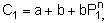
where C and P are cost and size, a and b are constants, and n is a scale factor, normally less than 1. This can also be derived from various graphical techniques; also
- check whether specifications or quality have a definable effect on the cost relationship, and incorporate this if possible into specific factors such as the a and b constants of the above formula.
- check also whether sub-components can be identified, and costs estimated as approximate percentage of total cost.
In practice, it may be difficult to use cost models in aquaculture with great accuracy, because of the
great variability from project to project, and from one component's specifications to another. As sites
are different, and as a ‘learning curve’ effect may occur (i.e. new projects may be better designed and
more efficient than older ones), past cost records and cost models based on them may be useful only
for preliminary estimates.
However, there are some cost models which are reasonably standardised within the plant engineering
and construction sector, covering items such as pumps, compressors, buildings, offices, cold
stores.
4 Simple cost assessments
The primary way in which projects or subprojects can be assessed is to be use the various static or ‘steady-state’ analysis, based on a ‘single picture’ description of the project, usually once it has reached its intended target. These methods would include (see earlier section):
- capital and operating costs, as described earlier, and their analysis to define, e.g. the items contributing greater or lesser amounts to these;
basic definitions of project build-up; i.e. when it is expected to reach target production. This factor is particularly important for aquaculture projects because of their relatively long start-up phase; techniques have to be established, stock has to grow, methods have to refined, etc; this will define approximately the point at which the expected project performance will be achieved, and the period over which the main investment inputs are required.
- ‘sensitivity analysis’ to define the effects on capital or operating cost, or profit, of changes in the main input capital or operating cost components;
- analysis of fixed and variable costs to define the probable economies of scale;
definition of basic ‘break-even’ sales price at specified production levels to define the project's longer-term strength, and profitability for example in more competitive future markets;
profit and loss accounts; formal presentations - depending one the particular accounting methods preferred - of the project's overall investment requirement, and its profitability both before and after capital charges;
- simple rate of return (SRR); normally defined as (before or after tax profit)/(total capital cost); this is related to e.g. current interest rates, company guidelines for investment, etc; the higher the risk considered for the project, the higher this value is normally required to be. For aquaculture projects an SRR of 25–50% may often be required;
payback period (PB); the inverse of the above, i.e. (total capital cost)/(profit), gives an indication of how long taken before the investment is paid back out of the project's profits; again a higher risk project would be expected to perform better, i.e. pay back more quickly. An aquaculture project may be required to pay back within four or five years. Note that in practical terms, this time must be added to the estimated ‘start-up’ times. This concept can also be useful if it felt that uncertainties-market, technical, political factors, etc may lie ahead, and that project must ‘clear itself’ before this time;
5 Production planning and time-based models
The most fundamental principle underlying most of the approaches used is that of the ‘time value’ of money, related in turn to interest rates; i.e. $1000 now is worth approx $1100 in one years time at 10% interest; an income amount of $1000 one year from now is at 10 % interest, equivalent to about $910 at present; an investment amount of $10,000 two years from now is equivalent to a payment of about $8,300 at present, at the same rate of interest. In this way, the year by year income from a particular project or part-project can be evaluated against the specific costs of setting it up at a specified time.
One of the primary requirements here is to define the expected patterns of cost return over a specified period - usually either a specified project life span or a predefined period related to investment criteria, lease conditions and/or taxation rules. This will include components of:
- capital build-up as the project is developed, expanded, modified, etc;
- the performance of the stock; related to stock availability, inputs required, growth rate, mortalities, harvest and marketing conditions, etc; this can be defined using time-based ‘production plans;’
- investment characteristics; e.g. equity and debt conditions, interest rates, repayment terms.
It is commonly the case that projects are evaluated in at least two stages, typically;
- on the basis of comparing simple costs and simple returns; free of considerations such as tax, investment structure, depreciation scheduling; this offers the basic, though crude view of whether the project is fundamentally viable, whether it is better than alternatives; etc;
- on the basis of full description of the financing proposed, the expected tax schedule, the mechanisms and timing of financing, and possible returns (e.g. to minimise exposure to taxation, etc, maximise returns to specific components of the financing)
Time related assessments are far more sensitive in defining the actual characteristics of a particular project, as these identify the actual point where expenditure is made and income earned, and incorporate the ‘time value of money’ concept to assess their relative importance to the project. The fundamental tool in this approach is the basic cash-flow analysis in which the main categories of capital and operating expenditure, and of revenue earned, are laid out on appropriate time-interval chart or table, which serves to identify the main movements of funds through the project. The technique can be applied to complete projects, to parts of projects (e.g. a hatchery unit, a processing unit), or to additions to existing projects (e.g. new equipment being installed, resulting in improved production, reduced operating costs, etc).
Time intervals of 3,6 or 12 months are common for aquaculture projects, through in some cases e.g. hatcheries with rapid start-up and short production periods, 2 or 4 weeks intervals might be used. The expenditures and revenues are totalled for each time interval, and the positive or negative balance entered at the bottom of the table. These can be carried forward to the subsequent time intervals for the cumulative cash flow. The table will normally extend for the defined project lifetime, or in some cases simply over the critical period in which investment is being made and must be recovered.
The general pattern is that of a deficit ‘negative cash flow’ period in the early stages of the project, followed by increased earning as the project comes into production, which starts to offset the initial deficit, to create a ‘positive cash flow’; Assumptions about the phasing of capital development, the build-up of production and sales changes in the need and costs for staff, vehicles equipment etc as production increases can all be incorporated in the presentation Replacement of capital items can either be handled by defining the actual replacement time and allocating suitable capital expenditure, or by allowing an appropriate annual depreciation figure.
In its simplest form, the cashflow depiction is extremely useful in presenting the actual movement of the project, and in allowing the implications of various development choices to be examined. By plotting thee net balance at cash time interval the characteristics of the project can be clearly displayed. In many cases, the cost of capital - e.g. interest charges, etc, are not included in the initial presentation, as the method can be used to identify the need and timing for ‘working capital’ and general project borrowing requirements. These can then be specified and their characteristics built in to a subsequent ‘run’ of the analysis.
The method is however at its most useful if the discounted cash flow is assessed. In this approach, the net balances at each time interval are brought to a common time basis by incorporating an interest or discount rate balance. The basic relationship is defined by:
| Ct | = Co* (1+r /100)n, where; |
| Ct | = Value of sum at time t, e.g. years, monthly |
| Co | = Value of the sum at present |
| r | = interest rate on corresponding time interval, e.g. annual, months |
| n | = number of time intervals from o to t |
These calculations can be done directly, or discount table can be used which provides the discount factors the amount the initial sums should be multiplied by - for particular interest rates and time intervals. There are two basic and related methods for handling or presenting these analyses. These are:
the Internal Rate of Return (IRR), which is defined as the discount rate at which the sum of the discounted balances over the cashflow period equal zero, i.e. that the expenditure exactly balances the revenue. In the case, a project can be considered interesting if the IRR is greater than the current commercial interest rate. The higher the project risk, the greater the IRR would need to exceed the interest rate. This concept is similar to that of the simple rate of return, SRR, but is much more accurate.
- the Net Present Value (NPV), which is defined as the net value of the expenditures and revenues when discounted by a specified interest rate, usually either the current or expected commercial rate, or the rate required for the project to be accepted. In this case the NPV should be positive at the tested rate; the more strongly so, the better the project.
6 GAMEPLAN; a ‘rapid evaluation’ spreadsheet system;
A range of spreadsheet descriptions of aquaculture projects has been developed for different purposes, though these are usually tailor-made for specific projects in particular locations. As such, they are useful and explicit in their own particular field, but cannot be useful used outside of these. For a wider and simpler process, for rapid screening, a simpler system can be very useful. GAMEPLAN - Generalised Aquaculture Modeling and Evaluation Plan was developed to meet these objectives, and uses simple generalised criteria such as market price, growth rate, feed cost and conversion, and stocking density, together with localised cost data, to provide relatively rapid feasibility assessments in a range of conditions. The basic models provided typical and operating cost definitions and simple IRR/NPV data. This was later developed to include assumptions made about build-up time, both in terms of capital build-up and expected lead time to maximum output, and also considered aspects such as finance structure, availability of subvention, etc. Typical input and output worksheets are shown.
Systems such as GAMEPLAN can be used for;
- rapid comparison of different systems, different species
- assessing implications of factors such as intensity of production, life span of key components
- reviewing the effects of other aspects such as build-up time, investment support
While they are very valuable in determining approximate characteristics, enable basic choices to be made, and illustrate very rapidly the implications of differing choices, they are not a full substitute for detailed models at the final business planning stage.
7 Business decisions
While the methods just described provide the basic elements of evaluating and comparing projects, several other techniques or approaches may also be considered:
- estimation of capital requirement and possible funding methods; may be one of the most crucial aspects once the project's basic needs have been defined, depending on the company or agency involved; the terms - cost of capital its availability, collateral required, equity and loan ratios, repayment needs, etc, will have a significant effect on the attractiveness of the project;
- estimation of ‘working capital’; the funds required to carry the costs of production before the main sales are made, frequently sought from commercial capital at current market rates - e.g. bank loans, etc,. Some formulae are used for manufacturing processes, but their applicability for aquaculture is questionable
- equity and loan ratios; define the proportion of the project's financing to be covered by share (owners) capital - the equity, and the amount required from commercial and other loans. Depending on the local conditions and project risks, etc acceptable ratios, or ‘gearing’ are often defined. In present (1992) conditions, if the ratio of loan to equity exceeds 1 or 2, commercial loans may be difficult to obtain.
- rate of return and payback on equity calculated as SRR and PB, but based only on the equity component of the funding; i.e. the shareholders capital; on the assumption that the remainder of the capital is raised on the normal markets, with definable interest rates and repayment terms, these figures represent the potential returns to the principal investors, the developers of the project.
- rates of return on operating costs; can usefully indicate the overall profitability of the current financial inputs to the project, and the possible marginal revenue from increased production;
- rates of return on specified assets; can be important for evaluating alternative uses of particular assets, (e.g. land, water, feed, labour, management, etc) if these are limited;
- productivity of individual components; can be used for comparative efficiency assessments, e.g. tonnes production per person employed, annual output per unit holding volume, fry output per spawner, production per tonne of food, etc.
- utilisation efficiency; similar to the above, can be used to define the percentage of actual or theoretical capacity the plant or other resource is used in the course of production.
- combined utilisation; it may be useful to consider the project in relation to a company's other activities, and assess whether existing assets can be more effectively used.
- cost-benefit analysis; may be used where project returns are not explicitly defined as income; there are many techniques; normally some value is assigned to specific benefits of the project-e.g. employment opportunities, income stability, provision of education, etc, and related to the cost of providing these.
- foreign exchange assessments; certain projects may be particularly preferred because of their potential for foreign exchange earnings. Here it is common to separate local from foreign currency indicators; return of foreign currency on local assets, while minimising input of imported resources, becomes an important criterion. Where exchange rates are controlled, projects may become particularly sensitive to political factors.
- supply security assessments; these apply both within the project, i.e. assessing the security of supply of essential inputs, the results (under-capacity poor efficiency, etc) of supply shortage, the possible need to improve security, and outside the projects, in the sense that the project may be important in securing supplies of its product in the country or region concerned.
- multi-stage operations; e.g. in ‘vertically integrated’ projects, in which several different production stages are linked together, such as hatchery, fingerling production, ongrowing, processing, distribution and sales, feed production, etc. Here each sub-project can be analysed separately, particularly if their products can be supplied on the open market Alternatively, the whole project can be assessed as a single unity. An important point is that of transfer prices, the prices, the prices set for the product as it passes from one sub-projects to another, if set too low the profitability of the first sub-project will reduce, while subsequent projects will increase, and vice-versa. This can be problematic if there is no equivalent open market price.
- assessing effects of inflation; in many cases, it is convenient to set inflation at zero over the lifetime of the project, on the assumption that input rises will be equally offset by sales price rises. Where this is thought to be improbable (e.g. due to supply/demand changes - see next), or because certain price trends can be defined, it may be necessary to adjust cashflow, etc accordingly.
- supply/demand assessments; for smaller projects he assumption is usually made that project output is unlikely to affect total supply, and that prices will thus not be affected. A basic test is the expected market share of he project's output; if less than 5% direct effect on price is unlikely. For greater market shares, where e.g. other producers will be changing total supply, or where income or demographic changes, etc may be expected to affect demand, it may however be necessary to assess more clearly the relationship between supply and demand. Thus the various elasticity (e.g. % change in price per % change in supply) can be estimated, or with e.g. time-series analysis, various trends and econometric relationships can be assessed (e.g. regression analyses of price vs supply, average income, price of alternatives, etc)
8 Risk analysis
Risk identification; is usually an important process for any project evaluation. Risks are sometimes classified as, e.g.;
- technical risks, including risks of project performance, stock performance, equipment failure, environmental problems;
- economic risks, including changes in interest rates, markets, price and consumption trends, etc;
- political risks, including legislative changes, problems of supply or markets due to political reasons, security of assets and staff, etc;
All of these risks should be examined, and where possible classified according to likelihood, possible consequences in the project, and possible means of limiting negative effect. Following from the above, is useful for attempting to quantify some of these risks. The simplest approach is that of sensitivity analysis (see earlier) in which the consequences of varying performance to project profitability or other indicators, are defined, e.g. as percentage profit change per percentage change of specific input factors. A more complete approach is to use methods based on probability, by assigning specific probability values for particular conditions, to obtain a ‘mean’ sensitivity.
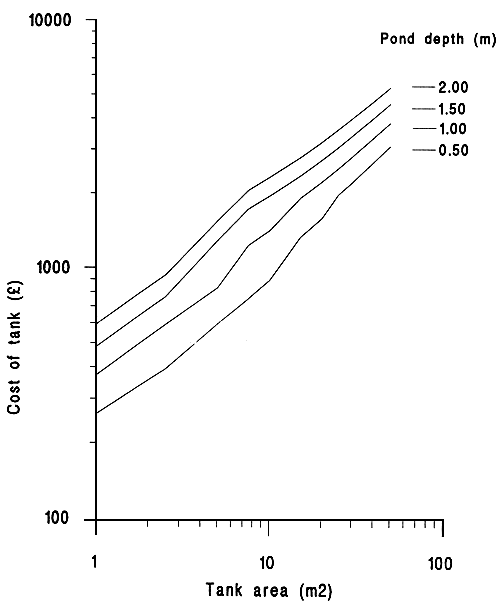
Rectangular concrete block-walled tank costs
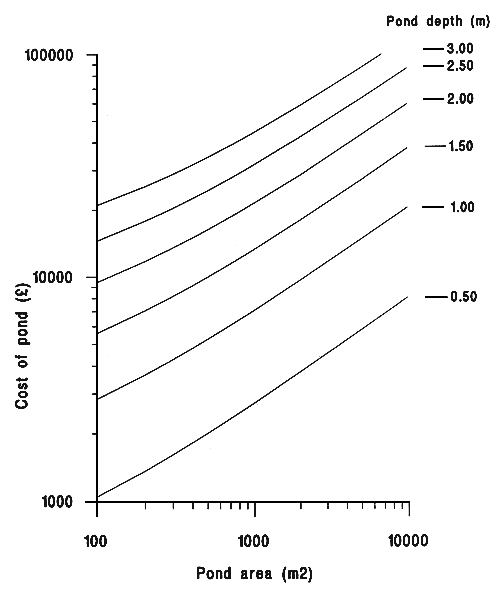
Fully raised earth pond costs
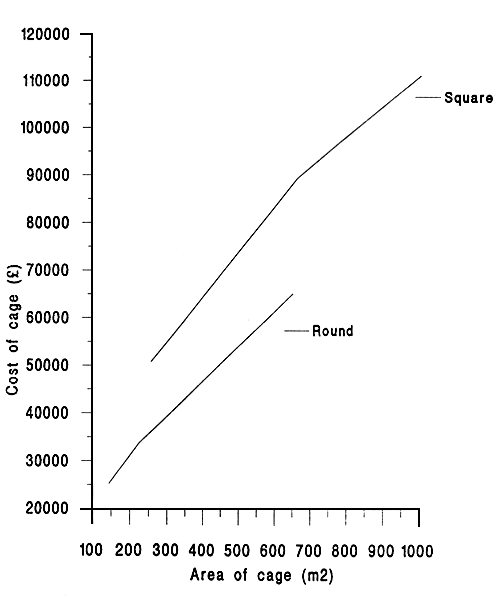
Cost of butyl rubber, double-tube collared cages
C.M. KENNEDY
Scotland
1 - INTRODUCTION
Often it is not until a loss situation arises that the true worth of insurance can be appreciated. If attention has been given to identifying a projects needs for insurance, if a suitable policy has been negotiated and the attached terms and conditions adhered to, the value of insurance in a catastrophic situation can mean the difference between the condition, or the termination of a project. The role of insurance is that vital.
Marine Insurance has long been recognised as a high risk area. Aquaculture by its very nature combines the worst elements of marine insurance (the unpredictability and savageness of the elements), and more. Losses are frequent, often costly and sometimes catastrophic.
To further complicate things, the aquaculture industry is one of rapid change. Technology is constantly changing, new experiment is continually appearing (some good some bad), cage designs come go, research leads to unfamiliar species being farmed, sites vary, environmental conditions change, people more than any one thing vary in experience and ability. The risks are a moving target and by necessity, Insurers in this market have had to actively involve Risk Management in order to continuously identify, assess and quantity the changing risks. Without such an approach, the viability of aquaculture insurance would be questionable and its availability to people such as yourselves involved in project development, limited.
By taking the initiative and employing full time risk management consultants, companies such as Sunderland marine mutual insurance Company Ltd., can confidently investigate wide ranging types of aquaculture and species the world over, to assess and establish realistic, economically viable terms of cover. Table I. illustrates the range of species presently insured with Sunderland Marine, Table 2 the types of installations covered.
| Table 1 | Species Insured with Sunderland Marine September 199 |
| Salmon | Lobsters |
| Trout | Oysters |
| Halibut | Mussels |
| Turbot | Scallop |
| Coarse Fish | Abalone |
| Bass and Bream |
At least two of the above species could be termed experimental culture projects. Halibut in particular are retained in various installations around Scotland for research purposes, from which it is hoped commercial industry will develop. The Abalone, insured in Ireland, is part of a pilot scheme also with many unknowns. Insurers may choose to become involved in such projects, where the risks appear reasonable, on the assumption that they will learn from the involvement acquiring valuable experience for potential application to the insurance of what eventually may be important commercial markets.
| Table 2 : | Types of Installations Insured with Sunderland Marine, September 1992 |
| Marine Farms : | Inshore and offshore with cage units ranging in size from 700 to 30,000 cubic metres. Made of wood, plastic, steel and rubber. |
| Pump Ashore : Marine Installations | Tanks and raceways. |
| Freshwater : Farms | Tanks, raceways, floating cages (in lakes) and ponds. Intensive production mostly. |
| Longlines, : Rafts and Trestles | Cultivation of shellfish. |
| Coarse : Fisheries | Extensive, managed fisheries throughout England utilised by leisure interests. |
| Recirculating : Systems | Freshwater generally. |
| Transports : | Live fish movements in well boats, by helicopter and by road. |
In this session today I intend the term Aquaculture insurance to fresh to the insurance of fish stock and equipment used for the farming of that stock, (holding units and ancillary items such as boats, rafts, grading machines etc.), and will restrict most of my discussion to this particular area.
Rather than point to any one Insurer or type of policy and say “this is the best”, I intend more to discuss the type of options available, terms and conditions that might be encountered and that should be understood before an insurance contract is agreed on, and hopefully assist the understanding of this sometimes costly input to project operations.
I have titled the sessions Aquaculture Insurance and Risk Management, because to talk about one without the other, would be to deal with only half the subject. Avoiding and where possible minimising losses is not only vital to the overall success of a project, but will in the long-term reduce the cost of insurance and maximise its return on the unpredictable and uncontrollable situations, that can inevitably arise in this business.
2- THE ROLE OF INSURANCE
Aquaculture projects vary considerably in design and purpose as do their respective insurance needs.
Whilst a shellfish operation involved in processing and marketing might require product liabilities
cover, an operation producing juvenile bream or bass for sale to ongrowers, is unlikely to find this
necessary. Before approaching an Insurance Agent, a Broker or an Underwriter directly, it is an
important exercise to identify possible areas in which Insurance will be required and to ascertain the
extent to which cover might be deemed necessary.
Insurance is an investment against the risk of loss and must be made in conjunction with other such
investments. I must be made in conjunction with other such investments. I met one manager in
Portugal who firmly believed the $30,000 annual premium being asked against stock loss, would be
better spent on improving his backup and security systems; and in that farms particular case it possible
he was right. In five years they had experienced no significant losses. Stock insurance is
undoubtedly the most expensive and the most difficult requirement to assess and as I have said the
area which I will deal mostly with in this session.
First however, it may be useful to run briefly through the various other types of cover relevant to
aquaculture business. (Table 3)
| Table 3 : | General Insurance | |
| 1- | Fire and Special Perils Insurance - Applicable to land based assets including buildings and associated equipment and stock therein. | |
| 2- | Loss of profits Insurance - Applicable to loss of gross profit arising from loss of or damage to any land based physical asset covered by specified insured perils. Not applicable to loss of profit arising from stock mortality. | |
| 3- | Employers Liability - Land and water operations. Cover provided for legal liability to Employees arising out of an accident arising in connecting with the business. Normally unlimited in amount of indemnity. May exclude diving and is usually subject in correct observation of certain safety precautions. | |
| 4- | Public/Products Liability - Land water operations. Public liability covers liability to third parties other than employees in respect of properly owned or used. Products liability covers the liability to customers in respect of damage or injury caused as a result of the use of the products manufactured or sold, (e.g. . food poisoning). | |
| 5- | Marine Insurance Transit Cover - Covers the movement of live stock by road, sea or air. | |
| 6- | Export Credit Insurance | |
| 7- | Vehicle Insurance | |
| 8- | Engineering Cover - Generally for the repair of essential production or processing equipment. | |
| 9- | Boat Insurance - Usually on an all risks basis including additional equipment such as outboard motors, radios, etc., and may also include third party liability. Certain conditions regarding safety equipment, boat conditions etc., may be applied. | |
| 10- | Personnel Non-Negligence Insurance - Personnel cover especially for accidents that occur where the company may not be held liable, (driving a company vehicle or diving in cages for example)- | |
In some countries many of the insurance as described in Table 3, are a compulsory requirement and require little decision making. Fire, (Building and contents) Insurance, Employees Liability, Vehicle Insurance etc., are mostly standard and can be arranged through an agent who may deal with one or more general insurance companies. Stock and marine equipment Insurance has traditionally been a more specialist area, an area in which Sunderland Marine Mutual Insurance, have been active for more than 100 years. As underwriters they deal with boats, fish farming equipment and fish stock only and as I have suggested already, of these fish stock Insurance is likely to be the most expensive. It is also likely to be the most frequently used and the most important cover purchased. In this respect there are a range of choices including, (Table 4).
| Table 4 : | Stock Insurance Options | |
| 1- | Full Cover-Including consequential loss so that in the event of a serious loss of stock or plant the financial position of a farm would be unchanged. Expensive if available, to my knowledge most UK Insurers will not offer consequential loss on stock. | |
| 2- | Reasonable Cover at Reasonable Values - The receipt of claim for a loss would allow the business to continue with minimal interruption. Profit might be lost but production targets may be kept intact. Especially where “stock replacement” can be achieved. Usually an “All Risks” policy. | |
| 3- | Minimal Cover at Low Values - “Disaster Cover”. A large percentage of the loss is carried by the operator (as much as 50%). Some perils (disease for example), may be excluded. | |
| 4- | No Cover or Self-Insured - Insurance is after all only one of many investments that can be made against risk. Operations free of investment liabilities and low in risk, operations involving multiple sites when the loss of one unit would not be a serious blow to the finances of a whole business, may opt for self insurance. | |
| Adapted from Marsham “Are You Sure You're Covered” Fish Farmer January/February 1990. | ||
Most aquaculture operations will tend to insure along the lines of option 2. Low risk operations (generally extensive) and operations where stock value is low, tend to options 3 and 4. The choice of “what” and “how much” stock insurance is a management decision and will depend on other factors, some already mentioned, pertaining to specific projects. In practical terms investing £30,000 for example in a second water source and improved backup systems could be of greater long term value than an “all risks stocks mortality policy”. Like everything priorities have to be assigned and decisions made accordingly.
If the decision is to assign a major role to stock insurance then an understanding of policies; the various terms, conditions and the options available, could be helpful.
3. SELECTING THE RIGHT INSURANCE PACKAGE
3.1 Terms and Definitions
Words such as “Premium”, “Deductible” and “Indemnity Value” may be familiar to many of you, although the interpretation of such terms can vary and give rise to misunderstandings so it might be useful if we were to run quickly through some of these. Certainly between policies the definitions of words such as “Disease”, “Site”, “Loss” etc., can vary and it is important to establish exactly what definitions apply to a particular policy. Definitions should be listed in the policy schedule.
(A worked example illustrating the calculation of premiums and application of deductibles is attached to the end of this paper).
| Table 5 : | Policy Terms |
| Premium - The cost of a policy. Gross premium is calculated against the “maximum” sum to be insured during the policy term. Net premium is the discounted rate, intended to reflect the “average” stock value over the policy term, (usually 65 to 70% of he gross premium), and is the sum paid to the Insurers. | |
| Excess (Deductible) - The proportion of value at risk that must be exceeded before a claim arises (generally between 10 an 30%). The claim will be settled for the value at risk above the deductible. | |
| Franchise - Similar to a deductible. A franchise must be exceeded before a claim arises, there after the deductible is used in the calculation of the claim settlement. | |
| Indemnity Value - The value of the Insured stock. Usually a scale of indemnities representing value at different stages of production, is attached to the policy. | |
| Disease Limitation Period - With disease Insurers liability is limited to a defined period of time (up to about 60 days). Variations on this exist, some better than others (see discussion). | |
| Monthly Stock Declaration - Declarations required to be made on a monthly basis, as to the value of stock. | |
| Normal Trade Mortality - Average mortality rate for the stock as specified in the schedule. | |
| Stock Replacement Clause - Some Insurers include the option of replacing stock (with the agreement of the Insured) rather than settling at indemnity. | |
| Exclusions - List of what a policy does not cover (such as inexplicable disappearance, trade mortalities, loss due to war, invasion, riot, etc). | |
| Warranties and Conditions - List of warranties and conditions that must be met for a policy to remain valid (such as not exceeding specified stocking densities, notifying Insurers of material changes, fitting and maintaining approved alarm systems etc.) | |
3–2 Variations in Policies
Policies offer varying extents of cover depending on:
Selecting the right package will depend largely on achieving the best combination of the above. In addition its well worth considering the claims settlement reputation of a company. Sometimes the way in which a policy is constructed can benefit this a aspect, in particular where indemnity scales are used.
3–3 All Risks or Named Perils
For full cover an “All Risks” policy is preferable. As its title suggests, a “Named Perils” policy offers cover limited to perils listed in the schedule only. The more risks covered, the more expensive the policy. Occasions can arise where such a policy can be a bad choice.
For example last year we were involved in a 2 million pound loss off the Island of Skye, in Scotland. Despite extensive water sampling during and after the loss, nothing was found to which the loss could be attributable. Laboratory analysis eventually isolated a toxin (that couldn't be identified), from gill and kidney tissue. Although we concluded the loss to be plankton, and settled accordingly (it was an “All Risk” policy), under a “Named Risks” policy the claim could have been thrown out because the cause of loss was never unequivocally identified. It might have been a pollution incident.
From time to time new problems arise, unpredictably so where a cause has yet to be identified. Because Insurance is principally aimed at the unpredictable, “Named Peril” policies can be extremely limiting.
It is also important to realise that aquaculture stock insurance policies (“All Risks” or “Named Perils”), will tend only to cover against mortality or explainable loss, (Theft or predation for example). Loss of stock condition, loss of profit or consequential loss, are almost never and option. Consequential loss was discussed earlier this year at a meeting of Insurers, which concluded:-
“Neither the Fish Farming nor insurance industries are ready to take aboard consequential loss insurance in its pure form. At current market prices Insured 's can not afford it, on the industries profit records and claims experience to date, insurers are not ready to offer it. Furthermore the inclusion of this form of insurance can only add to the complication of an already complex class of business.”
Extensions to include “Loss of Sale”, generally for juvenile production units or for broodstock units, which become infected with a notifiable disease and are forced to destroy stock, are sometimes available. This cover is generally expensive and applies only to diseases specified in the schedule (e.g. Furunculosis, IPN .,BKD, etc).
3–4 Application of Deductibles
Deductibles provide Insurance Companies with essential protection against small losses that are common enough in aquaculture. With different application they are also used to protect against predictable losses, which an Issuance Company will not wish to cover. For the fish farmer deductibles represent the proportion of risk they must be prepared to take. Their inclusion in policies has been found necessary to ensure affordable insurance can be offered
Variations in the ways in which deductibles can be applied include:-
Unless a cage is extremely large, but even then only in rare cases, 2(c) above will almost never be an option acceptable to an Insurer. Deductibles will be tended by Insurer with his quotes and will depend on a claims history of a site where it exists, and a Risk Surveyors report.
The preferable option here is to ensure that a deductible applies separately to each generation at each site. Grower stock is more valuable than juvenile stock, which can preclude a claim on the latter if the total value of the juvenile stock is less than the site deductible.
3.5 Disease Limitation Periods
When is a disease, when does it start and when does it finish?
Simple questions with a range of answers. Generally Insurers will accept the report of a Veterinarian or a recognised diagnostic laboratory, as prove of disease being responsible for a loss.
The question of “start” and “finish” is relevant where disease limitation periods are included in a policy. Various “start” points have been suggested but generally Insurers seem to agree that a useful start point is from when mortalities exceed trade mortalities (and for which reason the latter should be established and listed in the policy schedule when contracted). Obviously its never so clear cut but in our experience this very rarely causes much argument or conflict and common-sense usually prevails when establishing starting points.
Regarding disease limitation periods, some are better than others, offering more value. Points to note include:-
The length of the limitation period, (usually 30 to 60 days). The longer the better.
It there one or more specific periods. With one period it can either be from the starting point or floating. The latter is established after the loss and can be set to cover the worst mortalities.
With more than one period, subsequent periods will be dealt with as an entirely separate claim, subject to a separate deductible and based on the value at risk at the beginning of each period. This is the most common arrangement we deal with.
4. RISK MANAGEMENT
Throughout this session I have stressed the need to match Insurance requirements to risk, to make certain a project will still remain viable should unforeseen problems arise which lead to major stock or equipment losses.
Insurance is essentially for unpredictable and uncontrollable situations. When problems being to repeat themselves regularly, where losses occur for which economic solutions exist, there is a need to revise methods, technology and management. Insurance isn't and will never be a prop for poor aquaculture practices.
On one hand Insurance companies practice. Risk Management to gather relevant information that is necessary to allow them to provide economically viable, well balanced cover. They also, through people like myself and other specialists, actively encourage a Risk Management approach at all levels, intended to minimise loss and maximise profits. Profits for the fish farmer as well as the Insurer. Insurers will rarely ever profit from unprofitable business.
4.1 The Risk Survey
Risk Management can be defined as:
Risk Managers (or Surveyors) like myself, are employed to advise Insurance companies of (1) and (2), and where possible to contribute to (3), the control of risk. In assessing risk, some of the things we take into account include (Table 6).
| Table 6 : | Risk Assessment | |
| 1- | General Aspects | |
| a) | Environmental Conditions : Features of water quality in the area, natural parameters and fluctuations. History of plankton problems. | |
| b) | General Health Situation : Problems specific to the species being farmed, problems common to that area. | |
| c) | Human Activities : Physical (urbanisation, industry and pollution risks) and Social (objection to fish farming, vandalism, etc). | |
| d) | Species Suitability : To what extent has the farming technology developed if at all. Is there a history of farming in the area. | |
| e) | Support Services Available : Veterinary, Government etc. General infrastructure features that help make specific units a success. | |
| 2. | Specific Site Aspects | |
| a) | Backup Systems | |
| b) | Design of the unit : equipment specifications, maintenance requirements, suitability. | |
| c) | Financial Status and Viability : a well financed operations is usually a better risk than a company with financial problems. | |
| d) | Health Status and stock condition | |
| e) | management and Staff, Experience and Qualifications | |
| f) | Monitoring and Security Arrangements | |
| g) | Records and Site History, Where It Exists | |
| h) | Site Accessibility in an Emergency | |
| i) | Suitability of the Specific Site for the Species | |
| j) | Water Quality Controls : monitoring and ability to control quality - temperature, pH, filtration, etc. | |
The job of a Risk Surveyor is a very active role requiring a considerable number of site visits each year. While some information about operations looking to obtain insurance cover is acquired by the use of questionnaires and proposal forms, we also rely on an actual site visit to obtain a first hand impression, the subjective assessment. This is the opinion we form when attending a site, examine equipment, inspect stock and observe staff at work. We rely very much on our personal experience in aquaculture and as time goes by, our ever increasing experience in dealing with a wide range of loss causing situations.
With a site survey, time restraints will only allow a cursory inspection in the first instance and will usually consist of meeting the site manager, “walking through” the system, looking at stock and equipment, inspecting records, backup facilities and where appropriate, alarm systems. A visit will take from one hour to two or three hours depending on the size of the facility, its complexity and accessibility. Often we follow up a visit with a discussion and a written request for further information if we wish to query some aspect.
An aquaculture operation can Involve a wide range of technology, requiring a diversity of skill that no single Risk Surveyor can possibly have. At time therefore we may also employ a specialist to follow up on an aspect that concerns us. Often in this respect we make use of Marine Surveyors and Engineers, contracting their services to assess the viability of certain equipment in use at the site in question. In the past we have had wave model studies, cage analysis, water analysis and food analysis carried out.
A site survey and risk assessment report provides us and the Insurers with a point of reference from which to develop an ongoing relationship. Visits subsequent to an initial survey help develop the impression of how the risk on a site is changing. Where changes for the worse become evident, discussion with the insured may improve the situation before a loss and a claim occurs.
It is not always possible to rely on a site visit to assist in the risk assessment process. This is particularly the case with new and developing operations in which change can be so rapid as to make in the beginning, meaningful risk control visits impractical.
What we are finding however is that loss follows a pattern for most of the time and that once we understand a project or operation, we can predict in which areas problems might arise. Whilst a site visit is essential to obtain perspective on a project, and to assess management and staff in practice, there is a great deal that can also be contributed in the planning stage to minimise potential problems and reduce areas of risk, before they arise.
4.2 Claims Data - Identifying Risk
Claims history information can provide a useful indication of the scale of problems and associated, probable scale of risk attached to specific perils. It may be useful at this point to look briefly at the claims data for 1988 – 1991, that constitutes the main period of Sunderland Marine's involvement in aquaculture insurance. Data presented here must be qualified for the following reasons :-
This represents the claims experience of one Insurance company only (Sunderland Marine), mostly with Salmonid production in the UK and Ireland, although is based on more than 300 claims over four years, from some 400 or more aquaculture policies.
The data is claims data (and doesn't include losses that fall short of claims). This also creates problems for critical analysis of losses between years - deductibles for example have increased on average by 50% between 1988 and 1991. A 15% loss due to furunculosis in 1988 might have constituted a claim equal to 5% of he stock value against a 10% deductible. In 1991 it is unlikely to have resulted in a claim at all as most deductibles against furunculosis now exceed 15%).
The 1991 data (included) is provisional.
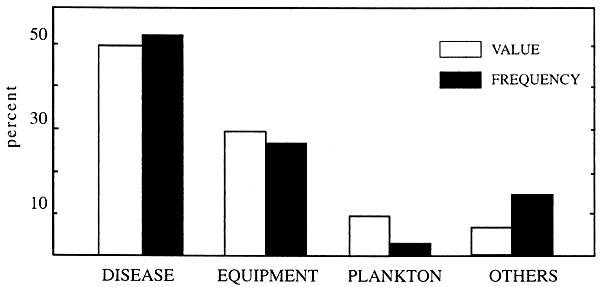
Figure 1 Claims in the UK and Ireland 88–91
Figure 1 illustrates the general pattern for the years 1988 to 1991 (“year” refers to policy year).
The term “others” refers to losses from situations that include:- predation, transit, pollution, water quality, vandalism, flooding, etc.
Clearly disease, equipment problems and plankton are the major areas of risk within the UK and Ireland, and I intend shortly to discuss these in more detail. I have only limited information on losses in the Mediterranean, but from the information available the problems in this region also look likely to fit into the same categories. (Figure 2).
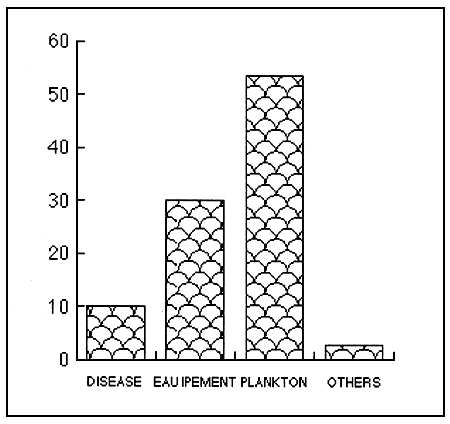
Figure 2 Claims in the Mediterranean and Black Sea
4.3 Disease Losses and Control
At present in the Mediterranean, disease doesn't appear to be a major contributor to loss. When salmon farming in the UK began some fifteen years ago the situation was similar. As aquaculture develops in this region however, disease will undoubtedly become a more significant peril. In respect of this there are lessons that could be learnt from the salmon farming industry.
In Table 6 I referred to the “general health situation of an area”. It is our experience that disease problems between areas will differ and that area problems will inevitably have a bearing on individual risks within that area. By way of illustration I have compared here our Irish claim data for disease losses on marine sites, to our British claims data for the same. These are all salmon farms with claims over the years 1988 to 1991, (Figure 3).
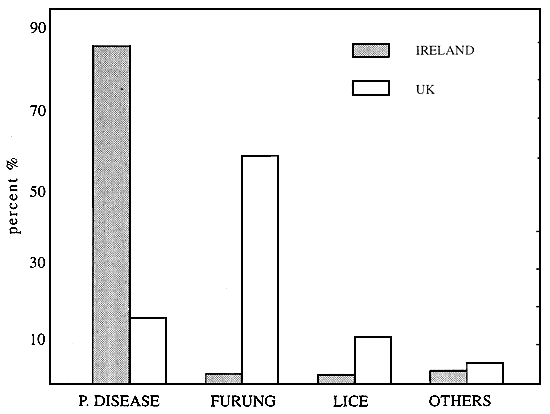
Figure 3 Disease claims UK and Ireland 88–91
Contrasting situations are illustrated. In Ireland p.D., is the major cause of loss, in the UK until now
at least, Furunculosis has been the major cause of loss.
Whilst the nature of the disease differs, common underlying features can be identified which have a
bearing on assessment and control of disease. These include (Table 7).
| Table 7 : | Disease Risk Assessment and Control | |
| 1. | stress : Stressful situations lead to stressed stock opening the door to escalating disease problems and acute losses. Stress arises from poor husbandry, had diets and over feeding, poor equipment, overstocking, handling of stock, poor environmental conditions, etc. | |
| 2. | Presence of a Pathogen : If Juvenile stock have been screened, usually horizontal transmission from grower stock in close proximity either on the same site or from nearby farms. Proximate carrier stock leads to re-infection and drug resistance developing. | |
| 3. | Ability of an Operator to React : To identify the problem (monitoring), process samples and identify a solution (veterinary and diagnostic support). Experience in administering treatment. | |
| 4. | Industry Solutions Available : Antibiotics and other therapeutic agents. Vaccines and relative success. | |
To date this year Sunderland Marine has not had a single furunculosis claim. P.D., problems in Ireland are still bad but losses are less than what was experienced 2 to 3 years ago. Both the UK and Ireland have worked very hard at reducing stress on their farms. Improved technology has helped (passive graders, non maturing stock, improved net antifoulants), but so has experience. Stocking levels today are considerably less (10 to 15kg per cubic metre maximum, compared to 25 to 30kg practised a few years ago).
In our view one of the most important general controls that is helping to reduce disease related problems (in the UK at least), is the advent of Inter-Management Schemes (we call them Loch Management Schemes). These are agreements that range from detailed and comprehensive programmes which might include introducing stress tested juvenile stock only, into an area in agreed years, linked to an agreed fallow period when all stock are effectively cleared from that area for a number of months; to a simple exchange of information on what problems are encountered and when, antibiotic sensitivity patterns and treatments, stock movements and other facts of relevance to one another.
Referring again to Table 7; our experience suggests successful control of disease problems can be achieved by:-
The management of stress. Particularly low stocking densities, maintaining a good environment, passive husbandry where stock handling is minimised etc.
By precluding a pathogen or at least by removing carrier populations by limiting mixing of generations.
Having in place a monitoring system and contingency plans to deal with an outbreak. (Who does the sampling, which lab to go to, source of drugs, methods and ability to treat).
The correct use of antibiotics and other therapeutic agents in association with vaccines.
The successful containment in the UK of furunculosis (and other diseases), appears to have come about by a combination of these four control measures. The Irish with their P.D., situation are not so fortunate as the P.D., causing agent has yet to be isolated and described; for now there is no obvious cure. However, research is closing the gap, partial vaccination has been achieved and improved husbandry, loch management schemes, attention to diet and feeding patterns are combining to contain the problem. Three years ago losses of 65 to 70% were occurring on sites that today experience less than 20 to 30% losses in a bad outbreak.
4.4 Losses Due to Equipment Failure and Their Control
Rather than deal with every form of loss due to equipment failure, I intend here to highlight the main problems only and suggest general approaches to minimise the risk of such losses.
The majority of the equipment failures we deal with occur at sea. Onshore operations with equipment failure related claims invariably suffer loss from interruption to water supplies. Such problems are less common today with modern units generally incorporating well designed safety and backup features. A rule of thumb we follow is to make sure everything essential has a backup, (intakes, pumps, power, ensure alarms have an independent power supply and sometimes dual transmission capability - radio and telephone for example). Staff must be practised in handling emergency drills, (pump replacement, which divers, engineers, electricians etc., to contact).
Finally backup systems are only as good as they are reliable and must be maintained, checked with checks logged, on a regular basis.
Offshore, (floating cage installations), equipment failure problems fall into three categories : cage structural failure, net failure and mooring failure. A summary of our claims data for the UK and Ireland illustrates to what extent each of these problems contributes to loss. (Figure 4).
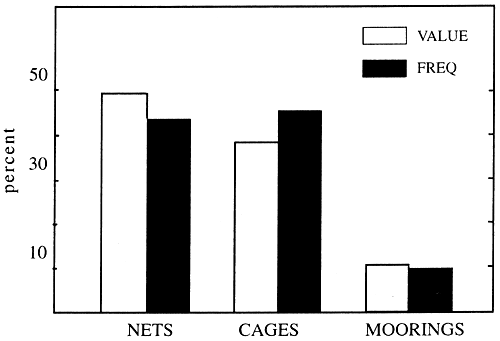
Figure 4 - Equipment failure losses cages sites UK and Ireland
Equipment failure mostly occurs when extreme weather conditions develop and generally Insurers cite “storm” as the cause of loss. However, whilst storm conditions might trigger a loss Risk Surveyors tend to take a harder line and look for the weak link that actually fails first, allowing the storm to create the loss.
Net Failures : These type of failures tend to be the most expensive and the most frequent. When a net fails most of the enclosed stock will be lost. WHen a cage breaks it doesn't always result in nets failing and stock loss. Often cage structural damage will appear gradually allowing for temporary repair and in some cases salvage of the stock.
At an Aquacultural Engineering meeting in Glasgow two years ago it was very obvious that the least researched the least developed and the weakest link in most floating cage units is the net. On a practical front we sometimes observe that it is also the most abused and least maintained piece of equipment.
Net weaknesses have become more apparent as sites have moved further offshore and cage sizes have increased. The biggest cage we presently insure is a 30,000 cubic meter Bridgestone in Ireland holding 100,000 salmon. At its maximum predicted stocking capacity some 300 tonne of salmon could be enclosed at a value close on one million pounds.
Early failures in the nets on the big flexible cages prompted studies into design and involved contributions from the fish farmer, net manufacturers and Insurance companies. Design features to improve net integrity include the introduction of shock absorber panels, rub panels (to protect against chaffing) and generally much heavier specifications of rope, stitching and mesh material.
Nets get damaged and lead to losses for a variety of reasons, including (Table 8A).
| Table 8A : | Reasons for Net Failures | |
| 1. | Badly designed, constructed or poorly fitted to the cages so that stanchions and cage collars, weights etc., will contribute to the damage. | |
| 2. | Underspecified. Exposed sites with strong currents require nets with tremendous strength and resilience. | |
| 3. | Predation and debris. | |
| 4. | Improperly maintained and handled badly. Well kept nets will better resist damage from (3) above than weak nets will. | |
Maintenance and handling is up to the operational staff.
We recommend a number of ways to protect a net from damage and extend its life expectancy, including
(Table 8B).
| Table 8B : | Net Maintenance and Handling | |
| 1. | Store out of the sunlight when not in use to avoid UV damage. | |
| 2. | Don't leave nets fouled up as decomposing weed etc., can generate heat and damage the fibre of the net. | |
| 3. | Don't drag nets across the shore or over cage structures. | |
| 4. | Repair torn panels promptly. | |
| 5. | Ensure tie off points nominated by the suppliers are utilised fully and effectively. | |
| 6. | Ensure comprehensive records are kept of nets age and usage. | |
| 7. | Return test panels for examination. | |
| 8. | Maintain a regular inspection procedure of nets in sites. | |
In planning and designing a floating marine installation never attempt to cost cut on nets (or cages and moorings). Cheap nets represent false economy and increase the risk of loss.
Cage Structural Failures : Rather than try and describe every type of cage structure failure an operator is likely to encounter, I think it would be more use here to suggest general guidelines for ensuring the equipment selected for a site is going to present minimal problems.
There are a great variety of cages available and more designs appearing all the time. Cage manufacturers and suppliers are in the business of making and selling such equipment and will invariably work towards the goal to the exclusion of all else. In most cases the advantages and good points of a cage will be stressed, the bad points glossed over.
For this reason when looking towards a potential design it is well worth investing in an independent marine survey - to be carried out by a consultant experienced with cage structural failures. I have to say that from my knowledge of the Aqua Systems barge loss in Ceuta Bay; it was an incident that would not have arisen if an independent survey report produced by a Glasgow surveyor, had been heeded. I believe that some ten months prior to the sinking of this barge Lloyds were advised not to Insure it.
Cages are designed for specific conditions. Another for loss occurs when these specification (wave height, water current, wind speed, mooring design, maintenance and applications), are not complied with. It is essential to ascertain from a designer or manufacturer the exact range of working conditions under which a cage has been designed for and to match those specifications with the extreme possible conditions likely to occur at a site. “Average” conditions are no measure at all. A site could be suitable 364 days a year with conditions on the 365th day causing a breakage.
There is always a major gap between the theoretical and practical. The only measure of success is operational experience. We would always advocate that project design makes the best use of tried and tested equipment whenever possible with consideration for after sales service and support. We believe the onus should be on developers of new cage equipment to carry the risks attached to experimental designs, that the development of new equipment must include, practical operation in sites that if anything, will exceed specifications. Usually it is not until a unit fails that we can identify its weakness.
Whilst Insures are presently prepared to insure new projects and aquaculture developments, our attitude to new cage design is through experience one of caution. Attempts to redress this attitude have been made. In particular with proposals for the classification of equipment.
Lloyds in may this year produced a set of provisional rules and regulations for the classification of fish farms. This report deals with :-
It is a complex report with formidable objectives and at present considered by many to be unworkable. It is likely implementation of the rules would be extremely costly and would still rely on the ability of surveyors, whose task to survey equipment at sea is neither easy nor lends itself to consistency. However, the ideas are sound in principle and if cage manufacturers are prepared to try and meet the standards proposed, this sort of move will undoubtedly lead in time to more reliable cage structures becoming available.
Moorings : This is an area that is increasingly less likely to contribute to equipment failure losses. there are many more specialist companies around today capable of advising on and installing moorings for virtually any form of marine structure and who will also often provide some form of guarantee for their work.
There are two general points I would still like to make here:-
It is essential that the mooring design is compatible with the cage equipment and that the design has been approved by the cage manufacturer.
We witness many plastic cage failures from lack of attention to this point, with poorly designed “do it yourself” moorings actually causing cage kinks and breakage. Likewise steel cages problems can be exacerbated by unsuitable mooring designs.
Ensure moorings are maintained regularly. Regular and visual diving inspections are necessary with records made of the various components so that can be compared with previous inspection and the rate of corrosion assessed.
We recommend moorings are lifted every second year with complete replacement of shackles and (subject to wear and tear) ropes.
4.5 Plankton
The last risk I would like to discuss in any detail, is that of loss due to plankton. Undoubtedly this is a significant risk. Claims are relatively infrequently infrequent but when they occur can be costly. Until the end of the 1990 Sunderland Marine's cumulative losses due to plankton in the UK and Ireland, came to no more than 2%.
One incident in Skye last year caused this to jump to 11%. The data I presented before for the Mediterranean region (Figure 2), included losses due to plankton totalling 4 million pounds, all stemming from one incident in Tunisia involving an algae bloom of Gymnodinium.
In Norway where the problem has been equally bad at one point about two years ago Insurance Companies were questioning their ability to insure against this peril.
Algal blooms are a feature of primary production on which the entire marine food chain depends. In some instance their general occurrence is predictable (site history records, hydrographic survey reports, meteorological data). Where circumstances permit and predictable situation are likely to arise it is possible to implement control measures that will at least mitigate a loss.
We insure a number of fish farms in the South of Ireland, in the Bantry Bay area, an area consistently experiencing dinoflagellate blooms in spite of which we have had very few claims here (due to losses directly resulting form plankton). One of the reasons for this is that these farmers are acutely aware of the danger from this risk. They constantly monitor plankton levels and have also developed techniques for minimising losses when blooms do occur.
The Irish farmers (and those in high risk areas in Norway), incorporate deep nets on the cages (20m) to allow salmon to dive below the high concentrations of dinoflagellates (down to 5m). They stop feeding the stock during bloom periods and run air lift pumps driven off compressors mounted on rafts, that brings uncontaminated water up through the cages considerably diluting plankton concentrations.
The ability of the Irish to avert disaster is linked to a high level of knowledge about the nature of he plankton they are dealing with, and a good infrastructure designed to predict the bloom incident.
Prediction however is not always possible. Our loss in Skye has still not been linked to any organism. One theory suggested by D.A.F.S., is that toxin produced by a bloom could exist long after the dinoflagellates have gone, moving around in a “cloud” undetected.
A better substantiated but equally unpredictable circumstance was described in Nature recently. The algae, also a dinoflagellate, is capable of changing from toxic to non toxic form, encysting and settling out within hours of coming into contact with fish. The algae ability to change swiftly from a poisonous to a benign form has been suggested as one reason why its link with mass fish deaths has never before been uncovered.
Trends and information are being investigated mare as time goes on. The International Committee for Exploration of the Seas is very active in compiling much of this data. Increasing our knowledge will lead to improved monitoring in turn to more effective control measures.
For now in many cases and particularly in the more open sites the exact time and place of arrival of a bloom is likely to remain relatively unpredictable, a situation which many framers would argue is a “raison de plus”, for having insurance in the first place.
5. CLAIMS AND LOSS ADJUSTMENT
I began this session by stressing the need to appraise insurance requirements within the context of a loss, to assess a policy's value in terms of the return to a project in the event of a claim.
Everyone hopes a claim will never happen, inevitably it will. If it didn't there wouldn't be insurance and I wouldn't be here today. It is important therefore to have some idea of what is involved in a claim, how to react, how the Insurer will deal with it and how the final figure for settlement will be arrived.
First and foremost is the need to Notify Insurers of a problem when it arises. Obviously it is not always possible to tell when a problem will become a claim, it cost nothing however to assume that it will and report it just the same. Most policy schedules stipulate that the Insurers or their representatives are notified within 48 hours of a problem being identified.
Evidence of a loss (mortalities, equipment), must also be preserved wherever possible until a claims assessor has visited, or unless the Insurance company agrees to disposal before hand.
Loss adjustment can be a nightmare in the absence of accurate record keeping, including stock numbers, stock movements, harvests, mortality etc. Where a policy requires stock returns to be made it is essential these have been kept up to date so that a claim can be processed unequivocally. A loss adjuster may also wish to inspect maintenance schedules, diving reports and so forth.
Making sure this information is on site and available a claim is investigated help this process move along quicker.
The role of the claims adjuster is to establish exactly what has happened. He, or she must find out the approximate numbers of fish stocks affected, whether mortalities are continuing, whether there is any risk of remaining stocks being affected by the same event and ensure that the farmer has done and is doing everything that can be done to prevent or minimise the loss.
I have already mentioned about the need to keep Insurers informed of change and to comply with policy warranties and conditions. It is important and management changes, are reported to the Insurers as soon as possible in order that a claim is not jeopardised. A key to ensuring as smooth claims settlement is to establish and maintain at all times, good communications with the Insurer either directly or through the brooking agent.
Often claims are complex, involving one or more factors, storm damage giving way to disease, pollution leading to disease etc. It is the claims adjusters job to identify the proximate cause of a loss wherever possible. I mentioned earlier about “split deductibles”. Obviously where losses arise where one or more cases might be responsible, a fair settlement will depend on an accurate interpretation of the loss. At the time of a loss therefore it is essential to gather as much information as possible that might contribute to this interpretation.
We advocate where appropriate, taking:-
If it is possible a third party is involved (pollution incidents especially), water samples and professional independent analysis may be essential to any recovery proceedings against that party.
Claims and loss assessment requires communication, information and co-operation.
POLICY TERMS
1. Premium Calculations (Stock Insurance)
| Example | |
| a) Maximum Stock Value | £ 1,000,000 |
| b) Rate quoted by Insurers | 4% |
| c) Expected average monthly value | 75% |
| Gross premium | = 4% × max.value |
| = £ 40,000 | |
| Deposit (net) premium | = 75% × Gross Premium |
| = £ 30,000 | |
Payable generally in twelve equal payments, by bankers order, Monthly returns must be submitted declaring numbers, weight and value of stock. This provides the basis for adjustment of claims and where appropriate, adjustment of the deposit premium where stock average value has varied from the predicted. If average stock value had actually been about 55% of the predicted maximum stock value in this example, the Insured might be eligible for a refund of £8,000. (If a claim occurs at any time during the policy term however, the deposit will always be retained in full).
2. Deductible Application (Stock Insurance)
| Example | |
| a) Stock Value at time of loss | £100,00 |
| b) Deductible | 20% |
| c) Actual value of stock loss | £60,000 |
Claim Calculation
| i) | Value of stock lost less | (Deductible × stock value at time of loss). |
| ii) | 60,000 less | (20% × £100,000). |
| iii) | Claim Settlement | = £ 40,000 |
If the loss bad been £20,000 or less then the deductible would not have been exceeded and there would be no claim.
When a franchise is included in a policy, claims are not initiated until the franchise is exceeded, thereafter the deductible applies:-
| e.g. | Franchise | = | 40% |
| Deductible | = | 20% |
In the above example a claim would only arise if the loss is greater than £40,000. If the loss had been £35,000 for example, despite exceeding the deductible the franchise has not been exceeded and a claim on the policy is not possible. Once a claim situation is valid however, the deductible (in this case 20%) would be applied to the claim calculation. In the £60,000 loss example on the preceding page, the settlement outcome would still be £40,000.
| BROODSTOCK | Locations BGI to BG6 | ||
| FFr 295.00 per kilogram | |||
| HATCHERY | Location RW 1 to RW 11 | ||
| 1 up to 2g | FFr 11.00 per fish | ||
| 2 up to 4g | FFr 13.00 per fish | ||
| 4 up to 6g | FFr 14.00 per fish | ||
| 6 up to 8g | FFr 15.00 per fish | ||
| 8 up to 10g | FFr 16.00 per fish | ||
| NURSERY | Location B1 to B12 | ||
| 10g up to 20g | FFr 17.00 per fish | ||
| 20g up to 50g | FFr 19.00 per fish | ||
| 50g up to 75g | FFr 23.00 per fish | ||
| 75g up to 100g | FFr 25.00 per fish | ||
| 100g up to 125g | FFr 27.00 per fish | ||
| 125g up to 150g | FFr 28.00 per fish | ||
| ONGROWING TANKS | Location 1 – 32 (outside) | ||
| 150g up to 200g | FFr 29.00 per fish | ||
| 200g up to 250g | FFr 32.00 per fish | ||
| 250g up to 350g | FFr 35.00 per fish | ||
| 350g up to 450g | FFr 41.00 per fish | ||
| 450g up to 550g | FFr 47.00 per fish | ||
| 550g up to 650g | FFr 53.00 per fish | ||
| 650g up to 750g | FFr 56.00 per fish | ||
| 750g up to 900g | FFr 60.00 per fish | ||
| 900g up to 1000g | FFr 60.00 per fish | ||
| Thereafter FFr 75.00 per kg. | |||
| (Pounds Sterling) | |||
| Ova, per Thousand | £4.00 | ||
| Fry, per Thousand | £12.00 | ||
| Fingerlings, 5 – 10 cm. per kg. | £5.00 | ||
| Growers, 10 – 18cm., per kg. | £2.50 | ||
| Young Stock, 60 – 300 gm., per kg. | £1.20 | ||
| Fish, 300 – 1 kg., per Kg. | £1.40 | ||
| Fish, over 1 kg., per kg. | £1.80 | ||
| Broodstock, per kg. | £2.00 | ||
par François. Van. Obregen.
France
INTRODUCTION
L'aquaculture est une science économique. Le but de l'aquaculture est accessoirement de fabriquer des poissons et principalement de fabriquer du profit.
Dans nos sociétés capitalistes s'exercent les lois du marché et de la concurrence, il ne s'agit pas seulemnt produire mais aussi de vendre et de vendre avec profit.
Les entreprises sont ainsi amenées à les meilleures et à se battre entres elles sur le marché. A l'avantage de tous, il est pourtant nécessaire d'établir un certain nombre de règles, par exemple, pour éviter des concurrences déloyales, pour financer les actions visant à étendre le marché total d'un produit (de telle manière qu'en augmentant la demande le maché accepte des quantités offertes plus importantes ou par la pression de la demande maintenir les prix à un niveau ré munéérateur).
LES O.P.
Par exception à la règle générale, et dans le cadre de la Politique Européenne des Produits de la Mer l'entente entre producteurs est légale, pour peu qu'elle s'exerce dans le cadre réglementaire prévu des Organisations de Producteurs. C'est une facilité, mais dont les aquaculteurs n'ont pas encore vraiment pris la mesure. Alors que de nombreuses O.P. existent pour la pêche.
L'O.P. permet aux producteurs de définir des normes de poids, qualité, conditionnement, étiquettage, etc… qu'ils ont ensuite à respecter, de surcroît dans la mesure où l'O.P. est suffisamment représentative les producteurs non adhérents à l'O.P peuvent avoir l'obligation d'en suivre les règles.
Pour aider ou démarrage des O.P.l' Etat, la Communauté en financent les frais de gesion pendant plusieurs années, et de manière dégressive.
Par convention avec l'O.P, des prix de retrait peuvent être établis, qui garantissent aux producteurs un prix minimum pour des produits spécifiques quand les prix de vente descendent sous ce seuil.
UNE COOPERATION EUROPEENNE…
Les aquaculteurs via leurs syndicats nationaux, en France, en Italie, en Espagne et en Grèce, principaux pays producteurs de loups et de dorades ont tenté et continuent de tenter la constitution d'une Fédération Européenne de l'Aquaculture des poissons marins (salmonidés exclus qui sont d'ailleurs déjà regroupés en une fédération européenne) première étape vers la constitution d'une O.P. à l'échelle européenne.
En effet une O.P. à l'échelle nationale ou régionale dans le Marché Unique n'aurait aucune signification puisque les marchandises voyagent librement sans droit de douane.
Aucune O.P. européenne de ce type n'a encore vu le jour, mais il faudra bien tendre à y arriver.
Les Salmoniculteurs qui depuis 1989 ont traversé une crise effroyable (des dizaines d'entreprises ont déposé le bilan Norvège, et toutes sont sont malades) ne sont pas arrivés à s'organiser lorsque les profits étaient importants, rares, ceux qui en ont alors ressenti le besoin. Maintenant que les prix sont au plus bas on commence seulement à parler d'O.P. Irlande, en Ecosse… Un peu tard.
Malheureusement, je pense que ni les pisciculteurs de loups e daurades ni les conchyliculteurs n'aient appris quoi que ce soit de la débacle de la salmoniculture et que nous ne commencerons sérieusement à parler d'une large O.P. que le jour où un nombre certain de producteurs de loups et de daurades auront d'éposé le bilan, et que tous nous serons malades.
Ce discours n'est pas neuf et au moins a-t-on commencé à répertorier les sujets d'intérêt commun dans le cadre national puis à Bruxelles, notamment lors de la réunion EURAQUA 92 dont je vous recommande vivement la lecture des actes (le document vient de paraître cf références ci-dessous).
ETENDUE A LA MEDITERRANEE
Lors de cette réunion de Bruxelles, Lazaro, Rosa et moi-même avons fait la proposition que les pays du Bassin Méditerranéen soient associès depuis le départ à la ré flexion et plus généralement aux travaux et aux décisions.
En effet, par exception aux règles du G.A.T.T., et en vertu d'accords bilatéraux avec la C.E.E un certain nombre de pays du Sud de la Méditerranné, entrent déjà leurs produits de la mer en franchise de droits de douane dans la C.E.E. De ce point de vue ils font donc déjà partie du Marché Unique.
SUJETS D'ENTENTE : Exemple
DENOMINATION DES POISSONS
Ainsi les poissons devraient-ils avoir des dénominations identiques pour chaque espèce spécifique non pas par pays mais par langue. On éviterait ainsi toute confusion. En novembre 1991 la nomenclature des poissons a été revue en France et proposée à Bruxelles (voir annexe № 1). Ainsi le Dicantrarchus labrax, notre loup va-t-il s'appeler loup, et lui seul va s'appelre loup. Ce que l'on vends au Champs Elysées sous le nom de loup dans des menus à 49,50 F e qui est une espèce d'horrible poisson venant de Norvège n'ayant rien avoir avec le loup, devra-t-il dorénavant s'appeler dragon.
Il en va de même pour les multiples variétés de sparidés, ou le denté qui s'appelai6t couramment dorade, devra désormais s'appeler denté. Seule la dorade royale-Sparus auata pourra s'appeler dorade royale.
Je ne vais faire l'inventaire des autres domaines ou une coopération, une entente serait très sou-haitable, en notant toutefois, qu'il serait préférable pour chacun d'y arriver entre producteurs plutôt que de se voir imposer des règles par voies légales.
Je suggère par conséquent que les producteurs des bassins méditerranéen dans les plus brefs délais se retrouvent et se concertent déjà sur des thèmes essentiels sur lesquels tous ont intérêt à s'entendre.
La coopération commence à l'échelle locale, à l'échelle régionale, à l'échelle nationale. L'entre-aide entre voisins plus ou moins proche est un premier pas naturel, circuits des commercialisations communs, OUMA (Coopérative d'Utilisation de Matériels Agricoles en Commun), SAVU (Service d'Assistance Vétérinaire d'Urgence) tel qu'il existe maintenant en France depuis 4 ans, entre dix-huit producteurs, à l'initiative du Comité Inter-Professionnel National que j'ai encore l'honneur de présider.
C'est seulement lorsque ces premières actions de coopération auront pu réussir sur un plan local, régional, national que l'on pourra penser à des coopérations plus larges. Avant tout une question d'état d'esprit.
Le MEDRAP en prenant l'initiative de la rencontre d'aujourd'hui, qui pour la première fois regroupe des producteurs de tout le Bassin Méditerranéen, crée l'occasion pour ceux-ci de contacts qui je l'espère conduiront à une réelle coopération entre producteurs.
