

MEDRAP II THIRD STEERING COMMITTEE MEETING
CONGRESS PALACE - TIRANA, ALBANIA
10–11 DECEMBER 1992
THURSDAY 10.12.92
OPENING SESSION
AGENDA ITEM 1
(1) The 3rd Steering Committee Meeting of MEDRAP II was held from 10–11 December 1992 in the Palace of Congress in Tirana, Albania.
(2) The Meeting was attended by the National and Sub-Regional Coordinators of Albania, Algeria, Croatia, Cyprus, Egypt, France, Lebanon, Malta, Morocco, Portugal, Tunisia, Syria and Turkey. Also present were Representatives of UNDP, FAO, IFREMER, CIHEAM and the Coordinator of MEDRAP II.
(3) The meeting was opened by the President of the previous cycle, Mr. A. Shinawy who welcomed all present and passed the floor as has become customery, to Mr. A. Flloko, the National Coordinator of Albania.
(4) Mr. A Flloko on behalf of the Ministry of Agriculture and Food and the Directorate General of Fisheries welcomed all participants wishing them a memorable stay.
(5) Mr. H. Akrout, the MEDRAP II Project Coordinator, thanked all the countries present, and our host in the person of Mr. L. Korra, Vice-Minister of the Ministry of Agriculture and Food. He asked the UNDP and FAO Representatives present to convey to their respective organisations our thanks for their continual support. He stressed the importance of UNDP contribution to RER budget.
(6) Mr. R. Ziesler, Representing FAO, thanked the hosts and expressed FAO appreciation and gratitude to the organisers. He wished the meeting success highlighting the fact that sustainability will ultimately rest on the countries of the region.
(7) Mr. Y. Ibrahim, representing UNDP highlighted the importance of MEDRAP II to the region particularly in relation to food production. He said further development is considered important by UNDP and that UNDP will continue to support financially this activity, and will assist governments in this important area.
(8) Mr. L. Korra, Vice-Minister of the Ministry of Agriculture and Food, thanked all present in the name of his Minister. He highlighted the importance of environmental considerations in relation to sound and sustainable development. He wished all a fruitful and constructive meeting.
(9) The officials of the meeting were unanimously designated as follows:
| President | : | Mr. A. Flloko (Albania) |
| Vice-Presidents | : | Mr. G. Kadari (Algeria) |
| Mr. C. Agius (Malta) | ||
| Rapporteur | : | Mr. H. Kouyoumjian (Lebanon) |
| Vice-Rapporteurs | : | Mr. A. Berraho (Morocco) |
| Mr. J. Menezes (Portugal) |
(10) Agenda was adopted as presented.
AGENDA ITEM 2 MEDRAP II ACTIVITIES REPORT
(1) The Coordinator, Mr. H. Akrout introduced document 1, describing briefly major activities. Action has followed recommendations of the previous Steering Committee Meeting except for 3 activities that were postponed upon the request of the host countries where these activities would have been held. He also referred to the recent supportive letter received from the EC Directorate General of Fisheries. Additional information on accomplished activities were Provided by Ph. Ferlin. B. Tritar, D. Stephanou, G. Kadari, C. Agius, and A. Berraho in their respective capacities of Coordinators of these activities, or representing the host countries where these activities were held.
AGENDA ITEM 3 NATIONAL, SUB-REGIONAL AND NETWORK REPORTS 1992
1) The following sub-regional coordinators presented concise reports about their respective regions.
| Mrs. D. Stephanou | (Cyprus, Lebanon. Syria) |
| Mr. Z. Farsi | (Morocco, Algeria, Tunisia and Portugal) |
| Mr. A. Benovic | (Croatia, Albania, Turkey and Bulgaria) |
| Mr. C. Agius | (Malta, Egypt, Libya) |
| on behalf of the Sub-Regional Coordinator. | |
All speakers stressed the importance of adhering to past recommendations, and in planning for the future, taking into consideration these reports.
2) Other speakers from Tunisia, Croatia, Syria and Albania gave additional information about their respective countries particularly in relation to environmental and market considerations.
3) Individual reports on the status of MEDRAP II prepared by each National Coordinator were distributed and annexed (Annexe 1).
4) Several recommendations were made. These are included at the end of the report of the meeting.
AGENDA ITEM 4 MEDRAP II BUDGET SITUATION 1992
1) Mr. R. Ziesler (FAO/FIDO) introduced Document 2, and mentioned the discrepancies between the RER and RAB allocations. He mentioned that the RER/B7/009 budget Revision “i” awaits UNDP approval, and that the contribution from the French Trust Fund might balance the deficits.
2) It was also suggested to consider the presence of EC Country Representatives in discussions and negotiations with the EC.
SESSION 2
AGENDA ITEM 5 BRIEFING ON THE AD HOC COMMITTEE ON MEDRAP III
1) Mr. G. Kadari introduced Document 4 in his capacity as Chairman if the Ad Hoc Committee Meeting, and briefly presented the main recommendations of the said meeting.
AGENDA ITEM 6 MEDRAP III PROPOSED FUTURE ACTION
1) Mr. H. Akrout introduced Document 5, 6 and 7. He mentioned in particular the contacts with CIHEAM in this respect. He presented a tentative proposal on the implementation of a MEDRAP III structure, given in the informative document circulated during the meeting and referred to as Annexe 1 to Document 6.
2) This was followed by a discussion session and the recommendations are given at the end of the report.
AGENDA ITEM 7 INVOLVEMENT OF THE CONCERNED PARTIES
1) The main contents of Document 7 were again mentioned by the MEDRAP Coordinator, who then invited the concerned parties or organisations for their comments.
2) Unfortunately no representative of GFCM was present for discussion and comments.
3) Mr. M. Valls reaffirmed CIHEAM interest in MEDRAP and their willingness to cooperate and contribute. However, he made the following conditional remarks:
- All agreements are subject to approval by CIHEAM Board of Directors.
- Possibility of participation of CIHEAM member countries to future MEDRAP activities.
- CIHEAM can not assume at this stage any budgetary allocations to future MEDRAP activities.
4) On behalf of the Director of PAP/RAC, Mr. A. Benovic (Croatia), highlighted the important aspects of Document 7, Annexe 1. He asked the Project Coordinator to clarify officially the interrelation of PAP/RAC and the Tunis Environment Network Centre.
5) Mr. B. Tritar (Tunisia) expanded on SIPAM projected activities and welcomed collaboration with all concerned. He reaffirmed the commitment of the Tunisian Government to host the SIPAM Project and to ensure its local operating costs.
6) Following these presentations, Mr. Ph. Ferlin (France) invited all to be practical. He said that all concerned parties including GFCM, CIHEAM, SIPAM, etc. must initiate quick action for a definitive resolution of their commitments to MEDRAP III, by April 1993.
The Network Steering Committee was informed about the measures taken for the implementation of SIPAM which will become operational on April 1st, 1993 in Tunisia. The NSC approves the proposed Project and the budget including the Funds from the general MEDRAP budget. The budget includes the contribution from the French Trust Fund and from Tunisian Authorities.
7) Mrs. D. Stephanou (Cyprus) said that she accepts in principle the proposed structure as having potentials of being successful, however, this could not be binding at this stage as she considers certain important elements are missing.
8) Mr. Menezes (Portugal) mentioned the accomplishments of MEDRAP II. He mentioned, however, that there were still unresolved problems like marketing that needed attention.
9) Mr. H. Kouyoumjian (Lebanon) mentioned the sad reality that a group of countries are still today where they were at the beginning of MEDRAP. Of course, this is mainly due to the absence of major aquaculture related activities in these countries. However, in the case of Lebanon the promises of various representatives, particularly those of UNDP representative have never been materialised even though Lebanon did follow the suggestions made by UNDP respresentatives assisting Steering Committee Meetings. In this respect, Lebanon has requested a small assistance in acquisition of communication equipment.
10) Mr. C. Agius (Malta) said the presence of UNDP at such a critical turing point is important. Various aspects of the budget could be unacceptable to governments. The way forward is to complete the various sub-networks that will make concrete proposals which then need to be prioritised by the Steering Committee before a final proposal is put forward.
11) Mr. H. Akrout responded to the points raised by saying that he is fully sympathetic to these problems, and that no major commitments from governments are requested at this stage. He said that the search for financial sources are of paramount importance.
As regards countries that are not CIHEAM members, Mr. Akrout said ways and means of collaboration must be looked into eventually.
12) Mr. J. Menezes (Portugal) raised several questions about the proposed structures and expressed his reserve. He is willing to propose alternative structures.
3RD SESSION
AGENDA ITEM 8 GLOBAL ACTIVITY PROGRAMME 1993
1) Mr. H. Akrout introduced Document 8, and gave additional information on most activities. The following remarks were made:
a) Mr. Shinawy (Egypt) asked to postpone the Workshop on Fresh Water Aquaculture to May.
b) Mr. Katavic (Croatia) concerning the Network Seminar on Aquaculture and Environment, said in principle he accepts the proposition provided the participation of Croatia to MEDRAP is legalised. He also said that the fresh water culture workshop could be held in Hungary in May.
c) Mrs. Stephanou (Cyprus) supports the idea of holding activities in non MEDRAP countries. Timing of such activities is very important.
d) Mr. Menezes (Portugal) said courses and seminars are two different things. You can hold a course only in countries where there is local expertise. In this respect, he supports the suggestion of Croatia. He said it is better to hold the training course on diagnosis in winter because of accomodation problems.
e) Mr. Agius (Malta) said it will be appropriate to consult Network Coordinators before final decisions are made. He asked the Coordinator to give some information on the seminar on constitution of aquaculture and environment network. He suggested Spain could be an alternative venue for the training course on Bact. diagnosis.
f) Mr. Akrout said there are always budget restrictions, and that MEDRAP can be more effective in developping aquaculture in Member Countries when manifestations are held in Member Countries. There can be no question of spending money on non-Member Countries.
g) Mr. Flloko (Albania) supports the suggestion that courses should be held in advanced countries within the MEDRAP region.
h) After further debate on the matter when representatives of Algeria, Malta, Portugal and Croatia took the floor, Mr. Akrout gave additional information and prioritised the activities. Finally the compromise suggestion of Lebanon to ensure an effective participation of the Szarvas Institute in technical aspects of the workshop was accepted.
i) Mr. Ferlin (France) referred to their contribution to SIPAM and said in principle he has on objection to hold the workshop on engineering in another venue, which they can then support to a certain degree.
j) Finally, Document 8 was reviewed and revised. MEDRAP II Coordination Centre will revise the document including prioritisation, and send it to National Coordinators. At this stage, unfortunately, the venue of several activities could not be finalised. The Project Coordinator was authorised to negotiate and finalise.
As regards the workshop on Artemia, the Project Coordinator is asked to discuss with Algeria and Libya 2 Sub-regions the possibility of organising a specialised meeting.
AGENDA ITEM 9 PREVISIONAL BUDGET 1993
1) Mr. Akrout introduced Document 9 and explained the various headings. Minor modifications were introduced by the participants. The budget will be reviewed together with Mr. Ziesler and all modifications reflected in the new version.
AGENDA ITEM 10 RECOMMENDATIONS
The following recommendations were made:
1) The decision taken in Cairo meetings as regards countries not advanced in aquaculture: Lebanon, Syria, Albania and Bulgaria, is reaffirmed. These countries are targetted for special attention and the Project Coordinator was invited to seek means and methods of special assistance particularly whenever some action toward aquaculture development is initiated.
2) The Project Coordinator was asked to follow up the question of the legal membership of Croatia to MEDRAP. The National Coordinator of Croatia was asked to follow up the matter also with his authorities.
3) There can be no question of introducing new administrative set-ups for the future development of MEDRAP. Existing infrastructures such as GFCM, CIHEAM and PAP/RAC should be considered while setting up perennial structures in this context.
4) In the discussions and negotiations as regards activities the relevant Network Coordinators must be consulted a priori. Priority should be give to organising all activities in MEDRAP countries where relevant expertise and facilities exist.
5) As regards future MEDRAP structures, the following recommendations were adopted:
a) The GFCM will ensure the General Coordination of the future activities and will have to establish a Committee on Aquaculture for the purpose.
b) The PAP/RAC should carry out the Aquaculture and Environment Network activities, the CIHEAM to be in charge of the Research and Training Network, and the Tunisian Government to host the SIPAM Project.
c) For each project, a draft proposal have to be elaborated, by MEDRAP, beginning of 1993, in collaboration with the concerned institutions, and if necessary, with a consultant's assistance.
d) A seminar should be organised to review and adopt the draft proposal early in 1993. All interested countries and other parties concerned will attend.
e) MEDRAP will be responsible for the elaboration of the final version of each Project Document, and the identification of funding sources, in collaboration with the concerned institutions.
f) The adoption of the Project by the respective councils of the concerned institutions should be made by mid-93.
g) By the end of 1993 the Project will be submitted to the Committee on Aquaculture for advice then to GFCM for adoption.
6) Concerning 1993 activities a number of changes and revisions were introduced before adoption. The Project Coordinator will introduce the changes and send a new version to the National Coordinators by the end of January 1993.
7) The budget was adopted with minor changes that reflect the changes in the Activities Programme, and the availability of funds. The Project Coordinator is invited to look for additional sources of finance.
AGENDA ITEM 11 MISCELLANEOUS
No items were discussed.
SESSION 4 REPORT AND RECOMMENDATIONS
The draft report was read and approved after the introduced modifications.
AGENDA ITEM 12 ADJOURNEMENT OF THE MEETING
At the end of the meeting all the Steering Committee Members reaffirmed their commitment to MEDRAP and their full support to the Project Coordinator. MEDRAP, not only supports aquaculture development in the region but also contributes to the elaboration of a network of human resources.
All the National and Sub-Regional Coordinators and the Project Coordinator take this opportunity to convey their special thanks to the Albanian Authorities and the National Coordinator Mr. A. Flloko who spared no efforts in making this meeting a fruitful and a memorable one.
NEXT STEERING COMMITTEE MEETING IN BEIRUT, LEBANON EARLY NOVEMBER 1993.
Meeting adjourned 14.30, December 11th, 1992.
By Mr. Miguel Valls
Miguel Valls
International Centre for
Advanced Mediterranean
Agronomic Studies
CIHEAM. MAI Zaragoza
INTRODUCTION
The Mediterranean region, -18 countries, 450M inhabitants,-does indeed present a considerable diversity between North, South, East and West, not only due to physical environmental factors but also to the different degree of development of the countries in the region and the importance of the great cultures there in. Not with standing this diversity, the geography, the long history shared and the political conviction that is needed to ensure stability make this region an increasingly more important entity.
The common bonds are complemented by the existence of similar problems related to the preservation of natural resources and agricultural production, the most outstanding being;
• The fragility of resources; soil (erosion, desertification) water (scarcity, salinization) and the sea (pollution, biological equilibrium).
• The relative importance of agriculture and the necessity of increasing production in order to meet the needs of a soaring demographic growth.
• The need to develop an adequate technology for Mediterranean conditions since very often the techniques and material produced by more developed countries are not applicable to less favourable ecological conditions.
The aforementioned has strengthened desirability to create cooperation links between countries which can contribute to the development of the region and consequently to its stability. This general objective is transformed into instrumental objectives promoting technological development through high level training and research, and creating links between institutions and experts in the Mediterranean countries. Those are the aims for the International Centre for Advanced Mediterranean Agronomic Studies (CIHEAM).
The Centre was created in 1962, under the auspices of the OCDE and the European Council by seven countries - France, Greece, Italy, Portugal, Spain, Turkey and Yugoslavia - in order to provide for complementary teaching, both economic and technical, and to develop the spirit of international cooperation among agriculture executive from Mediterranean Countries. From 1983, a progressive incorporation of other countries in the area has taken place leading to the current membership of 14 countries: Albania, Algeria, Egypt, France, Greece, Italy, Lebanon, Malta, Morocco, Portugal, Spain, Tunisia, Turkey and Yugoslavia.
This expansion of the Centre towards the southern Mediterranean area runs parallel to the implementation of a broader cooperation with other international organizations. Following Agreements of Cooperation signed by the Centre with the F.A.O. (Food and Agriculture Organization) (1976), the C.E.C. (Commission of the European Communities) (1983), the A.O.A.D. (Arab Organization for Agricultural Development) (1986). Observers from these organizations participate in the meeting of the board.
We summarize, as follows the main characteristics of the structure and activities of the Centre.
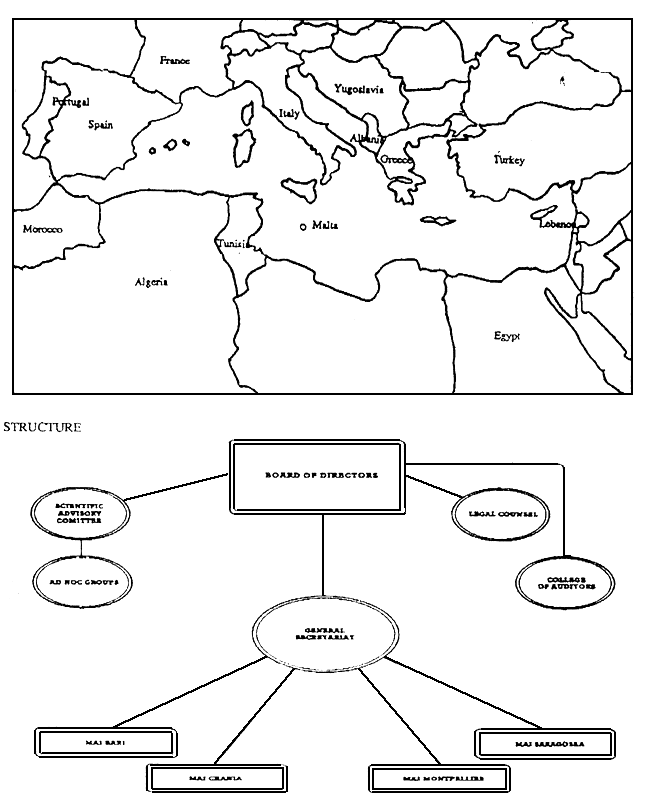
The CIHEAM is directed by governors' board, which includes a representative of each member country and has : 1) a scientiic adisory committee 2) a general secretary who coordinates the activity of the Centre and 3) four Mediterranean Agronomic Agronomic Institutes which develop the activities of the Centre. The General Secretariat is based in Paris and the four institutes are situated in Chania (Greece), Bari (Italy), Montpellier (France) and Zaragoza (Spain) (Tables 1,2).
The annual budget of the Organization is approximately 10M ECUS and counts on 130 persons distributed throughout the Centre of whom 50% are Scientific Administrators.
The activities of the Centre fall under the headings of the Production (Plant production, animal production, agricultural techniques) Economies and Agricultural Development and Environmental and Resource Management.
The small size of the Centre, its international character and acquired organization experience endow the CIHEAM with a great flexibility to adapt, both in the choice of activities and the form of organization, and with capacity for prompt action, conditions which are most advantageous for the functioning of a cooperation network.
CIHEAM NETWORK ACTIVITY
The actions developed by the CIHEAM are of four types;
The principal aspects of the organization and functioning of each, will be dealt with at a later stage.
Previously, it is important to underline some general principles which can be considered as the bases for action:
1. Avoid duplication Not to organize or promote activities when they are already organized by national or international institutions in the area.
2. Seek complementarity Become aware of and try to valorize the efforts initiated by otherscomplementing them either by topics, organizationally or financially. This is an essential aspect to be3 achieved rather than seeking exclusive protagonism.
3. Strive for excellence Both in human resources (experts and participants) and in programmes. The activities organized with an international character can not be dealt with on a large scale and therefore it is of utmost importance to attract the best.
4. Build up a network of collaboration between national institutions beyond the activity of the Centre.
The means available to accomplish the activities of the Centre comply with these bases of action. Thus the CIHEAM Institutes have not been conceived as large research centres with their own objectives, but as dynamic elements in the promotion of contacts. Until recently, all the training activities and many related to research and its networks, were carried out in the Institutes themselves. However nowadays a growing number of these activities are carried out in the specialized national institutions of the nember countries which are increasingly open to collaborations with other partners.
This policy permits a greater offer from the Centre and a valorization of the national institutions whose evolution makes up the firmest foundation for a stable technological improvement.
Training activities
The activity of the Centre has mainly focused on the organization of postgraduate courses. More than 4000 students of the CIHEAM hold posts in their respective countries, in Economy, Administration , Training and Research and in Government. Together with the evolution of national systems of further training in the member countries, this action has adapted and is now complemented by the organization of short duration courses on specialized topics catering for high level professionals (Table 3). The Centre currently offers both types of training.
a) Programme of postgraduate specialization. This consists of one academic year leading to the diploma of postgraduate specialization. According to the academic results of this first year, students may opt for a second year in which they will carry out a personal research study working towards the thesis of a Master of Science degree. This programme caters fundamentally for young graduates who wish to complete their specialized training.
b) Specialized courses. These courses are aimed towards professionals with very precise programmes lasting from two to four weeks. The objective of these courses, apart from their actual content, is to provide a positive interaction between participants and guest lecturers leading to expectations for a future collaboration.
In the organization of our training activities four criteria we considered to be of great importance. They permit a differentiation between these courses and other existing ones. These aspects are related to what have denominated above bases for action and they refer to:
1. Choice of topics and preparation of the programme. The choice of topics is made by the internal organs of the Centre based on proposals originating from the permanent and active consultations made with experts, responsible officials of institutions and firms related to the Institutes. The programmes are prepared by ad hoc groups of 5 or 6 experts from different countries who are invited to form such groups on the basis of their personal capacity.
2. Collaborations. The organization of activities in collaboration with institutions or organisms relevant to the topic dealt with, is for us an objective in itself. This collaboration allows us to improve the offer, ensuring diffusion, increasing the level of the candidates and creating cooperational links. Furthermore, as previously mentioned, an increasing number of activities can now be organized outside the Institutes.
The situation of institutes of the CIHEAM on or near a National Campus of Research Centres also facilitates a constant collaboration for the purposes of practical work or other studies on site.
3. Lecturers. The majority of lecturers participating in the courses (all in the case of the IAMZ) are guest lecturers. The groups of experts preparing the programme must propose the lecturers according to their personal competence. This is the main argument of interest in our courses and an aspect which ensures their success. In our experience, the staidness of our programmes, the possibilities of interaction with other colleagues and the contribution to the cooperation in a developing area of the word, are strong incentives which favour the presence of relevant specialists.
4. Participants. It is essential to promote the participation of persons with a high level of training and an activity or responsibility within their organizations of origin allowing a valorization of their presence and a continuity of contacts. The opportunity and quality of the programme are the principal motivations but even so, the institutional relationships and the involvement of the national organizations are the best guarantee for a good selection. This is why their participation in the selection process is desirable.
Research Activities
The Centre, apart from occasional projects, does not carry research activities independently. Its function, in this sense, is to promote agricultural research in the Mediterranean area with two objectives; 1) To encourage the cooperative activity of national structures in networks of cooperative research and 2) increase the available knowledge and technology for Mediterranean production systems and products which do not receive attention outside this area.
At the moment the Centre supports the functioning of approximately twenty research networks, each of which is made up of a group of researchers, (normally between four and fifteen) belonging to teams of different countries, brought together by a common objective (Table 4). The scientific objectives, the structure and degree of activity of the research networks are most variable and therefore flexibility must be respected in order to ensure their smooth-running.
From our experience, the main aspects related to the organization and functioning of research networks can be summarized as follows:
1. Origin and implementation. The origin of the networks is at times a decision which is taken as a result of a lack of scientific information and in many other cases a consequence of activities such as courses and seminars where participants have demonstrated a will to continue a task jointly undertaken. In order to set up a network, it is necessary to establish an objective and ensure the willingness of a number of individual researchers to participate. This could be achieved in several ways such as a survey of priorities, a preparatory meeting of the group initially interested, or organizing a larger seminar on a topic with the idea of continuity.
2. Objectives. First of all, the topic must be relevant and secondly, the objectives must be clearly defined and realistic irrespective of the scale of ambition. The extent of the objective, which may be a progressive one, defines the modality of the network. The activity of the networks normally begins with the purpose of exchanging information or material. They develop by means of complementary studies between teams and are consolidated with the accomplishment of common projects.
3. Structure and functioning. The participation in networks is based on a willingness which is almost always individual at the beginning. Therefore it should have a flexible and open structure in which the number of participants will depend on the degree of exigence of the objectives. It is absolutely necessary for one of the participants to be willing to ensure an active coordination. The periodical meetings must reach conclusions and the common activity should produce results. Without any visible result it is impossible to maintain the interest of the participants for whom the common activity is, as a rule, no more than a complement of their own professional interest.
4. Means. A structure of material support to the coordination, provided by the Institutes in the case of the CIHEAM, is the only specific requirement of the networks. The research activity is based, in general, on the actual resources of the national institutions. The networks are very often in fact the combination of individual projects. The activity of the networks encourages the preparation of joint projects stemming from the network that can be proposed to different external sources of financing. This is the case of approximately hiteen projects financed by the European Commission set up by the CIHEAM networks.
With regard to Research, the action of the Centre's networks is complemented 1) an Exchange Programme of researchers which permits short stays to perfect techniques 2) realization of a M Sc thesis tutored by researchers participating in the networks and 3) the organization of several scientific meetings and workshops every year.
Seminars
Apart from the seminars of a scientific nature which are programmed in connection with the research networks, the CIHEAM organizes, both independently and in collaboration with other Institutions, seminars on topics of general interest which aim to discuss the state of the are eventually contribute to the formation of a policy. During this year seminars were organized on issues such as; “Vulgarization in Maghreb countries” “Soils in the Mediterranean region” “Water economy” “Agricultural policies in Mediterranean countries”.
Representatives of National Administrations are invited to attend these seminars and the conclusions are transmitted to the governments through the members of the Governors Board. These seminars are the origin, at times, of the organization of courses or research networks as perviously mentioned.
Services
Provision of particular services which are either non-existent or incomplete in national organization, could be a strong enough reason in itself to motivate a network, In the case of the CIHEAM, due to the existing infrastructure and parallel to other programmes, opportunities have arisen to provide services linked to specific agreements (the Institute of Bari provides healthy plant material for regional growers; the Institute of Montpellier has a French language centre used by many organizations). However, there are two more general types of service which our Centre is developing;
1. Data banks, As a complementary activity to the networks, data banks with information concerning the Mediterranean are implemented. Three most significant examples are 1) basic information on the agro-food industries operating in the region 2) information on all large scale irrigation projects 3) Information on characteristics and evolution of forest fires controlled in the region. These date banks permit the analysis in greater depth of the factors of variation and thus contribute elements for decision taking in the future.
The creation of bibliographical data banks has been considered on certain issues, in particular regarding publications of limited diffusion. Nevertheless, the progress in this field advances at a slower pace.
2. The production of pedagogical resources for training to be used outside the environments of the establishments of the Centre, including audio-visual projects and books written by lectures in our courses and co-edited with international publishers.
During this year a programme of agricultural broad casting had been created for radio destined to French speaking countries in the area which besides international diffusion could be made available to local radio stations.
GENERAL TRENDS OF THE CIHEAM NETWORK OPERATION
1. Following the explanation regarding our activities, we hope it is clear that the establishment of links between people and organizations that underlies our activities, is in our opinion, the surest way to improve the technological capacity of national institutions of the member countries.
2. This aim cannot be achieved immediately even if great economic means were available to give incentive to this process. On the contrary, the process is always a progressive one in which first contacts are followed by mutual interest and consolidated by collaboration, availability and permanent communication.
3. The consolidation of a cooperation networks is, on the other hand, an informal process since this is based on the individual will to collaborate, motivated by different scientific, personal or even moral interests; Only the response to these interests can ensure the stability of the network and pass on to the collaboration between institutions.
4. Within the present structure of the CIHEAM we can identify different states according to which issues are dealt with. In some cases we find ourselves at the very initial stage of promoting a network and the contacts are established based on personal collaboration of an individual nature. Nevertheless, within the field of specialized training, we are in the phase of consolidating a more institutional collaboration with several organisms and universities which make up, together with the institutes of the CIHEAM, a true network, in all the member countries.
5. The relationship between the members of our network for the joint undertaking of activities in precise topics is formalized by specific agreements. The degree of institutional commitment varies according to the topics and whilst with some institutions agreement is made only to organize a short duration course, with others we are now offering joint Master of Science programmes.
6. The Institutes of the Centre constitute an important dynamic element in this process since they give the necessary impulse and structure and provide the additional resources. Their role is an essential one whose relevance continue in the future.
7. As a result of the existence of the collaboration network, the capacity of the Organization widens. As an example an agreement with the E.E.C. allows us to finance an increase of almost 20% of our offer of training in institutions of Southern Eastern Mediterranean countries.
NETWORKING CONTRIBUTION TO TECHNOLOGICAL CAPACITY
Improvement of technological capacity is a complex process based on the availability of trained personnel, the existence of infrastructures enabling this personnel to realize projects and the organization of a system of technology transfer including the training of personnel on an operational level.
The three stages of the process are necessary. Nevertheless the form of ogranization of the whole system can differ. Over the years, the building of large centres disconnected from the already existing infrastructures, which were very often precarious, has been a common practice. Nowadays, the improvement and promotion of these training and research or experimentation infrastructures, existing in almost all regions, connecting them with a cooperation network is a more interesting approximation.
The main contribution of networking to improve technological capacity is to allow isolated centres or low capacity centres to enter promptly into a technologically advanced system offering them great opportunities of training and cooperative work without leaving their habitual environment.
The advantages of networking for this purpose are:
1. This system is the quickest and most economical since existing structure are encouraged without creating new facilities. Even when this is necessary the planning allows for the participation of the existing structures.
2. To avoid localism and isolation, both of which are frequent, although scientists keep in direct contact with local problems as a source of their scientific activity. Therefore, the risk of brain draining also decreases.
3. The networking based on an international collaboration, as in the case of the CIHEAM, has the advantage of providing a framework in which the relationship between teams is a on a more equal basis, unlike the dominance which is often found in programmes of technical assistance or of bilateral cooperation. This helps to avoid risk of rejection based on nationalistic grounds.
4. The structure of coordination can be very small or the task may even be entrusted to one of the institutions involved.
In spite of these advantage, a certain risk of failure is always present stemming from loss of interest of the participants due to a lack of well defined objectives and lack of action taken. These shortcomings are replaced by bureaucratic activism and coordination meetings which neither hold technical content nor reach final agreements.
With regard to actions to be taken, the first step is, in our opinion, that of training through short duration specialized courses. After this first contact, the opportunity for thematic research networks may arise, besides support through services and infrastructures. This progressive construction of the network facilities stability and consequently credibility in order to mobilize resources of possible donors.
C.I.H.E.A.M.
INTERNATIONAL CENTRE FOR ADVANCED MEDITERRANEAN AGRONOMIC STUDIES
MEMBER COUNTRIES
C.I.H.E.A.M.
POST-GRADUATE PROGRAM ACADEMIC YEAR 1992–1993
SPECIALIZED POST-GRADUATE STUDIES DIPLOMA (ONE YEAR) MASTER OF SCIENCE DEGREE
(TWO YEARS)
SEPTEMBER 1992–JUNE 1993
AGRICULTURAL TECHNIQUES
ENVIRONMENT RESOURCE MANAGEMENT
RENEWABLE NATURAL RESOURCES (M.A.I.C.)
ECONOMICS - DEVELOPMENT
PLANT PRODUCTION
These courses are made up of a variable number of modules that can be taken separately. each one leading to the delivery of a certificate.
SPECIALIZED INTENSIVE SHORT COURSES
(TWO TO FOUR WEEKS)
ANIMAL PRODUCTION
PLANT PRODUCTION
AGRICULTURAL TECHNIQUES
ENVIRONMENT RESOURCE MANAGEMENT
ECONOMICS - DEVELOPMENT
APPLICATIONS
Selection will be based on academic record
The number of participants
Will be limited to twenty-five per course
A certain number of scholarships are awardarded each year.
With priority given to nationals from C.I.H.E.A.M. member countries
(Albania, Algeria, Egypt, France, Grece, Italy, Lebanon, Malta, Morocco, Portugal, Spain, Tunisia Türkye, Yugoslavia).
For further information, Please contact the institutes.
CIHEAM RESEARCH NETWORKS BY AREAS OF ACTIVITIES
| ACTIVITIES | PARTICIPANTS | INSTITUTIONAL COLLABORATIONS | |
| Number | Countries | ||
| PLANT PRODUCTION | |||
| GREMPA | 8 | AL,F,GR,I,S,TU,TK,Y | EEC |
| LEGUMES AND CEREALS | 9 | AL,F,GR,L,MO,S,TU,TK,Y | EEC,ICARDA |
| ANIMAL PRODUCTION | |||
| TABLES OF NUTRITIVE VALUE MED.FORAGES | 10 | AL,CY,F,GR,I,MO,P,S,TU,TK | EEC,FAO,FEZ |
| SHEEP AND GOAT PRODUCTION | 12 | AL,EG,F,GR,LIS,MO,P,S,TU,TKY | EEC,FAO,FEZ,ILCA |
| RABBIT PRODUCTION | 8 | AL,EG,F,I,MO,P,TU,TK | WRA |
| AGRICULTURAL TECHNIQUES | |||
| BRACKISH WATERS | 7 | EG,F,I,NL,MO,TU,Y | FAO |
| COMPLEMENTARY IRRIGATION | 4 | AL,EG,I,MO | FAO |
| DATA BANKS ON IRRIGATION PROJECTS | 4 | AL,EG,I,MO | FAO,WB |
| NON-SOIL CULTURES | 8 | EG,F,GB,GR,I,MO,TU,Y | ISHS |
| POST-HARVEST LOSSES | 3 | GR,I,S | ISHS |
| ENVIRONMENT - RESOURCE MANAGEMENT | |||
| PREVENTION OF FOREST FIRES | 9 | CY,F,GR,J,P,S,TU,TK,Y | FAO,EEC |
| FORAGE PRODUCTION IN ARID ZONES | 9 | AL,F,GR,J,MO,P,TU,TK,Y | FAO |
| AROMATIC AND MEDICINAL PLANTS | 11 | AL,F,GR,I,IS,MO,NL,S,TU,TK,Y | |
| ECOSYSTEMS | 5 | F,I,S,TU,TK | INTECOL |
| ECONOMICS - DEVELOPMENT | |||
| CEREAL INTENSIFICATION | 5 | AL,F,LMO,P, | |
| SMALL SCALE AGRICULTURE RAFAC | 7 | AL,F,MO,P,TU,TK,Y | |
| EGECOM/CEREAL POLICY | 4 | AL,F,MO,TU | |
| IRRIGATION IN THE MAGHREB | 5 | AL,F,LMO,TU | |
| DEVELOPMENT OF LESS FAVOURED AREAS | 5 | F,GR,I,S,P | |
| IAA AGRO-FOOD INDUSTRIES | AL,EG,F,GR,I,MO,S,TK, | ||
| AGRO-FOOD PROSPECTIVES | 4 | AL,F,MO,TU | FAO,WB |
| INTERNATIONAL COMPARISONS OF EFFICACY | 6 | F,I,S,TR,USA,Y | |
By Mr. Arnaud Muller-Feuga
Arnaud Muller-Feuga
MEDRAP II, Tunis, the 18th of may, 1993
Summary:
The development of new tools for aquaculture is examined with special reference to french experience during the last decade. The successive states from identification of needs to commercial promotion of technological products is detailed.
It is emphasized that both research activity and industrial partners are required, the first for seeking of innovation technical solutions, the later as guarantee of existing market and for commercial development. Illustrations of works are presented, especially for open sea equipments for both fish and shellfish farming: it becomes a growing concern for increasing space resources as well as for escaping coastal environment degradation.
The pre-commercial pamphlets of different products are presented.
The main steps
1: Identify and classify the needs
For each particular need:
2) Evaluate technical and economical
feasability
3) Choose industrial partner
4) Look for financing sources
5) Develop the commercial products
6) Contribute to promotion
Synthese des besoins en matiere de technologie aquacole Classés par ordre de priorités. Extrait des conclusions du groupe de travail animé par le Secrétariat d'Etat chargé de la Mer en 1984.
| Secteur d'activite | Domaine d'application | Fonction outil procede |
| Priorité1 | ||
| Information | Tous secteurs | - Annuaire professionnel |
| - Lettre d'information | ||
| Ostréiculture | Obtention de juvéniles | - Captage |
| - Pregrossissement | ||
| Tri - conditionnement | - Alimentation calibreuses huîres | |
| Consommation | - Ouverture des huîtres | |
| Gestion | - Aide au pilotage des élevages | |
| - Surveillance, sûreté des élevages | ||
| Affinage, verdissement | - Curage des claires | |
| - Limitation de l'envasement | ||
| - Contrôle des métaphytes | ||
| Contrôle qualité | - Purification bactérienne | |
| Elevage en eau profonde | - Récolte | |
| Mytiliculture | Conquête nouveaux sites d'élebvage | - Extension infralittorale bouchots |
| - Extension en mer ouverte | ||
| Priorité 2 | ||
| Information | Grand public, tous secteurs | - Plaquette générale |
| Ostréiculture | Grossissement | - mécanisation fixation huîtres sur support |
| Exploitation parcs découvrants | - Préparation et entretien | |
| - Récolte | ||
| - Transports sur estran | ||
| Exploitation eau profonde et lagune | - récolte et transport | |
| - Protection prédateurs, pollution | ||
| - Aménager circulation lagunes de Méditerranée | ||
| Mytiliculture | Elevage sur bouchots | - Rationalisation de l'exploitation |
| Conditionnement | - Décapage épibiontes durs | |
| Autres bivalves (palourde) | Estran ou bassins découvrant | - Récolte des mollusques enfouis |
| - Ensemencement mollusques enfouis | ||
| Elevages intensifs (crevettes, poissons, etc…) | Production de juvéniles | - Prise et rejet d'eau |
| - Obtention de nourriture larvaire | ||
| - Dénombrement des larves | ||
| Prégrossissement et grossissement | - Distribution d'aliment | |
| - Confinement en élevage | ||
| - Dénombrement | ||
| - Aide au pilotage de l'exploitation | ||
| - Tri - Calibrage | ||
| - Prophylaxie | ||
| - Récolte / recapture | ||
| Installations annexes | - Stockage et transport d'aliment | |
| Elevages extensifs et valorisation du littoral | Grossissement crevettes pénéides | - Confinement par enclos |
| Aménagement pêche en milieu ouvert | - Accroissement biomasse exploitable par récifs artificiels | |
| - Protection contre chalutage | ||
| Aménagement marais Atlantique | - Assurer la survie, voire la croissance hivernales | |
| Priorité 3 | ||
| Elevages intensifs (crevettes, poissons, etc…) | Production de juvéniles | - Traitement de l'eau en vue de son recyclage |
| - Confinement en élevage | ||
| Båtiment d'écloserie | - Transport et distribution d'eau | |
| - Thermorégulation | ||
- Entretien at nettoyage (bàssins, canalisations, cages) | ||
| Priorité 4 | ||
| Elevages intensifs (crevettes, poissons, etc…) | Elevage intensif en mer ouverte | - Elimination des biossalissures |
| - Serrage des animaux, recapture | ||
| Préparation | - Abattage | |
| Elevages extensifs | Gestion rationnelle des ressources | - Récolte de juvéniles |
Etat d'avancement des travaux debut 1990
| Developpements | Faisabilite | Realisation | Industrial | Commer. |
| Cage d'élevage piscicole sans cadre | ||||
| Concept PRINCIPIA de pisciculture en mer ouverte | ||||
| Cage d'élevage piscicole HEXAGONE | ||||
| Programme RESSAC d'essais de matériels | ||||
| Comptage des larves | ||||
| Tri qualitatif des huîtres | abandon | |||
| Véhicule chenillé d'estran | abandon | |||
| Coupeur d'algues | abandon | |||
| Systèmes mytilicoles des Frères COMMUNAL | ||||
| Tensiomètres sous-marins | ||||
| Système d'enceinte gonflable aquacole (SEGA) | ||||
| Calibrage au volume des huîtres | ||||
| Système de distribution d'aliment pour crevettes | ||||
| Machine de pêche des huˆtres | abandon | |||
| Projection aliment longue portée | abandon | |||
| Collecteurs à huîtres électrosolubles | abandon | |||
| Outil d'ouverture des huîtres | abandon | |||
| Auto-nourrisseur à la demande (capteur piézo) | ||||
| Comptage alevins AQUAVISION 2 | ||||
| Distributeur d'aliment tous temps | ||||
| Cage d'élevage piscicole SEA | ||||
| Comptage poissons AQUAVISION 1 | ||||
| Logiciel d'aide à la gestion en élevage intensif AQUASTOCK | ||||
| Système de cages immergeables AQUAVAR | ||||
| système de cages en bois JAMES | ||||
| Distribution d'aliment SAGAIE | ||||
| Conteneurs bivalves Ml 120 des ATELIERS MICHEL FRERES | ||||
| Récolteuse palourdes automotrice OCTRA | ||||
| Récolteuse palourdes automotrice SMGR | ||||
| Logical de dimensionnement des ouvrages d'eau BASMAR | ||||
| Alimentation calibreuses à huîtres LA TOURANGELLE | ||||
| Essais de matériels | Proposé | En cours | Terminé | Suites |
| Transbordement d'aliment en vrac | ||||
| Compteur à alevins AQUAVISION | ||||
| Filière SF, Roscanvel | ||||
| Filière SF, Pertuis Breton | ||||
| Filière SF, Sète | ||||
| Filière SF, Corsen | ||||
| Elevages SEGA, Ste Anne du Portzic | ||||
| Projection d'aliment longue portée, Guipavas | ||||
| Collecteurs solubles | ||||
| Oxygénation-brassage par hydro-éjecteur diphasique, Palavas | ||||
| Nourrisseur central SAGAIE en pisciculture, Braspart | ||||
| Cage SEA, Ste Anne du Portzic | ||||
| Remorquage SEGA de transport, Goulet de Brest | ||||
| Filières sub-surface, Gruissan | ||||
| Rétention de berges par palplanches, Salses | ||||
| Etudes de portee generale | Propose | En cours | Termine | Suites |
| Comportement hydrodynamique filets | ||||
| Measure biomasse par acoustique | ||||
| Mesure O par RMN | ||||
| Traitement de l'eau de mer (groupe de travail) | ||||
| Droit de la et aquaculture | ||||
| Bac aplexique | ||||
| Prévention des malaïgues | ||||
| Bateau conchylicole de service | ||||
| Pisciculture en mer ouverte (groupe de travail) | ||||
| Modélisation de la croissance en élevage | ||||
| Comportement hydrodynamique filières | ||||
| Annuaire de l'aquaculture | ||||
| Prestations | Propose | En cours | Termine | Suites |
| Véhicule d'estran (assistance) | ||||
| AQUAMER (essai) | ||||
| DUNLOP/SCOFLEX (essai) | ||||
| France-Turbot (conception/essai) | ||||
| ALSTHOM (essai) | ||||
| Bacs “BERGOT” (conception/essai) | ||||
| SALMOR (conception/essai) |
Produits ayant fait objet de fiches de présentation pré-commerciale.
| Nom commercial | Fabriquant | Nature du produit |
| SAGAIE | SEDIA | Distributeur central d'aliment programmacle |
| AQUASTOCK | CREO | Logiciel d;aide àla gestion en pisciculture intensive |
| Conteneur MI 120 | Ateliers Michel Frères | Structure gravitaire de grossissement de coquillages |
| Cage | AQUAVAR | Cage immergeable pour loud et dorade |
| Cage | SEA | Cage aluminium pour sites exposées avec nourrisseur |
| Cage | JAMES | Cage en bois pour zones abritées |
| AQUAVISION 1 | Keroman-Pesage | Compteur à poissons d'élevage |
| Filière SF | multiple | Filière sub-flottante d'élevage mytilicole |
 |  |
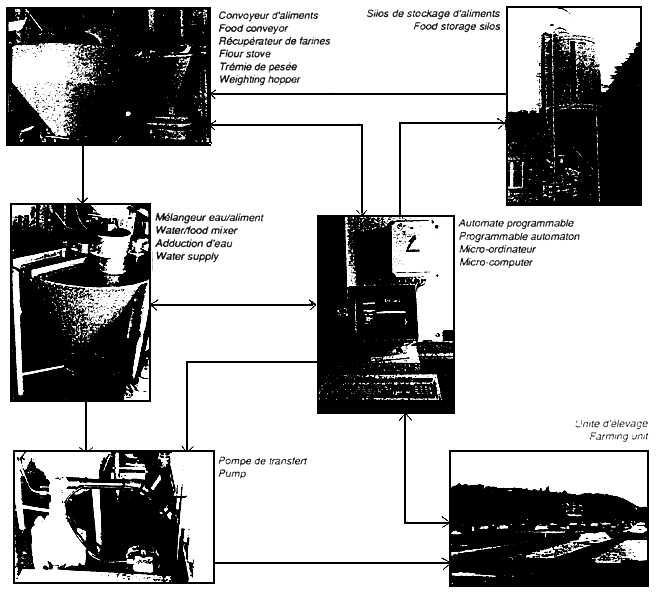
S.A.G.A.I.E.
Systeme Automatique de Gestion de l' Aquaculture Intensive et de son Environnement Automated System of Intensive Aquaculture and Environment Management
L'ifremer et la Société SEDIA ont développé et mis au point un dispositif performant de distribution automatique et de suivi d'alimentation pour piscicultures. Ce système est fabriqué et commercialisé par la Société SEDIA, sous le nom de SAGAIE.
IFREMER and SEDIA designed and developed an efficient, easy-to-operate system of automated supply and feeding control for fish farming. The SAGAIE system is manufactured and commercialized by SEDIA.
|  |
AQUASTOCK
Version 3.4
Aquastock est un logiciel d'aide à la gestion des élevages aquacoles marins, distribué sous licence IFREMER.
Aquastock permet un suivi rigoureux de la croissance par modélisation en fonction de l'alimentation pour les espèces tel que le loup, les saumons Coho et Salar, la truite, le turbot …

FONCTIONS
Aquastock permet:
1 - De connaître instantanément l'état de l'exploitation.
2 - De comparer les résultats mesurés à ceux de la modélisation.
3 - De calculer les rations alimentaires permettant une croissance optimale.
4 - De revenir sur les situations antérieures afin de modifier et de perfectionner les techniques d'élevage.
5 - D'envisager les états futures par simulation et de déterminer une stratégie d'élevage.
6 - De calculer automatiquement la composition des commandes d'aliments nécessaires à l'élevage.
7 - De calculer le prix de revient et de décider d'une éventuelle mise en marché.
Le logiciel Aquastock est conçu pour simuler la croissance animale à partir des quantités d'aliments distribuées et de la température de l'eau.
Les paramètres du calcul sont ajustés automatiquement en fonction des résultats obtenus, pour prendre en compte l'évolution de la technicité de l'éleveur et des performances des animaux.
MATERIEL
| Aquastock fonctionne sur tout micro-ordinateur compatible PC ou AT, utilisable à d'autres usages (secrétariat, comptabilité, …). | 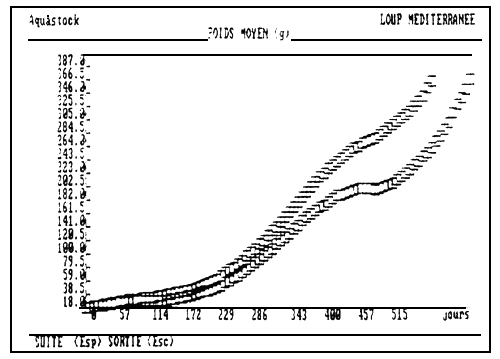 |
| Un matériel supportant le graphique permet l'exécution des fonctions graphiques, non indispensables mais particulièrement utiles. |
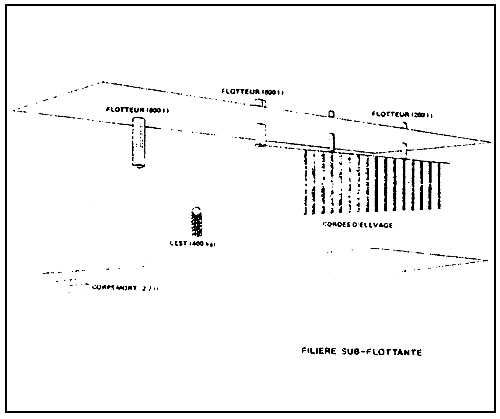
| FILIERE SUB-FLOTTANTE |
OBJECTIFS:
En liaison avec les professionnels, l'IFREMER conduit le développement de la filière d'élevage de moules sub-flottante (“SF”), spécialement adaptée aux mers à fort marnage.
Dans le but de limiter les effets néfastes de la houle sur l'élevage, les flotteurs sont de forme cylindrique et allongée : les coups de fouet imprimés aux cordes d'élevage par les mouvements de la surface sont ainsi évités.
PRINCIPE D'INSTALLATION
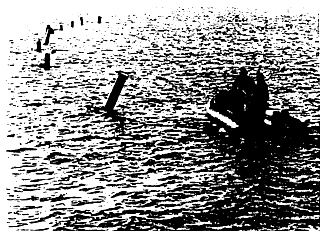
FILIERE SUB-FLOTTANTE EXPERIMENTEE AU CONQUET (FINISTERE)
CARACTERISTIQUES DE LA FILIERE :
- 4 flotteurs de 600 litres;
- 25 flotteurs de 200 litres (mis en place progressivement);
- 225 suspensions d'élevage (longueur : 6 m, soit 1350 m de support);
- aussière en cêble mixte (diamètre : 32 mm longueur : 200 m);
- production : 11 t/an;
CARACTERISTIQUES EXTREMES DES SITES D'ESSAI :
- courant : 2 noeuds;
- houle maxi décennale : 7,50 m;
- profondeur : de 8 à 35 m.
|  |
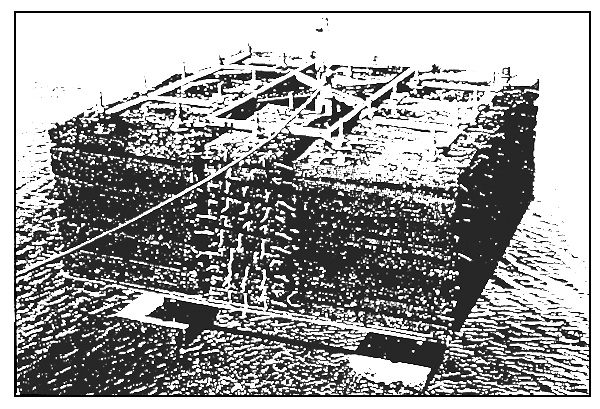
CONTENEUR MI 120
MI120 CONTAINER
| Pour capter, pré-grossir et/ou élever vos coquillages en mer ouverte, nous vous proposons le | For spats collecting, pre-rearing and on-growing of shellfish in open sea, we propose the |
| CONTENEUR MI 120 | MI 120 CONTAINER |
| qui offre : | which offers : |
| - une capacité de stockage de plusieurs types de paniers selon un agencement rationnel et compact, | - a storage capacity of several types of baskets according to compact and rational arrangement, |
| - une stabilité au retournement et au glissement qui le rend sûr par tous les temps, | - a stability to capsizing and sliding which makes it secure by any weather, |
 | |
| pour : | for : |
| - le captage des huîtres plates, | - flat oyster spats collecting, |
| - le pré-grossissement des huîtres plates, | - flat oysters pre-rearing, |
| - l'élevage expérimental des coquilles Saint-Jacques. | - experimental scallops on-growing. |
|  |
CAGE D'ELEVAGE PISCICOLE IMMERGEABLE
SUBMERSEABLE FISH-REARING CAGE
| Pour protéger votre cheptel en élevage contre ; | In order to protect your livestock against ; |
| - les conditions de mer sévères plus de 6 m de creux | - rough sea more than 6 m waves |
| - le vandalisme | - vandalism surface pollution |
| - les pollutions de surface | |
| nous proposons une cage immergeable par càble tendu | we propose the tension leg submersible cage |
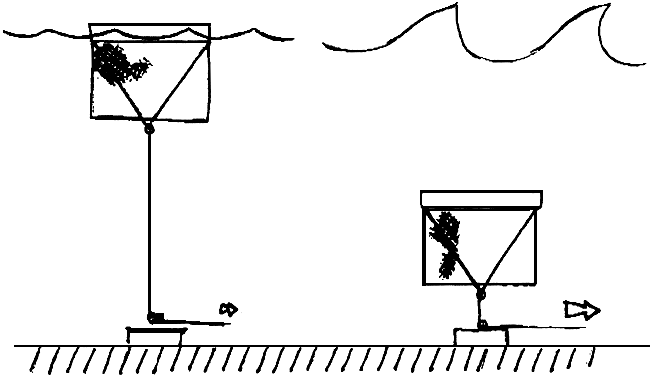 | |
| POSITION NORMALE/REGULAR POSITION | POSITION “SURVIE”/“SURVIVAL” POSITION |
| CONCEPTION (SYSTEME BREVETE) | DESIGN (PATENTED SYSTEM) |
| Le càble tire la cage vers le bas et fait office d'amarrage, il circule dans des poulles elles même fixées à des corps-morts | The cable pulls the cage towards e bottoms and plays also as mooring |
| La longueur du càble permet de régler l'immersion de la cage, Elle est déterminée soit par un treuil situé sur la berge, soit localement par un flotteur immergé plus ou moins plein d'air | The cable length, which determines the cage depth, is regulated by a winch operated from the shore or by a locally submerged float, which air volume can be adjusted. |
|  |
CAGE D'ELEVAGE PISCICOLE POUR SITE EXPOSE
REARING CAGE FOR EXPOSED AREA
| Opérationnelle depuis 1987, cette cage performante d'élevage de poissons marins est constituée de quatre casserelles articulées sur un flotteur central qui supporte le distributeur automatique d'aliment. | In operation since 1987, this efficient rearing cage for sea fishes is composed of four bridges articulated on a central float which supports the automatic feeding system. |
| Sa structure en croix, dotée d'articulations souples, permet d'étendre ses possibilités d'implantation à ces zones semi-exposées, offrant ainsi; | Its cruciform structure, equipped with flexible articulations, extends the use possibilities to semi-exposed areas, offering : |
| - une meilleure qualité de l'eau. | - a better quality of water |
| - une grande stabilité thermique d' l'eau | - a great themic stability of water |
| - peu de concurrence avec d'autres activités (pêche, tourisme, etc …) pour l'implantation de la cage. | - few competition with other activities (fishing, tourism, etc… |
 | |
| Le distributeur d'aliment programmable est autonome grâce à une batterie chargée par panneau photovoltaïque. L'aliment est ainsi reparti sur toute la surface de la cage. | The programmable feeding system is autonomous by means of a photovoltaic battery. The food is therefore spread on the whole surface of the cage. |
|  |
CAGE D'ELEVAGE EN EAUX CALMES
REARING CAGE FOR CALM WATERS
(houle ne dépassant pas 2 creux/swell not over 2 m)
| DESCRIPTION TECHNIQUE | TECHNICAL CHARACTERISTICS |
| La structure d'élevage, support de l'enceinte en filet, est composée de deux parties : | The rearing structure, support of the net enclosure, is divided in two parts : |
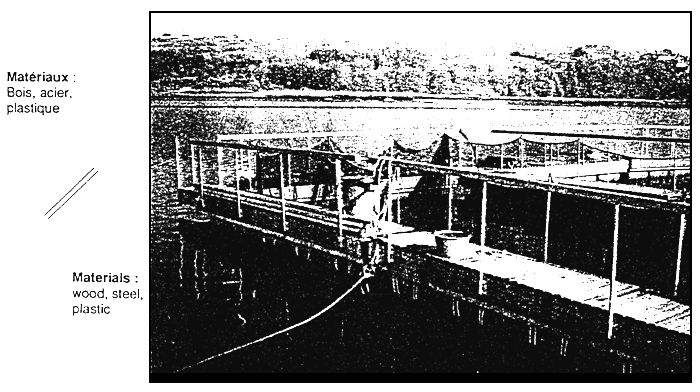 | |
| - pontons de 5 m × 0.80 m constitués par deux poutres en lamellé reliées par des ferrures d'extrémité et un platelage en bois pour la circulation | - 5 m × 0.8 m pontoons made of two lamellated gluec beams linked by extremity fittings and a wood plating for easy walk. |
| Les flotteurs sont des tûts en polyéthylène de 220). | The floats are polyethylene barrels of 220 l, |
| - éléments de jonction en acier (0,80 m). Les liaisons des différents éléments sont soit rigides (boulonnage), soit par charnières (avec axes). soit par cylindres en caoutchouc précontraints par des chaînes. | - steel junction elements (0.80 m × 0.80 m). The bonds between the different elements are either fixed (bolting), either by hinge-pin, or by rubber cylinder prestressed by chains. |
ADVANTAGES
- High production levels per volume unit
- Low investment for facilities
- Lightness and mobility of structures
- Rapidity of implementation according to the sites
- Low energy expense
- Self-cleaning
- Low draught
- Photoperiod control
- Collection of dead animals
- Reduction in feed wastes
- Possibility of distant water supply
- Possibility of livestock treatment through external access
- Feed teledistribution from shore
LIMITS
- No direct perception of livestock
- Difficult catching but sorting out possibility
SYSTEME D'ENCEINTE
GONFLABLE AQUACOLE
(S.E.G.A.)
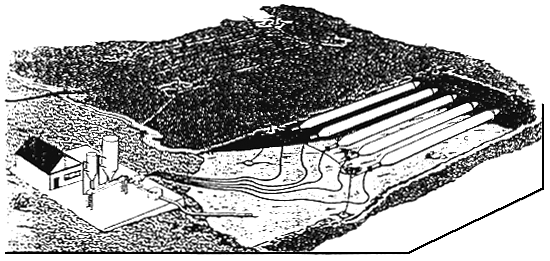 | A FARM IN ITS ENVIRONMENT |
S. E. G. A.
INFLATABLE ENCLOSURE SYSTEM FOR AQUACULTURE
|  |  |
AQUAVISION
COMPTEUR POISSONS D'ELEVAGE
FISH COUNTER
| AQUAVISION a été doté des derniers perfectionnements de la vision industrielle : une caméra voit tous les animaux qui traversent son champ, puis l'image est analysée par un logiciel qui effectue l'identification des individus et le comptage en temps réel. | AQUAVISION takes advantage of the most improvements of industrial vision. A camera sees all animals passing through its field. Then, the image is analysed by a software which identifies individuals and counts them at run time. |
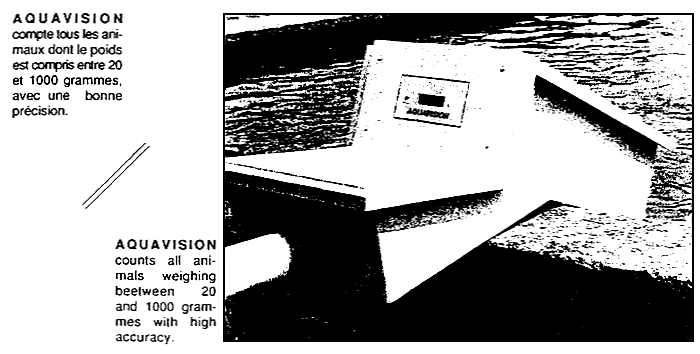 | |
| AQUAVISION doit sa précision à une fonction d'auto-apprentissage assurée par le logiciel : la taille moyenne des animaux est recalculée lors des premiers passages après remise à zéro : ce qui permet de séparer les animaux passant en groupes et d'éliminer une des principales causes d'erreurs de comptage. | AQUAVISION owes its accuracy to a self-teaching function provided by the software : the average size of the animals is re-calculated during first passages after each reset : which allows to separate grouped animals with single signature, and to eliminate a major counting error source. |
By Mr. James Young
MEDRAP II : TECHNOLOGY OF AQUACULTURE (TECAM) AND SOCIAL, ECONOMIC AND LEGAL ASPECTS OF AQUACULTURE (SELAM) SEMINAR
Tunis, 19 – 21 May 1993
“Socio-economic and legal aspects of aquaculture”
James A Young
Department of Marketing/Stirling Aquatic Resources,
University of Stirling, Scotland, FK9 4LA.
Introduction
Over recent years it has become increasingly accepted that the development of aquaculture might benefit from a wider disciplinary perspective than that traditionally associated with the subject. In particular socio-economic and related issues have been recognised to have received comparatively scant attention in the past. This deficiency is significant not least because of the role of such matters in determining the desirability and viability of aquaculture developments.
There are many dimensions to the socio-economics of aquaculture and within the confines of this paper it is the intention to focus on only a few key issues, and to illustrate useful parallels with the wider fishery sector, and with other areas of development interest. Hopefully these and other issues will arise in the course of subsequent discussion. In addressing this aim the first part of the paper is devoted to the legal aspects of aquaculture.
The Legal Framework for Aquaculture
There being no good reason to re-invent the wheel, the structure adopted in this section owes much to the perspective adopted in the excellent review by Van Houtte (1989). The process of comparing the legal framework of different countries and regions has identified considerable variations.
For enabling and development purposes, legal perspectives on an individual country basis are often require, as have been provided by the FAO Development Law Service since 1989. That apart, a basic tripartite division of countries may be made in respect of the legal framework for aquaculture. Firstly there are countries which have specific aquaculture legislation; secondly those with only some specific legislation and finally, there are those which use enabling legislation. It will be appreciated that considerable variations in the treatment of aquaculture may remain even within each of these categories.
Aquaculture Development: Some Basic Legal Issues
A number of fundamental issues need to be addressed in considering the legal aspects of aquaculture. Not the least concerns the scope of legal instruments in terms of the coverage of each type of aquaculture and the variations, if any, to be applied to different ownership structures. The identity and role of the legal authority is obviously of fundamental concern, and in particular it is necessary to clarify its position within the existing politico-legal hierarchy.
The actual form of the authorisation may also be varied to suit particular needs, conceivably ranging from a license-to-culture particular species through to the awarding of time-period or area rights. Various conditions, determined by local objectives, may also be attached to any authorisation. Information regarding past production, for example, may be used to establish any notional quota entitlement; a method some parallels in the imposition of resource management in capture fisheries. Entry to the industry may also be restricted on the basis of citizenship or other criteria such as qualifications. Authorisations may also be issued, and be renewable, for varied time periods; a situation which can introduce considerable uncertainty and temper propensity to invest. Superimposed upon these more standard criteria, special conditions may also need to be satisfied as a means of tailoring control to suit localised demands.
Legal Aspects of Land and Water Use
Particular issues tend to arise pertaining to the usage of land and water, though necessarily variations within each category will exist. Land ownership issues commonly revolve around the public or private status of the land. That under public ownership may be regarded as a common property resource to which individuals, as sections within society, may have some entitlement. Transfer of ownership to some private basis may thus result in some incurring a cost as a result of the access foregone. Interesting parallels may be drawn to events within capture fisheries and the classic analysis of the "Tragedy of the Commons".
Conflicts in land use may also result from the co-existence with other land policy measures, often established prior to the introduction of aquaculture. Policies dealing with agricultural development and land reform are commonly the source of dispute. Whilst such conflicts of interest may be inconvenient to the aquaculture sector, it is important to consider the reactions of the public who may be the ultimate market. For example, unfavourable publicity may result if aquaculture is perceived to develop a conservation site, reduce water quality or otherwise degrade the environment.
Both access to and usage of water may present a further source of legal problems due to a number of factors. For example, the legal status of ownership of the water may vary, as will those concerning access and rights to discharge. in some instances water space, formerly unrestricted in access, may become enclosed and preclude other traditional users who will then incur additional costs in finding alternative locations.
Also likely is the emergence of disputes over the introduction of property rights to formerly open access situations. For example in coastal locations an individual given entitlements to particular fish stocks may mean that some, or all, traditional harvesters of the resource may no longer be free to fish. Clearly much will depend upon the specific stipulations of any licence required; indeed the importance attached to any such licence itself will depend upon the standing of aquaculture within the hierarchy of competing resource users.
Restrictions also may apply in respect of discharge treatment and the quality of water passed on to other prospective users. In most situations water will pass through a number of different users, if not contemporaneously, then at subsequent time intervals. Protecting and safeguarding the standards of other users is thus a common prerequisite for equitable water management.
Finally, even this outline consideration of the legal aspects of aquaculture would be quite incomplete without some discussion of the key environmental issues. Interestingly, it may be noted that the attention of the fish farmer to environmental issues is increasingly important not least due to the consumers growing concern with products perceived to be“environmentally friendly” . The aquaculture industry must ensure that it does not fall prey to some of the consumer concerns raised in respect of many intensively-reared agricultural products. Whilst there is some evidence that this process has already begun, damage hitherto has been comparatively minor.
More traditional legal aspects of environmental matters may also be identified in respect of land use planning, zonation and the control over installation and operation of activities within designated areas. Control may be applied by some combination of the stick and carrot. Finite limits, representing a “tolerable” degradation of the environment, may be established with fiscal incentives, taxes and prohibitions being used to attain stated objectives, Environmental considerations may also encompass the movement of fish and measures to curtail the spread of fish diseases.
Some Conclusions on the legal Aspects of Aquaculture
Aquaculture has evolved under a diversity of legislation, comparatively little of which has been developed specifically to contend with aquaculture in isolation. Most frequently, rules and regulations have been developed and/or extended from the agriculture and fisheries sectors. Despite the apparent similarities of these respective industries, significant differences often exist and may present problems when transferred to aquaculture. Restrictions on species minimum landing size, water movement, ranching and several orders are frequent cases in conflict.
The very diversity of aquaculture legislation which has evolved to some extent also reflects the intrinsic differences which exist between aquaculture situations. Situation-specific legislation is often necessary to ensure the attainment of objectives deemed apposite to the location's needs. Neither is it surprising that aquaculture legislation may conflict with other activities. In many cases aquaculture has been superimposed upon existing systems, often with quite controversial and dynamic interactions.
The above characteristics of aquaculture have also tended to produce over-regulation. The fact that little aquaculture-specific legislation exists tends to encourage an endless sequence of legislative amendments whose contexture becomes evermore complex and inappropriate to the key tasks in hand. Again there is an interesting parrallel with the situation in caprture fisheries here. But whatever the deficiencies, the impression should not be gained that there is some ideal model “aquaculture law” awaiting uplift and implementation. But arguably there is a framework of points which, properly considered, should result in a more apposite legislative outcome than that which exists in many aquaculture developments at present.
Socio-economic Aspects of Aquaculture
In addressing the socio-economic issues, the caveat should be made once more that the constraints within this paper permit only the key matters to be discussed. The fuller significance of the socio-economic aspects of aquaculture has only begun to be recognised comparatively recently. The repercussions of this deficiency have been noted to be significant in some cases and may demand redress (Harrison,1993). Whilst this neglect may be explained by the subject's historical concern with production and related technologies, it remains the case that the success of production processes ultimately will be determined by their integration within the wider local economy and society.
Aquaculture and Fisheries
Much of the literature dealing with the socio-economic aspects of aquaculture has drawn strong parallels between aquaculture and fisheries. The validity of such comparisons however is very much dependent upon the type of aquaculture in question. In many cases the similarity extends merely to the fact that the end product is fish. For example, with inland aquaculture operations any similarity is often far closer to agriculture rather than aquaculture. This is because inland aquaculture commonly will encompass issues pertaining to land ownership and property rights.
In coastal aquaculture operations, the parallel with fisheries is much closer. Often the activity will be based upon a common property resource, although increasingly one in transition to a system of property rights. Basis industry inputs and outputs, for example labour, products and markets serviced, also tend to be much more similar.
Similarities and differences may also be identified in intensive and extensive operations. Intensive aquaculture is likely to portray rather similar characteristics to the industrial fisheries sector, or that of agribusiness. Extensive operations, on the other hand, are more akin to features found within the artisanal fisheries sector or subsistence agriculture. Whatever the similarities, analysis requires first that some consideration be given to the objectives of the aquaculture activity.
The Objectives of Aquaculture
The objectives established for aquaculture developments naturally will tend to vary between different situations and a wide range of plausible goals may thus be identified. Within this paper only the more common can be mentioned.
Aquaculture is often established with the aim of increasing National Income. Attainment of an increase in National Income however will also bring a range of other considerations; for example the distribution of benefits, compensation for the loss of traditional activities such as fishing or agriculture, or recompense for any degradation of the environment.
Related to the expansion of National wealth, aquaculture is also often established so as to increase export earnings. Concentration on production for the export market may result in a diminution in supply of particular species to the local population who cannot compete with the purchasing power of the export market.
The imbalance of power may be especially significant where availability of low-priced species is reduced. In more extreme circumstances an emphasis on exporting may reduce available protein supplies from the local food chain. Much the situation may also result where higher export earnings potential encourages the transfer of production capacity from low unit value species to those sought by the export market. Such possible outcomes suggest that aquaculture objectives must take into account the wider food policy objectives of the country. In particular it should be concerned as to how the impact of any policy decision will actually transfer down to more vulnerable, and needy, sections of society.
Aquaculture may also be established as a means of generating a number of welfare gains such as income and employment multiplier effects. Often these may occur in a region devoid of many, if any, alternative opportunities. Notwithstanding the potential significance of any such gains it should also be appreciated that usually gains cannot be achieved without some cost being incurred elsewhere and thus may warrant incorporation of some balancing mechanism.
Development of Aquaculture
The development of aquaculture, and its failure in some instances, has been the subject of much concern and many explanations have been forwarded. The role of donor agencies has figured prominently within the debate. In particular regarding the necessity and desirability of aid to develop and sustain projects.
The introductions, or adoption, of aquaculture within a particular location traditionally has been perceived by economists in terms of entry barriers. Whilst there is increasing debate over the full significance of entry barriers, it is likely that they will exert some influence in most situations. Capital barriers to entry clearly will tend to be more significant in those capital intensive operations where high entry costs may restrict participation. At the extreme capital barriers may preclude local participation and result in wholly exogenous ownership of wealth; a situation with potentially adverse implications for the local economy.
More intensive aquaculture operations will also tend to have higher technical barriers to entry. Whilst it can be expected that diffusion of knowledge will tend to lessen the significance of any barrier over time; in order to maintain a competitive advantage the firm constantly needs to remain innovative. Technical resources thus become a mechanism to maintain market power and failure to own them will result in diminished profitability and then industry exit.
Technical barriers clearly will be linked to the characteristics of the operation too, not least due to the need to maintain R & D programmes and expenditure. For example, product diversification, including production of new species, is an increasingly adopted strategy in order to avoid market saturation. Yet successful adoption of this strategy requires that the firm has the technical ability to invest in a new product sector, and with that the financial resources to fund it. Interestingly this situation has many precedents with pig cycles in agriculture and more generally within capture fisheries.
Human resources also represent a potential constraint on aquaculture development. The adoption of aquaculture may critically depend upon those currently possessed and those which can be acquired within realistic time and financial constraints. Whilst extension programmes and other training courses may provide valuable opportunities, questions must again be raised as to their opportunity cost. In many cases the more appropriate participants may not be able to attend because of their pivotal tole within the organisation. But on the other hand one may question the cost of non-participation.
Sustaining Aquaculture
Having overcome the initial barriers to the development of aquaculture, maintaining activities presents a further set of obstacles which warrant consideration. Clearly each individual success, or failure, will reflect its own particular circumstances, however some general features may be noted.
The existence of scale economies are commonly cited as a major reason for the ability of aquaculture to be sustained. Especially in capital intensive operations, expansion to a critical size is often found to be necessary so that some reduction in unit costs may be generated. In some situations constraints on ownership, due to other reasons, may preclude attainment of the necessary size. The example is often given to Norway, where the size of salmon farms had been limited in law in an attempt to restrict to any tendency towards monopoly control.
However whilst may well be some merit in exercising some control over the concentration of ownership, determination of optimal level is neither easy not static. moreover it is often very difficult, if not impossible, to determine exactly who owns whom. Covert ownership can thus render many restrictions ineffective. Even in those cases where legal ownership linkages may be controlled, larger operations may effect control over smaller units by practices such as contract growing. Scale economies thus may be attained in a variety of ways and make the task of small operation competing, and so sustaining their presence, all the more difficult.
However the existence of scale economies should not be interpreted such that expansion alone is seen as the sole route to survival. Other support mechanisms can also be implemented to encourage and develop the smaller scale operation. For instance Governmental advisory schemes provide a common mechanism whereby projects may receive a range of resource inputs. Producers may also generate scale economies trough joint and co-operative action. Producer and trade associations may be created so as to expand the collective market power of small unit. For example in the case of Atlantic salmon producers, many are currently in the process of joining a Producers Organisation so that they may control smolt production and thereby ultimately influence the market price for salmon.
In addition, co-operative actions may also be undertaken as improve activities and functions downstream in the marketing chain. Adding value to processing the product may be uneconomic for individual smaller scale operations, but in conjunction with supplies from other producers a viable capacity may be aggregated. This may extend to permit investment in more sophisticated plant and equipment thereby extending the product range and markets serviced. Similarly, co-operation in specialist distribution services may become viable on a joint-action basis.
Sustaining aquaculture development may thus demand that individual operation adopt a more unified perspective on their common needs. In many situations it needs to be recognised that there is much to be gained from joint and/or co-operative action, not least being the ability to compete with those operation which have adopted the more conventional “bigger is better” route. In addition to the foregoing, it should be emphasised that a vital corollary to ensuring that the project is sustained is some consideration of marketing.
Marketing Issues in Sustaining Aquaculture
Traditionally a rather narrow perspective on the function of marketing has tended to be adopted within fisheries and aquaculture. Often marketing has been interpreted as the selling of the finished product. More enlightened perspectives have recognised that marketing is concerned with the addition, communication and delivery of values. But what still tends to be omitted is the fact that the marketing function, as an interactive part of all the other operational systems, will have profound socio-economic implications too.
One of the characteristic features of any marketing environment is that of uncertainty. Irrespective of the quality of marketing resources within the organisation, decisions still need to contended with the exogenous forces at play. Whilst aquaculture to some extent operates in a more controlled environment than capture fisheries, uncertainty remains a significant consideration.
Market Structure
The ability to control marketing actions will also be influenced by the structure of the market. Market structure will help determine the power which an organisation may be able to exert over its competitors. Aquaculture products compete in the wider market for foods, within which there are significant concentrations of market share. Especially in the case of the North European countries, the food market is now dominated by the multiple retail outlet (MRO) or supermarket chains.
Although MROs do create the opportunity to target increasingly large numbers of end consumers, it must also be recognised that they may present a constraint to market penetration. Restrictions may arise since smaller aquaculture operations sometimes are unable to meet volume, quality, delivery and other specifications at the price offered. The imbalance in market power may thus suggest that smaller individual producers might seek other ways to circumvent the downward pressure on price which will face them. Although MROs are currently less dominant in Southern Europe, their importance is growing rapidly.
Marketing Management
Having identified some of the exogenous variables at play, it should also be emphasised that an effective marketing function demands productive management. Ultimately the aquaculture producer is concerned with producing products which convey value to the fish consumer. Exactly what gives value to consumers will change over time, for example as witnessed in the current emphasis upon healthy eating. To ensure ongoing delivery of value thus demands marketing information about the consumer and the target market.
Data collected through the various routes of marketing research should be assimilated so as to ensure the supply of a product delivering values currently sought and identification of new product opportunities. As other organisations within the food market, aquaculture must respond to changing consumer demands. Within these fundamental goals the aquaculture enterprise might also seek to increase the value added. This combination should ensure a greater chance of the operation longevity and with that an ongoing stream of socio-economic benefits to the local economy.
Environmental Considerations
Socio-economic gains also demand that the marketing function is responsive to wider issues of concern to consumers. A good example of this is found within the growing environmental concerns of consumers. Green issues have become of central importance and the potential vulnerability of aquaculture to the “cruel food” lobby should be both recognised and prepared for.
Notwithstanding the private costs and benefits which result from environmental issues, the much larger and wider social costs and benefits clearly must also be recognised. The possible risks of environmental degradation resultant from intensive aquaculture suggest the need to incorporate a more holistic perspective in planning aquaculture operations. There is a need to consider the implications for other users of the resources rather than just the aquaculture producer in isolation. For example, shrimp monoculture in Indonesia's mangroves has generated gains for some but only at considerable cost to other former users.
Conclusions
In the course of this brief overview of some legal and socio-economic aspects of aquaculture a great number of issues have been touched upon. That such a number of different issues is necessarily incorporated within, what constraints demand is, only a brief paper is testament in itself to the interdependence of socio-economic phenomena.
It may be argued that recognition and understanding of the interdependence of the various disciplines and related phenomena in aquaculture remains a goal yet to be fully achieved. Whether through technical and scientific myopia in the past, or a perceived lesser need, aquaculture is coming round to recognise the wider contributions to be made. This more holistic perspective in encouraging and is warranted, as evidenced by the diversity and importance of socio-economic phenomena discussed.
Acknowledgement
Thanks are due to Dr James Muir, Institute of Aquaculture, for a number of valuable comments in the preparation of this paper.
References
Harrison, E (1993) Aquaculture in Africa: Socio-economic Dimensions. School of African and Asian Studies, University of Sussex
Van Houtte, A R, Bonucci, N & Edeson, W R (1989) A Preliminary Review of Selected Legislation Governing Aquaculture Aquaculture Development and Coordination Programme ADCP/REP/89/42 FAO Rome.
