

by Mr.S.R. Coppola
FAO - November 1991
INFORMATION SYSTEM FOR PROMOTING AQUACULTURE IN THE MEDITERRANEAN
S I P A M
SYSTEM OVERVIEW
2. System Overview: Objectives and Characteristics
This paper presents the components of the proposed information system and explains the most important elements related to them. This preparatory work, along with the conceptual design, will enable an appropriate system analysis to be undertaken to match the identified functionalities (in terms of Objectives and Requirements) with the actual products, techniques and data/information available. For a better understanding of the technical terminology used in this report a glossary of computer terms is given in Appendix 2.
2.1. The Objectives
The primary objective of SIPAM is to provide the MEDRAP project, and through it the countries adhering to the project and associated countries, with an instrument and a methodology for rapid and targeted access to data and information of different types and form different sectors and sources. This technology will allow all users to establish their own “made-to-measure” research procedures tailored each time to suit their requirements.
A by-product of this System will be the exchange of data and information between peripherals (Countries/End-user Centres) and the centre (FAO/MEDRAP project) putting in motion a process of feedback.
In order to rationalize the development and implementation of the system, enhance the possibility of its success, increase its use by and interest of all parties concerned, the system will be made up of three Basic Modules:
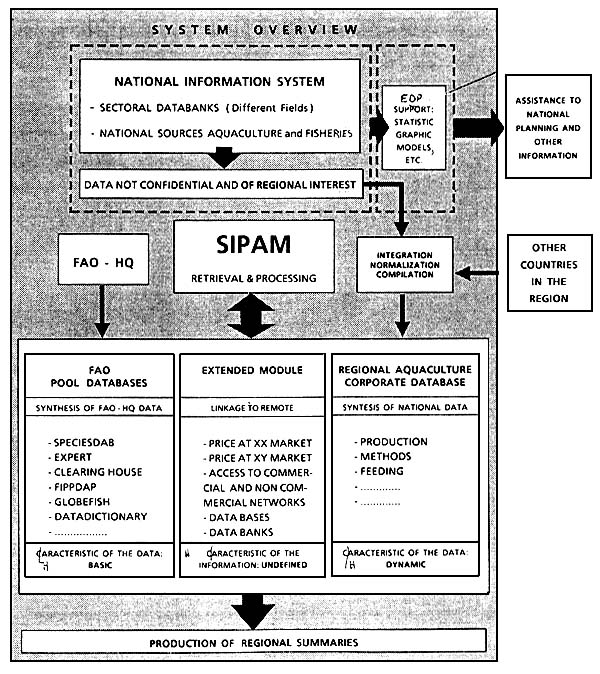
- To permit each country access to the regional data, the project will design and implement a REGIONAL Module and put at the disposal of the countries available information in a readily accessible manner. This module with be fed with non-confidential data and information of regional interest which each country has put at the disposal of the project.
- Alongside the regional sub system, the project will develop an FAO-HQ Module containing and managing some of the FAO officially-distributed databases.
- As complementary data, an EXTENDED SIPAM Module containing information from other data sources external to MEDRAP and FAO will be developed. In this Module data from commercial and non-commercial remote networks may also be considered if found necessary and useful for the completeness of SIPAM.
The overall SIPAM system will work using data and information in a structured and standardized mode to allow exchange and aggregation for textual, analytical and graphical manipulation.
Figure 1 presents the Sipam System Overview, whereas Figure 2 is an outline of a typical retrieval process around which the system will be designed.
However, all MEDRAP and associated countries, regardless of whether they are “data donors” or “information recipients”, will the same information system.
2.2. The Characteristics
The first qualifying characteristic of the proposed system is the basic role of the end user in its design and implementation. It is emphasized that the system will be mainly designed by the users themselves, based on their concrete need, and will not follow the normal logic of data dissemination per se.
The second peculiarity is that each country will continue to be free to install and manage its own Data Bases or Information Systems. The project may eventually be asked to assist interested countries in developing data entry procedures, or automatic data capture interfaces, in downloading/uploading national data (manually or automatically) into the regional sub-system.
A third characteristic variable is that countries will not be burdened with requests for additional Data Collection Operations to feed this System. However, it is clear that if a country/institution has no on-going data collection system covering items of information within a certain application, the Regional Module (aggregation of national information) will not contain its data.
INFORMATION SYSTEM FOR AQUACULTURE PLANNING
IN THE MEDITERRANEAN
S I P A M
SIPAM - Conceptual design
Fig. 1 - System Overview
INFORMATION SYSTEM FOR AQUACULTURE PLANNING
IN THE MEDITERRANEAN
S I P A M
DECISION MAKING PROCESS
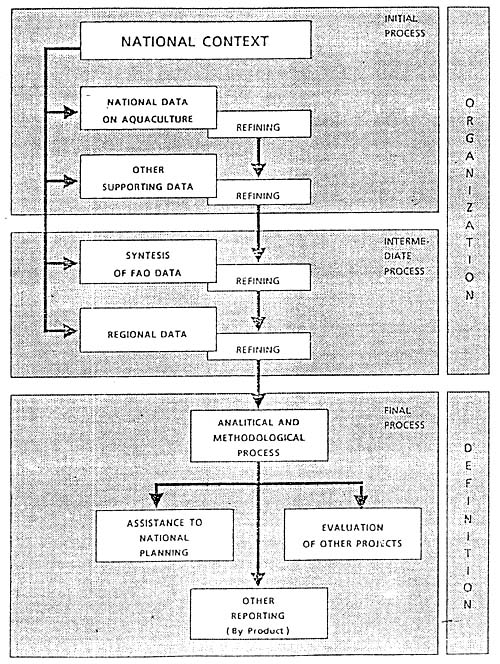
Fig. 2 - Decision-Making Process
3. The Conceptual Design
The Conceptual Design phase must identify the objectives and requirements of the SIPAM Information System.
This is a delicate phase because it immediately precedes the very important one of system analysis where the objectives and justifications have to have been already defined. The system analysis phase will, in practice, define the feasibility and at what cost (in terms of resources, risks, etc.) the project can be implemented.
Once the objectives and goals have been defined, the information system SIPAM can be seen as being made up of the following components:
A predefined architecture
A set (assembly) of human resources
A set of automatic and manual instruments for the collection, aggregation, retrieval and processing of data
A set of procedures and techniques to meet the objective
A predefined data-information model.
3.1. A predefined architecture
As described in the following section, the System will be constructed using a totally open architecture, i.e., a modular architecture. SIPAM will be composed of “blocks”, each defined by its area of application. The blocks will not be bound to interact to specific external specifications (hard/software); instead, it will be possible to tailor each block to different external formats as necessary according to the interfacing systems (hardware/software platforms) all converted to the same format.
This approach has the advantage of enabling the System to be developed stepwise with the possibility of adding to and expanding the elementary modules. It also enables more than one building team to work on different part of the System independently and simultaneously. In fact, in the development of the overall System, different tasks will be assigned to different units.
The SIPAM Structural Hierarchy will be as follows:
SIPAM Information System : A Relational Data Base Management System (RDBMS) to manage a collection of three Base Modules as well as two Accessory Modules, one for Data processing operations and one reserved for System maintenance.
The Five Modules are the following :
REGIONAL MODULE
FAO-HQ MODULE
EXTENDED MODULE
DATA PROCESSING MODULE
SYSTEM MANAGEMENT MODULE
Each Module is a collection of many Elements each representing one Stand-alone Application of various types:
Numerical Application
Bibliographic Application
Descriptive Retrieval
Graphical Application
Data Communication
Data Base Management Application
Access to Commercial Analytical/Graphical/WordProc. Tools
Access to Specialized Analytical/Graphical/WordProc. Tools
System Maintenance Routines
etc…
Each Element of the Base Modules will consist of three standardised functions:
Interphase To Source of Data
Perform Pre-defined Retrieval/Processing Functions
Output To Pre-defined Formats (Screen/Paper/Export)
The Data Flow will be the following:
| From/To | MEDRAP National Coordinators with SIPAM HQ |
| From/To | FAO-HQ with SIPAM HQ |
| From/To | MEDRAP National Coordinators with End-Users |
| From | Remote DataBases To SIPAM HQ |
| From | External Networks To SIPAM HQ |
| From/To | Remote SIPAM Work-Stations with SIPAM HQ |
| From | KeyBoard To SIPAM |
Import/Export Data will also follow a pre-established time pattern. Data should be captured, complied, normalized and distributed for three different time schedules:
| Yearly/Monthly | For static and little dynamic data |
| Weekly/Daily | For dynamic data |
| Occasionally | For permanent data (Reference Files),Occasional data, etc. |
and constitute three different Up-loading procedures. Data uploading and down-loading must be made according to type, frequency and use of the information, regardless of whether it is aquaculture data, fishery data or complementary data.
3.2. Human Resources
Three major components are normally involved in the design and implementation of any Information System.
| DESIGN UNIT | DEVELOPING UNIT | END USERS |
In the SIPAM Concept, the above become reorganised as follows:
The Design Unit
Each of the applications to be developed (Elements) will be considered as stand-alone applications with certain INPUT/OUTPUT or LINKAGES constraints to be fitted into each of the Modules.
The design unit is composed of the following:
The Tasks of the Design Unit
This group of experts, coordinated by the SIPAM System Manager, will decide which applications should be developed and the priorities, as and when required.
Once an application is identified, the design unit will prepare in detail the Application specifications which should contain inter alia:
Objective: Stating why that item was considered to be a particular interest.
Possible Source of Data:
Users of Particular Interest:
Data Entry Format:
Data Manipulation:
Data Retrieval Format:
Suggestions:
Constraints:
The SIPAM System Designer should assist this unit at the beginning in order to establish a consistent working method. It is not important that a data processing expert assist the unit at the outset of the work.
To be successful the design unit should foresee the optimum that can be obtained from a certain type of data/information, and design the INPUT/OUTPUT requirements as if they were to be carried out manually. It is also recommended to always bear in mind the scope, type and mature of the data to be entered into the system.
The Developing Unit
Once the Application has been conceived, the Analyst and/or Programmer will translate the requests into a software tool. At this moment modifications or suggestions may be incorporated into the original design.
For the successful implementation of this work it is imperative that the project provides the services of a full-time System Manager. This person, who does not necessarily need to have informatics or aquaculture qualifications, will ensure the correct and timely execution of all phases of the programme for the development and implementation of this system. The terms of reference of this officer are given in Appendix 3.
In addition to the System Manager, the project has to foresee the following personal inputs:
- Top-level analyst/computer programmer Consultant for the development of the Regional Module (based in Rome, FAO HQ or MEDRAP HQ).
- Contract for a computer programmer to assist in assembling the FAO Module into SIPAM (based in Rome FAO HQ).
- Programmer to ensure the system maintenance, undertake data downloading/uploading, train regional and national experts in the use of SIPAM, participate in the development, improvement and maintenance of the system (based in MEDRAP HQ).
- consultants to prepare reports and technical material.
Each country participating in this activity should involve national aquaculture planning and computer programming experts in this exercise as required.
The End-Users
The end-users can be classified by group according to the position they occupy and the field of their interest. The major end-user group is the staff of the fisheries and aquaculture service in the various national offices in the Region who will be using SIPAM mainly for reporting and planning purposes, but also to answer queries from their private sector. This group is also the most important one for data supply. Among a second group of end-users are aquaculturists, economists, fishery specialists, investors and traders in the industry, trade, and educational institutions, in both the public and private sectors. The SIPAM National Coordinator should organize its own national end-user group.
3.3 Automatic and Manual Instruments
This system will be designed as an integrated information system, that is a homogeneous system in which the end-user is not aware that it is built of different basic elements. It is important to note that in designing this system the end-user and his needs, and not the wish to produce one more instrument of data dissemination without a pre-established target, are the main consideration.
For reasons of compatibility with FAO standards, and for other technical and operative reasons, the networking hardware is configured around a platform based on the INTEL 80386 micro-processor family. The elements that need to be integrated to constitute the network through non-rigid connections are of a different nature and effort.
- At the system architecture level national, international and FAO environments used have to be made colloquiable.
- At the structure level different connecting protocols (interphases) to manage products coming from different environments need to be developed both for the input/output procedure and for the format and structure of the data.
- At the function/service level data format interchange with applicative software (standard commercial software ) and connection to different peripherals such as printers, scanners, modems, as well as electronic mail, must be foreseen.
At this level the different national working languages to be used in the system must also be taken into account. Therefore, the system will be provided with a multi-language data dictionary to allow quick and standardized user interfacing.
The system will be developed, both in the centre and at the periphery, on identical hardware in order to optimize the products and ensure the network performance. The configurations described in Appendix 1 do not necessarily need to be completed at the beginning of the project since they have been designed to be expanded as necessary although they all have to be completed and fully operative by the third phase of the working plan (see Work Plan and Schedule of Work).
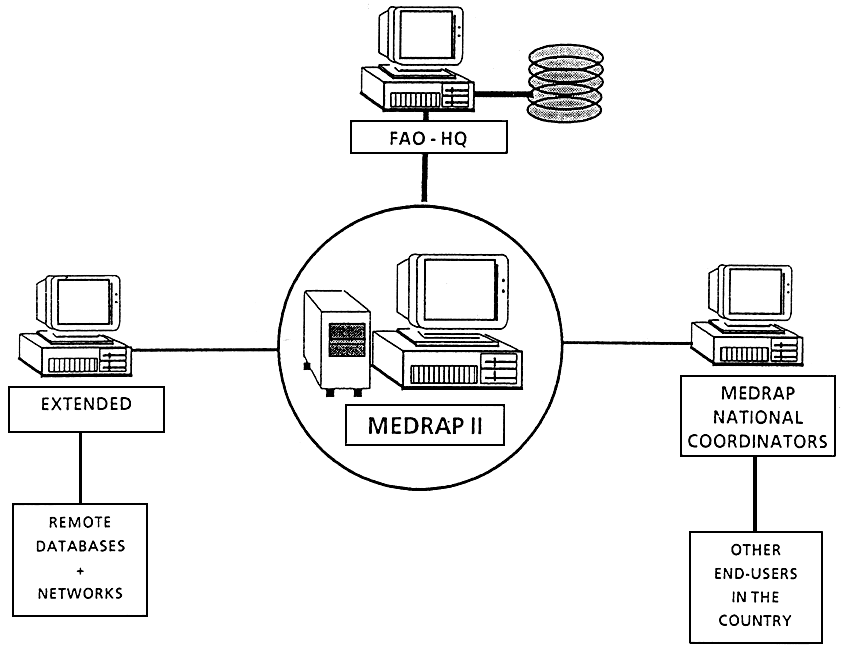
The system architecture will be designed on a “STAR” pattern with non-rigid connection in which the centre of the STAR represents the manager/server and the points represent the users. The System will have two operational levels one in the centre and one at the periphery. For an easier understanding of the above pattern a chart follows (Fig.3). In this particular case the system is developed around a network in which the centre of the STAR is represented by the MEDRAP project headquarters where the System Manager/server pilots all the applications at regional level. At the edges of this STAR are the countries and other end-users in the region. The Network is complete with two more connections, one representing the link to the FAO Fisheries Department SIPAM back-stopping team as Data/Information Supplier/Receiver, and a second one to an ideal node to connect remote databases and Networks.
The hardware configurations of the work-stations forming the project network are given in Appendix 1.
SIPAM-Conceptual design
Fig. 3. SIPAM - Regional Desk Information Network
3.4 A Set of Procedures
The development of the software is strongly influenced by the structural design of this network (STAR) which has been conceived to allow the integrated system to be developed in a modular way independently from the two levels of implementation. To make full use of the above structure a slightly unconventional approach has been chosen in the development of the system. The first level network which covers the project headquarters, FAO-HQ and the remote centres applies a so-called “TOP-DOWN” strategy. This strategy is typical of a vertical initiative in which, without taking too much account of the final characteristics of the user, the application is developed and imposed. For the application of this strategy the initial components (FAO databases with their ‘known’ specifications and environments) of the system are known beforehand. The FAO information module will be developed and implemented using this strategy and will be distributed by the project headquarters to the end-user centres.
The national centres will manage the flow of the data between the various national sources of data and themselves and will be responsible for the interfacing procedures (installation, training, setting-up, etc.) to the Regional Module. This Module, to be developed in the SIPAM Headquarters (regional information module), will have the dual task of interacting with the project headquarters and with the country. Since this module is strongly dependent on the various national contexts, a “BOTTOM-UP” strategy is applied. For this, a methodology which permits the identification of many simple problems and their solution independently is applied. This module will therefore be developed by consolidating and expanding the system, both in dimension and application, as new blocks are added from the bottom upwards. This is a strategy where the analyst does not need to know initially all the situations he will be faced with (different national contexts).
One of the most interesting features of this programme of work at the cooperation level is the direct involvement of national personnel and the end-users in the development and system enhancement of the Interfacing Modules. This approach (to use national staff) is considered a basic condition for the success of the programme of work during and after project implementation.
The software to be developed is limited to that for the management of the FAO and regional information modules and the input/output protocols for uploading/downloading FAO and regional databases, maintenance systems and the interphases with the various and different national systems. Towards the end of the project procedures for tele-maintenance and tele-updating via modem through a “carbon copy” approach, both from Rome FAO-HQ and from the project headquarters in Tunis, should be in place. This approach will allow the System Manager to temporarily control the remote work station through a modern and special software.
The analytical function of the system, as well as the word processing, statistical analysis, graphics, project management, etc., will be carried out in one area of the system (Data Processing Module) which will make use of commercial software possibly standard within the FAO family. This Module may also contain programs and procedures developed by the project to allow standardized and repetitive data processing, report generation, etc. The commercial software may be integrated with built-in macro instructions to perform certain operations.
For the SIPAM software development, dBase IV is the selected Relational Data Base Management System, Not only because it is an internationally accepted de facto standard, but also because many FAO applications, as well as national applications, have already been developed using dBase. For the supporting software the use of the following, classified as FAO standard is foreseen:
| Word processing (Multi-language) | Word Perfect 5.1 |
| Spreadsheet | LOTUS 123 |
| Graphics | Harvard graphics |
| Statistical package | STATGRAPHICS |
| Project management tool | MS/project |
| High-level language (only external routines) | BASICA/PASCAL/C … |
| Aquaculture Planning Tools | To be decided |
The above packages are acceptable at the time of writing and, in any case, are only indicative and may be changed and/or added to at any moment.
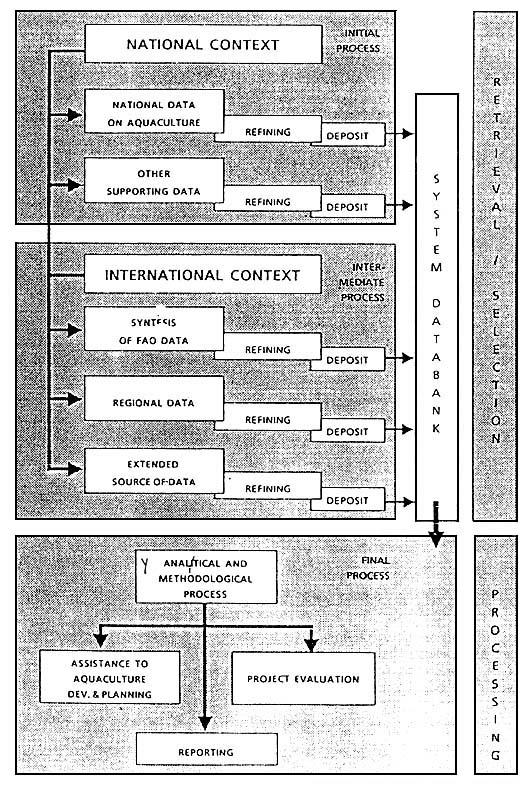
The functional process of the system (Fig. 4) will follow the same pattern as the Decision-making Process shown in Figure 2.
INFORMATION SYSTEM FOR AQUACULTURE PLANNING
IN THE MEDITERRANEAN
S I P A M
OPERATIONAL PROCESSING CHART
SIPAM - Conceptual design
Fig. 4. Operational Processing Chart
3.5 Pre-established Data Information Model
The data information flow will be developed within a strategy defined by a working group, composed of national, regional and project experts, which will indicate the information needed. The major concern here is the possible inadequacy of some national infrastructures to support the proposed strategy and the obligation to provide additional resources for this work. The data/information flow will grow in a selective manner without duplicating existing work already carried out by other organizations/institutions. The members of the working group will be in contact with each other to identify and disseminate information of interest from various national, regional and international sources. At this point the project must make a great effort, both in the research of data/information and in reaching agreement with the various institutions, to obtain authorization to receive and utilize the data/information needed.
In fact, as far as the relationship with FAO is concerned, this subject is regulated by Director General Bulletin No.90/22, and is the object of discussion by a working group set up by the Director-General to give guidelines on this matter. The project MEDRAP will be responsible for obtaining the data/information alimenting the FAO Information Module (FAO sources).
Regarding the national data/information to be integrated in the sub-regional and regional systems (Regional Information Modules), the national coordinators will be responsible for obtaining such authorization. However, the project should prepare a standard draft letter of agreement between the project and the national institution concerned or other supplier of data to be used as a basis.
It is essential for the present and future life of this system that all data entering the SIPAM network be appropriately authorized.
The data/information model used in this system will be of a complex type (Fig.5), i.e., data and information are linked at three levels. At the basic level the data collected through a system is processed and published according to given methodology, standards and frequency (output).
At the second level, some of the information produced at the basic level becomes data (input) to be processed and analyzed together with data and information coming from other sources within the same field
At the third level (complex model), some of the information produced at the basic and second levels becomes data (input) to be processed and analyzed together with data and information coming from sources of a different nature.
Figure 5 is the complex data information model shown which assembles all three levels.
DATA INFORMATION MODEL
COMPLEX MODEL
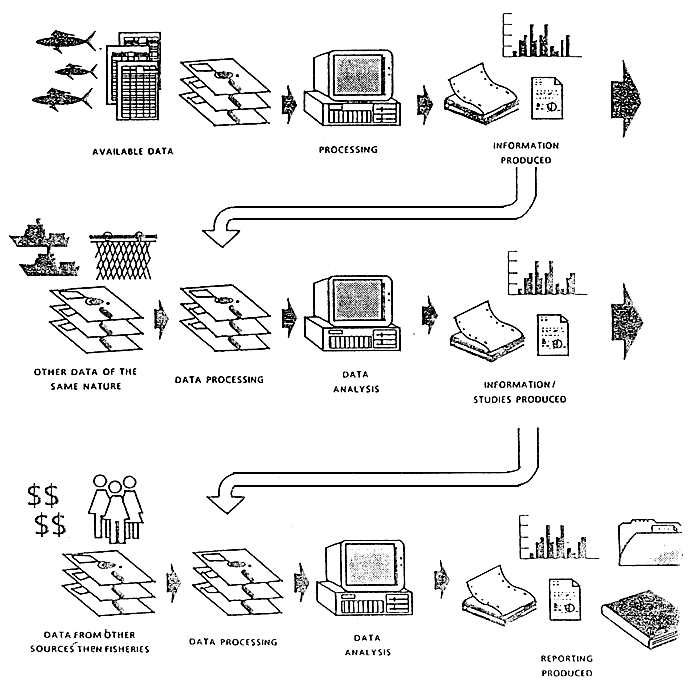
Fig 5. The Complex Data Information Model
4. Work Plan and Schedule of Work
The MEDRAP Project (through its Headquarters in Tunis), FAO-HQ backstopping and few selected countries within the Project area, will launch a programme of work with the aim of establishing an Integrated Information System to assist national and regional operators in the field of aquaculture. This target will be accomplished by:
- developing the methodology and providing a tool to collect and process in a systematic way information useful for aquaculture development in the region. In addition to their own compiled data, the countries will have direct access (from the same work station) to regional data and FAO data
- designing and implementing a Regional Module to put regional information at the disposal of the countries in a readable and comparable format. The Regional Information System will be alimented with non-confidential national data of regional interest which each country has put at the disposal of the Project
- designing and implementing an FAO Information Module which will incorporate all the available authorized FAO data-bases of interest to this programme of work
- designing and implementing a network linking remote sources of data and networks with the EXTENDED SIPAM Module through automatic data transmission
- assisting the selected countries in the use and maintenance of the system
- extending the network whenever possible to other countries and other selected end-users
Time Schedule:
Preparatory work : December 1991 – June 1992
Discussion review and approval of the above design
Ordering of the remaining computer equipment
Identification of few countries to be included in the pilot Regional Information System
Identification of possible source of funding
Complete delivery and installation of the remaining work-stations Identification of a retrieval approach (Terminology, function, Keyboard usage, logic data selection flow, etc.) most commonly used in a Desk Information System in the selected countries
Inventory of all pertinent national, regional and international data/information available for possible inclusion in SIPAM
Analysis of the immediate needs and the available national data in the selected countries
Phase I - System Design and Development : July 1992 – June 1993
Design and implementation of the pilot FAO Information Module
Design of the Regional Information Module
National coordinators of the selected countries reorganize output from national data/information systems into the SIPAM National Information Module structure (With advice from the MEDRAP Project)
Development of interfacing protocols to integrate national systems into the Regional Information Module
Revision and implementation of the Regional Information Module
Preliminary testing, evaluation and validation of the two Modules
Setting-up the pilot EXTENDED Module through arrangements and contracts with governmental and non-governmental institutions for direct access to their on-line DataBases and Networks. The information captured from these systems will be treated according to the agreed contract and processed with the same logic as in the other two Modules
Integration of the three Modules into the system
Phase II - Evaluation/Revision/Improvement: July – December 1993
Delivery to and installation of the full configuration in the selected Centres and countries (training, etc. included)
Evaluvation of the delivered system
Revision and improvement of the system
Delivered of associated documentation.
An additional phase may be envisaged before delivering the System:
Phase III - Consolidation/Expantion: January – June 1994
Expansion of the coverage of the system
Installation of the system into some other centre and/or countries
Completion of the System by finalising the EXTENDED Module.
The work-plan will be completed with analysis and evaluation of the whole programme of work, delivery of final documentation and finally by setting-up a SIPAM on-line accessible network (anticipated 6 months).
5. Expected budget
For the first year of implementation of SIPAM (phase I) the following resources should be allocated :
| US $ | |
| Full-time SIPAM System Manager to coordinate all EDP and non-EDP activities - duty station SIPAM HQ | 36 000 |
| Full-time Computer programmer SIPAM System development Assistant - duty station SIPAM HQ | 24 000 |
| Consultant/contract high-level Analyst programmer (regional module) - duty station Rome HQ - SIPAM HQ | 12 000 |
| Consultant/contract computer programmer (FAO module) - duty station Rome HQ | 3 000 |
| Preparation of Reference Manuals | 5 000 |
| Hardware already purchased by MEDRAP | 40 000 |
| Hardware to be completed | 20 000 |
| Purchased of special software | 3 500 |
| FAO backstopping missions (4) | 10 000 |
| End-User WG Meetings (2 × 5 persons) | 25,0001 |
The above estimates refer to a system using one working language only (English or French). Should the system be “translated” into other languages (i.e., (English/French, Arabic), this component should be evaluated separately by the project.
APPENDIX 1
Hardware Configuration for the Work-stations forming the project Network
Server/Manager work-station, 1st level (project HQ)
IBM PC or 100% compatible with the following characteristics:
- Desk top type
- CPU 80486 at 33 MHz 4MB RAM expandable
- Colour monitor 14" VGA card
- 1 M.disk drive unit 1.44 Mbytes 3.5"
- 1 F.disk drive unit 1.2 Mbytes 5.25"
- 1 H.disk drive 100 Mbytes or more - Acc.time < 30m.sec
- International advanced keyboard 102 keys
- 2 Parallel ports
- 1 Serial port RS232C
- Bus mouse Microsoft or Microsoft compatible
- 1 back-up tape unit
- 1 Modem Haynes compatible 960/1200/2400 band rates
- 1 Advanced Arabic keyboard
- 1 Advanced French keyboard
- 1 Matrix dot printer wide carriage (136 chrs) with NLQ capability/24 pins/260 chrs/sec IBM/EPSOM compatible parallel interface
- 1 Laser printer HP Laserjet III compatible parallel interface
- 1 Scanner HP SCANJET compatible
System Development, 2nd level work-stations (Project HQ)
It is strongly advisable to parallel the above microcomputer with another one similar in characteristics and lower in performance (because of cost) to be used for system development, as server back-up unit, and for other duties to be assigned.
IBM PC or 100% compatible with the following characteristics:
- Desk top type
- CPU 80386SX at 16 MHz 2 Mbytes RAM expandable
- Colour monitor 14" VGA card
- 1 M.disk drive unit 1.44 Mbytes 3.5"
- 1 H.disk drive 100 Mbytes or more - Acc.time < 30m.sec
- 1 International advanced keyboard
- 1 Parallel port
- 1 Serial port RS 232C
- 1 Bus mouse Microsoft or Microsoft compatible
- 1 Modern Haynes compatible 960/1200/2400 band rates
- 1 Matrix dot printer wide carriage (136 chrs) with NLQ capability * 24 pins *260 chrs/sec* IBM/EPSON compatible* parallel interface
Backstopping, Training, Seminars, Demonstrations etc., 2nd level work-station (Project HQ)
IBM PC or 100% compatible with the following characteristics:
- Portable type
- CPU 80286 at 12MHz 640 Kbytes RAM Expandable
- 1 Back lit L.C: monitor VGA compatible
- 1M.disk drive unit 1.44 Mbytes 3.5"
- 1 H.disk drive 20 Mbytes Acc.time < 30 m.sec
- 1 Parallel port
- 1 Serial port
- Travel accessories (bag/batteries, etc.)
- 1 Diconix or Canon portable printer with travel accessories
2nd level work-station (National centres)
IBM PC or 100% compatible with the following characteristics:
- Desk top type
- CPU 80386SX at 16 MHz 2 Mbytes RAM expandable
- Colour monitor 14" VGA card
- 1 M.disk drive unit 1.44 Mbytes 3.5"
- 1 H.disk drive 100 Mbytes or more - Acc.time <30m.sec
- 1 International advanced keyboard
- 1 Parallel port
- 1 Serial port RS 232C
- 1 Bus mouse Microsoft or Microsoft compatible
- 1 Modern Haynes compatible 960/1200/2400 band rates
- 1 Matrix dot printer wide carriage (136 chrs) with NLQ capability * 24 pins *260 chrs/sec* IBM/EPSON compatible* parallel interface
FAO HQ Rome (for system design, datacommunication and feedback)
One project 2nd level work-station temporarily located in the backstopping Division (FIR). This system will be delivered to one of the end-users on completion of the work.
NOTE. All work-station will be provided with identical software covering:
- DOS Operating System (Rel 5.xx)
- Word processing
- Spreadsheet
- Data Base Management System
- High level language
- Data communication software
- Tools
- Specific applications software
APPENDIX 2
GLOSSARY
Application program -- Computer program that performs an end-user function, rather than a system-oriented function.
ASCII files -- Files in which the individual characters are represented according to a numerical code (and its internal representation as a binary numbers) that conforms to the American Standard Code for information interchange. such files are widely used to transfer data between different hardware and software environments, ASCII was created for this purpose.
Backup -- The process of making secondary copies of a file or files in the event that the original becomes damaged.
Configuration -- The assortment of equipment (disk, diskette, terminal, printers , etc.) in a particular system.
Computer network -- An interconnection of computer systems, terminals, and communication facilities
Data -- Known facts, numbers, letters and symbols for storage and manipulation by a computer system expressed in character form. Data can be though of as the basic elements of information used, created or otherwise processed by an application program.
Data communication -- The movement of coded data from a sender to a receiver by means of electricity-transmitted signal.
Datafield -- A group of memory or screen locations within a database that are logically linked to hold information of a given kind . Typically, the user may regard datafields as a place to store a certain kind of data.
Database -- System of arranging data in structured way in a computer system, for user access or for processing by application programs.
Dataset -- A series of data elements or units of information that are logically arranged in a particular format.
Datasheet -- A printed page on which data are arranged according to a specific format.
DOS -- An acronym for Disk Operating System, the program used in the microcomputer environment to control the use of hardware and integrates the use of this hardware so that is available to software applications.
Down-loading -- Data/information transfer from a central level system (Organization HQ) to peripheral systems (Departments)
Driver -- A software program that controls the action of a peripheral device not otherwise controlled by the operating system.
Export -- The transport of data out of a application. Typically, this will involve translation from the internal format of the application to a variety of alternate formats that may be used by other programs as input. (see also import)
File -- A collection of logically related records or data treated as a single item.
Format -- The way in which data are physically arranged in a file.
Hardware -- A term used to indicate the physical part of a computer, such as the keyboard, memory, printer, monitor, as opposed to the software.
Export -- The transport of data into an application. Typically, this will involve translation from the format of the external application into the standard used by the ongoing application.
Information -- Data that are communicated
Interface (Hardware) -- An electronic assembly to enable two computer systems to communicate with each other (wired).
Interface (Software) -- Series of programs that allow the system of exchange data from one format to another.
Main Menu -- A horizontal bar that presents the user with a series of choices, one of which will be selected to perform that activity.
Menu System -- A kind of program design that uses a sequence of choices that permit the user to choose among them by pressing a key (usually the Enter key). These choices are arranged on the screen much as a restaurant menu presents a series of selections.
Operating System -- The software program that controls the various parts of a computer (keyboard, screen, hard drive, printer, etc.) and puts them to work together to perform useful work. SIPAM will work on computers which use the PC-DOS or MS-DOS operating system.
Non-rigid connection -- A type of manual file transfer between computer systems through removable supports (diskette, tape) occasionally carried out.
Package -- A set of computer programs tied together through a menu system.
Platform -- A computer, its peripheral devices and activities working together.
Procedure -- A specific program or task to which a computer solution can be applied
Record -- A collection of related data items.
References File -- Authority files containing reference variables such as country codes, names and attributes; item codes, names, attributes etc.
Relation Database -- A file or system of files used to contain data that is structured to permit the data to be readily input and output. When constructed of multiple files, relations between individual data fields in the different files can be linked to permit data in one field of one file to act as means of retrieving information ion one or more data fields in the other file or files.
Rigid connection -- Type of connection in which a group of computer systems are connected to each other by communication lines to allow automatic and controlled file transfer at regular intervals.
Software -- Computer algorithms (programs) that are written in a computer language that make the computer (hardware) perform work (write to the screen, print, sort, etc.).
Up-loading -- Data/information transfer from peripheral systems to a central system
APPENDIX 3
TERMS OF REFERENCE FOR SYSTEM MANAGER
Under the general supervision of the Project Director and the System Designer and the overall guidance of the SIPAM User Working Group (UWG) be responsible for all the data administration function to build up the proposed information system SIPAM.
In a particular be responsible for:
- Nominating, coordinating and leading the SIPAM UWG
- In close collaboration with the Analyst Programmer consultant prepare the system design of SIPAM environment.
- In close collaboration with the Analyst Programmer consultant, and following the advice of the UWG, prepare the design of the various elements composing the regional module
- Organize, plan, coordinate and support all the activities related to the development of SIPAM
- Monitor the development and implementation of SIPAM
- Be responsible for requesting and receiving the necessary approval for using data/information
- Organize and distribute the appropriate documentation
- Perform other related duties as required
QUALIFICATION
University degree in statistics, or computers science, or economics, or mathematics
Proved professional experience in data administration
Working knowledge (level C) of English, French, Spanish or Arabic and limited knowledge of one of the other three
Knowledge of data processing and data analysis methodologies
Knowledge of Micro computers operation and RDBMS (Relational Data Base Management Systems)
APPENDIX 4
TERMS OF REFERENCES FOR ANALYST PROGRAMMER
Under the general supervision of the Project Director and the direct supervision of the Manager provide technical assistance for the development, maintenance, and distribution of the information system SIPAM.
In particular be responsible for:
- Assisting in the design, development, tuning and maintenance of the various modules of the system
- Performing and testing developed procedures
- Assisting the end-user to assess the new system
- In close collaboration with the Data Manager, developing and maintaining the data dictionary, technical documentation and related technical and procedural manuals.
- Performing other related duties as required
QUALIFICATION
University degree in computer science, or electronic engineering or closely related field of specialization.
Proved professional experience in EDP.
Working knowledge (level C) of English, French, Spanish or Arabic and limited knowledge of one of the other three.
Good knowledge of data processing methodologies and techniques.
Ability to use Micro computers and basic software products such as WP, Spreadsheet, dBase and some high-level language.
Ability to write clear and concise technical documents and reports.
