

ISLAMIC REPUBLIC OF IRAN
Shilat, the Fisheries Department of the Islamic Republic of Iran (IRI), is presently entrusted with a national programme of reconstruction in line with overall Government policy. To this end, a Unilateral Trust Fund (UTF) project financed by the IRI and administered by the Food and Agriculture Organization of the United Nations (FAO) was established in April 1992 with the objective of strengthening the technical and managerial capabilities of the fisheries sector, including the capture and culture sub-sectors, with a focus on the Iranian Fisheries Research and Training Organization (IFRTO) under Shilat.
In order to identify specific elements for the design of the aquaculture component of the UTF Project, the IRI requested FAO assistance, through the Technical Cooperation Programme (TCP), for a rapid diagnosis of the aquaculture sector to arrive at priorities for its development. The TCP Project was signed in February 1992.
The resulting FAO-TCP mission, consisting of a mission leader (aquaculture planning), an economist, a feed specialist and a geneticist, visited the IRI from 23 September to 5 October. The specific terms of reference of the mission members are provided in Annex I. On the request of the Shilat, the terms of reference of the feed specialist and geneticist included specific duties dealing with selected problems of immediate concern to the Shilat. The related reports are appended as Annexes 2 and 3.
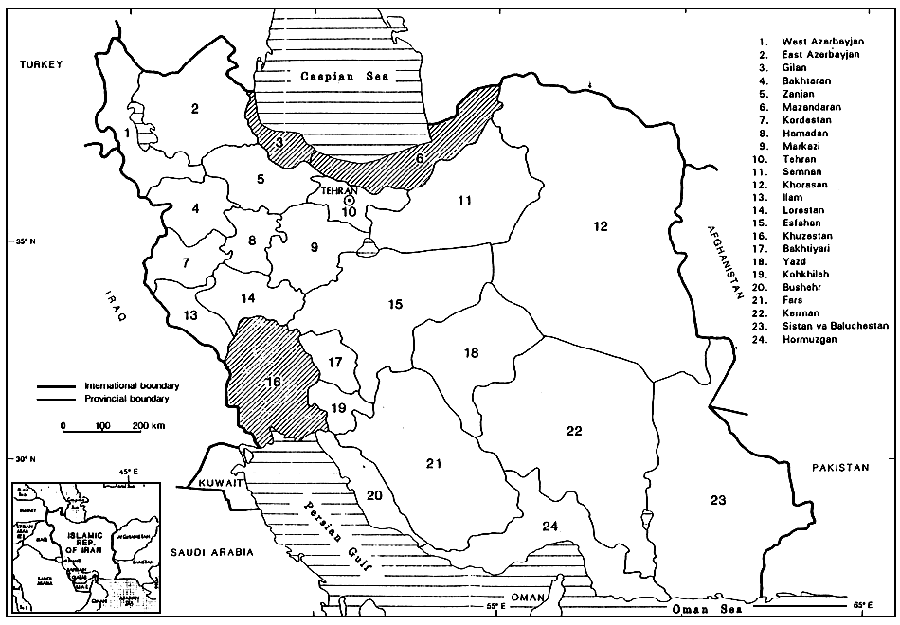
The team conducted field visits to the Provinces of Gilan, Mazandaran and Khuzestan (see Map), which account for 80% of the total aquaculture production in the IRI. In the field, interviews were held with staff of the Shilat provincial offices and of the Mirza Koochek Training Centre in Gilan Province, farmers, hatchery operators and fish traders (see Annex 4 for persons contacted).
Since carps are the predominant species in aquaculture (97% of total production in 1990), field interviews were largely focused on carp culture in the above mentioned provinces.
The analysis of the aquaculture sector presented in this report is based exclusively on information obtained by personal interviews. Background material, requested by FAO in advance of the mission, was not ready in time and the results of a recent aquaculture survey conducted by the Shilat in 1991 were not made available to the team.
As a result, the description of the present situation should be considered tentative and should be confirmed and refined through in-depth surveys at farm level through the existing UTF Project.
2.1.1 Basic economic indicators
The IRI covers an area of about 1.6 million square kilometres and has a population of about 57 million, which has been growing at an annual rate of just over 3%; population density is thus about 36/km2. Its Gross National Product (GNP) per capita was about US$ 2 450 in 1 990, but was expected to be lower in 1991 due to the large effective depreciation of the Rial in that year, The most important sectors in terms of contribution to the GNP are services, industry (oil contributes 50% to the overall industrial sector) and agriculture. Consumer price inflation is estimated at about 19% (World Bank, 1991).
2.1.2 Natural setting
The IRI can be divided into five major geographic zones: (i) the Iranian fertile crescent in the northwest and west (Lorestan, Kordestan and Azerbayjan), with good and reliable rainfall which supports herding and rainfed agriculture; (ii) the southern area from Khuzestan to the Persian Gulf, with a hot climate and scanty rainfall, although the valley of Khuzestan has large areas of good soil under irrigated agriculture; (iii) the central plateau and the low land drainage area adjacent to Afghanistan and Pakistan, comprising a salt and sand desert; (iv) the northern Khorasan with fertile soils and irrigation, but climatic extremes; (v) the Caspian coastlands and the northern slopes of the Alborz mountain range which receive 1 000–1 200 mm of rain per year and sustain a prosperous agriculture.
About three fourths of the country receive less than 250 mm of annual rainfall and about 40% of the crops are irrigated. Plans for irrigation expansion have been established and most of the water sources not yet used have been already claimed for crop cultivation.
2.1.3 Administrative division
The IRI is administratively divided into 24 provinces, 195 townships and 498 districts. Population is relatively well spread; populated provinces in rank of importance are: Teheran (5.3 million), Khorasan (3.2 million), East Azerbayjan (3.2 million), Mazandaran (2.4 million), Esfahan (2.2 million) and Khuzestan (2.2 million).
Fisheries in the IRI is relatively well developed, particularly the marine sub-sector, which in 1991 engaged about 67,000 fishermen; inland fisheries involved about 5 600, mainly part time fishermen in 1991; aquaculture (largely carp and some trout cultivation) engaged about 4 400 fish farmers.
Estimated total fish production for the period 1985–1989 is shown below.
Fish Production* (metric tons × 1 000)
| Source | 1985 | 1986 | 1987 | 1988 | 1989 |
| Marine | 96 | 122 | 170 | 189 | 209 |
| Inland** | 22 | 30 | 42 | 47 | 50 |
| Total | 118 | 152 | 212 | 236 | 259 |
**lncludes aquaculture production
Total fish production for 1 991 is reported by Shilat to be about 350 000 mt, mainly sold in the domestic market. Per capita fish consumption is presently estimated at about 5 kg, just over 1 kg of which appears to be freshwater fish. The major fish markets are in the provinces of Gilan, Mazandaran, Teheran, Khuzestan, Hormuzgan and Bushehr,
The Government's policy for the fisheries, livestock and poultry sectors is aimed at increasing protein production to meet domestic needs. For the fisheries sector, this is mainly to come from aquaculture, which has the largest potential for further production increase. So far, Government's policy objectives for the overall protein sector have been pursued through direct as well as indirect subsidies. It is understood that Government is presently reconsidering the subsidy approach; as a consequence, feed (mainly imported) subsidies for poultry and livestock have been significantly reduced.
