


The study has developed under three phases (shown in figure 2-1). Vulnerability and Adaptation (V&A) profiling of the major vulnerable livelihood groups have been developed under several layers of methodological measures/ initiatives and in four sequential phases. In each phase, respective outputs have contributed towards the overall composition of the vulnerability and adaptation profiling.
Firstly: Review of secondary information and description of geophysical features of the study area.
Secondly: Reconnaissance field visit, elaboration of the methodology for the investigation and implementation.
Thirdly: Field assessment (comprising of PRA/RRA sessions, upazila and district workshops and key informant interviews), and
Fourthly: Analysis and document of the findings. The activities of each phase are diagrammatically shown in the figure below.
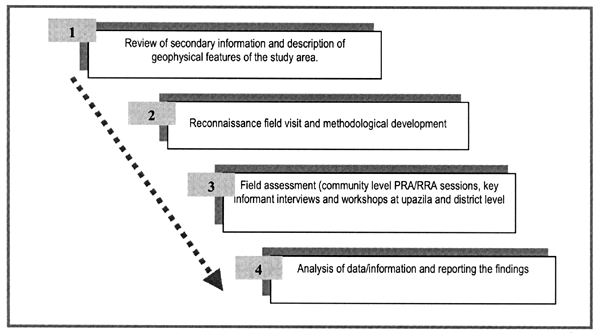
Figure 2-1. Sequential progression of four phases of the study
Focusing on the study objectives and the major study questions, the present study primarily devised with both quantitative and qualitative nature of investigation. Primarily in devising the physio-geographic features of the study area, the study developed a quantitative account and made use of existing secondary sources of available data.
In identification of the major vulnerable livelihood groups the secondary statistics from standard national statistics were used as well.
The vulnerable livelihoods profiling exercise (also some least vulnerable groups to see contrasts) on the other hand were devised largely following the innovative analytical framework of “Sustainable Livelihoods Framework (SLF)” from which rich qualitative understanding of the local realities have been developed. In these exercise, the major intention was to identify and understand the qualitative enriched intrinsic characteristics of the local livelihoods, their vulnerabilities and their adaptive strategies. A more detailed profiling of the agriculturally based livelihood systems was clearly outlined for practical implications.
In developing such profiles of the livelihood systems, climatic vulnerabilities, adaptive practices and institutional domains the question of ‘representativeness’ was addressed through “multi-layer-multi-stakeholder validation and triangulation”. In addressing the representativeness of the study findings, a “gradual up scaling method” based on various levels of validation (from individual to community and from upazila/district to national level) and “triangulation of multiple methodological techniques” of information collection -- such as PRAs, Key Informant Interviews, Community Sessions, matrix administration etc. -- have been conscious adopted as opposed to any strictly quantitative procedures of statistical representativeness.
In the following section (also outlined in the Table 2-1), the study methodology is outlined by detailing out the methodological measures that were applied in different phases.
Table 2-1. The methodological measure, issues, tools and sources
| SL | Objectives | Analytical Issues | Methods/tools used | Sources | ||||
| 1 | Physical descriptions and of secondary review | - | Geographical locations | - | Secondary review | - | BMDA, DAE, NWRD, BWDB, SRDI, and so forth. | |
| - | Humidity | |||||||
| - | GIS based analysis | |||||||
| - | Temperature | |||||||
| - | Rainfall | |||||||
| - | Rainfall surplus-deficit | |||||||
| - | ET -Ground water | |||||||
| - | Land physiography | |||||||
| - | Soils | |||||||
| - | Drainage class | |||||||
| - | Water bodies | |||||||
| - | Agriculture landuse | |||||||
| - | Major crops | |||||||
| 2 | Assess local perceptions of climate hazard, past and present climate risk/impact | - | Local perceptions on climatic hazards | - | Community level PRA sessions | - | Primary field data. | |
| - | Local perceptions on impacts of various climatic risks/ hazards in the present situation | - | Interviews | |||||
| 3 | Study livelihood systems and establish livelihood profiles of the major vulnerable groups considering household categories (Land less, marginal, small, medium, large) their subgroups (if any) in 12 villages, a non-vulnerable group should also be profiled. | - | Hazard characterization | - | Community level PRA sessions | - | Primary field data | |
| - | Composition of livelihoods activities | - | Interviews | |||||
| - | Vulnerability factors | - | Upazila level workshops | |||||
| - | Temporal connotation of vulnerabilities | |||||||
| - | Impact of drought on livelihood activities | |||||||
| - | Local knowledge | |||||||
| - | Drought hazard management measures | |||||||
| 4 | Investigate about current and past (30 years) adaptive responses and coping strategies of the vulnerable groups to risks in particular climate risk. | - | Various types of adaptive practices and responses existing in the study area. | - | Community level PRA sessions | - | Primary field data. | |
| - | Interviews | |||||||
| - | Upazila level workshops | |||||||
| 5 | Review the mandates, actual roles and capacities of communities and local institutions/ organizations (including local government agencies and self-help groups) in disaster prevention preparedness, as well as the service they offer and resources they can plan with. | - | Following the existing methodologies developed in various earlier studies with FAO. | - | Interviews | - | Primary field data. | |
| - | Upazila level workshops | |||||||
| - | District workshops | |||||||
The study activities have started with the review of secondary information. The secondary review of the study was carried out looking at the various sources of information relating to three major domains.
Geo-physical features of the study area [major sources are: NWRD, SRDI, DAE, BMDA and so forth];
Relevant climate change adaptation related guidelines [e.g. guidelines on APF, NAPA etc.];
Relevant climate change and adaptation related publications in Bangladesh;
Existing project/study publications for Livelihoods and institutional profiling [e.g. National Water Management Plan (2005), CEGIS-SSDP (2005) study, CEGIS-FAO (2004), CARE (2002 and 2004) and so forth.];
And other relevant literature and secondary sources of information.
The study field activities have started with a reconnaissance field visit to the study upazilas. From 11-14 July, 2005 CEGIS study team has visited all the study upazilas and all then prospective study villages. Some the major outcomes of the study were as follows:
Visit all four upazila field locations for observation of the field situation.
Visit all 12 villages of the study area for finalizing village selection.
Introductory discussion with the all four upazila and district DAE offices.
Identification/selection of the study villages.
Raw field findings for developing context based methodology and field instruments/protocols.
Identify locations of the field sessions and workshops.
Discussion with the community people and some key informants.
Identification of the major vulnerable groups in the community
Follow up to the reconnaissance field visit the study team members have developed a detailed work-plan and forwarded to FAO and DAE for suggestion and clearance. The detailed work-plan then updated and the field activities have been planned with National Subcomponent Manager and other officials for organizing the field sessions and workshops accordingly.
An exercise of identification of the major livelihood groups has been performed by the CEGIS study team during the reconnaissance field visit (11–14 July, 2005). The major livelihood groups emerged in the study area are as follows:
Farmer (small/marginal/large)
Wage labourers
Petty traders/businessmen
Fishers (very few in numbers and primarily seasonal)
Large businessmen (can be considered as least vulnerable)
From this initial identification of the livelihood groups existing in the study villages major livelihood groups and vulnerable groups have been selected. Detailed discussion on the selection process and relevant statistics are outlined in the Chapter 5 of the report.
The twelve study villages have been pre-selected by the project and finalized to include in the study during reconnaissance stage. The villages are selected from all four study upazilas. From each upazilas both the irrigated and non-irrigated areas are considered. In each upazila two villages have been selected from the non-irrigated areas of the upazila and an irrigated village has been selected. The names of the villages and their categories are shown in the Table 2-2.
Table 2-2. Selected study villages by category
| Sl. no. | Village | Union | Upazila | District | Category |
| 1 | Basuldanga | Sapahar | Sapahar | Naogaon | Non irrigated area |
| 2 | Bahapur | Sapahar | Sapahar | Naogaon | Non irrigated area |
| 3 | Chachahar | Tilna | Sapahar | Naogaon | Irrigated area |
| 4 | Sobhapur | Nithpur | Porsha | Naogaon | Irrigated area |
| 5 | Saharada | Tentulia | Porsha | Naogaon | Non irrigated area |
| 6 | Chhaor | Chhaor | Porsha | Naogaon | Non irrigated area |
| 7 | Bara Dadpur | Parbatipur | Gomastapur | Nawabganj | Non irrigated area |
| 8 | Malpur | Parbatipur | Gomastapur | Nawabganj | Non irrigated area |
| 9 | Prasadpur | Rohanpur | Gomastapur | Nawabganj | Irrigated area |
| 10 | Ajhair | Kasba | Nachole | Nawabganj | Non irrigated area |
| 11 | Shibpur/Siala | Nachole | Nachole | Nawabganj | Irrigated area |
| 12 | Bakail/Basbaria | Nizampur | Nachole | Nawabganj | Non irrigated area |
The vulnerable group profiling and institutional analysis in this study has been developed focusing the study objectives. The methodological measures for the present has been developed both: a) taking experiences from the already established methodologies that are applied in the context of Bangladesh (e.g. CEGIS May 2004, CEGIS-DAE-FAO May 2005), and b) trying out innovative vulnerable group profiling approach to develop climate change specific vulnerability analysis that are useful for assessing climatic hazards and adaptive practices/responses at a local level.
Under the present study the vulnerable group profiling has been instrumented through:
Carrying out community level PRA/RRA sessions;
Carrying out upazila/district level workshops;
Key informant interviews; and
Community level observations and visual depiction through photography.
The institutional analysis was developed through:
Reviewing of relevant documents, policies and publications;
Carrying out community level PRA/RRA sessions;
Carrying out upazila/district level workshops;
Carrying out open discussions with relevant institutional professionals and local knowledgeable persons, and
Field observations by the researchers.
In each community session, discussions have been held with major livelihood groups in the community. Representatives of the various livelihood groups were present in the community level PRA/RRA sessions. In these sessions, intensive discussions were generated on the pre-devised matrices (see in the annex section for details) were filled out by the facilitators.
CEGIS team comprising experienced participatory appraisal facilitators have facilitated the discussion. These community sessions assessments were carried out adopting participatory approach and methods. This allowed participation of the vulnerable groups and inclusion of their respective community perspectives in a more pro-active interface. The primary focus was on the qualitative data but was converted to the matrices that ultimately allowed quantitative figures as well. The field team prior carrying out the field assessments have been trained in house by the study lead anthropologist on administering participatory tools and techniques in the field work.
In each of these sessions, a dedicated “note-taker” has been appointed for detailed documentation. In each community sessions a cross section of approximately twenty participants have participated. The community sessions were held at selected village locations.
In the upazila and district level sessions focus has been dual. In the upazila level workshops upazila level line agency professionals were present in the workshops. On the other hand in the district workshops district level officials of relevance participated. Some representatives from the upazila offices of respective districts have also participated in the district workshops.
Both the livelihoods and institutional issues along with adaptation issues (with possibilities) have been discussed in detail in these formal workshops. In the upazila workshops both matrices and the discussions were inspired. These sessions also remained participatory in nature.
Two district workshops were carried out in the study after completion of the four upazila level workshops. Taking a gradual scalling up approach the community and upazila level session findings were shared in these district workshops. Additional needed data and information have also been collected in these district workshops following “Delphi method” (through cards). At district level, more policy level issues have been collected to develop greater understanding of the vulnerability and the adaptation of the respective districts of the study area.
Additional to the community sessions and upazila level workshops, key informant interviews were carried out with various relevant people and professionals. Interviews were usually carried out in a “one to one” mode, “one to many mode” and in many cases with more “elderly informants/members of the community” as well. Some interviews were carried out with female members as well. Usually, after each community sessions researchers sat with respective key informants for such interviews in a more suitable locations preferred by the informants. Key informant interviews were carried out with relevant: a) institutional (i.e. agency) resource professionals, b) local knowledgeable people, c) livelihood group members; d) female members, and e) other associated people. Approximately over thirty such key informant interview sessions were carried out sporadically in four upazilas of the study area.
2.9.1 Organizing sessions and workshops with DAE offices
Prior collection of information from the field, the team members went to the field location again on 5 July, 2005 for organizing the community level field sessions and upazila workshops with the local upazila DAE offices and particularly with the respective SAAOs (earlier known as Block Supervisors) of the study area. The CEGIS field team has taken a formal “letter of invitation” from the National Subcomponent Manager requesting to participate in the participatory field information collection workshops and sessions. The respective SAAOs have been provided with a fixed amount of honorarium for their respective days of services in organizing the field activities and facilitating roles. This allowed the SAAOs the necessary field movements that were needed to organized the field activities with the CEGIS team.
2.9.2 Community level sessions and upazila workshops
The field information/data collection activities in terms of three following methodological measures have been carried out from 10 to 15 July, 2005. During this time CEGIS team carried out following number of activities:
12 community level session
The field activities, the CEGIS field team worked in three groups where each team comprised of following members:
A facilitator from CEGIS,
A note-taker from CEGIS,
Respective SAAO,
Community representative(s) for the workshop, and
Observer/monitor (CEGIS/FAO/DAE).
A total of 406 participants attended the community sessions and upazila sessions. The details of the field sessions and workshops are shown in the following Table. The gray shaded rows are used for demarcation of upazila and district workshops that are of more formal nature.
Table 2-3. Details of the field sessions and workshops by dates
| Date | Type of Session/ workshops | Venue | Name of Professionals | Number of participants | ||
| CEGIS | DAE | MONITORS | ||||
| 10 July, 2005 (Sunday) | Community session (Malpur) | Mulpur bazaar, Gomastapur | Md. Akbar Ali & Kazi Kamrul Hassan | Md. Mainul Haque (SAAO) | Atiq Kainan Ahmed (CEGIS) | 44 |
| Community session (Prasadpur) | Prasadpur UP member's house, Gomastapur | Md.Aminur Rahman Shah & Susanto Paul | Md. Rabiul Islam (SAAO) | Depandra Mohon Saha (UAO, Gomastapur) | 25 | |
| Community session (Bardadpur) | Bardadpur School, Gomastapur | Md. Abdur Rashid & Bhudeb Sarkar | Md. Ashan Habib (SAAO) | Atiq Kainan Ahmed (CEGIS) | 25 | |
| 11 July, 2005 (Monday) | Community session (Basbaria) | Basbaria School, Nachole | Md. Akbar Ali & Susanto Paul | Md. Golam Murtoja (SAAO) | Atiq Kainan Ahmed (CEGIS) | 25 |
| Community session (Sialia) | Community Location, Nachole | Bhudab Sarkar & Abdur Rashid | MD. Aminl Islam (SAAO) | Atiq Kainan Ahmed (CEGIS) | 24 | |
| Community session (Ajhair) | Community Location, Nachole | Md. Aminur Rahman Shah & Kazi Kamrul Hassan | Md. Motiur Rahman (SAAO) | Abdul Mannan (FAO) and Atiq Kainan Ahmed (CEGIS) | 22 | |
| 12 July, 2005 (Tuesday) | Community session (Basuldanga) | Basuldanga,School Sapahar | Md. Akbar Ali & Kazi Kamrul Hasan | Ranjit kumar Shingha (SAAO) | A.B.M. Mustafizur Rahman (UAO, Sapahar, DAE), Abdul Mannan (FAO), and Atiq Kainan Ahmed (CEGIS) | 39 |
| Community session (Bahapur) | Bahapur School Sapahar | Md. Aminur Rahman Shah & Abdur Rashid | Denischandra Sarkar (SAAO) | Abdul Mannan (FAO) A.B.M. Mustafizur Rahman (UAO, Sapahar, DAE) and Atiq Kainan Ahmed (CEGIS) | 25 | |
| Community session (Chachahar) | Chachahar Madrasha, Sapahar | Susanto Paul & Bhudab Sarkar | Saydur Rahman (SAAO) | A.B.M. Mustafizur Rahman (UAO, Sapahar, DAE), Abdul Mannan (FAO), and Atiq Kainan Ahmed (CEGIS) | 23 | |
| 13 July, 2005 (Wednesday) | Community session (Sobhapur) | Community Location, Porsha | Md. Aminur Rahman Shah & Kazi Kamrul. | Md. Mahatab Uddin (SAAO) | UAO, DAE (Porsha) | 25 |
| Upazila level Workshop (Gomastapur) | Upazila Parishad Hall RoomUpazila: GomastapurDistrict: Nawabganj | Susanto Paul & Bhudev Sarkar | All respective SAAOs. | Depandra Mohon Saha (UAO), Abdul Mannan (FAO), and Atiq Kainan Ahmed (CEGIS) | 29 | |
| Upazila level Workshop (Nachole) | Upazila Parishad Hall RoomUpazila: NacholeDistrict: Nawabganj | Md. Akbar Ali & Abdur Rashid | All respective SAAOs. | UNO (Nachole), Md. Mizanur Rahman (UAO, DAE), and Abdul Mannan (FAO), | 16 | |
| 14 July, 2005 (Thursday) | Upazila level Workshop (Porsha) | Upazila Parishad Hall RoomUpazila: Porsha District: Naogaon | Susanto Paul & Md.Aminur Rahman Shah | All respective SAAOs. | Md. Rafiqul Islam (UAO, Porsha), Abdul Mannan (FAO), and Atiq Kainan Ahmed (CEGIS). | 22 |
| Upazila level Workshop (Sapahar) | Upazila Parishad Hall RoomUpazila: SapaharDistrict: Naogaon | Abdur Rashid & Kazi Kamrul Hassan | All respective SAAOs. | TNO (Sapahar) A.B.M. Mustafizur Rahman (UAO, DAE, Porsha). | 17 | |
| Community session (Saharanda) | Community Location, Porsha | Md. Akbar Ali & Bhudeb Sarkar | Md. Joynal Abedin (SAAO) | - | 25 | |
| 15 July, 2005 (Friday) | Community session (Chhaor) | Community Location, Porsha | Md. Akbar Ali Kazi Kamrul Hassan | Md. Ganioul Islam (SAAO) | - | 20 |
| Total no. of participants in the community sessions and upazila workshops = | 406 | |||||
Source: CEGIS study database (2005).
2.9.3 District level workshops and central validation meeting
The CEGIS team jointly with ADPC has organized two district workshops where the team presented field findings according to the study objectives for validation and also collected some additional data for further analysis.
A central level validation meeting was also held at DAE headquarters where a cross section of fifteen agency representatives, researchers and central officials participated and validated the study findings at a central level. The draft final report was also circulated to various groups for comments and the comments were incorporated in the final (present) document.
Table 2-4. Dates, venue and participation related information of the district workshops
| Date | Districts | Venue | Name of Professionals | Number of participants | ||
| CEGIS | DAE | MONITORS | ||||
| 16 August, 2005 (Tuesday) | Nowabganj | RHRI Hall Room, Chapai Nawabganj. | Atiq Kainan Ahmed, Ehsan Hafiz Chowdhury, Akbar Ali and Sushanto (CEGIS). Dr. Silvaraju (ADPC) | NPD, DD-DAE Chapai Nowabganj, all respective UAOs and SAAOs. | Mr. Tariqul Islam (UNDP) and Dr Mahmudul Islam (FAO). | 42 |
| 17 August, 2005 (Wednesday) | Naogaon | DD-DAE office Hall Room, Naogaon. | Atiq Kainan Ahmed, Ehsan Hafiz Chowdhury, Akbar Ali and Sushanto (CEGIS). Dr Silvaraju (ADPC) | NPD, DD-DAE Naogaon, all respective UAOs and SAAOs. | Mr. Tariqul Islam (UNDP) and Dr Mahmudul Islam (FAO). | 38 |
| Total participants in two district workshops = | 80 | |||||
Source: CEGIS study database (2005).
The information collected through the workshops and the review of secondary data was analyzed by the research team. Standard analytical process for analyzing qualitative and quantitative data/ information was developed.
In developing the data analysis for qualitative raw data, standard spreadsheet analysis and GIS based technologies based on ARCGIS were used. The analysis of descriptive statistical figures was also developed with spreadsheets. Several types of prioritization and rankings were also performed using such software.
In order to develop qualitative analysis and synergies several standard applied anthropological methods were used. Standard code based methods, use of Microsoft access and compilation of field regular notes were generated to develop comparative analysis and primary accounts.
In order to reach adequate understanding of the local patterns of practices a strong concentration on the visual applications were used. A collection and preservation procedure of regular field photographs with thematic connotations has been adopted. This allowed presenting the findings in more visual manner of the local contexts and meanings.
