


The risk perceptions of the livelihoods groups and community among the non-irrigated and irrigated areas of the pilot study villages have been discussed in this Chapter.
The risk perceptions are developed on the basis of the information collected from the fieldwork carried out in the eight selected non-irrigated villages and four villages with irrigation facilities under the four pilot study upazilas in Nowarbganj and Naogaon districts.
The perception of people towards the current and past risks in the study area was found of various natures. Some of the perceptions that were found persisting relating to risks in the area outlined in the section below.
These perceptions are of community people and of members of the study livelihood groups and based on their local and indigenous understanding of the reality in their given geo-physical settings. Hence, the local understanding and perceptions needs to be read in association with their given “geo-physical and environmental niches” as well as with their “cultural settings” in which they live in.
People perceive that the current climate (which is of a “longer period” than the “weather”) in the area has been behaving differently from the past years. The elderly peoples of the study area have frequently referred earlier days were the better days (the past 30 years) in terms of the climatic conditions are concerned.
People perceive that the seasonal cycle (locally called rhituchakra) has changed from the past. Where in past years it used to be six distinct seasons in the year, in the present days the number of seasons have reduced to upto 3 or 4 seasons in a year.
A large number of people have pointed out that the climatic conditions in the study area have changed due to the God’s will (khodar ichaay) and the way out - the rainfall is also in the God’s hand (akasher pani allar haatey).
People also perceived that the drought is more frequent now that before.
People's perception towards drought in the area also equates with few other issues such as: a) consecutive non-rainy days (locally called ana-bristi), b) dryness (locally called shukna), c) lack of deep tube-well facilities (a more recent connotation) and so forth.
It is perceived that the incidence of pest and disease incidences have been increased in the recent time than the past. It was identified that people connote this incidences with the introduction of High Yielding Varieties (HYV) rice and the frequent occurrences of droughts.
People also identified that although the production of rice (HYV) and yield have increased comparing to the earlier practiced local varieties of rice but the increase in the drought situation has actually increased the loss of production as well.
People also identified that the average temperature has increased in the area in the summer season. While in the duration of winter season has shortened on one side and the severity in some winter days are often felt increased.
It is also perceived locally that the cultivation and production of winter vegetable and mostly the growth and production of major fruits, several varieties of mango in particular remained affected due to temporal variations in rainfall, temperature and drought situations.
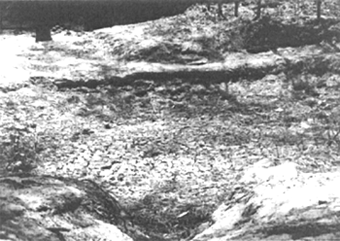
High evaporation rate and temperature
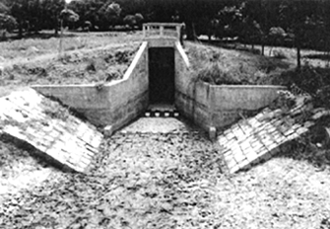 | 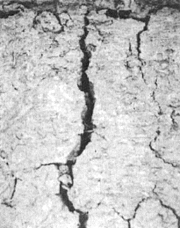 |
| Dried out water bodies and canals | High agricultural drought and dryness |
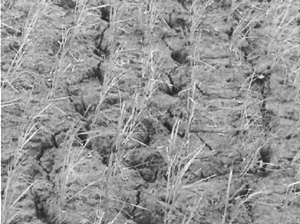 | |
Affected stages of agricultural crops
The nature of these risks have changed over the time and also changed in the frequency in various parts of the are over the past 100 years period. At the same time exposure of several risks have also reduced and new risks have emerged in the area. Some of the most prominent risks in the past few decades in the non-irrigated area were as identified by the community is outlined below.
Major risks:
Drought
Hailstorm/Tornado
Floods
Excessive rainfall
Non-major risks:
Crop and livestock diseases
Cold
Pest Infestation
Fog
Road communication problems
Earthquake
And so forth.
However, the past records (district gazetteer) suggest that drought, rainfall, cyclone and flood remained as the major climatic hazards in the area.
A multiplicity of the climatic and non-climatic risks were found to be existing in the non-irrigated study areas.
Among the present trends of risks, it was emerged from the field study that the climatic risks have wider impacts over the agriculture and other livelihood activities of people residing in the area. It was pointed out in the fieldwork that the drought as a climatic phenomenon has been the most thriving risk both in the past and in the recent times experienced by the local communities in the study upazilas.
Climatic features such as irregular and low rainfall, excessive, evaporation, dryness and so forth are causing several types of droughts in the area. Metrological, hydrological and agricultural drought evidently have a wider impact over the risk characterization of the non-irrigated villages of the study area.
Among the other climatic risks: cold winter, fog, hailstorm/tornado, temperature/heat-stress, flood/excessive rainfall are prominent.
Beside these climatic risks, some non-climatic or anthropogenic risks are affecting the livelihoods that eventually adds on to the adversity of the climatic risk factors in the non-irrigated areas.
The results are shown in the following Figure 4–1 and 4–2 explains the factor.
Figure 4-1. Risk composition and climatic risks in non-irrigated areas.
Community perceptions on composition of major
risks in the irrigated area
(shown in percentages)
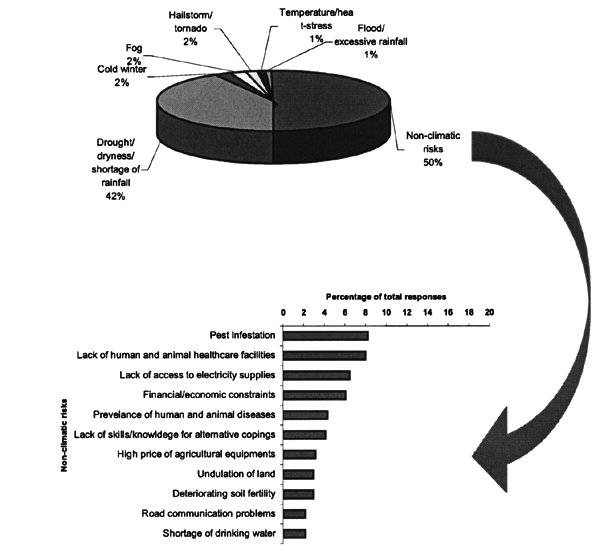
Figure 4-2. Non-climatic risks in non-irrigated areas
Among the non-climatic risks pest infestation, lack of human and animal healthcare facilities, lack of access to electricity supplies, financial/economic constraints, prevalence of human and animal diseases, lack of skills/knowledge for alternative copings, high price of agricultural equipments, undulation of land, deteriorating soil fertility, road communication problems, shortage of drinking water remained as the prominent ones to the community in the non-irrigated area.
The risks in irrigated area are also of multiple. Here the climatic risks are also thriving the agriculture and livelihoods of the people but the non-climatic parameters are making a parallel situation of vulnerability as well.
Among the present climatic risks the drought is also pressing. But due to availability the irrigation facilities in the area the situation of drought impacts is lesser in comparing to the non-irrigated area. Among the other climatic risks: flood/excessive rainfall, fog, cold winter and hailstorm/tornado are the most common ones.
Some of the results are shown in the following Figure 4–3 and 4–4.
Figure 4-3. Risk composition and climatic risks in irrigated areas
Community perceptions on composition of major
risks in the irrigated area
(shown in percentages)
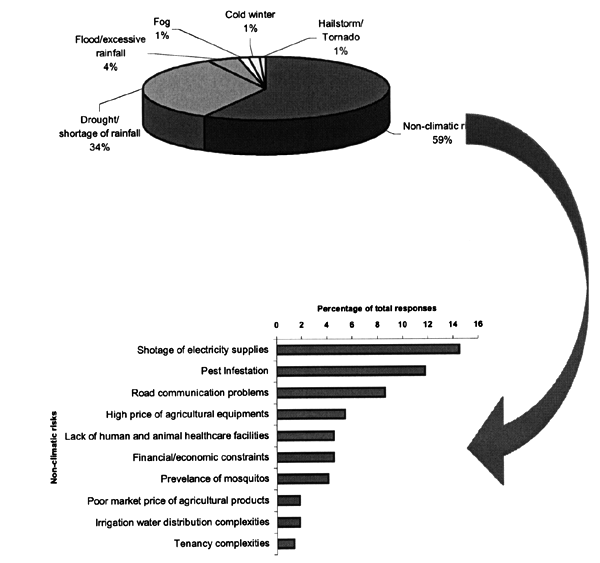
Figure 4-4. Non-climatic risks in irrigated areas
Among the non-climatic risks shortage of electricity supplies, pest infestation, road communication problems, high price of agricultural equipments, lack of human and animal healthcare facilities, financial/economic constraints, prevalence of mosquitoes, poor market price of agricultural products, irrigation water distribution complexities, tenancy complexities and so forth remained as the major ones according to the community in irrigated area.
