Previous - Next
Chapter 5 : Macro-economic policies and agriculture
Inflation
control
Currency
devaluations
Credit
tightening
Difficulties with other short-term effects of
structural adjustment programmes
We now tackle the problem of those aspects of economic policy which certainly do not belong to agricultural policy, which are not primarily intended to affect farmers, and yet which greatly impinge upon their daily life: inflation, currency devaluation and credit policy.
Inflation is not a decision of economic policy. Rather it is the outcome of a number of decisions and historical legacies. Removing inflation is one of the targets of many macro-economic and structural adjustment policies. At the same time, in many Latin American countries inflation is viewed as a "second best"- a way of avoiding more dramatic situations - and certainly not as a permanent obstacle in daily economic life.
Inflation, when it exists, is probably one of the major obstacles to the incorporation of small fanners into the monetary system. So long as they remain autarkic, they can ignore inflation. But as soon as they want to sell something, their only possible strategy to avoid money depreciation is to buy back other assets immediately. But this is precisely what a small farmer in a remote area, with transport problems and imperfect markets, cannot do. This is most important as many quasi-monetary assets that can be used to protect savings from inflation are usually sold in indivisible batches, the size of which is far too large for a small farmer. Thus, in the case of inflation, small farmers are deprived of their best means of action, namely the possibility of accumulating capital year after year in order to increase farming intensity and expand production. They cannot play the roles indicated above, and they are doomed to stay poor autarkic farmers, without profit for anybody (again, a market failure).
In addition, inflation increases both nominal and real rates of interest. This is not apparent at the begining of the process: for instance, in Argentina, in the mid- 1970s, real interest rates were negative, because the rate of inflation was higher than the current interest rate. As a consequence, for one peso borrowed one year, the borrower had to reimburse a sum of I + t the following year. Since the average cost of living had been raised by I + x, with x > t, the true cost of the reimbursement was (I + t)/l + x, less than 1. Notice that such reasoning does not necessarily apply to smallholders. Their own cost-of-living index may not be the same as the general cost of living, because they do not buy the same commodities as the average consumer. Setting aside this objection, it must be stressed that a situation where the real rate of interest is negative cannot last for very long. Sooner or later, the real rate of interest becomes positive, and the nominal rate becomes the sum of the real rate and of the rate of inflation. In fact, it is much higher because the rate of inflation is never constant. Thus, there is great uncertainty over the true value of the average rate of inflation in the medium term. As with any uncertainty, the latter has a cost, which is reflected in the "normal" real rates of interest being increased by a risk premium.
As a consequence of the above remarks, it is likely that any successful measure against inflation can be considered as highly beneficial for smallholders. Nevertheless, it would be foolish to attribute any failure in rural development programmes to inflation. Failure in rural development programmes is much more common than inflation. Bolivia, with an average annual rate of inflation of about 50 percent, is not worse off than Senegal with a rate of 9 percent, and is much better than Ethiopia with a rate of 4.4 percent.
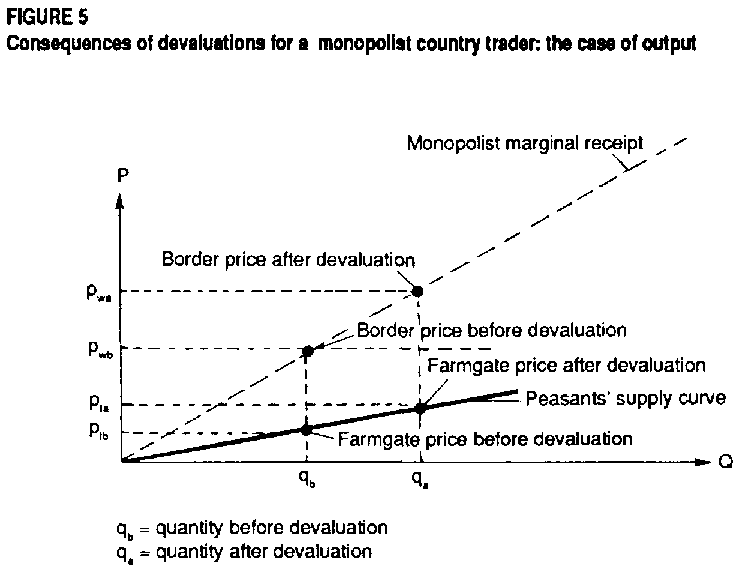
Currency devaluations have two contradictory effects. First, they increase the internal price of exported commodities. This is, in principle, beneficial to smallholders, inasmuch as they produce exported commodities. Notice that farmgate prices of groundnuts, cocoa or coffee do not increase automatically after a devaluation and, in any case, do not increase at the same rate as the rate of devaluation. In the long chain of processes from farmgates to borders, many intermediate decision-makers (including governments) may maintain the difference between increased selling prices and former buying prices. The simplest case is depicted in Figure 5, which represents a monopolist trader buying agricultural products for export from peasants and selling them abroad.
FIGURE 5 : Consequences of devaluations for a monopolist country trader: the case of output
Before devaluation, themonopolist, maximizing his or her profit, operates quantity qb, which equates world price (in local currency, at current exchange rate) with marginal benefit (receipt, minus price given to farmer). This is a curve with the same intercept and twice the slope of the peasants' supply curve. Therefore, he or she purchases quantity qb at price Pfb to farmers. After devaluation, the same reasoning leads to quantity qa, paid to farmer price pfa. It is important to note that, because of the slope of the peasants supply curve, the difference pfa- Pfb (the price increase to farmers) is less than pwa- pwb (the difference in border prices between "before" and "after" devaluation). Thus, peasants benefit from a price advantage, which is significant, although smaller than the devaluation itself.
They also benefit from an increase in the quantity they sell, as is depicted by the difference between qa. and qb. The more elastic the peasants' supply curve, the bigger the difference between qa. and qb. We have already seen that such a high elasticity of supply with respect to price was not Utopian in the context of smallholder agriculture. But this classroom situation is probably less complicated than the reality, so the above conclusions should be taken lightly.
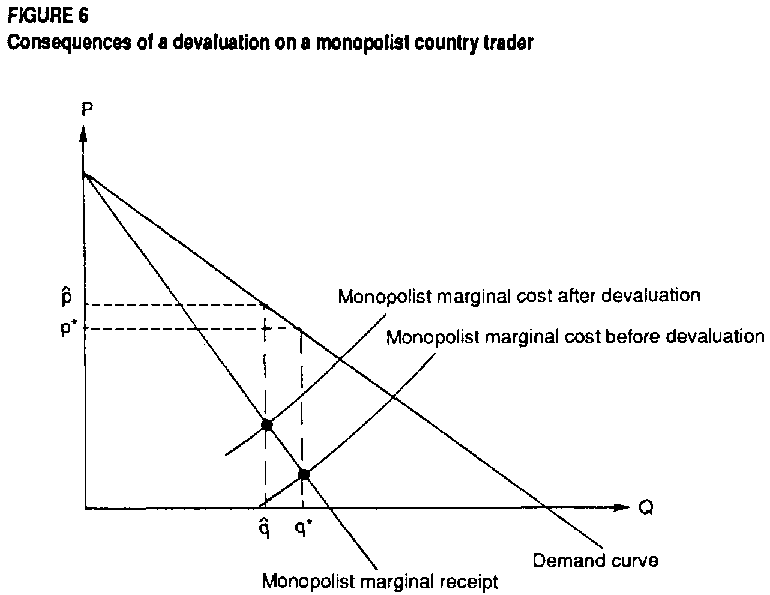
Second, devaluations increase the internal cost of imported inputs. This is, in principle, detrimental to smallholders. But, again, this is not necessarily the rule, for a number of reasons. Smallholders normally use comparatively fewer imported inputs than modern capital-intensive farms which cannot work without imported spare parts for tractors and fertilizers, for instance. Thus, smallholders are less affected by this consequence of devaluations than modem farm companies. Moreover, just as the increased price of output may vanish between the border and farmgate, the cost of smallholders' inputs may not be fully adjusted to the new border price, especially if traditional country traders are involved in the distribution. In so far as the latter behave like monopolists in their remote zones of operation, they are aware of the demand curve of their customers, as shown in Figure 6. Before devaluation, the situation is a classical monopoly equilibrium, with optimal quantity at the intersection of the marginal cost of monopolist and of the marginal receipt (derived from the demand curve by doubling the slope, and keeping the P axis intersect).
Devaluation increases the marginal cost of the monopolist. As a consequence, the latter reduces the quantity sold and increases its selling price by an amount which is less than the increase in marginal cost.
The total impact of a devaluation on smallholders is a combination of the two effects just described. Although it is difficult to predict their overall direction, these effects are most likely to be beneficial, with increased benefits greater than increased costs. In addition, because devaluation increases the price of purchased inputs, it increases the smallholder's need for cash. We shall now see how this is important.
FIGURE 6 : Consequences of a devaluation on a monopolist country trader
Credit policies are among the most controversial of the measures taken on behalf of structural adjustment. Economic theory teaches us that credit must be tightened and interest rates increased to curb inflation and restore monetary value. At the same time, credit is needed to increase production, to match the excess demand and to create an exportable surplus. The case of smallholders illustrates this dilemma. They will benefit from the reduction of inflation, as we have seen. At the same time, because they cannot expand their production without cash, they have to be given some sort of credit to be able to play their role properly in producing exportable goods for debt repayment, and domestic food for urban consumers.
Things are, nevertheless, a little more complicated than this. First, are smallholders directly hit by credit restrictions decided at a macro-economic level? Such restrictions normally affect commercial banks. But, for the reasons indicated above, commercial banks are not interested in smallholders. Even agricultural banks are seldom involved in operations with smallholders, whose only sources of financing are credit from their customers, or credit from relatives or associates, or traditional moneylenders, landlords and so on.
It may happen that national credit tightening reduces the availability of these sources of credit to smallholders, but not automatically. In addition, given the high marginal productivity of capital in traditional agriculture it is unlikely that, even if money becomes scarcer for these decision-makers, they will react by cutting credit to smallholders, or by increasing the (largely traditional) rate of interest. More probably, as far as possible, they would rather reduce the volume of their operations with partners other than smallholders, at least because, as we have seen, the latter are paying higher rates of interest.
Would credit restrictions reduce the supply from smallholders? This is also questionable. Obviously, credit restrictions will not affect those who do not have recourse to credit. They certainly represent the vast majority of smallholders, although the proportion of "credit using" smallholders may vary considerably from one country to another. For the others, they probably will lower their production and adopt new production systems closer to autarky. This does not mean they would cut their production in proportion to the reduction in credit availability.
Finally, both credit demand by smallholders and credit supply by lenders are determined by many variables other than the supply of money in the economy. We have seen that risk aversion and security seeking are probably determining in this respect. For this reason, it may very well happen that smallholders make use of much larger sums of fresh money in periods of economic stability, low inflation, and steady prices than in periods of monetary turbulence and price instability. This would mean that the reduction in agricultural production, which may eventually be observed immediately after a structural adjustment period, is probably more the consequence of the instability that such an adjustment triggers, or reveals, than of the adjustment itself.
Difficulties with other short-term effects of structural adjustment programmes
The common features of the policy instruments examined in this chapter are those dealing with short-term effects of structural adjustment programmes. The three most important points in this respect have just been discussed. As we have seen, the overall impression is that these aspects of structural adjustment, even in the short term, are quite beneficial to smallholders, so that no particular steps should be taken to protect the latter from temporary harm that they may suffer as a result of this policy. But other aspects may not be as favourable.
Removal of Input subsidies
Before structural adjustment, input subsidies had previously been viewed as a compensation for low output prices, and a way of solving the conflict between the two contradictory goals of cheap food and increased agricultural production. It is true that, ceteris paribus, removing input subsidies will, in general, decrease agricultural production and be harmful to smallholders. At the same time, the ceteris paribus clause does not hold here, since output prices must increase as well. Nevertheless, discrepancies can arise between input and output price increases.
A theoretical consideration must be kept in view at this stage: we have seen that the agricultural production function is homogeneous and of degree one. In that case, according to Euler's theorem, value of outputs equals the value of inputs, measured at marginal productivity prices. It follows that removing input subsidies will decrease the value of agricultural production by no more than the value of the subsidies. This is far less than ordinarily assumed by policy analysts. Most of them justify the subsidy assuming that, by encouraging "modem practices", it will trigger a production increase much larger than the amount of government money spent. In fact, by encouraging a better allocative efficiency, removing the subsidy will probably lower agricultural production by less than the value of the subsidy. In addition, smallholders will be hurt in proportion to their previous use of subsidized inputs: it is reasonable to assume that the poorest will be the least hurt, because they are the smaller users.
Privatization of parastatals
We have seen that, as a rule, there are no reasons for governments to commit themselves in trade operations. The privatization of parastatal agencies is, therefore, a sound policy in principle, aiming at correcting former mistakes. However, privatization itself may raise serious problems when the old system is no longer in use, and private organizations are not ready to relay them immediately. Let us examine, for instance, the case of the Turkish parastatal wheat monopoly (Reusse, 1987). At the time of its abolition, it owned the only bulk handling port facility. Nobody left instructions for this facility to be put at the disposal of private institutions which, in such a context, were greatly handicapped, with export and grain collection falling abruptly as a consequence of liberalization.
Numerous examples of analogous difficulties are given by Reusse ( 1987). To some extent, they are more illustrations of the lack of adaptability of parastatals - including adaptability to their own disappearance - than proofs of the failures of the private sector. However, sensible policy-makers must still be very careful with this type of difficulty, the solution of which depends essentially on local circumstances.
Removal of facilities
The search for a "real price" regime implies that some facilities, which previously were provided free vat a price far belong their actual cost, should be discontinued. As an example of such a service, let us consider the
Mexican crop insurance scheme (Hazel!, Pomareda and Valdes, 1986). The system originated in an early perception of the role of risk in smallholders' decisions, as presented above. Now, if risk is so important in preventing farmers from increasing their production, why not eliminate it by an adequate crop insurance scheme? This was certainly a good idea, except that the difficulty was to avoid "moral hazard", that is, unjustified claims for indemnities (e.g. if the crop failure was due to inadequate cultural practices instead of climatic conditions). To deal with this problem, supervisors were recruited with the mission of monitoring peasants' activity. They were so numerous that no private firm would have taken on such a task and no peasant would have subscribed to any crop insurance contract if he or she had been charged the full cost. In this kind of circumstance, state withdrawal entails a fall in production (this is whet happened in Mexico when President de la Madrid decided to discontinue the ambitious Systema Alimentario Mexicano set up by his predecessor President López Portillo), a tragedy for civil servants, and a loss of welfare for smallholders. But the fact is that the previous system was simply impossible to maintain. It would have been cheaper to distribute free the food bought on international markets.
The mistake was not in discontinuing the system, which imposed a severe strain on all other productive segments of the population, but rather in allowing such a system to develop in the first place. Nevertheless, it is equally difficult to eliminate the mistake without taking precautions, particularly as wrong systems tend to perpetuate. (Thus, the Mexican system is going to rise anew from its ashes, under the pressure of necessity, see Austin and Esteva, 1987.) Again, no general precepts can be given in this respect, the golden rule being probably to go slowly and to compensate vested interests whenever they are hurt.
Chapter 6 : Conclusions and directions for research
Summary
Approaches available for assessing the impact of
structural adjustment on smallholders
Outline of possible case studies
Defining the notion of smallholders is not easy especially if this definition is to be used for statistical purposes. Nevertheless, smallholders, taken together, present certain permanent features-mainly, in the techniques with which they work - which make them a distinct subject of study, despite their diversities.
Smallholders have a role to play in economic growth - that of bringing about the necessary smooth transition between traditional, labour-intensive, small productivity, and modern capital-intensive, high productivity techniques. The best way for them to play this role is to "disappear", either by leaving agriculture, or by becoming large farmers. But, for this disappearance to be worthwhile, it should be the result of an enrichment process. It is the responsibility of goverments to create the necessary conditions for the latter to be triggered.
Until recently, it was generally accepted that this objective should be achieved by a direct involvement in rural development of the state, through its participation in a variety of projects, and of parastatal organizations. Such policies have been shown to be incompatible with considerations of general equilibrium, as well as lacking efficiency in general. After the 1970s they were progressively abandoned, either spontaneously or under the pressure of international organizations, such as the IMF or the World Bank. The impact of structural adjustment on smallholders must be seen in this historical context.
Economic theory suggests that smallholders will suffer from state withdrawal from non-marketable facilities, such as roads, railways and irrigation. They will suffer even more from a reduction in size or efficiency of agricultural research and extension. Conversely, they will generally benefit from state withdrawal from marketable facilities, because parastatal organizations are usually less flexible, and provide less reliable services, than private traders. However, there may be difficulties the transition period. In addition, the policies distributional effects may be important, some smallholders benefiting (the best located, and the richer, for example) and some suffering.
Removing inflation, whenever it exists, is probably extremely beneficial to smallholders, although there exist cases where inflation is very low, and peasants are very poor, thus showing that inflation is not the main obstacle to the development of smallholders. The same can be said for devaluations, which are usually beneficial.
The main obstacle to development, nevertheless, seems to be the difficulty of obtaining credit, despite the high productivity of capital in smallholdings. This is a consequence of risk and uncertainty, which prevent peasants from requesting loans and bankers from granting them. This casts a new light on several structural adjustment issues. In particular, it shows that directly linking domestic and foreign markets, without any stabilizing device dampening the fluctuations of the latter, may be very detrimental to smallholders, and may induce them to withdraw from markets, being content with self-sufficiency. Similarly, risk issues are important when discussing the equilibrium between food and export crops. In Africa, for instance, a stabilization of food crop markets is likely to trigger an increase in food crop production, without changes in average prices.
The possibility of compensating for the detrimental effects of state withdrawal by institutional improvements has been examined. The importance of private land ownership has been stressed.
In general, smallholders should not be too directly affected by structural adjustment or, rather, it is often possible to design structural adjustment so as not to hurt smallholders too directly. Nevertheless, inadequate measures can affect their welfare and, even more, their production potential. In addition, there are situations - especially when too optimistic governments have provided too costly rural services at no charge - where structural adjustment unavoidably hurts smallholders. In such cases, the supply of agricultural commodities by smallholders shrinks. Fanners return to self-sufficiency and traditional extensive techniques. As a consequence, land becomes scarce, and urban labour markets are rapidly flooded by rural unemployed.
Situations vary enormously from one country to another and, even within one country, from one region to another. Therefore, generalizations are dangerous and generally ill-founded. This explains why this paper is so difficult write, and why it is so vague. It is impossible to deal with such a variety of situations.
This is why further studies should both improve basic theory and provide empirical information for action.
Approaches available for assessing the impact of structural adjustment on smallholders
The necessity of modelling
There are a number of difficulties involved in designing a plan for research and information-gathering on smallholders:
First, there is the difficulty of defining stratifications among smallholders. Throughout this paper, although the diversity of smallholder populations has been stressed, no attempt has been made to provide a typology of smallholders, as the reader may have expected. This deserves a few explanations.
When dealing with any heterogeneous population, it is natural to try to split it up into segments which could be treated homogeneously one after another. This is, after all, what was done when planning a paper on "smallholders". The latter are supposed to constitute a more homogeneous category than "the poor" or "farmers". But we have seen the difficulties involved in defining "smallholders": they belong to a continuum. It is difficult to say that the smallholder category stops at a particular point in this continuum, because any other point in the vicinity could have been chosen just as well. This difficulty is real when speaking of "smallholders" in general. It is even more acute when speaking of any smallholder subcategory.
For this reason, another approach has been taken. According to a line of thought which also has its tradition (see, for instance, Just and Zilberman, 1988), a general model of smallholders (to which most individual farmers, even relatively large ones, are added), should be constructed. It should treat any observed case as a particular point in a multi-dimensional space, defined by labour, capital and land endowments, as well as by technical, economic and institutional environment, including risk and uncertainty. Thus, despite obvious individual differences, the basic homogeneity of farmer populations is stressed. It is possible to understand how an agricultural worker, during a life span, can traverse the whole continuum beginning as a small-scale smallholder and ending as a wealthy farmer, or the contrary.
Ignoring this possibility, and assuming that people fall into a definite and permanent category, is probably a major error in policy-making, liable to suggest useless and inappropriate measures. It is hoped that readers of the present study will not fall into this trap.
Second, there is the difficulty of attributing an observed change to a particular measure. Suppose we observe simultaneously (or, rather, after a year's lapse, so that a price increase can play its assumed role) an increase in the price of groundnuts, and an increase in groundnut supply. It is tempting to describe the increase in price as the cause of the production increase. But this is not necessarily true. The production increase may have been caused by better climatic conditions, or some other reason. A similar well-known case is milk supply in the European Community: it has been observed for years that the milk price has been decreasing, and production increasing. Supporters of the milk price increase have argued that this is proof that an increasing price would decrease production. But this is wrong. Econometric evidence, and a few current experiences, show that with higher prices, production would have been even greater. The observed increase in production comes from technical progress, capital accumulation, and other circumstances which have nothing to do with price decrease. On the contrary, the decrease in price contributes to slowing down an evolution which otherwise could have been more rapid.
The same line of reasoning applies to the appraisal of many structural adjustment programmes and measures.' The associated difficulty is sometimes called the "counter factual analysis" issue. Indeed, what is observed is the situation before structural adjustment, and the situation after. But this is not what we need. We need to compare the situation with structural adjustment and the situation without structural adjustment. Unfortunately, such situations are not observable, so it is necessary to construct them mentally, or by using explicit models.
But which models can we use? Two types of approaches have been envisaged: one is micro-economic, and the other macro-economic. In fact, they are complementary.
Macro-economic approaches
These are the approaches followed by early analysts of the sectoral effects of adjustment programmes, such as Zulu and Nsouli (1985) or Johnson and Salop (1986), or even Heller et. al. (1988). The general idea consists of identifying target groups for the analysis (in our case, "smallholders" constitute a target group, but the "smallholder" category will normally be split up into various subcategories, such as "producers of export crops" and "producers of marketed domestic food". The characteristics of each group are then determined, using national accountancy techniques. Thus, for each group of smallholders, one must try to determine the magnitude and nature (self-consumption or market sales) of gross receipts, the magnitude and nature (self-supplied, or market-purchased) of input expenses, the distribution of income between members of the holdings (wage paid, income of wives, for instance), the magnitude and nature of savings and consumption, and so on. In this way, a partial social account matrix (SAM) is built up, explicity or implicity. Then, assuming no change whatsoever, it is possible to assess the impact of a given change in any price or quantity on smallholders, using (again, explicitly or implicitly) the techniques known under the general heading of "computable general equilibrium models".
In their most classical form, these models consist of a set of equations expressing that anything produced must be used as intermediate inputs, consumed, saved or traded with foreign countries. Another set of equations expresses that the value of each product (that is, its price) is distributed between variable inputs and fixed factors. In general, a certain amount of input substitutability is assumed: if the price of one input increases, ceteris paribus, then this input is used in smaller quantities. Other equations "close" the model, with a description of foreign exchange decisions, as well as consumption and savings decisions.
The main advantage of such models is that they provide perfectly consistent projections of the main variables in the economy. By their very logic, demand equates supply, income equates expenses, and so on. In addition, they take account of the many feedbacks and simultaneity existing in any economic system. For instance, increasing agricultural prices, in principle, increases agricultural incomes and demand, but decreases urban incomes and demand. What will be the overall effect of these contradictory motions on the gross national product ? These models are designed to answer such questions. Finally, although until now they have been used almost exclusively at the national or international they could (and should) be used for regional planning, where the criticisms that have been addressed to them are probably less valid.
But they have been criticized. Without going too deeply into the famous "closure debate" (see Bell, 1979 or Ratts, I 9 82), let us lust note that the heart of the matter is in the definition of endogenous and exogenous variables, especially regarding to the levels and prices of fixed factors. For instance, if labour is considered a fixed factor, it is still possible to assume either that its price is given exogenously(in which case, the corresponding endogenous variable is the quantity of labour used in the economy eventually far less than the available amount of labour, thus implying the possibility of unemployment), or that its quantity is predetermined (in which case, the wage adapts itself to the marginal productivity of labour, which can be smaller than the current average level). Theory shows, and experience confirms, that the model behaves in a completely different way under these two alternative assumptions concerning the supply and demand of labour. Similar problems arise with interest rates and savings, as well as with foreign trade, and, finally, with government expenditure.
These questions are obviously of the utmost importance when planning national economic policies, and assessing the global impact of structural adjustment. To some extent, they recall the ongoing debate among "neoclassical", "Keynesian" and "Kaldorian" theorists. Thus, they widely encompass the problem addressed here.
But the same kind of model can be used at a more modest regional level, with probably fewer difficulties in the choice of key variables. To some extent, many studies (such as those quoted above) which do not make explicit reference to computable general equilibrium models in fact belong to this category, although with somewhat naive "closing rules" involving, for instance, no substitutability among inputs and in consumption decision. Rather than despising "complicated" models and relying upon a false simplicity, it would be as well to be aware of the assumptions of simple models or accounting schemes, and to establish clear and explicit ties between them and more comprehensive models of the whole economy.
However, such models must not be used for their predictive power (which is probably poor), but rather for their ability to suggest situations that would not have been envisaged otherwise, and whose consideration could avoid serious mistakes. This is why a prudent use of computable general equilibrium models is recommended in this paper, at least as an adjuvant to micro-models, provided that users are aware of the multiple caveats that have to be issued.
Micro-economic approaches
As we have seen, macro-economic approaches rely upon micro-economic assumptions. The latter must be formulated and checked before use. The basic tool for doing so (at least, whenever the farm sector is concerned) is another category of models called "farm household models". They consist of building a complete farm plan under different assumptions (for instance, "with" or "without" structural measures), and deducing forecast behavioural changes from the comparison of various alternatives. It is essential to stress the fact that the "farm plans" in question must include the household consumption plan as well as the farm production plan. Given the observations in Chapter 2 about the interrelationship between the two, this is not surprising, and justifies the generic name of these kinds of model.
The farm plan building itself can be done using several methodological options: using a pencil and an eraser on a sheet of paper, or with the help of a computer, avoiding tedious arithmetical operations by using a spreadsheet program. For farm planning, in particular, there exist a number of specialized programs, such as FAO's DASI (Data Analysis and Simulation), (Cappi, 1984). However, for the kind of services we expect from them in the present context, the best and most reliable way of building up household models is probably to use a mathematical programming system. It will maximize the utility of family consumption, under the constraint that what is consumed must have been previously produced or bought. In some cases, bought. In some cases, as suggested by Singh, Squire and Strauss (1986), it would be possible to simplify the problem by making use of certain separability theorems, allowing for a recursive analysis of the production and consumption plans. Although it may have a certain practical relevance, this aspect is not very important. It is much more important to take account of two things that are essential in the case of smallholders:
Although these factors were recognized as early as 1923 in the case of Tchayanov and, more recently, by a number of authors, including Nakajima (1970), they have been little employed in an actual model. Nevertheless, such considerations usually express quite well many factors that otherwise would be difficult to understand in the behaviour of small farmers; for instance, why they are so reluctant to borrow, even if the expected marginal productivity of capital is higher than the interest rate; why they constitute reserves of financial or other assets (granaries and herds, for example) and borrow at the same time.
Most of the remarks made in this paper are derived from the empirical operation of this kind of model. Such empirical studies suggest a conclusion that cannot be drawn in a paper like this or, rather, that cannot be made apparent, as is the case in reality: that is, the incredible variety of situations, and the difficulty of formulating general statements about smallholders' behaviour. Slight variations in prices, institutional settings, available techniques and technical coefficients are sufficient to trigger great differences in model outcomes, and to yield apparently contradictory results. This is why careful picturing of each particular situation is so badly needed.
Outline of possible case studies
In view of this heterogeneity, it would certainly be useful to launch a few empirical case-studies.
Studies have already been performed by various organizations, such as the IMF (Heller et al., 1988); the World Bank (especially, Glewwe and de Tray, 1987); and the OECD (Bonvin, 1986, and Lecaillon et al., 1987). Others include Demery, 1988, and Delgado, 1983. These references represent only a small sample of what has been done.
These studies are not primarily concerned with smallholders. They deal with the poor and, since smallholders form the bulk of rural poor, they more or less cover our field. Yet, in the present study, emphasis has been placed on two points that are still largely neglected in the literature:
Thus, a set of case-studies on the impact of structural adjustment on smallholders should emphasize these two points. The two approaches that have just been identified (that is, the "macro-economic approach" and the "micro-economic approach") should be used in parallel, and their results compared, to assess the influence of alternative assumptions.
Concretely, the study could take the shape of a set of village studies, in a few selected countries (at least one in the Far East, Thailand or Indonesia; one in Africa, Burkina Faso, Mali, Malawi or the United Republic of Tanzania; and one in Latin America, Colombia, Honduras or Ecuador).
If possible, a survey could be performed at the village level (therefore, not too costly), to identify a few key subgroups of smallholders and other decision-makers, as well as to estimate reliable input/output coefficients, consumption coefficients, and an income distribution map. From this information, a social account matrix would be built up for the village (the methodology is well established; see Hazell and Roell, 1983), and a computable general equilibrium model built up along the general lines indicated above.
At the same time, a household model study would be conducted over a set of farms, if possible representative of the categories revealed by the survey. Again, the same kind of experiment would be performed with these farm models. Results would be compared with the assessment of smallholders' productive capacity to assess to what extent risk considerations modify the conclusions drawn from the relatively light SAM approach.
In this way, not only would an undisputable assessment of the effect of structural adjustment on selected villages be available from a comparison of results in different states, but it would be possible to obtain information about the effect of institutional setting on possible reactions from smallholders. In addition, two general methodologies would be available: one for assessing the consequences of structural policies at a relatively simple level (it could be called the "SAM" methodology, although another name will have to be found, if only to keep good relations with the promoters of the SAM idea!); and the other, more costly and more detailed, the "risk constrained programming approach".
Of course, field-work would have to be performed by local citizens, preferably scholars from local universities. The bulk of the study team should consist of economists. The assistance of at least one sociologist would be needed to set up smallholder behaviour models. Computer operating expertise should also be made available. The relatively heavy infrastructure of FAO projects, for example, give it a definite comparative advantage for this kind of study. It should be easy to find FAO projects with farm surveys in each state concerned. This would considerably alleviate the data collection task. Ideally, surveys would already be completed, with questionnaires detailed enough for only a little additional processing to be necessary. Probably, it would be necessary to add a few questions to "starting" questionnaires. In any case, this would only be a marginal effort required from FAO project officers, and a way of involving them in more thorough studies than those to which they are accustomed.