Previous - Next
Chapter four: Institutional assumptions and adjustment of the economy
The small country modeled above can behave in different ways, depending on what is assumed about the external sector. One possibility is for the country to set the official nominal exchange rate e0, and assume that it can finance whatever deficit F incurs from abroad. If this is the case then the government in essence can completely control the economy by setting the domestic terms of trade pa. The domestic economic agents (producers and consumers) will respond to whatever prices are offered to them by supplying and demanding the two commodities. The residual in the agricultural sector will be exported, and the required inputs for the production of the profit maximizing nonagricultural good will be imported. Any domestic and foreign deficits will be financed from abroad.
The polar situation described above is rather unrealistic as it implies that the rest of the world is willing to accommodate whatever policy decisions are made by the government. While this might be the case in some periods it clearly cannot continue, forever, especially if it implies substantial external deficits. In the post-independence experiences of many developing countries the willingness of external donors and financial institutions to finance external deficits, was usually tied to domestic policies generally not objected to by donors. It is when some policies were not reformed that external financing became more stringent.
The other polar situation that can be imposed on our small country, is an external financing constraint, namely a fixed value for F in (3.16) (a special case is the one of balanced trade, namely F = 0). If this is the case, then the government clearly cannot set the nominal exchange rate at will. The equilibrium exchange rate must be such as to satisfy the external financing constraint (3.16). Hence in this case the exchange rate is endogenous. The government can choose the rates of taxation of exports and imports, but the external balance (3.16) must always be satisfied. Hence the terms of trade of agriculture pa are, in this case, endogenous, and cannot be specified independently.
A third situation, which seems to be much more common in developing countries, is one where there is an external financing constraint, but the government, nevertheless, sets a nominal exchange rate. Clearly, unless the government sets the nominal exchange rate by chance equal to the equilibrium rate implied by the external balance (4.16), there will be inability of the system to equilibrate unless we assume that something else happens. The normal response of many governments to such situations has been rationing of imports, so as to satisfy the external balance at the official exchange rates. Rationing of imports means that the value of imports is set equal to the available foreign exchange. Since the desired quantity of imports at the official rate is larger than what is available, the scarcity value of imports in the economy is higher than what is suggested by the official rate. In essence, anyone who obtains a unit of imports at the official exchange rate also obtains a "rent", which is equal to the difference between the "equilibrium" price of imports, and the official price of imports. The issue is who is the recipient of these rents. If it is the government, then this policy confers an "implicit tax" to the government. if it is the private sector then the policy acts as a redistributive mechanism. It is convenient, for our purposes to consider the rent as accruing to the government (i.e. as an implicit tax). Any redistribution to the private sector can then be viewed as government transfers.
From the model's perspective, if these transfers to the private sector are all saved then they do not affect at all the structure of the equations. If not, then the consumed part of GDP, namely the wage income Y would have to be augmented by a fraction of these rents. In the sequel we assume for simplicity that all rents are saved. Hence the model structure remains unaffected.
We shall denote the three different macro-closures above as Au (adjustment under unrestricted external financing), Ac (adjustment under constrained external financing), and Ar (adjustment with constrained external financing and rents).
It is instructive to exhibit the magnitude of the total tax revenue under the three macro-adjustment assumptions. Notice that in the model we have abstracted from direct income or profit taxes, and indirect domestic sales taxes, focusing exclusively on trade taxes. The reason is that we are interested in the interactions between adjustment policies, which are induced by external constraints and domestic trade distortions and domestic policy vis-à-vis the terms of trade of agriculture.
Let the rate of explicit export taxation be denoted by ta,
and the rate of ad-valorem import tariff on the imported good be
tm. Then the domestic prices of exports and imports
are given by the following expressions (remember that  = 1 )
= 1 )
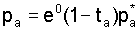 (4.1)
(4.1)
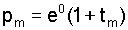 (4.2)
(4.2)
The explicit tax revenue of the government in domestic currency generated by international trade can be found by utilizing equation (3.14).
 (4.3)
(4.3)
where by Te we denote the explicit tax revenue, and be e0 the initial exchange rate which by choice of units we can set equal to one.
Under regime Au, the level of explicit taxation  will be equal to the
total tax revenue Tu of the government. Under regime Ac,
the exchange rate is endogenous. Assuming that this floating rate
is also the one officially adopted, then the total tax revenue of
the government is all explicit and equal to
will be equal to the
total tax revenue Tu of the government. Under regime Ac,
the exchange rate is endogenous. Assuming that this floating rate
is also the one officially adopted, then the total tax revenue of
the government is all explicit and equal to
 (4. 4)
where ec is the equilibrium exchange rate, found by
setting the level of external finance F equal to some fixed level
 .
.
Under regime Ar, the official exchange rate e0
does not balance the external market when F is constrained to
some fixed level .
The level of exports associated with the domestic price of
agriculture, which is determined by the official exchange rate as
in 14. 1), and the level of external finance, together dictate a
rationed level of imports Mr. Hence the level of
explicit taxation is equal to
 (4.5)
(4.5)
Given the domestic demand for imports, we can compute the
level of domestic price of imports  that would make this demand equal to the
rationed level Mr. Since by assumption the rationed
level of imports is lower than the level of imports that would be
demanded at the official import price
that would make this demand equal to the
rationed level Mr. Since by assumption the rationed
level of imports is lower than the level of imports that would be
demanded at the official import price  (which is given by equation (4.2)), it
follows that
(which is given by equation (4.2)), it
follows that  .
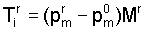
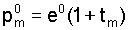
Hence the implicit tax earned by the government is equal to
.
Hence the implicit tax earned by the government is equal to
 (4.6)
(4.6)
where
 (4.7)
(4.7)
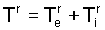
The total level of taxation in this case is equal to the sum of the two tax revenues.
 (4.8)
(4.8)
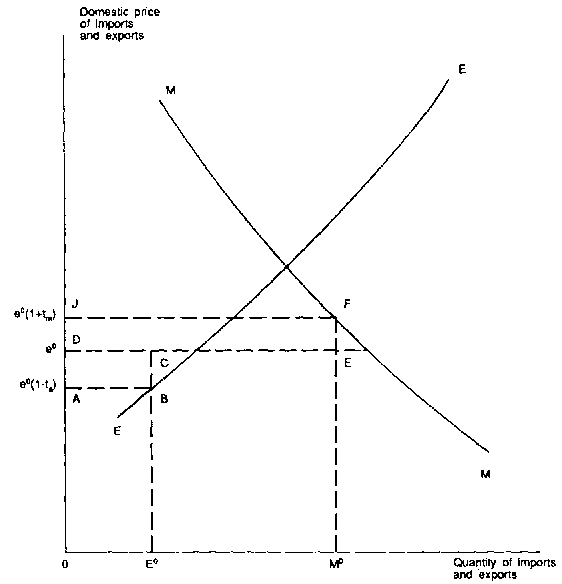
The alternative cases can be illustrated as follows. In Figure 1 the schedule EE denotes the country's supply curve of exports, while the schedule MM represents the demand curve for imports. For illustrative purposes we have assumed that the foreign price of exports is also equal to one, so that the domestic supply price of exports is equal to the official exchange rate modified by the export tax. At an official exchange rate equal to e0 and an export tax ta, the quantity of exports will be equal to 0E0 = AB, and the explicit export tax revenue will be equal to the area ABCD. If the import tariff rate is equal to tm, then at the official exchange rate the quantity of imports demanded will be equal to 0M0 = JF. The explicit import tariff revenue is equal to the area DEFJ. The implied required external financing will be equal to OM0 - OE0, which can be portrayed as the difference between the distance JF and AB.
The above figure illustrates the situation under regime Au. Under regime Ac the geometric representation does not change from what is exhibited in Figure 1. If the distance between OM0 and OE0 corresponds to the available external financing, then the equilibrium exchange rate ec would be equal to the distance OD.
Notice that by changing the export tax and import tariff rates under fixed external finance is equivalent to changing the equilibrium "effective" exchange rate e. Increasing the export tax rate ta, reduces the volume of exports. Under fixed external finance, this necessitates a reduction in the volume of imports. This can be effected by an exchange rate depreciation (an increase in the nominal value of ec).
An increase in the rate of import tariff will reduce the volume of imports. To maintain the level of external finance constant, the volume of exports must decline, and this can be effected by an exchange rate appreciation, namely a reduction in the value of ec.
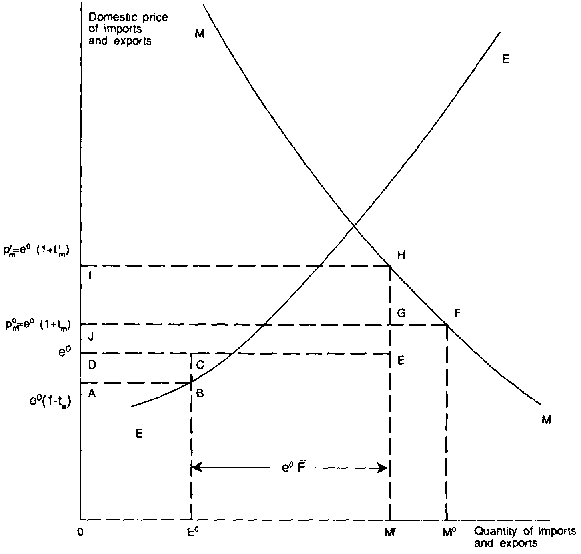
Figure 2 exhibits the situation under regime Ar.
The notation is similar to that of Figure 1. The available
financing  is
smaller than what would be required at the official exchange
rate, e0, which in the figure is the distance OM0
- OE0 This implies a rationed level of imports equal
to OMr = JG. The domestic import price that would be
compatible with such a level of imports is equal to
is
smaller than what would be required at the official exchange
rate, e0, which in the figure is the distance OM0
- OE0 This implies a rationed level of imports equal
to OMr = JG. The domestic import price that would be
compatible with such a level of imports is equal to  . In the figure the
level of explicit taxation is equal to the area ABCD plus the
area DEGJ, while the level of rent, or implicit taxation is equal
to JGHI.
. In the figure the
level of explicit taxation is equal to the area ABCD plus the
area DEGJ, while the level of rent, or implicit taxation is equal
to JGHI.
Figure
1 External equilibrium and taxation
Figure 2 Equilibrium and taxation under
external financing constraints and import rationing
From the figure it is easy to see that there exist an
equivalent rate of import tariff  at which the official imports would be
exactly equal to the rationed imports Mr. Since we
assume that all rents accrue to the government, it is not
necessary in this case to consider the explicit rate of tariff tm,
as its only function is to divide the total import tax between
explicit and implicit.
at which the official imports would be
exactly equal to the rationed imports Mr. Since we
assume that all rents accrue to the government, it is not
necessary in this case to consider the explicit rate of tariff tm,
as its only function is to divide the total import tax between
explicit and implicit.
The overvaluation of the exchange rate in this case will be
equal to the ratio between er and e0, where
er is the equilibrium exchange rate that would obtain
if the model was solved under regime Ac, with an
available level of external finance equal to  .
.
Note that in the model we have made the assumption that the volume of imports and exports always passes through official channels, and hence can always be taxed. It is, of course, well known, that when the tax rate (explicit and implicit) becomes high, then parallel markets develop, and the tax base, namely the volume of official imports and exports is eroded. We shall deal with this issue later.
It is of interest to inquire whether the total tax revenue (explicit plus implicit) under a regime of constrained external finance is higher under the floating regime Ac, or under the import rationing regime Ar. This question will be considered later. In any case it is instructive to note that the difference between regimes Ac and Ar is that in the former the constraint impinges on both imports and exports, as it affects the exchange rate, while in the latter it impinges only on imports, as it affects the implicit import tariff.
The model equations in level form as well as the log-linearized version of the model are summarized in Appendix B. while Appendix A illustrates the actual relevant parameters for the low income developing countries [according to the World Bank) in 1989.