


Access to agricultural resources and services
Land. 66% of farmers, who produce the country's staple food grains, have access to only 8% of all cultivable land. Women comprise only 4% of the beneficiaries of land in 30 years of the agrarian reform process, and 22% of those in the land title programme. Women's plots tend to be very small.
Livestock. Data collection needed.
Forestry. Data collection needed.
Water. The lack of an adequate water supply for irrigated agriculture is a major problem for both women and men.
Credit. Many NGOS have directed small credit schemes to rural women and some larger bilateral and multi-lateral projects provide credit and revolving funds for women. However, women still have less access to credit than men, and receive smaller amounts. The Honduran Coffee Institute (IHCAFE) provides credit to the coffee sector, but only 9.5% of the beneficiaries in 1990 were women.
Extension services and agricultural training. Although the present institutional and programmatic framework of extension services and training is weak, there is openness to a greater participation of peasant women in the establishment of a more adequate structure. SRN carries out extension through contacts with small farmers, agrarian reform settlers and women's organizations. Work with women is usually carried out by women "promoters". In the period 1990-93, women comprised 11% of those trained in appropriate technologies. No women participated in the training on mechanization and food storage. Data on other types of training is not gender-disaggregated. The Honduran Corporation for Forest Development (COHDEFOR) and the Honduran Coffee Institute (IHCAFE) also carry out training activities. Women comprised 25% of those trained by COHDEFOR, and 9.3% of those trained by IHCAFE in 1993.
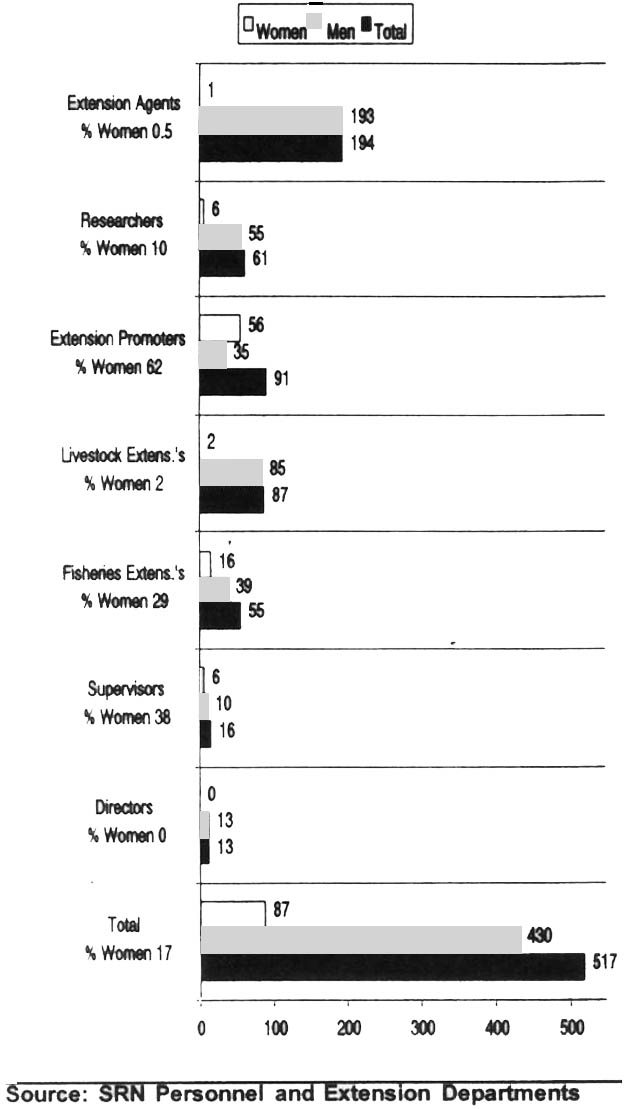
Secretariat of natural resources (SRN) extension staff by position and gender, 1993
In regards to agricultural training at the university level, women comprised 12.4% of the students in agronomic engineering, 36.2% in forestry engineering, and 42.2% in agricultural economics in 1993.
