Session guide: Barriers to the flow of information
Barriers to the flow of information (exercise worksheet)
|
DATE |
|
|
TIME |
|
|
FORMAT |
Group exercise, followed by a plenary participatory session |
|
TRAINER |
|
OBJECTIVES
|
At the end of this session, participants should: 1. Be conscious of barriers to the flow of information in their countries. |
INSTRUCTIONAL MATERIALS
|
Exhibit 1 |
Functions of some information services in minimizing of difficulties information users |
|
Exhibit 2 |
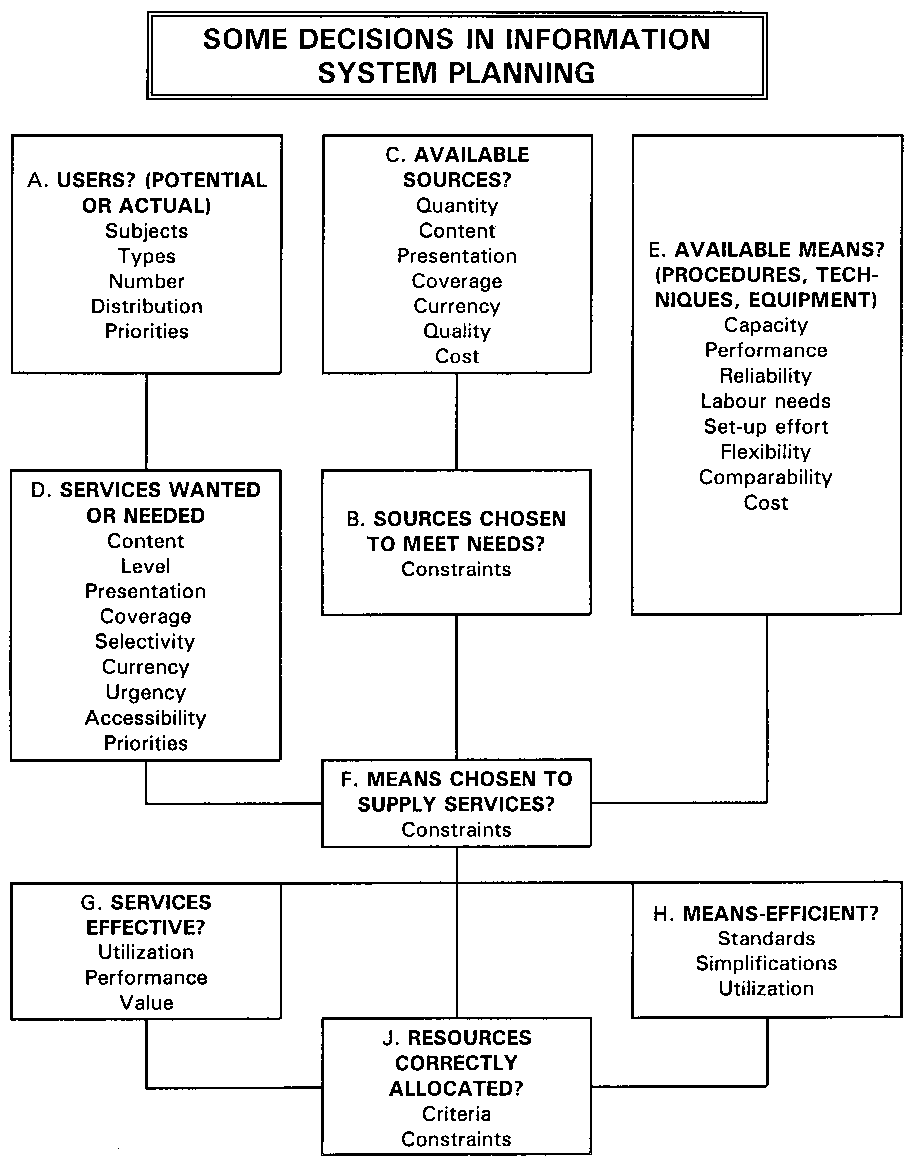
Some decisions in information system design |
REQUIRED READING
|
Exercise: Barriers to the flow of information (worksheet) |
BACKGROUND READING
|
1. Abdus Sattar, & Lancaster, F.W. No date. The Role of the Information Specialist in the Dissemination of Agricultural Information. Interpaks [International Program for Agricultural Knowledge Systems], Univ. of Illinois at Urbana-Champaign, USA. 2. Admimorah, E.N.O. 1977. Agricultural librarianship, documentation and information science in Nigeria. International Library Review, 9: 413-280. 3. Menou, M.J. Agricultural librarianship and documentation as a profession in the less developed countries, pp. 211-216, in: Agricultural Information to Hasten Development - Proceedings of the 6th World Congress of IAALD. Los Banos, the Philippines. 4. International Rice Research Institute. 1980. Communication Responsibilities of the International Agricultural Research Centres. Los Banos, the Philippines: IRRI. |
SPECIAL EQUIPMENT AND AIDS
|
Overhead projector and chalkboard |
Functions of some information services in minimizing difficulties of information users
The worksheet on barriers to flow of information should be distributed to the programme participants the evening before this session is programmed so that they can consider the questions raised in the worksheet.
The session should begin with discussion in small groups. Participants from different countries should provide answers to the three questions raised in the worksheet:
· What is the ideal situation for information flow in your country? What response would you like when you need information for a specific R&D project?· What are the constraints to the ideal information flow described?
· What solutions or strategies are available for overcoming the constraints and barriers?
Before concluding their group discussions, participants should group items into similar categories.
The plenary session should be conducted by asking the participants each of the three questions raised in the worksheet.
The session should provide ample opportunity for the participants to share their country experiences and discover commonalities in the barriers, constraints and strategies.
Show EXHIBIT 1 and discuss how to minimize difficulties for the information users. The exhibit discusses user difficulties of the world of information. Each of these difficulties should be discussed, identifying system capabilities which would help overcome the specific difficulties.
EXHIBIT 2 identifies some decision areas in information system design. This exhibit should help to summarize the key issues discussed in Module 9 as a whole. The discussion can be summarized by observing that:
· Agricultural documentation and information work is difficult because
- agriculture draws from various disciplines in the sciences, arts and commerce, which makes it both interdisciplinary and complex,- literature in agriculture is fragmented, scattered and exists in different languages coming from different countries.
· Agricultural documentation consists of the collection, classification, recording and organization of literature. This is distinct from information science in agriculture, which pertains to the collection, collation, evaluation, classification, storage, retrieval and dissemination of recorded agricultural knowledge.
· The agricultural information system has benignly neglected non-scientist users, such as extension workers and farmers, who put greater emphasis on verbal information and non-conventional literature.
· An information professional must play a linking role rather than a merely custodial one. His or her role in an agricultural research institution overlaps with the role of an extension agent.
· Participants should take a critical re-assessment or appraisal of the information service being provided, in order to redesign the service to serve the clientele more effectively, and should also be prepared, if necessary, to redefine the role of the information service within the framework of the organization.
|
FEATURES OF THE WORLD OF INFORMATION |
USERS' DIFFICULTIES |
INFORMATION SERVICE OR SYSTEM CAPABILITIES |
|
Generators and users of information are usually located far apart |
Awareness of information generated difficult |
Current awareness service; SDI; extension services; publications; publicity |
|
Cumulation of vast quantities of information |
Overabundance: need for selection |
Indexing; classification and storage systems; reference services |
|
Accelerating growth of information; increasing rate of obsolescence |
Quickly obtaining problem-specific information |
Reviews; state-of-the-art and trend reports; digests; information analysis; enquiry service |
|
Interdisciplinary nature of information scatter |
Can specialize only in a restricted subject area |
Indexing techniques to interlink subjects; information analysis; enquiry service |
|
Multiplicity of languages |
Can be familiar with only one or a few languages |
Translation service |
|
Wide range of standards and modes of presentation of ideas |
Only some standards and modes are convenient to some users |
Selection and presentation or repackaging to meet users' needs |
|
Wide variation in quality and reliability |
Difficulties in and inadequate time for evaluating and selecting |
Information and data analysis; evaluation |
|
Delays in final stage of document provision |
Difficulties in obtaining copies of documents required |
Obtaining copies of documents; reprographic facilities |
Source: Based on Atherton, P. Handbook for Information Systems and Services. Paris: UNESCO.
Some decisions in information system planning
1. What is the ideal situation for information flow in your country? What would you like to experience when you need information for a specific R&D purpose?
List your ideas and others from the group
|
1.................................................... |
|
2.................................................... |
|
3.................................................... |
|
4.................................................... |
|
5.................................................... |
|
6.................................................... |
|
7.................................................... |
|
8.................................................... |
Group the items into similar categories:
|
A.................................................... |
|
B.................................................... |
|
C................................................... |
|
D................................................... |
Name the categories:
|
.................................................. |
|
................................................... |
2. What are the constraints to the ideal flow of information described in section I? What are the barriers to the flow of information within your country?
List your ideas and items from the group:
|
1. .................................................. |
|
2. .................................................. |
|
3. .................................................. |
|
4. .................................................. |
|
5. .................................................. |
|
6. .................................................. |
|
7. .................................................. |
|
8. .................................................. |
|
9. .................................................. |
|
10. .................................................. |
Group the items into similar categories:
|
A.................................................... |
|
B.................................................... |
|
C................................................... |
|
D................................................... |
Name the categories:
|
.................................................. |
|
................................................... |
3. What are solutions or strategies for overcoming the constraints and barriers identified above?
List your ideas and items from the group:
|
1.................................................... |
|
2.................................................... |
|
3................................................... |
|
4................................................... |
Group the items into similar categories:
|
A.................................................... |
|
B.................................................... |
|
C................................................... |
|
D................................................... |
Name the categories:
|
.................................................. |
|
................................................... |
This training manual has been prepared as basic reference material to help national research trainers structure and conduct training courses on research management at the institute level. It is intended primarily for managers of agricultural research institutes in developing countries and for institutions of higher education interested in presenting in-service training courses on research management. The manual consists of ten modules, each addressing major management functions including motivation, leadership, direction, priority setting, communications and delegation. The four structural functions of management - planning, organization, monitoring and control, and evaluation - are covered in individual modules. The manual has been designed to support participatory learning through case-studies, group exercises and presentations by the participants.