Iran proposed to host the activities and to organize these, in cooperation with FAO, during the shrimp fishing season, in October.
Trips at sea were organised for a five-day period on board commercial vessels off Bandar Abbas with observers, fisheries officers from the countries of the Gulfs having shrimp trawling fisheries, on board to participate in the tests and training.
A fishing technologist from Australia, experienced in by-catch reduction devices, Mr. Steve Eayrs, was recruited to conduct the experiments at sea and was responsible, in cooperation with a fishing technologist of FAO, for the demonstration and training.
The hosting country, Iran, had agreed to bring on board, for the duration of the tests, a journalist and a crew for a documentary (videofilm).
The proposed activities consisted of:
The by-catch reduction devices to be used were selected in collaboration with the concerned Gulfs countries, the Australian technologist and the Fishing Technology Service of FAO.
The followings were proposed: square-mesh window, fisheye, cones and rigid grid (NAFTED type).
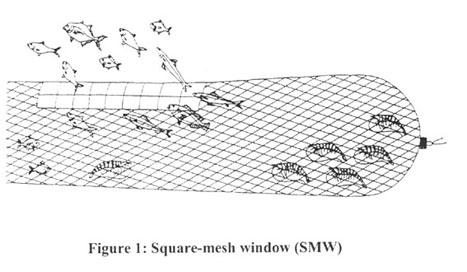
The simplest BRD. The window allows fish to escape upwards through the large square mesh, while the shrimps that do not swim as well as fish pass into the codend. It is normally located in the trawl extension immediately ahead of the codend.
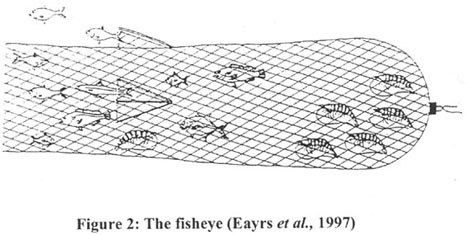
It is a simple steel frame attached to the codend to provide a small elliptical opening for fish to escape through. It faces forward in the top of the codend. Animals pass into the codend and must turn to swim forward to escape through this device.
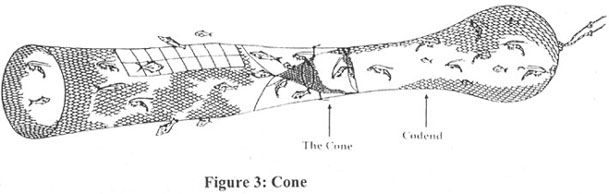
The Cone is not a BRD but has been designed to increase the efficiency of BRDs to exclude fish from the trawl. Developed by shrimp fishermen in the Gulf of Mexico, it is simply two panels of netting attached to a small wire hoop and inserted behind a BRD such as a fisheye, square-mesh window (or RES, Radial Escape Section). The cone impedes the passage of fish into the codend and 'stimulates' them to swim forward and through the escape openings.
The NAFTED was originally designed by the Australian Maritime College to exclude large animals such as sharks, stingrays and turtles from the trawl (however, the experience shows that, in general, small fish are also excluded). The NAFTED BRD features a grid, with a bar spacing appropriate to local conditions, secured to the trawl at 45 degrees. A panel of netting guides all animals to the bottom of the codend and prevents shrimp loss through the escape opening in the top of the codend. Large animals are physically guided by the grid through the
escape opening while shrimp and other small animals pass through the bars and into the codend.
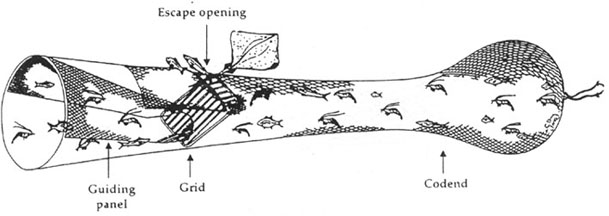
Figure 4: Rigid grid, the NAFTED (Eayrs et al., 1997)
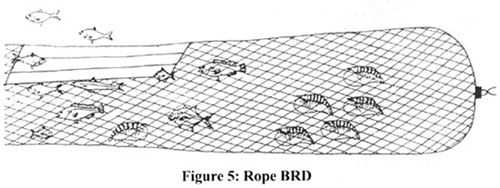
The rope BRD consists in a window including parallel ropes extending lengthwise along the trawl (in place of square mesh). It is normally located in the same position as the square mesh window.