The Iranian shrimp fishery extends along much of the Iranian coast and is divided into three regions or provinces, namely Bushehr, Hormozgan and Khozestan. Trawling is the main harvesting method and in each province the fishing season is of approximately six weeks duration.
The Iranian shrirnp fishery supports three types of fishing vessels. In the industrial sector, 39 steel trawlers, between 20 to 25m in length, with engine power for these vessels ranging from 257 to 588kW (350 to 800hp). The artisanal sector consists in two parts: - approximately 850 timber traditional vessels, "dhows", around 16m in length and with 73 to 160Kw (100 to 220hp) engines and - an estimate of 1,500 small fibreglass trawlers, about 7m in length and have 25 to 45hp. (Over the last ten years, a reduction in the number of vessels has been observed both in the "dhows"and industrial fleets, while the number of FRP small boats is increasing).
The industrial shrimp trawlers tow two trawls simultaneously with outriggers, flat trawls, semi-ballon or ballon trawls. The traditional wooden boats, "dhows", tow a single shrimp net or carry out pair trawling; the mechanized FRP crafts alway use a single trawl net. In this respect, it is worth noting that bottom trawling for shrimp except during the shrimping season as well as trawling for fish is banned in Iran.
In general, the codends are made of two layers of netting, 30-40mm meshsize, with, in addition, a protective chafer. However, smaller meshsize would frequently be used in coastal waters.
As already mentioned, the fishing season is of approximately one and half months and is closed in each province when trawl surveys indicate that 20% (or less) of the shrimp stock remains.
In this connection it is worth mentioning that because of obvious increasing fishing effort and some concern regarding a risk of over-exploitation, the duration of the shrimp fishing season has been progressively reduced over the last few years. In addition, the number of fishing licences issued has been seriously curtailed (but at the same time illegal fishing is reported to be on the increase).
The artisanal sector fishing in coastal waters now accounts for more of the total production than the industrial fleet.
The shrimp fishing industry has landed more than 4,600 tonnes in 1996, to a value of US$ 32,200,000.
The wholesale price of shrimp is approximately 11000 - 12000 R/kg (A$4/kg) and the catch is sold locally and abroad.
The dominant target species in the Hormozgan province is Banana shrimp (Penaeus merguiensis) while Tiger shrimp (P. semisulcatus) dominate in Bushehr and Metapenaeus affinis dominate in Khozestan. All provinces record catches of Parapenaeopsis stylifera. Fishing activity occurs mainly in daylight hours.
The Iranian shrimp fishery is typical of many tropical shrimp fisheries worldwide, being characterised by a wide variety of bycatch species and variable but often high bycatch to shrimp ratios. The bycatch in this fishery has been grouped by Shilat into three major categories: small adult fish; juvenile fish; and, large fish. Large fish comprise approximately 8-10% of total catch weight and other bycatch species 60-65% of catch weight. Shrimp comprise the remainder of the catch.
Small fish are categorised as those under 15 cm length and is dominated by Theraponidae, Threadfin bream (Nemipteridae), Orangefin ponyfish (Leiognathus bindus), Shad (Anodontostoma chacunda), Crab, Sardine (Clupeidae) and Mullet (Mugilidae). These species make up to 90% of total small fish bycatch. Juvenile fish are usually between 15-30 cm in length and comprise of Tongue sole (Cynoglossidae), Flounder (Bothidae) and Indian flathead (Platycephalus indicus), Cat fish (Ariidae), Shark (Carcharhinidae), Lizard fish (Saurida undosquamis) and Stingrays. These species make up to 80% of the total juvenile catch. Large fish are usually those greater than 30 cm in length and include Lizard fish (S. undosquamis), Stingrays, Indian flathead (P. indicus), Shark (Carcharhinidae), Croaker (Johnius aneus), Hairtail (Trichiurus lepturus), Grouper (Serranidae), Southern meager and Grunt (Haemulidae). These species make up to 90% of the large fish bycatch.
The order of priority in terms of bycatch exclusion is juvenile fish, large fish and then small fish.
Shilat Fisheries Technologists have been investigating the effectiveness of square-mesh windows (SMW) and other BRDs for over three years. More recently, a SMW with a 100 mm mesh size measuring 45 bar lengths wide and 75 bar lengths long has been extensively tested. This BRD allows small fish to escape by providing mesh openings large enough for them to swim through and escape. Shrimp, on the other hand, do not have this swimming ability and passively enter the codend. A total of 210 trawl shots (settings) by two steel trawlers and eight dhows resulted in substantial reductions in bycatch but also similar rates of shrimp loss (Table 1). Based on these tests, bycatch reduction rates were highest on steel vessels while the highest shrimp losses occurred on the dhows. The reasons for this are unknown.
| Target species | Bycatch species | ||||
| Species Gear type Catch (kg) .+/- (%) |
Shrimp Shrimp smw Standard 7112 8352 -20 |
Juveniles Juveniles smw Standard 1233 1680 -27 |
Small fish <15 cm smw Standard 12122 16022 -24 |
large fish >30cm SMW Standard 950 911 +4 |
Total Total SMW standard 21717 26998 -20 |
Table 1: Catch data recorded pre-1997 by Shilat Fisheries Technologists
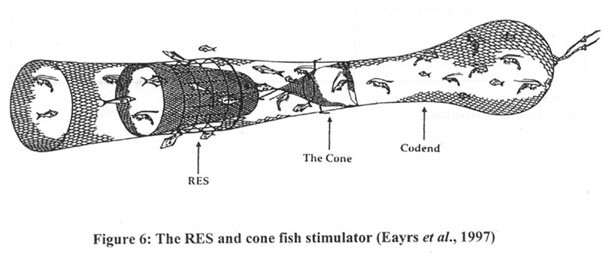
In July, 1997, the author tested the above mentioned SMW in the Bushehr province near Ameri. A radial escape section (RES) and a fish stimulator called a cone was also tested (Figure 6). The SMW was identical to the window described above and it was located in the extension of the trawl 15 meshes ahead of the codend. The RES is also designed to exclude fish from the trawl and uses a funnel of netting to guide all animals into the centre of the codend. As fish exit the funnel, many turn, orientate towards the direction of tow, swim forward and escape through square meshes that extend radially around the codend. Shrimp are unable to orientate themselves and swim forward to reach the escape openings. The cone was developed by US shrimp fishermen to improve fish exclusion rates from the RES. The cone consists of two triangular shaped sections of trawl netting attached to a 10 mm diameter wire hoop measuring 1000 mm in circumference. It is attached to the trawl behind a BRD such as a SMW or RES, and by partially blocking the codend fish are stimulated to swim forward and out through the BRD. In these tests the point of the cone was located 13 meshes behind the trailing edge of the SMW and RES. To keep the codend open a hoop of 10 mm diameter wire measuring 63O mm in diameter was attached to the 13th row of codend meshes (measured from the leading edge of the codend). The results of these trials indicated that the SMW + Cone combination was superior to other BRDs in excluding bycatch. It excluded 44% of large bycatch and 41% of small bycatch with no loss of shrimp.
Prior to the commencement of these latest tests, Fisheries Technologists from Shilat tested the SMW + Cone and compared the effect of 600 mm, 900 mm and 1500 mm codend hoop diameters on catch rates (Table 2). Compared to a standard codend, average shrimp catches varied by 3% or less and commercial fish catches varied by 4% or less. A 41% reduction in bycatch was measured with the 600 mm hoop, and the 900 and 1500 mm hoops resulted in bycatch reductions of 37% and 28% respectively.
| SMW +cone | Standard |
||||||||||
Shot |
Time |
Time |
Hoop |
Shrimp |
Comm. |
Total |
Shrimp |
Comm. |
Total |
||
No. |
start |
finish |
dia. (mm) |
fish |
Bycatch |
fish |
Bycatch |
||||
1 |
12:30 |
15:30 |
600 |
1,50 |
1,00 |
4.75 |
1.50 |
1.00 |
8.00 |
||
2 |
5:00 |
8.00 |
600 |
1.00 |
2.00 |
3.00 |
1.00 |
2.25 |
5.50 |
||
3 |
8:30 |
11:30 |
600 |
1.25 |
1.50 |
4,50 |
1.25 |
1.50 |
8.00 |
||
4 |
16:00 |
19:00 |
600 |
2.00 |
1.50 |
5.50 |
2.00 |
1.50 |
9.00 |
||
5 |
19:30 |
23:30 |
600 |
1.00 |
0.75 |
3.75 |
1.00 |
0.75 |
6.00 |
||
| Total no. baskets | 6.75 |
6.75 |
21.50 |
6.75 |
7.00 |
36.50 |
|||||
| Average | 1.35 |
1.35 |
4.30 |
1.35 |
1.40 |
7.30 |
|||||
6 |
3:00 |
6:00 |
900 |
2.00 |
1.50 |
5.00 |
2.00 |
1.50 |
7.75 |
||
7 |
7:00 |
10:40 |
900 |
0.75 |
0.75 |
3.75 |
0,75 |
0,75 |
6.00 |
||
8 |
11:30 |
14:30 |
900 |
1.00 |
1.25 |
3.00 |
1.00 |
1.25 |
5.00 |
||
9 |
19:30 |
22:30 |
900 |
1,75 |
1.00 |
6.00 |
2.00 |
1.00 |
11 MO |
||
10 |
23:00 |
2:00 |
900 |
1.75 |
1.00 |
9.00 |
1.75 |
1.00 |
13.00 |
||
| Total no. baskets | 7.25 |
5.50 |
26.75 |
7.50 |
5.50 |
42.75 |
|||||
| Average | 1.45 |
1.10 |
5.35 |
1.50 |
1.10 |
8.55 |
|||||
11 |
3:00 |
6:30 |
1500 |
1.25 |
2.00 |
6.50 |
1.50 |
2.00 |
10.00 |
||
12 8:40 |
11:30 |
1500 |
1.50 |
1.75 |
7.75 |
1.50 |
2.00 |
11.00 |
|||
13 12:00 |
15:00 |
1500 |
0.75 |
3.00 |
8.50 |
0.75 |
3.25 |
10.50 |
|||
14* 15:00 |
18:00 |
1500 |
2.00 |
4.00 |
NR |
100 |
3.00 |
NR |
|||
15 19:30 |
22:30 |
1500 |
1.50 |
1.25 |
8.00 |
2.00 |
1.75 |
11,00 |
|||
| Total no. baskets | 7.00 |
12.00 |
30.75 |
6.75 |
12.00 |
42.50 |
|||||
| Average | 1.25 |
2.00 |
7.69 |
1.44 |
2.25 |
10.63 |
|||||
| NR - Not Recorded | |||||||||||
| * Fish trap caught - results | excluded |
||||||||||
Table 2: Results of various hoop diameters (SMW + Cone v Standard)