


All the interventions were as planned and in time:
- the fishing technologist/trainer, expert in by-catch reduction device, Mr. Steve Eayrs, from the Australian Maritime College (AMC), Tasmania, Australia;
- the trainees from the Gulfs countries (one from Kuwait, one from Bahrain, one from Oman and two from Qatar);
- almost twenty participants from Iran, fishing technologists from Sheilat (Ministry of Fisheries) and from the Industrial Fishing Co. of Iran (INFICO), fisheries officers from the General Directorate of Fisheries, as well as from regional Fisheries Directorates; biologists from the Oman Sea Research Institute.
See List of participants in Annex
For carrying out tests and demonstrations at sea, two vessels, outriggers shrimp trawlers, commercial type, 22 and 24 m (one private, one belonging to Shilat) had been made available.
The two trawlers were equipped with standard commercial equipment, including net webbing for making modifications to the trawls. The consultant had brought from Australia a BRD/grid, especially modified to suit (per hypothesis) the conditions in the Gulfs; in addition, in order to facilitate the test and to make the demonstration more evident, he had been asked to bring an underwater camera (which was used for two days only because of difficulties in bringing this piece of equipment into the country).
In addition to manoeuvering or modifying fishing gear, the members of the crews on the two vessels (14 and 16, respectively) participated, with all other participants, in sorting and measuring fish.
Four BRDs and a fish stimulator called a cone were tested in a six day period onboard the steel shrimp trawlers, FV Mehrdad and FV Tabas (22.5 m, 550 hp). The tests were conducted in Horinozgan province in 530 m of water near Hormuz Island.
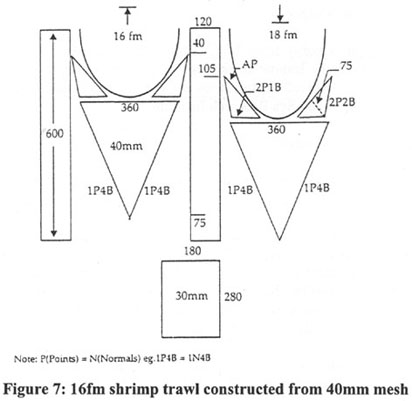
The trawl nets were a four seam design originating from the Gulf of Mexico shrimp fishery. Two trawls were towed simultaneously in a double rig configuration. Both trawls were identical in design and the headline and footline of each measured 29.3 and 33 m (16 and 18
fathoms) respectively (Figure 7). The mesh size in the main part of the trawl (body) measured 40 mm while codend mesh size measured 30 mm.
The top and bottom panels of each trawl were identical in design and all netting was constructed from polyamide (nylon). To each wingend, a 770 mm upper sweep and a 1200 mm lower sweep was attached. A 100 kg ground chain was 'scalloped' along the footrope of each trawl. The diameter of each link was 18 mm and 11 links extended between each 200 mm hanging. A 33 m (18 fm) tickler chain was extended between the otterboards and link diameter was 5 mm. The codend of each trawl measured 180 meshes in circumference and 280 meshes deep. Rectangular flat otter boards were used measuring 2.41 m x 1.13 m and weighing approximately 250 kg each.
A square-mesh window (SMW), fisheyes, NAFTED, rope BRD and a cone (fish stimulator) were tested.
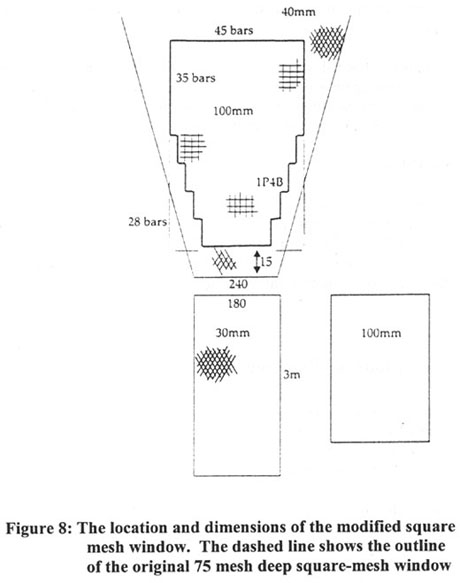
The square-mesh window (SMW) used during the tests was developed by Iranian Fisheries Technologists to suit local conditions. The window was located in the extension of the trawl 15 meshes ahead of the codend (Figure 8). The SMW was constructed from 210/72 polyamide and measured 45 bar lengths wide and 75 bar lengths deep. Mesh size was l00 mm.
The fisheye consisted of a steel framework attached to the codend to provide an elliptical escape opening through which fish swim and escape (Figure 2). The escape opening measured 400 mm across and 200 mm high. Two fisheyes were tested simultaneously onboard the FV Tabas and only one onboard the FV Mehrdad. In both cases they were located in the leading section of the codend.
The NAFTED was designed at the AMC specifically to exclude large animals such as sharks, stingrays and turtles from the trawl. This BRD consists of an aluminium grid inclined at 45 degrees and a guiding panel of netting located ahead of the grid (Figure 4). The panel of netting guides all animals to the bottom of the codend. Large animals unable to pass through the bars are excluded through an escape opening located in the top of the codend. It is worth mentioning that the NAFTED is similar in design to the Nordmore grid with the exception that the bars of the grid are bent backwards to prevent blockage of sponges and other debris. In these tests a bar spacing of 40 mm was used to increase the exclusion of smaller animals from the trawl. It was located between the codend and trawl extension.
The rope BRD was located in the same position as the square mesh window and consisted of parallel ropes extending lengthwise along the trawl. Rope diameter was 8 mm and rope spacing was 150 mm.
The design of the cone has been described above. In these tests the hoop of the cone was located 5 meshes behind the seam joining the codend to the trawl. A 900 mm diameter wire hoop extending around the circumference of the codend was also attached to this seam and served to keep the codend open with a constant diameter.
The underwater video system consisted of a Sony Hi8 camcorder located inside an aluminium housing. An aluminium frame attached to the housing provided a means of attachment to the trawl. The housing is waterproof to approximately 40 m. To commence recording a simple toggle switch is activated prior to deploying the trawl and recording for up 60 minutes is possible. Video footage is then viewed either through the camcorder itself or via connection to a television monitor.
At the commencement of the tests one shot was completed with both port and starboard trawls equipped with standard diamond mesh codends in order to ensure that both trawls were functioning correctly and measure any catch bias between sides. The number of baskets of shrimp were counted and both sides were found to be the same.
At the completion of each tow both codends were emptied on to the deck of the trawler, taking care to prevent mixing of port and starboard catches. Initially, the catch from each side was sorted into the following categories: shrimp, small bycatch, large bycatch and commercial fish. However, as much of the bycatch was approximately 15 cm long and therefore easily categorised as either large or small bycatch, it became apparent that the bycatch categories were unsuitable. All bycatch was then placed into a single category. Each category was placed into baskets and the number of baskets counted (Table 3). Full baskets weighed 20 kg.
Initially, shot duration was standardised to one hour. However, large shrimp catches on October 14 necessitated a reduction to half an hour. This duration was retained for the remainder of the tests.
In addition, in order to gain a better understanding of the species composition and size ranges of fish and shrimp, catch sub-samples were taken during the last few days of the tests.
BRD |
Port or |
No. |
Shrimp |
Commercial |
Total bycatch |
Stb. |
shots |
fish |
|||
Standard |
p |
34.0 |
2.5 |
65.0 |
|
y |
2 |
||||
Fisheye |
S |
26.5 |
2.5 |
44.0 |
|
Standard codend |
P |
45.5 |
11 |
23 0 |
|
y |
3 |
||||
Fisheve + Cone' |
S |
26.75 |
3.23 |
9.75 |
|
Rope BRD |
P |
0.1 |
0.75 |
0.75 |
|
y |
1 |
||||
Standard codend' |
S |
0.1 |
0.75 |
1.0 |
Table 3: Catch summary by number of baskets
