


Chapter 3: Education, training and access to technology
Regional education has demonstrated increasing expansion since the '50's which is reflected in a marked reduction, generation after generation, in the lack of formal education in society. However, this expansion has responded to a set of complex pressures which translate into an example of unequal distribution of the benefits in the educational system. This distribution is characterized by social segmentation of education, a growing rural-urban imbalance, and less relative access for women.
Towards 1980, one-third of the people over 45 years old were classified as "bearing no education" while only slightly more than 10% of the population between 15 and 19 years old were placed in the same category (CEPAL/Unesco, 1992).
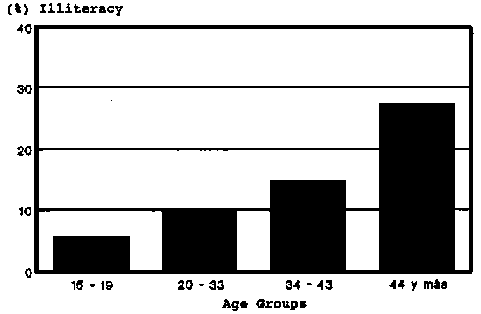
The analysis of the totally illiterate confirms the same: extending to 15% of the population over 15 years of age in the Region in 1990 and particularly within those older than 438 (Graph 5). The largest part of illiteracy in the elder age group is a common factor in all of the sub-regions, as illustrated in Table 8 (Unesco/OREALC, 1992).
8 In Unesco/OREALC, 1992, totally illiteracy is defined as those classified as such in the population census.
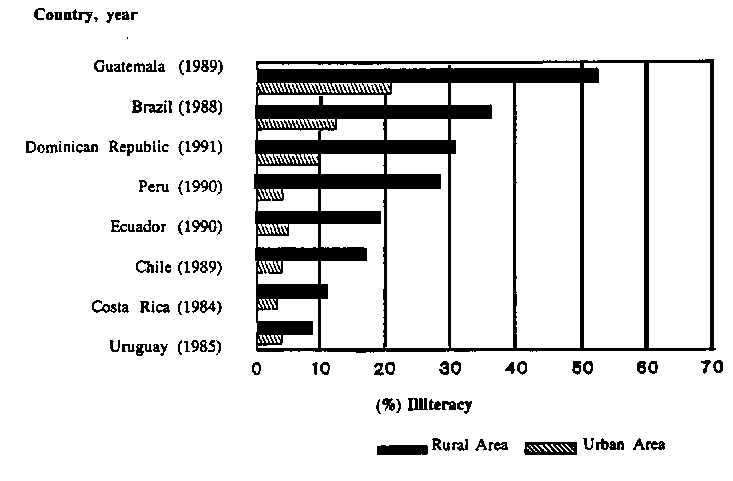
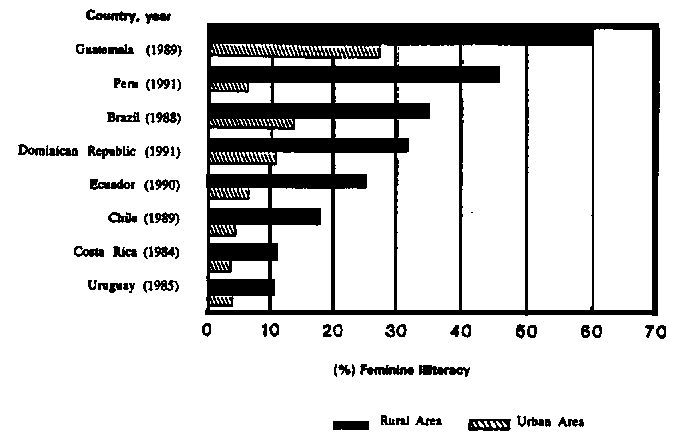
In the majority of the Regional countries, urban population possess higher education levels than those in rural areas. Recent available information for some of the countries in the Region reveal that in all countries illiteracy in the rural areas is double or more than that in urban areas (Table 9, Graph 6). Feminine illiteracy follows this same trend; that is, illiteracy is higher in rural areas than in urban areas. There is a difference of almost 5 percentage points in Uruguay reaching 31 percentage points in Guatemala (Graph 7).
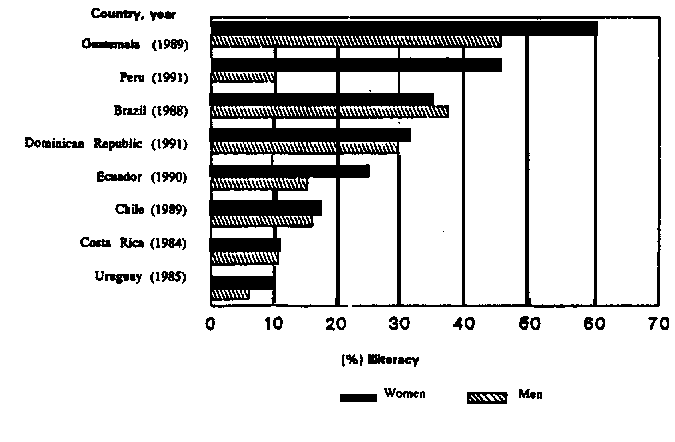
In the rural population, women generally obtain an inferior education than do men. The rural, feminine illiteracy rates in the Regional countries fluctuated between 19.2% and 48% in 1985 (CEPAL/CELADE 1993:57). This situation is worse in Peru where the difference between men and women is nearly 35 percentage points. Costa Rica, with almost no difference and Brazil, where the rural masculine illiteracy rate is greater than the feminine one by approximately 3 percentage points (Graph 8), are the exceptions to this tendency.
TABLE N° 8 LATIN AMERICA AND TEE CARIBBEAN: ILLITERACY PER AGE GROUP (%) 1990 ESTIMATES
Age Groups |
South America |
Central America and Panama |
Gulf of Mexico |
English - speaking Caribbean |
Total |
15 - 19 |
5 9 |
13.3 |
3.7 |
3.7 |
5.7 |
20 - 33 |
9.3 |
23.1 |
8.7 |
8.7 |
9.9 |
34 - 43 |
13.9 |
27.7 |
14.8 |
14.8 |
1 14.6 |
44+ |
26.3 |
40.1 |
27.1 |
27.1 |
27.1 |
Total |
14.9 |
26.60 |
13.4 |
2.1 |
15.1 |
*Antigua and Barbuda, Netherland Antilles, Aruba and the Bahamas are not included.
SOURCE: "Education in Latin America and the Caribbean, 1980-1989" Unesco/OREALC. Santiago, Chile, 1992.
Graph 5 Latin America and the Caribbean illiteracy per age group, 1990
Source: Table 8
TABLE N° 9 LATIN AMERICA: ILLITERACY RATES PER GENDER, PER AREA (%) POPULATION OVER 15 YEARS OF AGE, 8 COUNTRIES
Country |
Year |
Rural Area |
Urban Area | ||||
Man |
Women |
Total |
Men |
Women |
Total | ||
Brazil* |
1988 |
37.5 |
34.7 |
36.1 |
11.5 |
13.6 |
12.6 |
Costa Rica |
1984 |
10.9 |
11.0 |
11.0 |
2.7 |
3.8 |
3.3 |
Chile |
1989 |
16.3 |
17.5 |
16.8 |
3.6 |
4.4 |
4.1 |
Ecuador |
1990 |
15.5 |
25.1 |
19.2 |
3.6 |
6.5 |
5.1 |
Guatemala |
1989 |
45.6 |
160.0 |
52.3 |
16.5 |
27.0 |
21.0 |
Peru |
1991 |
10.4 |
45.6 |
28.1 |
2.2 |
6.3 |
4.2 |
Dominican Republic |
1991 |
29.7 |
31.4 |
30.6 |
8.7 |
10.8 |
9.8 |
Uruguay |
1985 |
6.2 |
10.4 |
8.7 |
3.8 |
4.1 |
4.0 |
* Population older than 10 years of age.
SOURCE: Based on "Latin American Women Statistically Speaking" FLACSO-CHILE, WOMEN'S INSTITUTE, SPAIN, 1993 (Volumes correspond to each country).
Graph 6 Latin America, 8 countries illiteracy rate per zone
Source: Table 9
Graph 7 Latin America, 8 countries feminine illiteracy rate per zone
Source: Table 9
Graph 8 Latin America, 8 countries rural area illiteracy per gender
Source: Table 9
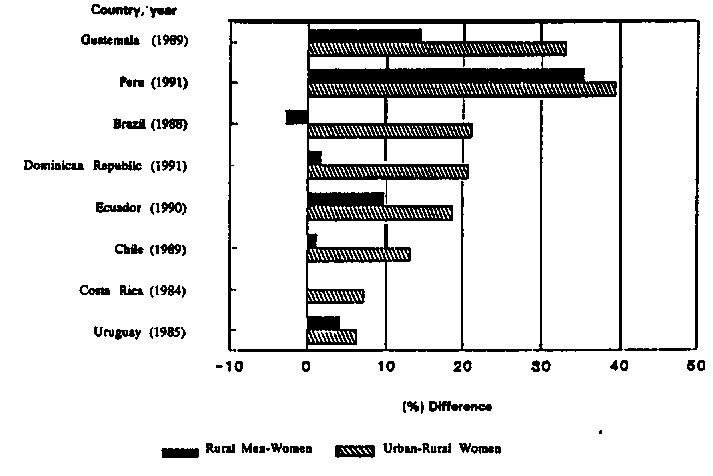
Upon comparing rural and urban area differences regarding feminine illiteracy and illiteracy among men and women within the rural areas, results were found that for the countries analyzed, the first are significantly higher than the second (Graph 9). This indicates that most likely the lack of education in rural women is more related to their geographical location rather than their being women, a conclusion which is quite important from a gender perspective.
Although it may be true that for some time rural parents considered that education for their daughters was unnecessary, the indicated figures seem to show that today both parents acknowledge that children, both sons and daughters, should be educated thereby generating more opportunities for girls than their mothers had. For example, this is demonstrated among Bolivian and Peruvian rural inhabitants. The Bolivians additionally stated that: "Current generations have an improved standard of living because women are educated", "Our life is better because we are treated better and we go to school, therefore we are better informed and know more things" (14-18 year old age group), (FAO 1991:33). As for the Peruvians, they add a new element: teachers: "the least prepared are sent, they are "third category" teachers" (FAO 1991c:23). Other indicators referred to below are not as clear in this regard revealing that still men are favored over women.
Educational levels of rural women result as being lower than those of men due to the rural migration which is predominantly feminine: in effect, migrating women are younger and generally represent higher education levels than other rural women. Leaving the countryside produces a breach in educational levels in these areas, thereby increasing illiteracy and decreasing teaching levels.
Unfortunately, there is no recent information regarding the differences per age groups concerning educational levels attained by rural women in the Region. The Unesco yearbooks, which is supposedly the most authorized source in this subject, do not provide such information. In the literature which was revised to create this document, no recent works were found in this regard.
Graph 9 Latin America, 8 countries illiteracy differences per area and order
Source: Table 9
An analysis of the census of the '80's, (CELADE, 1987), showed that instruction levels attained (years of study approved or passed) are generally lower in rural areas, women and the elderly. To be fully aware of the recent makeup in the Region, we must wait for the analysis of the '90's. However, surely the difference per age will not present important changes: they are related to the educational policies applied in the Regional countries which have affected various generations. Still, it will take many decades to minimize their effects. For this reason, the lack of education is greater when global indicators are taken into consideration for the analysis. This could lead to confusion by interpreting them as the product of actions currently taken. Furthermore, the higher education levels attained by young women favors the success of training and technology transfer programs which would lead to situations of their becoming priority recipients of these programs.
Lack of education among the elderly is frequently observed in the rural areas of the Region as well as in the indigenous communities of various countries (Hernández, "Ethnic Conscience and Adult Education for the Indigenous in Latin America, 1984, UFRO/INE/FII/PAESMI/CELADE, 1990). A census of indigenous groups conducted in four rural districts of Chile reveals that illiteracy is greater among older people, both men and women9. Feminine illiteracy is higher than masculine (60% of the total illiteracy rate is comprised of women) and the difference per gender becomes relevant starting at 25 years of age. Among the younger ages, illiteracy rates are even slightly lower among women thus indicating greater incorporation of these women to the educational system (Table 10). Regarding school levels, men between 5 and 29 years of age have an average of 4.9 years of approved studies, while women in the same age group have a slightly lower average, 4.7 years. The differences are greater related to the population over 30 years of age: men have an average of 3.8 years, while women bear an average of 2.6 years (UFRO/INE/FII/PAESMI/CELADE, 1990).
9 The illiterate population is defined as that which has not approved any course in the educational system.
TABLE N° 10 CHILE: SELECTED INDIGENOUS GROUPS ABSOLUTE ILLITERACY RATES OF POPULATION OVER SIX YEARS OF AGE PER GENDER (%) 1988 CENSUS
Age Groups |
(%) Illiteracy Rates | ||
Men |
Women |
Total | |
6 |
89.4 |
92.1 |
90.8 |
7 |
55.3 |
56.9 |
56.1 |
8 |
17.7 |
18.6 |
18.2 |
9 |
5.8 |
2.8 |
4.3 |
10-14 |
1.8 |
1.3 |
1.6 |
15-19 |
1.2 |
0.8 |
1.0 |
20-24 |
2.9 |
2.3 |
2.6 |
25-29 |
2.2 |
4.3 |
3.3 |
30-34 |
1.5 |
6.1 |
3.8 |
35-39 |
3.8 |
10.0 |
6.9 |
40-44 |
7.6 |
18.0 |
12.8 |
45-49 |
12.7 |
25.3 |
19.0 |
50-54 |
18.6 |
34.9 |
26.8 |
55-59 |
21.4 |
43.9 |
32.7 |
60-64 |
29.6 |
55.0 |
42.3 |
SOURCE: "Census of selected indigenous groups" UFRO/INE/FII/PAESMI/CELADE, 1990, Pg. 123.
The quantitative expansion in the Region during the 1950's occurred mainly in primary school which became obligatory and free in all of the Regional countries (CEPAL/Unesco, 1992). However, it must be remembered that, even though educational coverage has increased in rural areas, "In all countries bearing information, schooling of about 50% or more of the rural youths reaches barely 6 years of primary school or less" (CEPAL/Unesco, 1992). Additionally, juvenile illiteracy in the Region (15-24 years old) is a predominantly rural occurrence. Recent statistics indicate that the average illiteracy rate in these groups was 31.1% in rural areas and 7.6% in urban areas (Unesco/FAO, 1988). Likewise, course failure in rural areas was, in some cases, double than that of urban areas. This influences schooling delay which is not attributable only to failing, but also to delayed enrollment to school common in rural areas (Rama: "Educational Styles" in "Education and society in Latin America and the Caribbean", Unesco/CEPAL/UNDP/UNICEF, 1980, in Unesco/FAO, 1988). The actual meaning of these figures should be interpreted through a comparison to developed countries where finishing high school requires at least 12 years of schooling which has become practically universal.
The fact that there is an ever-increasing number of rural youths entering the educational system does not mean they receive an adequate education for their developing requirements. Teaching quality is a problem existing in and beyond the cities; however, this is stressed in rural areas due to the following factors:
a) the obligatory curriculum of primary school is designed in the cities and the urban criteria prevails; the latter being inadequate for rural children, they confuse them and make them feel uprooted from their rural living. The difficulty of the fact that studies are in Spanish constitute another factor that limits access to children of indigenous communities which bear a limited or void knowledge of Spanish;
b) the incompatibility of school vacations and peak periods for manual labor in the country thus contributing to temporary absence and poor educational results;
c) the poor preparation of the teachers: the portion of unlicensed teachers tends to level at one third and 50% than the national average;
d) the simultaneous education of various grades without proper teacher preparation in this regard; and
e) the detachment of the teachers from the community since they frequently do not live in the community as a result of transportation improvements (CEPAL/Unesco, 1992).
All of the above points towards the fact that the core problem would not only linked to having access to education, rather its quality and the possibilities of remaining in the school system.
Attempts to resolve these problems have been more oriented towards quantitative expansion of the education in rural areas than in creating and offering an education pertaining to rural living. Furthermore, instruction and class modifications rarely have been evaluated and systematically diffused (CEPAL/Unesco, 1992).
Delving deeper into these qualitative aspects, FAO (1991a) analyzed the education in the rural sectors of Bolivia, Colombia, Ecuador, Peru and Venezuela indicating that the quality of the educational services in rural areas of these countries is quite poor and that men and women enjoy distinct conditions and opportunities.
In Bolivia, the feminine school abandonment is higher than men's and the informal educational programs for rural women tend to reinforce their domestic role (cooking, sewing, etc.) In Peru educational differences between men and women in rural areas are crossed due to cultural factors: the lack of resources cause the parents to favor the sons with education. A similar situation occurs in Ecuador where it is believed that the education provided does not coincide with or is not useful for country living.
Despite the fact that the women in the Region enjoy more educational opportunities than did their mothers, school texts used in primary school continue to transmit images highlighting women's roles at home, thereby underestimating their participation in other functions. Studies conducted in Chile, Costa Rica and Guatemala demonstrated the preeminence of masculine characters and images that associate men to productive activities and women to domestic activities. Over recent years, the Costa Rican government has made efforts to mitigate this situation (CEPAL/Unesco, 1992).
Although the effects of teachers transmitting stereotype gender roles through teaching (Rossetti and collaborators, 1994) have not been studied in the rural environment, there is no reason to assume that teachers could be more fair in the country than in the city. On the contrary, it should be also considered that what occurs in rural areas also happens in the cities, and that teachers reinforce stereotypes through their teaching methods and mannerisms in dealing with their boys and girls in the classroom.
The influence of education in employment opportunities is another topic of interest when analyzing the extent of educational coverage. Valdés (1992) upon studying three life stories of women in central Chile indicated that agrarian and social modernization would increasingly influence children and adolescents through the schooling system, prolonging the age of infancy, distinguishing and separating learning experiences collected with adults within rural families from the school education. She also states that attaining higher education does not seem to lead to better jobs since market conditions do not offer better employment opportunities to youths who attained a higher education than their parents.
This proposal agrees with that from CEPAL-CELADE where it is indicated that the educational influence on the growing social movability seems to be decreasing: "Upon widening educational coverage, increasing demands regarding necessary schooling have been observed; the above, so that education would imply better employment options and a better living" (CEPAL/CELADE, 1993).
Despite the formal education limitations which have already been mentioned and that impede education to be the most adequate instruction for productive living in rural areas, education has been proposed to increase agricultural productivity through three potential effects: a) improving the work quality thus yielding more production with the same amount of supplies; b) improving the capability of the producer to process information and allocate resources for competitive uses; and c) improving supply selection in the short term and operating scales in the long term. In this framework, various studies indicate that productivity improves up to 7% or more if the farmer has passed four years of primary school.
These four years have been defined as the "minimum" necessary beginning. However, the incorporation of new technologies require large capacity in reading and writing, as well as mathematics (the four basics, ratios, percentages and the rule of three) which begin being acquired starting in the fourth grade at school and which should be studied in more detail after the sixth grade. Therefore, it may be affirmed that although the three or four years of primary education (considered sufficient for literacy) may act as catalysts, accelerating entrance in the first phases of technological changes, higher education is required to increase technological development (CEPAL/Unesco, 1992). In this regard, increased formal education becomes a requirement to adequately incorporate and manage new technologies.
Regarding rural women, the above implies the necessity to make efforts to extend their formal education, but more to guarantee their remaining in the educational system and overcoming the stereotypes taught through the teaching practices and learning texts. Then they should focus on favoring their development as women and particularly the success of the technology transfer programs.
As will be seen later, to date, in rural areas greater innovative efforts regarding gender have been made in training, which is part of the adult education and therefore necessarily restricted. What bears the most impact for mass, profound changes in the hierarchy and division of the sexes has not been considered; meaning what could enrich course studies and teaching practices of the formal education system throughout its different levels in view of equal opportunities between men and women. This would imply that before anything else, teachers of both sexes who work in rural primary and secondary schools should be made aware of this element.
Efforts in the formal system, even if they are delayed in their execution, are advantageous in achieving greater impact and being more permanent.
Generally, literature referring to the access that rural women have to training and technology indicates that such access is restricted. The " invisibility" of the productive work she does perform - due to the fact that she is not paid for it, as analyzed earlier - could constitute an exclusion factor regarding women's training. For some reason, it is assumed that since she in not paid, the rural female does not work; and given the fact that she does not work, therefore no training program is required (CEPAL 1990a).
This vision of limiting women to domestic-reproductive roles has also lead to their training being conceived in such a manner that reinforces their traditional feminine role. In these cases, training for rural women is basically oriented towards health aid activities, nutrition, environmental cleaning, home gardens, home improvement, sewing and handicrafts. Therefore, in this manner, women are taught to expect these types of projects and they will seek training to reinforce their domestic activities thus not developing their potential in productive projects in other productive areas.
However, in recent years productive projects have been developed for rural women in several countries in the Region (Aranda and Olavarría, 1988). This is not the moment to expound on all of them, although some of the projects are mentioned in Chapter 6. As one illustration, in Chile the program "Forming and Training Workshop for Rural Women" motivated by the government (INDAP-PRODEMU Agreement) which has been performed since 1992, conducted 304 courses in 1993; of which, 134 were related to agriculture and livestock (the majority of them were in reference to home gardens, greenhouses, fruit or vegetable processing and flower growing), 117 to handwork (sewing, knitting, cooking and baking), and 53 to handicrafts (weaving and wickering). Handwork represents nearly one third of all the courses; however it is important to indicate that these courses responded to the demands of women who still drag their experiences from the traditional Centers for Mothers which were not questioned during the military government (Reyes et al., 1993).
In this regard, León's observation would apply which proposes that upon considering training, women think about those courses which are traditionally offered to them, creating a vicious circle: women are interested in traditional courses and the organizations and grantors foster this interest by not offering different alternatives.
An area where there has been much progress but until recently it was not systematically evaluated concerns the diffusion of alternative technologies for rural women. Regarding this subject, there seems to be scarce Regional information existing. Taking this into consideration, the UN Fund for Women (UNIFEM) created a directory of organizations working in this area in 1993 in El Salvador, Guatemala, Mexico and Nicaragua, based on research conducted two years before (UNIFEM, 1993). The directory provides 185 governmental and non-governmental organizations working in such countries: 32 in El Salvador, 50 in Guatemala, 47 in Mexico10 and 56 in Nicaragua. Work areas are comprised of: a) agriculture (home gardens, organic fertilizers, compost and sutrane, minimum cultivation, biodigesters); b) stock breeding (manufacture of alternate foods); c) health (hygiene and nutrition, alternative medicine, drinking water processing) and d) food processing/micro-businesses (this line of work is scarce and the majority of the projects relates to food production). Other programs include the breeding and fattening of animals (chickens and pigs) elaboration of sausages, sewing, knitting and assembly); e) housing (use of sun-dried brick, brick latrines, solar heaters, heaters (lorenas, Barneys and others); and f) forestry (forest management, oil extraction, forestry, reforestation).
10 Only includes Non-Governmental Organizational
The list is vast, especially considering that it only covers 4 countries in the Region. Similar lists could certainly be formed in all countries in Latin America and the Caribbean, recovering the experiences that abound starting from the '70's. The difficulties rests, without a doubt, on the fact that many of these initiatives are defined as action projects and do not count on the necessary resources to form and maintain a registry regarding achievements and results of the same.
The spreading of new technologies and their assimilation by the population is a subject discussed in the urban and rural environments. Regarding the rural areas, CEPAL (1990a) affirmed that the adoption of technological development in the agriculture and stock breeding sector has increased, in the majority of the countries, the polarization and heterogeneity of the productive structure. Although the incorporation of technology leads to be a greater control by the rural person of the technical conditions of the productive process, it has not been proven, in general terms, that poverty tends to be eliminated or decreased. One explanation is offered, alluding to Schajtman ("Country and Biotechnology. Notes to Reflect Upon. 1988), CEPAL poses that technology is not the "source of perversity" but rather economic and social conditions determine the lack of "neutrality" of the selection and technological adoption processes.
The incorporation of technology has also been discussed in relation to its effects on the work division between the sexes. In rural families it has been observed that they demonstrate flexibility when redefining labor divisions in crisis situations but then return to their traditional standards when such situations are overcome11. (Ureta and Karremans, 1993). This is very similar to what Cock-burn detected ("Dominating Machinery: women, men and technical know-how, 1988, CEPAL 1990a) based on three case studies of industries in Great Britain. In general terms, the technological change does not affect the standard according to which men withhold knowledge and technical skills. However, technology incorporation provokes a commotion which implies a redistribution of tasks between men and women which ceases when everything has returned to normal. If this were so, CEPAL suggests that one should take advantage of the "commotion " moment to act on redistributing tasks between the sexes.
11 See 4.3. "Family and work division per gender".
Regarding the relation between technological incorporation and employment, to date the systematic effects are unknown as to the incorporation of new technologies in employment. Generally, manual labor production increases but the effects vary depending upon the type of technological change and the preexisting working conditions (CEPAL 1990a). Technological changes may have different effects on men and women. Joeckers ("Women and global economy., 1987, CEPAL 1990a) analyzed the situation of the developing countries and distinguished three levels of technological change which would be facilitating elements for incorporating it to work sites, particularly in the rural area: the improvement of the tools will accelerate the specialization process; mechanization overtakes manual labor and automatization increases the degree of participation, attention and preparation required by the work force. One example of this is the use of modern varieties of high-yield crops which generally generate jobs as they incorporate other phases of work, among them, fertilization and land care.
Women could benefit from jobs generated by the incorporation of technology for two reasons: a) they represent, together with the youths, the only source of manual labor (particularly when there are low overall unemployment levels) and b) some activities requiring thoroughness and care, which demand, at the same time, much manual labor, specifically during the harvest, are classified as feminine work since agriculture follows the traditional standard of work division by gender. Furthermore, if men were to enter the agricultural industry, women would have to replace them in the farm.
Independent of the peculiarities of the processes of technology adoption in agriculture in Latin America and the Caribbean and the relationship between technology-generic division of the work and technology-employment, there is a consensus regarding the fact that training of rural women and the technical assistance programs can facilitate greater and better incorporation of women to production in different areas, a general increase of agricultural productivity and an improvement in the family socioeconomic conditions.
In this area, it should be asked to what degree are rural women willing to incorporate new technologies, considering their low educational levels and subordinate role to which they have been subject during hundreds of years. In fact, this question has been hardly developed. For example, in the Sub-Regional Workshops regarding the execution of the FAO Action Plan (FAO, 1992b), in the workshop conducted for South America, all the countries indicated as obstacles, although in varying degrees, the following: cultural barriers, scarce gender outline in public organizations and the lack of preparation of the officials, and legal and financial problems. Only one country, Chile, indicated an additional unsureness of rural women being interested in productive projects.
An example of the exclusion of women from training programs and technology access and the disregard of women's points of view, is found in some experiences in Peru (Alcántara, 1991). According to the author, in this country various energy projects have been developed (National Council of Energy, ITINTEC, Cajamarca University and DESCO) to use solar, heolic energy, biogas and hydroelectric energy, all in an experimental phase with limited scopes. No project included specific training for women. This is even more relevant when one considers that women directly use energy in their domestic and productive duties.
Another project, also conducted in Peru, INFOR/FAO/Government of Holland, trained to forest grantors as a means to motivate reforestation in some Andean communities in the sierra. Similar to the previously mentioned situation, these programs included a minimal participation of rural women. However, the same project considered a program of improved kitchens in two areas of the country (Huaraz and Huancayo) training the grantors to train women in some communities. In the eyes of the author these programs had "...a relative success due to construction costs yet with few efforts at convincing women to adopt these new kitchens" (op. cit. pg. 6). It is interesting to highlight this evaluation since it could lead to a questionable understanding: it could be said that the success of a technology transfer program lies in the capacity to convince the executors without considering the opinion and behavior of the beneficiaries.
In fact, considering the vision of rural women themselves regarding the training programs is a key element in the discussion regarding women's access to them. For example, research conducted by the Technology Transfer Program of the National Institute for Agriculture and Livestock Development (INDAP) in Chile (Olavarría, 1991) consulted the family grantors on, among other aspects, the demands of the beneficiaries. It was revealed that they were mainly centered on matters not related to agriculture such as material painting, knitting, cutting and assembly, cooking and baking. As an exception, in areas where there is or was some degree of organization, support to conduct activities that would contribute to women earning some type of monetary income was sought; such as the sales of some products (wood caving ovens to make bread, flower and vegetable growing in greenhousse).
To those offering the programs, this reveals that women do not wish to be trained in matters related to agricultural work. They believe that "they know everything about agriculture" or that they like to do things "their way". Furthermore, they are aware that many of the courses they demand do not contribute to their income but that they would like to be trained so as to have a better house or to knit for their family. In this same sense, it wee observed that they require training for matters that they already know how to do which represent an extension of their domestic role and whose main effect would be perhaps a "solid" activity so as to justify their leaving the home (Grunfeld, 1990).
The valuation of training courses centered on home improvement is not an exclusive rural phenomenon. Research conducted in industrial workers in Santiago, Chile, found the same opinions regarding training (Rosetti, 1984). This reveals the precarious insertion of the women in the working world for the urban and rural sectors.
In Olavarría's opinion, it is very likely that women 'e demands are influenced by the feminine stereotype linked exclusively to the maternal role which has been traditionally transmitted through programs aimed at rural women and which is systematically reinforced by the media. Therefore, Olavarría concludes that one should "...support the beneficiaries in defining their identity as women, as rural women, and in valuing their contribution to the family, production and society."
It is clear that programs should be designed to incorporate gender contents which allow the rural woman to redefine her role as a woman and producer, but it is fundamental to consider various elements when developing said programs. On one hand, the rationality of women themselves: their interest for training in areas linked to domestic duties does not only reflect a millenary lesson, perhaps it is also a sign of growing women, who do not wish to see themselves restricted exclusively to the working environment. In any event, forgetting such reasoning could become an important fact in the failure of a specific policy. In Colombia, for example, the contents of certain sexual educational courses oriented to rural women were considered by the same as strong thus provoking rejection from their families and the women themselves. Additionally, women even opposed to the creation of organizations with gender content as they considered the proposal of equality between the sexes as very bold. (FAO, 1991d).
A second factor to consider is that before one can train women in nontraditional areas, a sustained awareness is required from the organisms which provide training and from the trainers as well so that they learn to better manage women's resistance to the change; a resistance that was fostered by the organizations themselves for decades.
Another important factor to consider is the magnitude of the activities developed by women and the time that they dedicate to them. The opinion of a female Andean leader is decisive: "Some initiatives for development, official or private, do not consider the excessive work of rural women and they add more work by believing that by improving the family situation they will improve women's life immediately" ("Andean Women", ISIS International, women's Editions No. 6. In Aranda and (Olavarría, 1988:40).
Training for rural women has been proposed to be centered on the activities they perform. In this regard, FAO (1989) indicated that normally this aspect is not considered since agricultural training has been directed towards activities which commonly women do not perform. In this sense, it affirms that "Women will not be sufficiently assisted by the agrarian extension services unless the extension message is more pertinent to their needs: related to the crops that women produce, the stock that she raises, the agricultural systems she uses and the time which she dedicates to her work'' (op. cit. pg. 98).
León (1986) believes, however, that the above in necessary but it is not sufficient. Training projects which would enable women to be more technically involved in their essential, usual activities such as gardens or care for smaller species, would contribute to reproducing the subordination of women if they take the existing work separation as a fact. The author defines the training as "the urgency to make the rural woman aware that what she does generates the power for making changes". (op. cit. pg. 13).
Finally, Aranda and (Olavarría, (1988) add important elements to the above. They believe that training should be made through the integration of three dimensions that contain the main missing factors of the poor, rural woman: economic-productive arena, organization and personal development.
Regarding the economic-productive factor, is should be considered, other than the technical element, training understood as "work education". According to this, the authors disregard providing technical specific knowledge favoring a "learning the job" experience; which is to say, a vision of the process in which technical aspects make sense. This perspective is proposed as the most adequate to provide rural women not only with modern techniques, but also with business management. In practical terms, training which combines both dimensions - techniques and management- also contains the advantage of being applicable as of the recognition of women's role as an agricultural producer and the reconsideration of the productive character of the home garden. The reality of rural women, their tasks and the environment with which they are associated, serve to boost those aspects where major faults are found.
In reference to organization, training should be focused on strengthening rural women 'e organizations. When confronting this, two important elements to be considered are proposed. First, the organization should constitute an instance where cultural traditions delegating woman to the private environment are discussed. Second, it must consider that many women's organizations reinforce the spirit of service of the woman and her domestic role; these are highly valued by women as a social participation which is different from the home. Training should strengthen these organizations so that they become more political with the ability to move and make demands throughout the community.
Regarding the personal development, they indicate that any project or program geared to rural women must be familiar with the problems which have been repeatedly proposed: domestic closing in, isolation, lack of participation, separation from society, and ignorance regarding relevant aspects of herself. Training for specific projects require a wider projection: beyond the type of program which should be brought into practice, "it requires a women with a minimum of knowledge and technical preparation, capable of expressing herself and her judgments, of forming and receiving criticisms. A participating woman; a woman "equal" to men; a woman that can be connected with external agents, go to cities, perform movements, apply for credits, program production, etc." (op. cit. pg. 41). In these terms, a training program emphasizing personal development may not obtain economic-productive results in the short term. However, in the long term its effects could become permanent thereby leading to new training projects.
The information regarding educational levels for the rural areas on a Regional level, separated by gender and ethnic group is not enough. For this insufficiency, one important recommendation is that the analysis of the census conducted in the 90's be made entailing a thorough review of the educational differentiation's in rural areas, a matter scarcely considered in the regional documents.
In recent decades, the Regional education has been characterized by an ever-growing coverage but with unequal distribution particularly between rural areas and cities. Therefore, the education of the rural women corresponds more to their geographical location than to their status as women: educational differences are larger between urban and rural women than between rural men and women.
Together with increased coverage of education, there has been a change in the rural people's valuation of education considering it is as necessary for their sons as for their daughters. Both occurrences are expressed in the fact that the education attained by young women is superior to those of older women which does not mean to say that the first count on adequate education.
The fact that young women have acquired higher educational levels than their mothers constitutes an auspicious element for development, training and technology transfer projects. Therefore, it is necessary to give these women special attention thus providing opportunities to avoid their facing an obligation to seek said opportunities in the urban environment.
Educational coverage has grown; however, it must be born in mind that for more than 50% of the individuals, it encompasses barely 6 years of primary education which is clearly insufficient for the development of these countries. Furthermore, there are high levels of course failure and abandonment.
Not only are there problems of coverage and permanence in the school system, but the teaching quality problem is also present. This is not fully relevant as it applies the urban curriculum and the same school order in rural areas.
As for rural women, gender stereotypes are added which reinforce their orientation towards fulfilling traditional roles by means of the school texts and the teaching methods used in the classroom.
There are different points of view with respect to the incidence of the education in attaining employment in rural areas. Some say that a higher educational level does not guarantee finding a job. Others, although they acknowledge that demands for work positions have increased, state that a higher education is essential in order to improve agricultural work productivity and technology transfer and therefore the quality of job performance.
Regarding training, rural women tend to be excluded because rural society and politics and the training organizations do not consider them as "worker". This also occurs because when training is offered, courses related to domestic work, not productive work, are offered. At the same time, women are interested in traditional courses and this interest is fostered by the organizations and grantors by not offering different alternatives.
It is erroneous to sustain that improvements have not been made. In fact, the productive project list for rural women is quite long in the majority of the countries and the same happens, although to a lesser extent, with those projects related to alternative technology transfer. What dote remain is that innovations have not been obtained in the majority of the cases to overcome the poverty of the population or break the role separation between men and women. The technological change does not affect the standard according to which men continue to withhold knowledge, technical abilities and power. Notwithstanding, the incorporation of new technologies has meant, to a certain degree, more employment for women: for example, in fruit growing businesses.
Recommendations to improve training directed to rural women are listed below:
- Training should start by considering rural women's points of view and interests, even though it initially may be limited to the domestic work;
- Parallely, educational authorities, organisms and officials who design and conduct training programs should be made aware of the perspective of equal opportunities for both sexes. The goal is to gradually offer women courses that are not traditional, that are linked with agriculture/farm management, and that provide the acquisition of abilities and specific techniques.
- Training directed to women must be conducted in productive activities that they perform which does not tend to occur habitually. In other words, incorporating knowledge and technology in their own, familiar areas, thereby gradually overcoming some uses and customs.
- All training should incorporate personal development of rural women and stimulate their involvement in social organizations, both of gender as well as of the community.
Training is important and enormous progress has been made handled, in the majority of the cases, by Non Governmental Organizations, but it is important to realize that they are directed to adult women and therefore only to a portion of them. Hence, the need to encourage rural women to increase their formal education will never be emphasized strongly enough and it will not be enough to provoke changes in gender separation through formal education. In fact, a more massive education may have the biggest impact.
