


During a special seminar held at the 16th Session of the Asia-Pacific Forestry Commission held in Yangon, Myanmar (15-20 January 1996), the FAO presented a proposal for a forestry sector outlook study for the Asia-Pacific region (FAO, 1996). Given the rapid growth of forestry activities in the region, combined with the current prominence of forestry issues on the international scene, the Commission felt that a study of this type would be an important aid to decision-making on national, regional and global issues. The Commission gave full support to the proposal and recommended its implementation.
This paper is a contribution to that study. The objective of the paper is to analyse historical trends in social and economic developments in the region, to provide a commentary on factors which appear to influence growth, and to highlight the implications of future development for the forestry sector. The paper concentrates on two main variables: population and gross domestic product (GDP). It also examines wider issues thought likely to have an effect on the forestry sector, such as: population density; income distribution; the structure of economies; development planning; investment; trade and the prominence of the forest sector in the national economy.
For the purposes of this study, the Asia-Pacific region extends from People's Republic of China and Mongolia in the North to New Zealand in the South and from Pakistan in the West to the International Date Line in the East. It covers just under one-third of the World's land area and contains over half the World's population. Many of the countries in the region are similar in terms of the size of their populations and economies. However, given the vast size and range of this region, it is not surprising that it contains some extremes.
In terms of land area, People's Republic of China is the third largest country in the World (covering just under 1 million km2) and is closely followed by Australia and India in sixth and seventh places. People's Republic of China and India are also the World's two most populous countries. Indonesia, Pakistan, Japan and Bangladesh join them in the list of the World's ten most populated countries.
At the other end of the scale, half of the countries in the region cover less than 10,000 km2 each and add up to about 1% of the region's land area in total and the population of all the Pacific Islands added together comes to less than the population of most of the other countries in the region.
Another important variation is in the size and individual strengths of the economies in the region. A few countries have large economies because of the size of their populations (e.g. People's Republic of China, India and Indonesia) or high level of development (e.g. Japan and Australia). Other far smaller countries however, have also developed large economies due to exceptional economic performance (e.g. Singapore, China Hong Kong SAR, Taiwan Province of China and Republic of Korea).
These extremes mean that it is often difficult or misleading to present averages for the region as a whole as if they characterise the condition or prospects of many of its inhabitants.
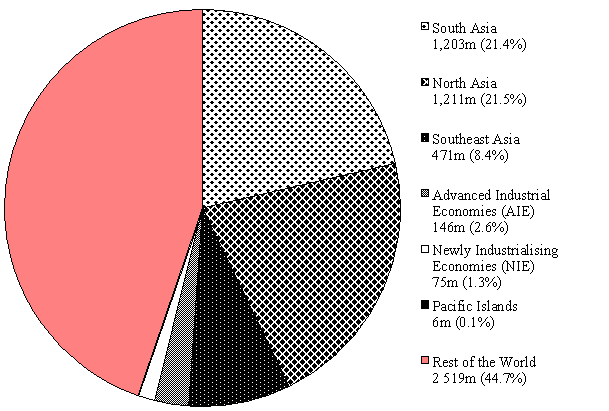
Population is one of the most important social parameters which should be examined in any outlook work for the Asia-Pacific region. Figure 1 shows that the region accounted for just over 55% of the World's total population of 5.6 billion in 1994.
Figure 1: The Asia-Pacific share of World population in 1994
Source: FAO (1997a)
Although the Asia-Pacific share of World population has remained roughly the same over the last 35 years, the distribution of population within the region has changed over time. For example, in 1950 Japan had a larger population than both Indonesia and Pakistan, but now that situation has been reversed. This is due to historical differences in population growth rates in each of the countries within the region. These are shown in Table 1 along with the trend (total absolute change) in growth rates over the last 35 years for each of the country groups.
Table 1 - Selected population statistics for the Asia-Pacific Region
Country group |
Annual population growth rate (%) |
Land resources in 1994 (ha per capita) |
Rural population (% of total) |
Agricultural population (% of total) | ||||
1994 |
trend 1962-96 |
All land |
Agricultural land |
1994 |
trend 1961-96 |
1994 |
trend 1961-96 | |
AIE |
0.3 |
-1.1 |
5.7 |
3.3 |
21 |
-12 |
6 |
-5 |
NIE |
1.0 |
-2.1 |
0.2 |
0.0 |
17 |
-50 |
11 |
-21 |
North Asia |
1.0 |
-1.6 |
0.9 |
0.5 |
70 |
-13 |
71 |
-3 |
Southeast Asia |
1.7 |
-0.9 |
0.9 |
0.2 |
67 |
-17 |
54 |
-7 |
South Asia |
1.8 |
-0.5 |
0.3 |
0.2 |
74 |
-10 |
58 |
-10 |
Pacific Islands |
2.2 |
-0.6 |
8.8 |
0.3 |
79 |
-11 |
69 |
-5 |
Asia-Pacific |
1.4 |
-1.1 |
0.9 |
0.5 |
68 |
-12 |
59 |
-7 |
World |
1.4 |
-0.7 |
2.4 |
0.9 |
55 |
-11 |
46 |
-6 |
Source: FAO (1997a)
Population growth has fallen overall in the region to 1.4% pa, a decline of about 1.1% (in absolute terms) over the last 35 years. The Advanced Industrial Economies have the lowest population growth rate and this appears to have levelled-off in recent years. Population growth in the Newly Industrialising Economies and North Asia has fallen dramatically and is now at the level experienced in Advanced Industrial Economies about 20 years ago. Population growth has declined only slightly in the rest of the region, and in recent years has begun to increase again in the Pacific Islands. The only very large country in the region which still has a high rate of population growth is Pakistan (2.6% p.a. in 1994).
Another important social dimension for forestry is the location of population and availability of land. A large rural population, especially if associated with low incomes and poor agricultural productivity may well be expected to suffer persistent loss of forests. The Asia-Pacific region has some countries with such a profile but there are some which are entirely different.
The high density of population in the region is shown by the ratio of land area to population, which stood at 0.9 ha per capita in 1994. This figure is less than half the World average. In terms of agricultural land the region has about 0.5 ha per capita, slightly more than half the World average. Most of the countries in the region have fairly similar levels of population density, the exceptions being: Australia, New Zealand, Mongolia, Papua New Guinea and New Caledonia (which are sparsely populated) and Japan, Maldives and the Newly Industrialising Economies, which have very high population densities.
A major proportion of the population in the region still lives in rural areas and depends on agriculture as its main source of income. This is particularly the case in the countries of North Asia, South Asia and the Pacific Islands. The Advanced Industrial Economies and Newly Industrialising Economies are much more urbanised and less dependent on agriculture. The Newly Industrialising Economies and, to a lesser extent, countries of Southeast Asia have also changed remarkably over the last 35 years from rural to urban societies. In contrast, the countries of North Asia and the Pacific Islands have changed very little. Overall, the region is steadily urbanizing.
UN population projections (1996 revision) have been used in this study (see Table 2). The medium fertility scenario projections (considered by the UN to be the most likely) suggest that population growth in the Asia-Pacific region will fall to just over 1% p.a. by 2005-2010. The region's population is expected to grow in absolute terms by about 21% by 2010 to 3.8 billion, which will still account for about 55% of total World population (forecast to reach 6.9 billion by the year 2010). Projected growth is only slightly lower under the alternative low fertility scenario, with the Asia-Pacific population increasing to 3.7 billion by 2010 and the World population increasing to 6.7 billion.
The same projections also predict that the rural population in the region will decline between 1994 and 2025. After adjusting these projections to the period of the outlook study, it is estimated that the rural population in the region will decline by 22 million by 2010, equal to just over 1% of the rural population in 1994. Decreases in some countries will be offset by increases elsewhere. The small overall reduction in rural population will, however, be accompanied by the growth of some major cities and Asia is likely to have many of the World's largest cities by 2010.
Decreases in the rural population are expected to occur in the following major countries and territories: Japan, People's Republic of China and Hong Kong SAR, China, Indonesia, Philippines, Thailand and Australia. Another eight smaller countries also show this trend. Major countries where the rural population is expected to increase are: Nepal; Pakistan; Socialist Republic of Vietnam; Bangladesh; Myanmar and India. Another three medium-sized countries are also expected to change in this way. However, the overall proportion of the population living in rural areas is expected to decline in all countries in the region.
Table 2 - UN Population projections for the Asia-Pacific Region (medium fertility)
Country group |
Actual and projected population (in millions) |
Total increase (%) |
Rural population in 1994 |
Rural population in 2010 | |||||
1994 |
2000 |
2005 |
2010 |
1994-2010 millions |
millions |
% of total |
millions |
% of total | |
AIE |
146 |
149 |
151 |
152 |
+4 |
31 |
21 |
25 |
17 |
NIE |
75 |
79 |
82 |
84 |
+12 |
9 |
17 |
6 |
9 |
North Asia |
1,211 |
1,279 |
1,325 |
1,365 |
+13 |
848 |
70 |
763 |
56 |
Southeast Asia |
471 |
518 |
556 |
590 |
+25 |
317 |
67 |
315 |
53 |
South Asia |
1,203 |
1,336 |
1,448 |
1,557 |
+29 |
888 |
74 |
962 |
62 |
Pacific Islands |
6 |
7 |
8 |
8 |
+39 |
5 |
79 |
6 |
67 |
Asia-Pacific |
3,112 |
3,369 |
3,570 |
3,758 |
+21 |
2,099 |
68 |
2,076 |
55 |
Source: UN (1996)
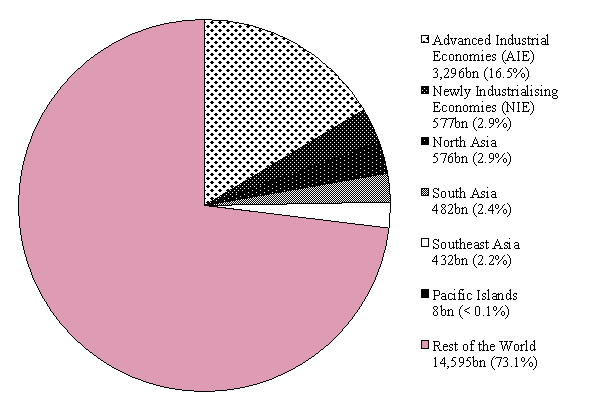
Despite the size of the Asia-Pacific region's economy, the region is still relatively poor, it is a large region but currently accounts for only about a quarter of World GDP (see Figure 2). Half of the rural population live below the poverty line in eight of the countries in the region. However, a modest proportion of the population enjoys some prosperity and due to the size of the overall population, this translates into a major purchasing capacity in absolute terms.
Figure 2: The Asia-Pacific share of World GDP in 1995
Source: FAO (1997b) All figures are in US$ at 1987 prices and exchange rates
Japan's economy accounts for more than half of the Asia-Pacific GDP and dominates the large share held by the Advanced Industrial Economies. In contrast, the Pacific Island economies are tiny and the other four regions share roughly equally the remaining regional GDP.
The current share of World GDP is a vast improvement on 40 years ago, when the region's share was less than 5%. This increase has been achieved with an historical rate of economic growth in the region about seven times higher than the World average. However, this dramatic growth has not been experienced everywhere in the region and can be mostly attributed to just a handful of countries of which only China and Indonesia are large.
For roughly 30 years from 1945 onwards, Japan was the first country to demonstrate the potential of the region for dramatic and sustained economic growth. Japan's growth record has yet to be surpassed, but the four Newly Industrialising Economies came close to repeating it in the 1970s and 1980s and other countries are following in their footsteps if we assume that the severe economic downturn of 1997 is only temporary.
Table 3 - Trends in GDP in the Asia-Pacific Region
Country group |
Real GDP at factor cost (in billion US$ at 1994 prices) |
GDP per capita (US$ at 1994 prices) |
Real GDP growth (average annual % growth) | |||||
1980 |
1985 |
1990 |
1994 |
1994 |
1980-84 |
1985-89 |
1990-94 | |
AIE |
2,770 |
3,220 |
3,756 |
4,243 |
25,000 |
3.0 |
3.0 |
3.0 |
NIE |
315 |
429 |
586 |
750 |
10,000 |
6.0 |
6.0 |
6.0 |
North Asia |
213 |
323 |
491 |
749 |
620 |
8.0 |
8.0 |
10.0 |
Southeast Asia |
236 |
322 |
439 |
562 |
1,190 |
6.0 |
6.0 |
6.0 |
South Asia |
354 |
434 |
532 |
627 |
521 |
4.0 |
4.0 |
4.0 |
Pacific Islands |
8 |
8 |
9 |
10 |
1,666 |
2.0 |
2.0 |
2.0 |
Asia-Pacific |
3,896 |
4,736 |
5,813 |
6,941 |
2,230 |
2.4 |
2.5 |
3.0 |
Source: AsDB (1997a) and IBRD (1997)
Table 3 shows trends in GDP and economic growth over the last 15 years. In terms of economic growth and the size of their economies, the countries of the region fall roughly into 5 tiers:
1. The Advanced Industrial Economies. These economies have had modest growth rates for quite a number of years, usually in the range of 2-4%. Per capita GDP is very high and this group contains the first and fourth largest economies in the region (Japan and Australia).
2. The Newly Industrialising Economies. Growth in these economies has slowed in recent years, but is still generally well above average at about 7-8%. Per capita GDP is high and rising and this group contains some of the largest economies in the region.
3. The third tier is mostly from Southeast Asia (Indonesia, Malaysia, Thailand and, very recently, Socialist Republic of Vietnam) but also includes People's Republic of China (the second largest economy in the region). These emerging economies have had sustained growth rates of over 7% a level now maintained by China alone since the 1997 dislocation. Due to high populations of a number of these countries, this group also contains some of the largest economies in the region, but per capita GDP is currently moderate in most of these countries.
4. The fourth tier contains a mixture of countries from Southeast Asia (Myanmar and the Philippines) and South Asia (Bangladesh, India, Pakistan and Sri Lanka). These countries are starting to benefit from economic liberalisation and other reforms. Modest and variable economic growth rates of between 3-6% characterise this group. With the exception of India, the size of the economies in this group fall into the middle of the range for the Asia-Pacific region and per capita GDP is low.
5. All the other countries in the region (many in the Pacific) have economies which are generally quite small. Some of these countries have quite high but often unstable rates of economic growth but most fall in the range 1-3%. Per capita GDP is also generally very low (with the exception of Brunei).
The foundations for economic growth
There are no miraculous explanations for the rapid growth rates which some of the countries in the Asia-Pacific region have achieved; they have arisen from sustained peace and political stability, high levels of economic and social discipline, hard work and what were seen as appropriate government policies before recent economic failures revealed weaknesses.
A major contributing factor has been that governments have developed macro-economic climate conducive to rapid growth (see Table 4). This is reflected by the high savings rates, low budget deficits, low rates of inflation and low levels of external debt in these countries.
Table 4 - Selected macro-economic statistics for the Asia-Pacific Region in
Country group |
Savings rate |
Budget deficit |
Investment (GDFCF) |
Exports |
Trade balance |
(% of GDP) |
(% of GDP) |
(% of GDP) |
(% of GDP) |
(% of GDP) | |
AIE |
28 |
-0.6 |
19 |
12 |
1 |
NIE |
36 |
2.7 |
31 |
81 |
-4 |
North Asia |
26 |
2.5 |
32 |
22 |
1 |
Southeast Asia |
23 |
2.0 |
28 |
28 |
-2 |
South Asia |
20 |
1.6 |
25 |
17 |
-15 |
Pacific Islands |
10 |
6.7 |
17 |
27 |
-35 |
Asia-Pacific |
24 |
2.5 |
26 |
37 |
13 |
Source: AsDB (1997a) and IBRD (1997)
Other contributing factors have been: effective population policies; focus on export growth; high rates of investment in both human and physical capital (with an emphasis on private-sector investment) and pursuit of greater efficiency through improvements in factor productivity. Asia-Pacific countries have been open to foreign ideas and technology and have invested locally in technological development. Their governments have also systematically intervened to ensure focus on the development of specific high-potential industries until comparative advantage has been won or reinforced.
The best performers have also tended to promote equitable income distribution. Indeed, the major social change currently influencing many of the economies of the region is the emergence of a large middle class. Before the 1997 economic turmoil struck, in addition to the roughly 80 million people in the region who can be considered seriously rich, a "middle class" of between 375 and 500 million was developing. A further 750 million people were also leaving their poverty behind and beginning to have significant spending power.
In the aftermath of the 1997 economic meltdown, it emerges that many had weak supervision of their financial sectors which became severely over-extended and could not support a dip in the region's exports. A major challenge facing the countries outside the two top tiers is to put in place similar policies to what helped achieve the "Asian Miracle" while avoiding the mistakes that led to the 1997 collapse of several key economies.
The initial major aim of this analysis - to present GDP projections for each country in the Asia-Pacific region to be used in the supply and demand analysis elsewhere in the outlook study - has been superseded but projections of future GDP eventually adopted in spite of rapid recent change and structural shifts are given in Table 5. There is very high uncertainty associated with these projections. Table 6 is an effort to give a more pessimistic "apocalypse" scenario for the region especially for the most affected countries but taking into account "pull-down" effects on the other regional economies.
The projections presented in Table 5 are for the period till 2005 taken from the Compendium of demographic and macro-economic assumptions (FAO, 1997b) produced for the forthcoming study: Medium-term prospects for agricultural commodities: projections to the year 2005. The projections for the years 2000-2005 in that study have been extended to the year 2010 for the purposes of this study.
The pre 1997 growth rates presented for many of the developing countries in the region are quite high and a question that has to be faced is whether those rates are sustainable. Until the meltdown, conventional wisdom was that the growth rates would be maintained due to the resilience of many of the economies in the region. It was often quoted, for example, that rates of economic growth of 5-10% had been maintained in many of the developing countries in the region during the entire downward cycle of the Japanese economy. Southeast Asia and South Asia showed the most resilience, due to their relatively low reliance on primary commodities, the competitiveness of their manufactured exports, growing intraregional trade, low debt and continued access to external financing (due to a good borrowing record). Because of the high savings rates in many Asia-Pacific countries, much of the investment in the region was being financed from domestic savings rather than foreign investment and this was thought to protect it to some degree from external shocks.
However, the region has undergone a major crisis, with export growth rate far below normal. It appears that provided the Japanese Yen is strong and Japan can import, the region is able to offset weak demand from elsewhere in the world. However, if demand from elsewhere falters at the same time as that from Japan, the region is left over-exposed and reveals great vulnerability. The strong linkages among the region's economies appears under these conditions to have been disadvantageous - far from offering resilience, it caused the entire set of economies to go down together.
Notwithstanding the current dislocation, the region's economic prospects in the short to medium term are optimistic in view of expected healthy expansion of global and inter-regional trade in an environment of increasing post-Uruguay Round liberalisation and commitment to regional and Pacific Basin economic agreements. The general perception is therefore, that the economies of the region will resume a trajectory of rapid growth. Regarding how long it will take to regain growth there is no consensus.
Table 5 - GDP projections for the Asia-Pacific outlook study
GDP forecasts (in billion US$ at 1994 prices) |
GDP Growth rate forecasts (annual percentage growth) | |||||||||
Base year |
FAO (1997b) |
FAO (1997b) |
APFSOS downturn scenario (1998) | |||||||
1994 |
2000 |
2005 |
2010 |
1994-2000 |
2001-2005 |
2006-2010 |
1994-2000 |
2001-2005 |
2006-2010 | |
North Asia |
||||||||||
Japan |
4,222,622 |
5,071,474 |
5,879,228 |
6,815,637 |
3.10 |
3.00 |
3.00 |
2.10 |
2.50 |
2.90 |
Korea DPR |
11,257 |
12,677 |
13,996 |
15,453 |
2.00 |
2.00 |
2.00 |
1.40 |
1.60 |
1.80 |
Mongolia |
732 |
824 |
955 |
1,107 |
2.00 |
3.00 |
3.00 |
1.90 |
2.70 |
3.00 |
The People's Republic of China |
540,492 |
862,469 |
1,226,710 |
1,744,780 |
8.10 |
7.30 |
7.30 |
7.00 |
6.80 |
7.10 |
- Hong Kong SAR, China |
130,580 |
176,999 |
231,330 |
302,339 |
5.20 |
5.50 |
5.50 |
3.20 |
4.40 |
5.00 |
- Taiwan Province of China |
241,014 |
241,014 |
241,014 |
241,014 |
||||||
The Republic of Korea |
380,825 |
549,445 |
745,746 |
1,012,179 |
6.30 |
6.30 |
6.30 |
2.50 |
4.00 |
5.70 |
Southeast Asia |
||||||||||
Brunei |
4,495 |
5,062 |
5,588 |
6,170 |
2.00 |
2.00 |
2.00 |
1.50 |
1.60 |
2.00 |
Cambodia |
2,376 |
3,371 |
4,511 |
6,036 |
6.00 |
6.00 |
6.00 |
3.80 |
4.80 |
5.70 |
Indonesia |
175,500 |
275,417 |
395,396 |
567,642 |
7.80 |
7.50 |
7.50 |
2.50 |
3.80 |
5.80 |
Malaysia |
74,146 |
117,661 |
170,495 |
247,052 |
8.00 |
7.70 |
7.70 |
4.40 |
5.90 |
7.30 |
Myanmar |
74,005 |
105,572 |
130,934 |
162,389 |
6.10 |
4.40 |
4.40 |
4.10 |
4.40 |
4.20 |
Laos |
1,515 |
2,030 |
2,717 |
3,635 |
5.00 |
6.00 |
6.00 |
3.30 |
4.50 |
5.50 |
Philippines |
64,114 |
87,403 |
113,153 |
146,490 |
5.30 |
5.30 |
5.30 |
3.10 |
4.10 |
5.20 |
Viet Nam |
15,478 |
21,956 |
30,081 |
41,214 |
6.00 |
6.50 |
6.50 |
4.50 |
5.20 |
6.30 |
Singapore |
69,516 |
103,741 |
141,468 |
192,915 |
6.90 |
6.40 |
6.40 |
4.70 |
5.50 |
6.20 |
Thailand |
143,177 |
205,410 |
288,098 |
404,072 |
6.20 |
7.00 |
7.00 |
1.70 |
3.30 |
5.20 |
South Asia |
||||||||||
Bangladesh |
26,034 |
34,888 |
47,352 |
64,269 |
5.00 |
6.30 |
6.30 |
3.60 |
5.10 |
5.60 |
Bhutan |
255 |
342 |
437 |
557 |
5.00 |
5.00 |
5.00 |
3.60 |
4.30 |
4.50 |
India |
272,527 |
390,982 |
523,222 |
700,189 |
6.20 |
6.00 |
6.00 |
4.80 |
5.20 |
5.20 |
Maldives |
241 |
342 |
457 |
612 |
6.00 |
6.00 |
6.00 |
4.70 |
5.20 |
5.20 |
Nepal |
3,786 |
5,103 |
6,670 |
8,717 |
5.10 |
5.50 |
5.50 |
3.90 |
4.60 |
4.70 |
Pakistan |
46,955 |
65,113 |
85,100 |
111,222 |
5.60 |
5.50 |
5.50 |
4.40 |
4.70 |
4.70 |
Sri Lanka |
11,719 |
16,436 |
22,519 |
30,854 |
5.80 |
6.50 |
6.50 |
4.40 |
5.50 |
5.80 |
Oceania |
||||||||||
Australia |
288,934 |
357,237 |
424,286 |
503,919 |
3.60 |
3.50 |
3.50 |
2.90 |
3.20 |
3.40 |
Cook Islands |
87 |
98 |
114 |
132 |
2.00 |
3.00 |
3.00 |
1.90 |
2.70 |
3.00 |
Fiji |
1,597 |
1,799 |
2,055 |
2,348 |
2.00 |
2.70 |
2.70 |
1.70 |
2.40 |
2.60 |
Kiribati |
38 |
43 |
47 |
52 |
2.00 |
2.00 |
2.00 |
3.20 |
3.60 |
4.00 |
New Caledonia |
894 |
949 |
1,022 |
1,101 |
1.00 |
1.50 |
1.50 |
1.0 |
1.40 |
1.50 |
New Zealand |
44,290 |
51,967 |
59,662 |
68,495 |
2.70 |
2.80 |
2.80 |
2.00 |
2.40 |
2.80 |
Papua New Guinea |
6,994 |
7,830 |
8,773 |
9,830 |
1.90 |
2.30 |
2.30 |
1.30 |
2.00 |
2.10 |
Samoa |
127 |
139 |
149 |
161 |
1.50 |
1.50 |
1.50 |
1.50 |
1.50 |
1.50 |
Solomon Islands |
186 |
249 |
326 |
426 |
5.00 |
5.50 |
5.50 |
3.90 |
4.80 |
5.30 |
Tonga |
135 |
161 |
192 |
227 |
3.00 |
3.50 |
3.50 |
2.90 |
3.30 |
3.50 |
Vanuatu |
193 |
211 |
233 |
258 |
1.50 |
2.00 |
2.00 |
1.20 |
1.80 |
2.00 |
Implications for the forest sector
The preceding summary of social and economic changes suggests that that the forestry sector in the Asia-Pacific region is faced with four major challenges.
Firstly, continued population growth, particularly in countries with large rural populations or high dependency on agriculture, is likely to continue to put pressure on the forest resource base. A few countries are witnessing a reduction in land under crops, but in most of the large countries in the region the cropped frontier continues to spread. For example, in Pakistan (which has one of the region's fastest population growth rates) the area of permanent farmland is growing at such a rate that it would double in only 14 years if present trends continued. Similar extrapolation would result in the doubling of farmland in the Socialist Republic of Vietnam in 18 years and for Thailand and Indonesia in 19 years and 31 years respectively. In many areas of most countries this expansion may involve the conversion of forest to agricultural land to a significant degree. This may consequently reduce future forest cover and consequently product supply potential if no yield-enhancing measures are taken.
The other three challenges would all arise if the rapid rate of economic growth in the region is resumed shortly:
Fast growth in demand for forest products: Until the 1997 meltdown, some expectations were that within 15 years, some 700 million people in China, India and Indonesia alone would have an average income equivalent to that of Spain today. One source suggested that if past rates of 6-10% economic growth continued, by the year 2010, the region (excluding Japan) could have spending power in the neighbourhood of 50% more than the United States of America has today. This great increase in domestic purchasing power in the region would create domestic markets far larger than have ever been seen before. In countries where the control of access to forests is weak, this could lead to greater problems of illegal logging and poor forest management. In countries with large forest products export sectors it may also place the forests or exports (or both) under some strain.
Shift towards non-product benefits of forests: with prosperity, a greater interest in other forest functions would develop, such as greater concern for the environment. One result would be a desire to divert forests away from wood production to conservation and recreation uses - this could put other pressures on the future wood supply potential. It might also require a large redirection of forestry policy in some countries in the region.
Possible threat to sustainable forest management?: The final challenge concerns the reconciliation of high economic growth rates with sustainable forest management. Many of the most dynamic countries in the region are not particularly rich in natural resources (e.g. Japan, Singapore, Hong Kong SAR, China). However, wood products have been used as an engine for economic growth in some others (notably Malaysia and Indonesia). The forestry policy challenge facing many countries will be to repeat the experiences of Japan and some of the more successful countries in the region, but without depleting forest resources in the process. This will require better long-term planning in the forestry sector and probably stronger forest protection policies.
