


During mid-1997, the media was full of stories expressing concern at the deteriorating situation of the Thai economy. Reports of a property crash and a general feeling that one of the prime miracles in Asia was about to grind to a halt led to extensive currency speculation. Co-operation amongst south-east Asian nations to support the Baht had some effect, but other currencies followed the Baht down. Since then the malaise has spread and in Indonesia and Republic of Korea, the currencies and financial sectors have come close to collapse.
Turning to population, rapid shifts are illustrated by the following examples: in 1950, Indonesia had a population which was less than that of Japan. However, by 1961 Indonesia's population had surpassed Japan's and it has continued to grow until it now exceeds Japan's by about 50%. In a repeat of this story, Pakistan, which had only half of Japan's population in 1950, passed it in 1991 and continues to grow rapidly. At the present rate of growth Pakistan has potential to catch up and even surpass Indonesia in population within the next century.
In addition to changes in the distribution of population between countries in the region, changes in the location of population within countries are also taking place. In many countries people are migrating to cities and the rural population may decline in a few of them, but in a majority of countries the rural population will continue to grow and be important for quite some time.
These elements are only some facets of a complex combination of economic and social conditions which are in a state of flux in the Asia-Pacific region and in respect of which there is much diversity among the countries.
The objective of the paper is to analyse historical trends in social and economic developments in the region, present forecasts for the future and highlight the implications of future developments for the forestry sector. The paper concentrates on two main variables: population and gross domestic product (GDP). It also examines wider issues thought likely to have an effect on the forestry sector, such as: population density; income distribution; the structure of economies; development planning; investment; trade and the prominence of the forest sector in the national economy.
Work of this nature is only partly analytical; much "judgement" is involved. Among other things, judgement has to be exercised in assessing how resilient growth can be when it is so heavily dependent on external trade - a particularly unpredictable element but which has been the main motor towards prosperity for all the region's high-performance economies.
Social and economic changes are key determinants of demand and, sometimes, also of supply for forest goods and services. For this reason, this paper reviews selected changes in these parameters, with a focus on population and economic growth. The review refers mainly to information collected over the last three decades and looks at the future until the year 2010, the horizon of the outlook study. Occasional references are nevertheless made to periods outside this time frame.
Population and income have separate and joint effect on the demand for forest goods and services and on the other pressures exerted on forests. Population operates directly on forest product demand by multiplying the consumption requirements of a country, i.e. at any given price and average income level, total consumption in a country will increase if the number of people there increases. A more complex effect of population change is the pressure exerted on the forest from competing land-uses.
For many products and services, income has a strong effect on demand. Generally, as incomes rise demand for products increases, except for economically "inferior" goods (examples of possible inferior goods in the forest sector, the consumption of which decreases as incomes rise - include fuelwood and some subsistence non-wood forest products. The much higher consumption levels for many industrial commodities observed for wealthy nations, relative to levels in developing countries give witness to the frequently stronger effect of income than of gross population in determining the capacity to consume. In reviewing developments in these two parameters, this paper avoids deriving their mathematical correlations with forestry development.
This review lays no claim to original research but interprets the thorough work of many important institutions such as the Asian Development Bank (AsDB), the World Bank (IBRD), the International Monetary Fund (IMF), and Organisation for Economic Cooperation and Development (OECD) which regularly carry out in-depth studies on Asia-Pacific development. The enormous human and financial resources the institutions mentioned apply to this task (as reflected in the rich collection of published material on this fast-growing region) cannot be improved upon for the purposes of a sectoral study. All these sources have, of course, been proved wrong by the economic collapse of 1997; some serious analysis has proved to have been an exercise in applauding what "has worked" and suggesting that others could copy it.
Making projections into the future is at best an inexact science; there is no certainty in outlook work. So much is the "judgmental" element in outlook work that the Asian Development Bank routinely organises seminars of experts from its member countries to discuss its biennial regional outlook so as to benefit from a diversity of perceptions. The AsDB also complements its rigorous economic analyses with polls of eminent business personalities regarding their expectations for the future of various national economies and reflects these in its "consensus" projections.
The review starts by giving a brief description of the region in terms of it's size and location and the size of it's population and economies compared with the rest of the World. This section also describes current efforts at regional collaboration. This is followed by three detailed sections containing the main analytical work and results of the review.
The first detailed analysis examines population in the region. The next section examines the economies of the region including analysis of trends, presentation of the current situation and analysis of the factors behind economic developments in the region. Sets of economic growth projections are presented here accompanied by a commentary on key features of each country's determinants of growth.
The third detailed analysis examines social changes which have taken place in the region and may continue in the future. Issues examined here include: urbanisation; agricultural dependency; and incomes and income distribution.
The final section draws together the main results of the three previous sections and presents some implications of these developments for the future of the forestry sector.
Countries and territories included in outlook study
For the purposes of this study, the Asia-Pacific region has been defined as the area roughly bounded by Pakistan in the West, Mongolia in the North and the International Date Line in the East (see Map 1).
Map 1: Countries and territories included in the Asia-Pacific outlook study
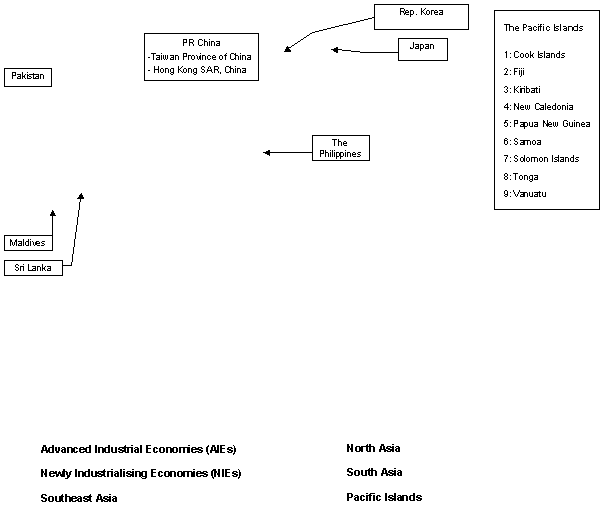
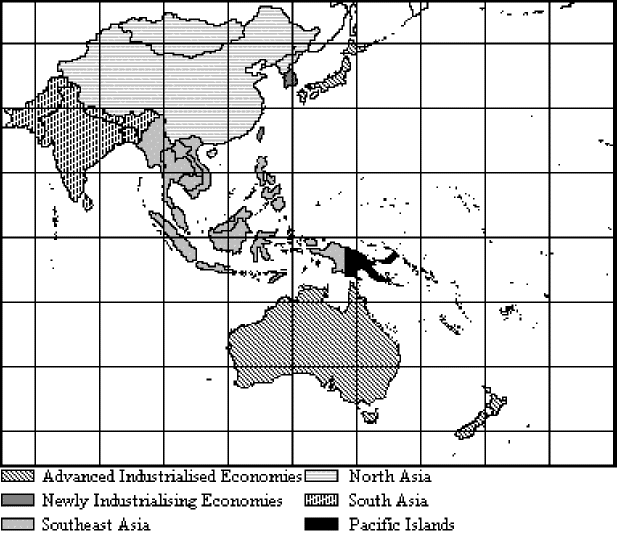
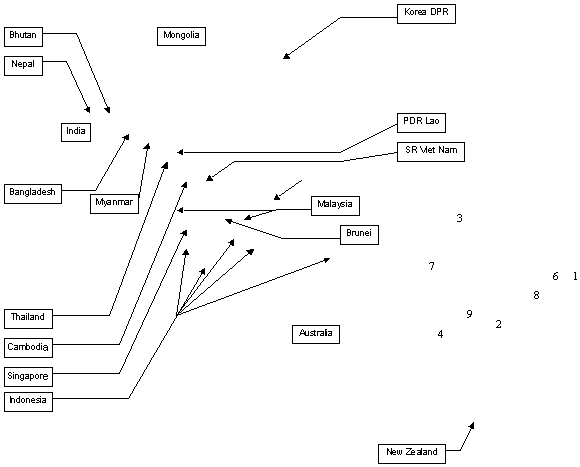
All Asian countries and territories, except those of the former USSR and the Near East, have been included in the study. Out of a total of 33 countries and territories in the Oceanic region, 10 have been included in the study. About half of those excluded were to the East of the International Date Line and the remainder were so small that it was though unlikely that data would be available for them.
A full listing of the countries and territories included in this study, along with the country groupings used, is given in Box 1. Countries and territories in the region have been grouped according to the classification used by the AsDB. Some countries included in this study however, are not members of the AsDB, so the groupings have had to be modified slightly to include non-member countries and territories.
Box 1.1: GEOGRAPHIC DISTRIBUTION OF COUNTRIES AND TERRITORIES INCLUDED IN
THE ASIA-PACIFIC FOREST SECTOR OUTLOOK STUDYNorth Asia (NA) South Asia (SA)
Democratic People's Republic of Korea Bangladesh
Japan (AIE) Bhutan
Mongolia India
The People's Republic of China Maldives
- Hong Kong SAR, China (NIE) Nepal
- Taiwan Province of China (NIE) Pakistan
The Republic of Korea (NIE) Sri Lanka
Southeast Asia (SEA) Pacific Islands (PI)
Brunei Australia (AIE)
Cambodia Cook Islands
Indonesia Fiji
Malaysia Kiribati
Myanmar New Caledonia
People's Democratic Republic of Lao (Laos) New Zealand (AIE)
Philippines Papua New Guinea
Singapore (NIE) Samoa
Socialist Republic of Viet Nam Solomon Islands
Thailand Tonga
Vanuatu
Note: Recognising commonalities between countries and territories at different stages of industrialisation, those labelled AIE (Advanced Industrial Economies) and NIE (Newly Industrialising Economies) have been grouped together in the analysis.
Due to differences in their levels of economic development and importance to the forestry sector, People's Republic of China, Taiwan Province of China and Hong Kong SAR, China have all been analysed separately in the study.
