


AN OVERVIEW OF THE ASIA-PACIFIC REGION
In terms of it's land area and population, the Asia-Pacific region is one of the largest regions of the World. However, the economies of the region, with the exception of Japan, are relatively small compared with Europe and North America, but they are growing rapidly and are well integrated into the World economy. This section briefly describes the region as a whole and compares it with the other major regions of the World.
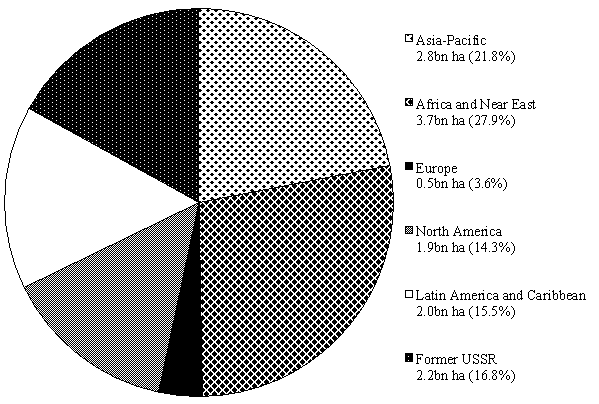
The location and extent of the Asia-Pacific region has already been described (see Introduction). In terms of land area, the region is the second largest in the World after Africa and the Near East and covers about 2.8 bn ha or just under a quarter of the World's total land area (see Figure 3).
Figure 3: Land area of the major geographical regions of the World in 1994
Source: FAO (1997a)
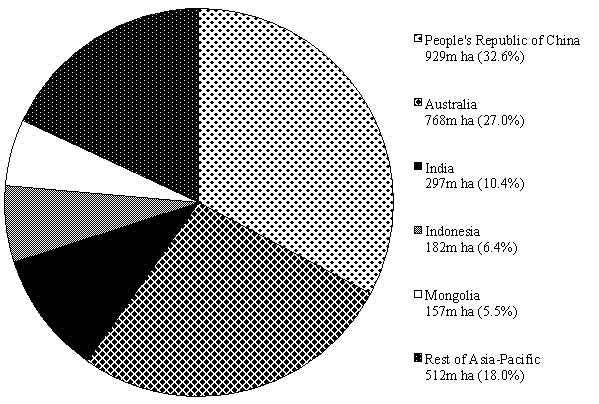
However, within the region there is great variation. Five countries are larger than 100m ha (People's Republic of China, Australia, India, Indonesia and Mongolia) and between them, they cover over 80% of the region (see Figure 4). People's Republic of China is the third largest country in the World, closely followed by Australia and India in sixth and seventh places. In contrast, 16 countries in the region are less than 10m ha in area and the total area of all the Pacific Islands added together is less than the area of most other countries in the region.
Figure 4: Land area of the five largest countries in the Asia-Pacific region in 1994
Source: FAO (1997a)
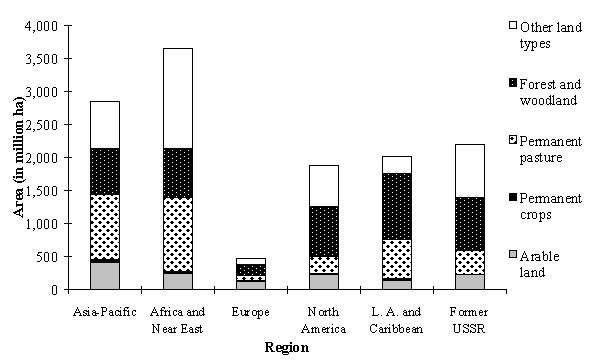
Figure 5: Distribution of land-uses in the major geographical regions in 1994
Source: FAO (1997a)
Just over half of all land in the Asia-Pacific region is used for agriculture (permanent and arable crops and pasture). The remainder is divided equally between forests and other land types2. Only Europe has a higher proportion of land in agriculture than the Asia-Pacific region. The Asia-Pacific region also has the second lowest proportion of land covered by forests (after Africa and the Near East).
Due to its size and the large proportion of the area used for agriculture, the Asia Pacific region has the largest share of the World's arable, permanent crop and permanent pasture land (see Figure 5) with a roughly one-third share of each of these land uses. However, despite it's size, the region has the second smallest share of the World's forest resources (16.7%) after Europe. This is still a significant share though and in terms of tropical forests the region is relatively more important.
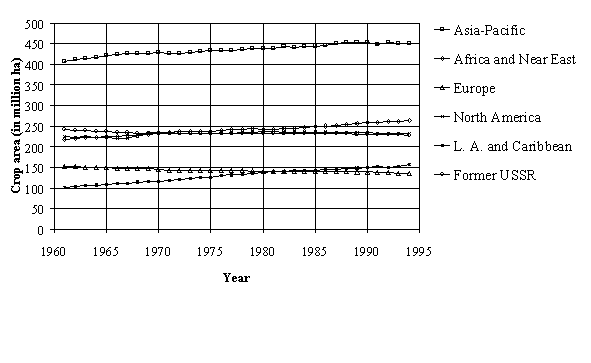
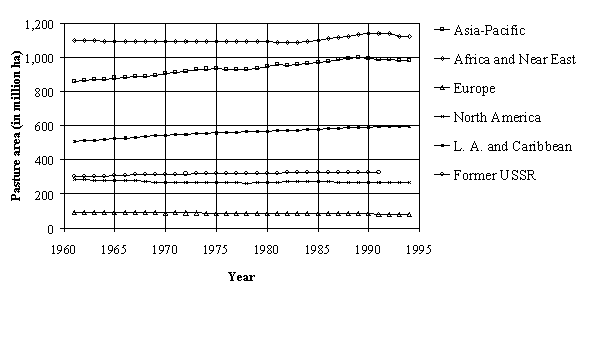
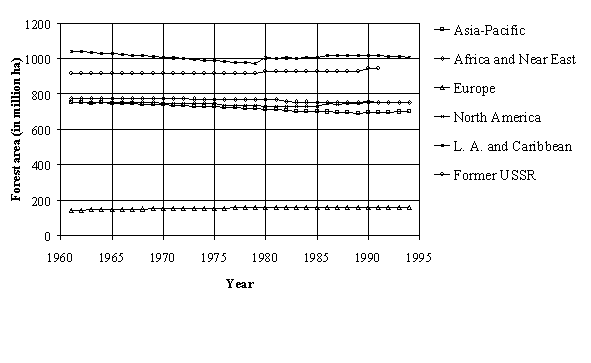
Figure 6 shows trends in the area of crops, pasture and forest in each of the major regions of the World from 1961 to 1994. The area of land used for crops and pasture has increased in the Asia-Pacific region over the period while the area of forests has declined. This pattern is repeated but to a lesser extent in the Africa and Near East and Latin America and Caribbean regions.
The area of crops in the Asia-Pacific region has increased by 11% or 43m ha (equal to about 1.3m ha/yr). Similar increases have occurred in Africa and the Near East (+ 45m ha) and Latin America and the Caribbean (+ 54m ha). The area of crops has remained about the same or fallen in the other three regions.
The area of land used for pasture in the Asia-Pacific has increased even more dramatically by 14% or 124m ha (equal to about 3.6m ha/yr). This compares with increases of 22m ha in Africa and the Near East and 86m ha in Latin America and the Caribbean. Again, there has been little change in this variable in the other regions.
In terms of forest and other woodland, the Asia-Pacific region has shown the largest decline in area over the period. In 1961 the region had 752m ha of forest (slightly more than North America at that time). This has declined by 7% or 54m ha (equal to about 1.6m ha/yr). Africa and the Near East has lost 24m ha and Latin America and the Caribbean has lost 35m ha. In contrast, North Americal has lost only 2m ha and the forest area of Europe has increased by 15m ha.
These figures give a brief picture of land-use in the region compared with other regions of the World. As later sections will show, they hide a considerable amount of diversity within the region, so trends and proportions shown here should not be considered as typical for every country in the region.
Figure 6: Trends in crop, pasture and forest area in the major World regions
Source: FAO (1997a)
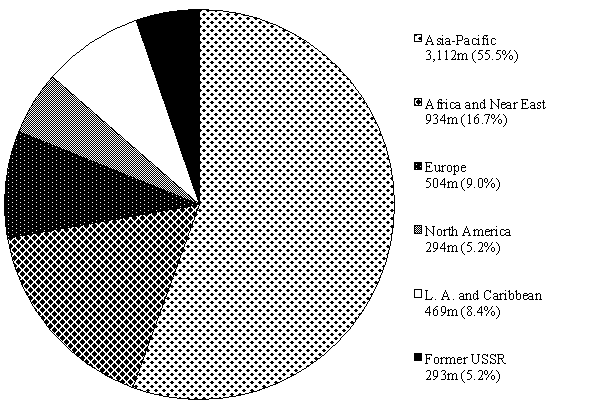
The prominence of the Asia-Pacific region in terms of population is shown in Figure 7. The region contains over half of the World's population and is far larger than the next largest region - Africa and the Near East.
Figure 7: Population of the major geographical regions of the World in 1994
Source: FAO (1997a)
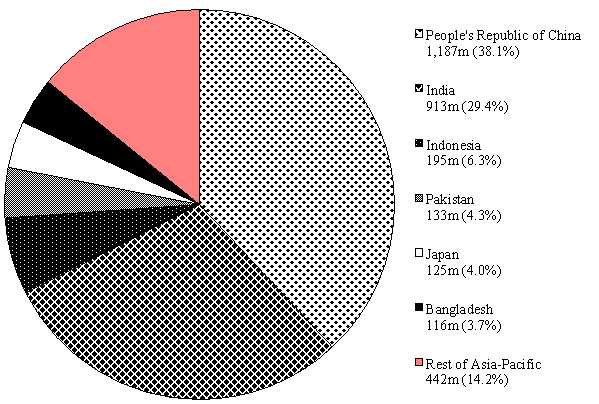
Population is even more unevenly distributed between the countries in the region than land area. Two countries, People's Republic of China and India, account for nearly 70% of the region's population (see Figure 8). These are the two most populated countries in the World. Four other countries in the region have populations of over 100m and are in the World's top ten. Together these six countries contain over 85% of the region's population.
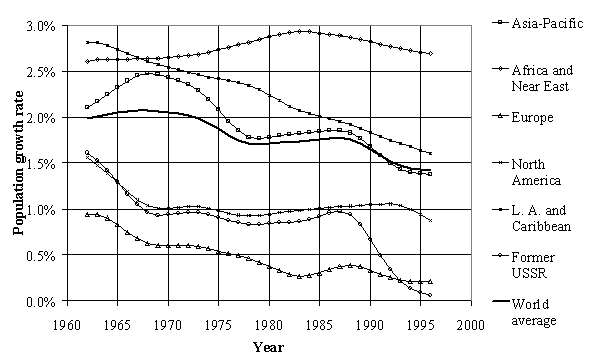
The Asia-Pacific region's share of World population has increased slightly from 52.8% in 1961. However, population growth has declined from 2% p.a. in 1962 to under 1.5% p.a. and is now close to the World average (see Figure 9). Of the large countries in the region, People's Republic of China and Japan currently have below average population growth rates (1.0% p.a. and 0.2% p.a. respectively in 1994) and India, Indonesia and Bangladesh are about average. Pakistan is well above average (2.6% p.a. in 1994) and, if current trends continue, may become the third largest country in the region in terms of population in the middle of the next century.
Figure 8: The distribution of population in the Asia-Pacific region in 1994
Source: FAO (1997a)
Figure 9: Population growth in the major regions of the World 1962-1996
Source: FAO (1997a)
It is not easy to find a single source which gives economic information in a readily comparable form for both developed and developing countries. The now-discontinued World Tables of the World Bank (IBRD, 1995a) gave details for developing countries but no breakdown in the summary tables for OECD countries other than Japan. The "Stars" Database of the World Bank (IBRD, 1997) is more detailed, but not always complete. The Asian Development Bank website (AsDB, 1997a) gives very detailed time-series information back to 1978 but only for developing member countries. All three of these sources have therefore been used to build-up a picture of the importance of the economies in the region.
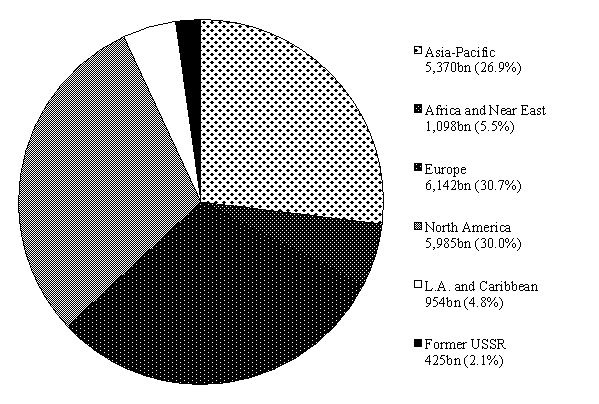
In approximate terms, the World Tables and Stars Database information shows that the Asia-Pacific region's share of World GDP rose from US$ 2,216 bn (20.4%) in 1975 (at 1987 prices and exchange rates) to US$ 4,859 bn (26.3%) in 1993. Subsequent updating of this information by FAO (FAO 1997b) suggests that this share had increased to US$ 5,370 bn (26.9%) by 1995 (see Figure 10).
Figure 10: The Asia-Pacific share of World GDP in 1995
Source: FAO (1997b) All figures are in US$ at 1987 prices and exchange rates
The Asia-Pacific share of World GDP is now just slightly behind the shares held by Europe and North America. However, this has not always been the case. The Asian share was once much higher, but dropped from 58.3% in 1820 to 19.3% by 1950 due to a long period of poor growth relative to Europe and North America (Maddison, 1995).
For example, in 1820, China was the world's leading economy, and accounted for 28.7% of World GDP (and 35.5% of it's population) and India had 16.0% of World GDP (19.6% of population). Both of these countries have become much less important. In contrast, Japan's share of World GDP and population were only 3.1% and 2.9% respectively in 1820, but Japan has since become the World's second largest economy and the most important in the region, accounting for 56% of Asia-Pacific GDP in 1994.
Table 6 - World GDP growth rates (%) summary1
Region or grouping |
1966-73 |
1974-80 |
1981-90 |
1991-93 |
1994 estimate |
1995-96 forecast |
1995-04 forecast |
World average |
5.1 |
3.4 |
3.2 |
1.2 |
2.8 |
3.2 |
3.3 |
High-income countries |
4.8 |
3.0 |
3.2 |
1.3 |
3.0 |
3.0 |
2.8 |
Developing countries |
6.9 |
5.0 |
3.2 |
0.8 |
2.0 |
4.0 |
4.9 |
Developing countries2 |
6.2 |
4.9 |
3.3 |
4.6 |
4.6 |
4.8 |
5.2 |
East Asia |
7.9 |
6.8 |
7.6 |
8.7 |
9.3 |
8.1 |
7.7 |
South Asia |
3.7 |
4.0 |
5.7 |
3.2 |
4.7 |
5.0 |
5.4 |
Source: IBRD (1995a) - extracted from Table 1-1.
Notes: 1. All figures are percentage changes in GDP measured at market prices and expressed in 1987 prices and exchange rates. Average growth rates have been computed using least squares regression.
2. Excluding Eastern Europe and former Soviet Union
The recent recovery in the Asia-Pacific share of World GDP can be attributed to high economic growth rates. Table 6 compares South Asian and East Asian GDP growth since 1966 with the rest of the World. This shows that rates of GDP growth in East Asia have been better than average for a long some time. It also shows the recent emergence of the economies of South Asia and the high hopes for these countries in the future. According to the World Bank (IBRD, 1995a), the rapid rates of growth in some of these Asian economies (especially in East Asia) are not particularly new, but built upon already respectable growth rates of national output and productivity in earlier decades.
The increased economic importance of the Asia-Pacific region has helped to return many countries to former prominence. For example, there have been references to the likelihood of People's Republic of China becoming the World's largest economy, surpassing even the United States as early as 2020 or at another date within the first half of the next century.
A large part of the recent growth in Asia-Pacific GDP can be attributed to growth in exports and the region's share of World trade has grown even faster than it's growth in GDP. It is therefore, useful to describe the linkages between the economies of the Asia-Pacific region and those of the other regions and report recent trends in those other regions.
The United States of America is the largest single external market for many Asia-Pacific countries. The United States of America has retained modest performance as a result of prudent measures to avoid over-rapid expansion in an economy with already high rates of industrial capacity and labour utilisation (OECD, 1996). Economic growth of 2.1% reported by the World Bank for 1995 was the lowest level of growth since 1991 and future growth is expected to be higher.
Japan, although a smaller market than the United States of America, has possibly an even greater influence on the economies of the region because of it's close proximity particularly strong linkages with countries in the region. According to the Asian Development Bank (AsDB, 1996), the Japanese economy is emerging from its longest post-war period of low growth, with 1995 being the first year to show improvement; the economy was projected to grow by 2% in 1996 and to maintain momentum to reach 2.5% growth in 1997. Since this assessment Japan's situation has, if anything, gone worse and the possibility of zero growth in 1998 has begun to be mentioned.
Continuing weakness of the Yen into 1997 was expected to boost Japan's exports but reduce it's capacity to import from the region's developing economies, whose currencies are generally pegged to the US dollar. This may be a major contributor to the current export malaise affecting all the region's export-driven economies. Recent major currency devaluations were expected to have changed this picture somewhat by enabling Japan to import more even with a weakened Yen; however, financing exports has become difficult for the dislocated banking sector of the affected countries.
Europe is the third force with potential to affect economic development in the Asia-Pacific region. In the medium-term the main factor is likely to be some economic contraction in Europe as governments tighten fiscal discipline in order to meet and maintain compliance with the Maastricht Criteria for a single European currency. For example, in 1996 economic growth slowed to 1.6% from 2.5% in 1995.
In addition to Japan, several major economies of the Asia-Pacific region are themselves becoming more important to the others in the region; similar bail out support was extended to Indonesia. This is shown by the recent tendency of the Asia-Pacific economies to depend more on each other and relatively less on the G7 economies. For example, a large part of the money lent to Thailand in 1997 after it's efforts to support the Baht, came form other Asian countries. Recent regional integration initiatives also provide evidence of efforts to increase the importance of the intraregional market. However, the focus of most countries is likely to remain outside the region for many years to come.
At the present time, the Asia-Pacific region is not greatly affected by the performance of the World's other developing regions. In future, however, links which have the greatest potential for growth are with the countries on the other side of the Pacific Ocean in Latin America where some of the fastest growing economies are on the Pacific Rim - Colombia, Peru, Chile. Economic performance there has recently suffered from a crisis of confidence resulting from the problems of the recent Mexican financial markets. There are, however, potentially dynamic economies such as Chile, Brazil, Peru and Colombia which in the medium-term could have mutually beneficial links with the growing economies of the Asia-Pacific region. For example, some investments from Asia are already flowing into Latin America (including several large projects in the forestry sector).
Also to be considered is the importance of Asia-Pacific dependency on trade on the resilience of these economies. Currently, the most advanced economies in the Asia-Pacific region are all having to cope with a sharp drop in exports. The Asian Development Bank (AsDB, 1997b) reports that the slowdown started in late 1995, when the annual growth of merchandise exports from the top 13 exporting countries in the region fell to 4.8% in 1996 from 22.1% in 1995 and 18.6% in 1994. This event has served to highlight the risks associated with the export-led growth strategies being pursued. There are suggestions that the high reliance on electronics in the export mix and the impact of Yen depreciation on countries linked to the US dollar have also been adverse factors. Analysis also suggests that the competitive advantage in labour-intensive manufacturing currently enjoyed by many countries in the region is starting to be eroded. The lessons of the slowdown could, if properly captured and responded to, lead to greater strength and resilience in future.
A critical contributory factor to the long and uninterrupted period of rapid growth in the region has been relative political stability and maintenance of peace. Some differences of opinion exist in the region over issues such as human rights, democratic freedoms and the environment and, more seriously, a number most of the countries in the region are in dispute over territory with neighbouring countries; these have potential to flare up in times of economic hardship. However, many analysts see few issues that could escalate into major military conflict. Indeed, self-interest in mutually achieving prosperity through a "prosper thy neighbour" policy within the region may be the most important protection against conflict.
There are two main reasons why stability is likely to persist. The first is that the Asia-Pacific region is relatively well endowed with regional or subregional economic and political groupings and institutions. Examples include institutions comprised of members from within the region such as ASEAN and the South Pacific Forum and others with a wider geographical coverage such as the Asia-Pacific Economic Cooperation Forum (APEC) (see Annex 1 for profiles of the main collaborative institutions in the region). These institutions fulfil not only economic goals, but also serve to reduce tension in the region by providing fora for discussion and conflict resolution.
The second is that the World's other major powers continue to have a strong and stabilising presence in the region. They also have a vested interest in a peaceful and prosperous Asia as a profitable partner in trade.
The most likely threat to future stability within the region may come from provinces with separatist desires in some Asia-Pacific countries. Ironically, this may be exacerbated if the costs and benefits of rapid economic development are not shared fairly. The governments of the region have however, a fairly successful record of dealing with such issues and it is unlikely that such conflicts, should they arise in the future, would have a long or significant effect on the economic performance of the region.
2 Mostly unproductive land such as mountain tops, deserts or tundra, but also including settlements and industrial land.
