


Over half of the World's population lives in the Asia-Pacific region which has only contains 20% of the World's land area (see Figure 3 and Figure 7). The population is also growing rapidly: the region's population in 1994 was higher than the total population of the World in 1960. The sheer size of this population, it's relatively high density and it's high rate of growth, makes population one of the most important social parameters to consider in regional outlook work for any sector.
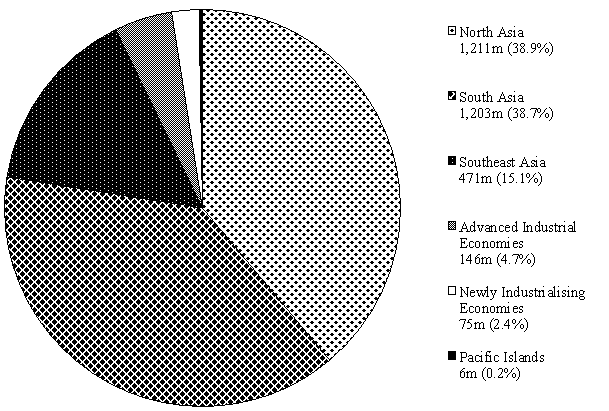
The current distribution of population in the Asia-Pacific region is shown in Figure 11. Over three-quarters of the region's population live in the North Asia and South Asia sub-regions and a further 15% live in Southeast Asia. The relatively more prosperous Advanced Industrial Economies and Newly Industrialising Economies account for less than 10% of the region's population and the Pacific Islands account for less than 1%.
Figure 11: The distribution of population in the Asia-Pacific region in 1994
Source: FAO (1997a)
However, as Figure 4 showed, most of the region's population can be found in just six countries and these countries also dominate most of the sub-regions. People's Republic of China accounts for nearly all of the population in North Asia. India, Pakistan and Bangladesh account for most of South Asia's population and Indonesia and Japan account for large shares of the population in Southeast Asia and the Advanced Industrial Economies respectively.
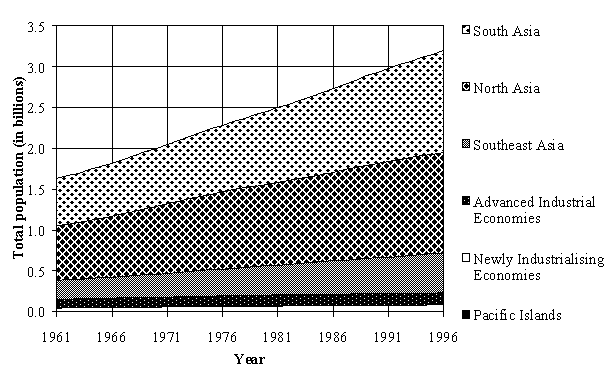
The distribution of population within the Asia-Pacific region has also changed slightly over the last 35 years. Overall, the region's population has almost doubled (see Figure 12), but some sub-regions have grown more than others. From 1961 to 1996, the population of North Asia and the Newly Industrialising Countries increased by 80%, but the population of the Advanced Industrial Economies increased by only 35%. In contrast, the population of all the other sub-regions more than doubled. Therefore in terms of population, these sub-regions (particularly South Asia and Southeast Asia) are now more important than they used to be.
Figure 12: Changes in Asia-Pacific population 1961-1996
Source: FAO (1997a)
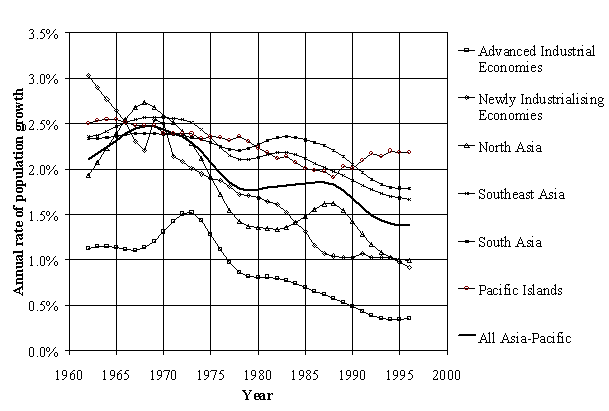
Figure 13 shows the rates of population growth experienced in each of the Asia-Pacific sub-regions over the last 35 years. This shows the remarkable success in reducing population growth which has been achieved in the region in the last few decades. Overall growth has declined by more than one percentage point from it's peak in 1969, although some sub-regions have been much less successful in reducing population growth than others.
Population growth has fallen the most in North Asia and the Newly Industrialising Economies, largely as a result of effective family planning policies in these countries. The reduction for the whole Asia-Pacific region follows quite closely the trend in the North Asia sub-region because this region accounts for such a large share of the Asia-Pacific total.
Population growth has reduced by only a modest amount in South and Southeast Asia, so these sub-regions are likely to continue to have greater shares of the region's population in the future. Population growth has also hardly changed at all in the Pacific Islands, although the relatively small population of this sub-region means that this will have little effect on the region overall.
Figure 13: Rates of population growth in the Asia-Pacific region 1962-1996
Source: FAO (1997a)
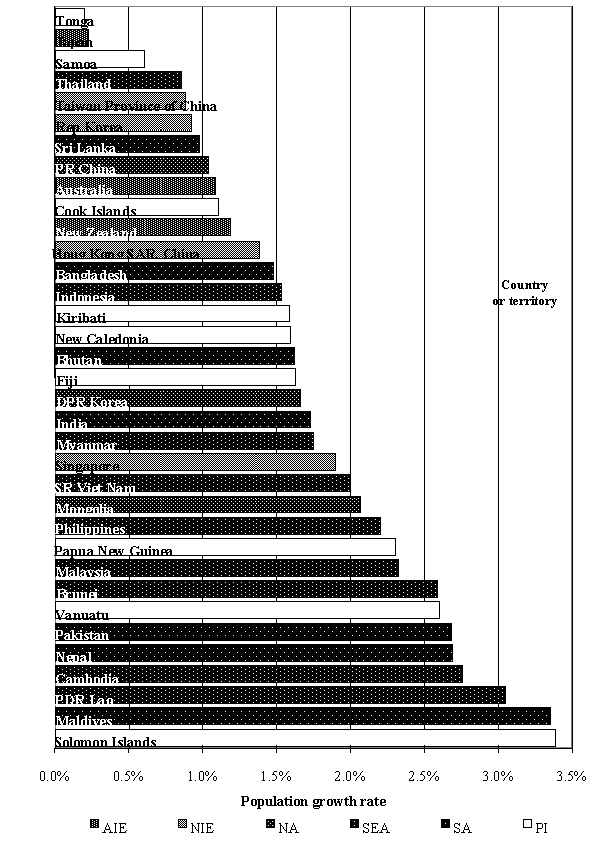
Within the sub-regions, there is considerable variation between population growth rates in different countries (see Figure 14). For example, in South Asia, Sri Lanka's rate of population growth is well below the average; Bangladesh and India are close to the average, but Pakistan, Nepal and the Maldives are well above it. Similarly, in Southeast Asia, there is a two percentage point difference between the rate of population growth in Thailand and the rates in Cambodia and the People's Democratic Republic of Lao (more detailed information about population on an individual country basis can be found in Annex 2). With one or two exceptions (most notably Singapore and Malaysia), the relatively more prosperous countries and territories in the region have lower population growth rates.
Population growth rate has actually increased over the last 35 years in a small number of countries and territories in the region. Countries and territories where this has occurred are: Cambodia; People's Democratic Republic of Lao; Bhutan; Maldives; Nepal; Pakistan and the Solomon Islands. The majority of these countries are in South Asia.
Figure 14: Average annual population growth in the Asia-Pacific region 1992-1996
Source: FAO (1997a)
Table 7 combines the information on population size and growth rates for individual countries in the Asia-Pacific region. Four of the large countries in the region: Thailand, Japan, People's Republic of China and Bangladesh have low rates of population growth and, with the exception of Bangladesh, low rates of fertility3. Three have medium rates of population growth and fertility: India, Indonesia and Socialist Republic of Vietnam. Pakistan and the Philippines have high rates of population growth and, of the large countries, Pakistan is expected to take the longest to slow down to replacement fertility growth rates.
Table 7 - The size and growth of countries in the Asia Pacific region in 1994
Average annual population growth |
Population size range in 1994 | ||
rate 1992-1996 |
Under 50 million |
50-100 million |
Over 100 million |
0.0-1.0% |
Sri Lanka; Taiwan Province of China; Rep. Korea; Samoa; Tonga. |
Thailand. |
Japan. |
1.0-1.5% |
Hong Kong SAR, China; Australia; New Zealand; Cook Islands. |
PR China; Bangladesh. | |
1.5-2.0% |
Kiribati; Bhutan; Fiji; New Caledonia; Myanmar; Singapore; DPR Korea. |
SR Vietnam. |
Indonesia; India. |
over 2.0% |
Maldives; PDR Lao; Cambodia; Nepal; Vanuatu; Brunei; Malaysia; Mongolia; Papua New Guinea; Solomon Islands. |
Philippines. |
Pakistan. |
Source: FAO (1997a)
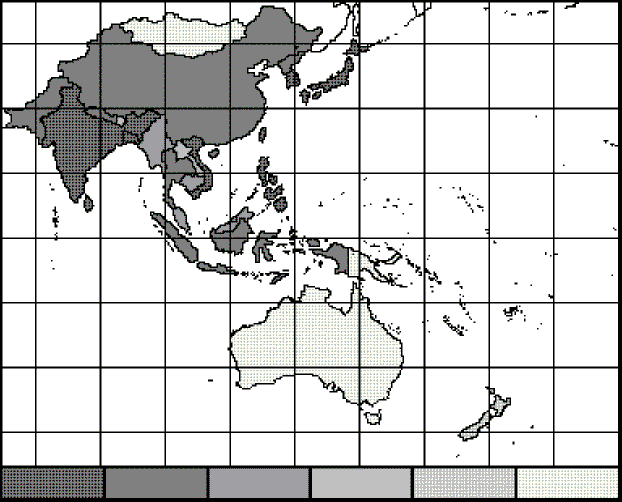
Map 2: Population density in the Asia-Pacific region in 1994
0 - 0.5 ha/cap 0.5 - 1 ha/cap 1 - 2 ha/cap 2 - 5 ha/cap 5 - 10 ha/cap over 10 ha/cap
Source: FAO (1997a)
Average population density in the Asia-Pacific region (expressed in hectares per capita) is shown in Map 2. Overall population density in the region is so high that land availability is only about 0.9 ha per capita. This is less than half of the average for the whole World.
However, examination of the map shows that a large proportion of the population in the region lives in areas which are even more densely populated than this. About 45% of the population in the region live in the 11 countries with the highest population densities (less than 0.5 ha per capita).Australia and Mongolia are two of the least densely populated countries in the region and also two of the largest. For the 99.5% of the population in the region who live outside of these two countries, the population density gives a land ratio to 0.6 ha per capita. Despite having large total areas People's Republic of China and India have very high crowding (0.8 ha per capita and 0.3 ha per capita respectively).
Despite important successes in family planning, population in the Asia-Pacific region is still growing rapidly in terms of absolute numbers due to the size and age-structure of the population built-up in earlier years. More than half of Asia's population is currently aged 25 or less (in contrast, this age group accounts for only 19% of the total population in Europe and 22% in North America). As a result of this age-structure, Sanderson and Tan (1995) believe that a substantial further increase in population in Asian countries in the next 40 or so years is unavoidable. The momentum inherent in such an age-structure would carry it forward even if replacement fertility were reached immediately. Coping with the demands of an increasing population will therefore remain a key issue for economic development in the Asia-Pacific region for many years to come.
In October 1996, the United Nations released a pre-final draft of its 1996 revision of population prospects to 2050 (UN, 1996). The UN population projections are authoritative in that they involve periodic in-depth consideration of the major developments affecting births and mortality as well as a thorough analysis of age-structures, family planning and health development prospects. The last revision even took into account probable rates of adoption and the effectiveness of family planning in countries at different stages of development. The high quality of analysis in these projections means that they can usually be taken to be the best available information for most regions and countries in the World, with little need for further interpretation. They were therefore used for this review.
According to the revised UN population projections, World population grew initially at below 2% p.a. between 1950 and 1965. Growth then increased to over 2% p.a. between 1965 and 1970 but has since declined to about 1½% p.a. in the period 1990 to 1995 (1¾% p.a. in developing regions). A key element of this latest revision to the UN population projections is that the recent decline has been faster than was previously expected. The population growth rate is expected to continue declining so that sometime before year 2009 it will start to take more time for the World's population to increase by one billion. This would be a reversal of the current situation and would represent a turning point, signalling the start of steady progress towards a replacement-rate of World population fertility.
Population growth in the Asia-Pacific region has broadly followed these global trends (see Figure 13). The peak in growth was significantly higher and occurred slightly later (in 1969) than in the rest of the World, but growth has also fallen by more since then (to 1.37% p.a. in 1996), such that it is now below the World average.
The UN has produced three population projections based on assumptions of high, medium and low fertility and the latter two have been used in this study. The medium fertility scenario is considered by the UN to be the most likely and should be used as the main point of reference. It is considered highly unlikely that progress achieved so far in family planning either would or indeed could be reversed or significantly slowed. The high fertility projection is, therefore, considered very unlikely to occur and has not been used in this study.
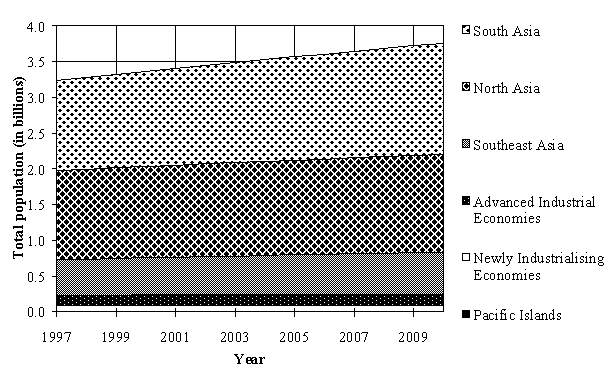
The medium fertility projection of population in the Asia-Pacific region is shown in Figure 15 and both medium and low fertility projections are given in Table 8. The projections suggest that the World population growth rate will fall to 1.27% p.a. in 2001-2005 and 1.20% p.a. in 2005-2010 (medium fertility). In the Asia-Pacific region, the corresponding growth rates will be 1.16% p.a. and 1.02% p.a.
Under the medium fertility scenario, the Asia-Pacific population is forecast to increase by about 650 million people or just over 21% to 3.8 billion by 2010. The Asia-Pacific share of World population will remain the same as at present at about 55% but of a World total growth to 6.8 billion for 2010. The low fertility scenario produces projections which are only slightly lower (an increase of 550 million or 18% resulting in a 55% share of a projected World total of 6.7 billion).
Over half of the increase in population in the region is projected to occur in South Asia (about 150 million or an increase of 29% over current population levels in the sub-region). The population of North Asia will grow by about 150 million or 13% and Southeast Asia is forecast to grow by 120 million or 25%. In terms of population therefore, the sub-regions of South and Southeast Asia will become relatively more important. The Pacific Islands are also projected to grow dramatically by 39%, but this will have little effect on the region overall due to their relatively small size.
Figure 15: UN medium fertility population projection for the Asia-Pacific region
Source: UN (1996)
Table 8 - UN population projections for countries in the Asia-Pacific region to 2010
Country |
Current and forecast population (in millions) |
Population growth forecasts (%) | |||||||||||
Base |
Medium fertility |
Low fertility |
Medium fertility |
Low fertility | |||||||||
1994 |
2000 |
2005 |
2010 |
2000 |
2005 |
2010 |
96-00 |
01-05 |
06-10 |
94-00 |
01-05 |
06-10 | |
AIE |
146 |
149 |
151 |
152 |
149 |
150 |
150 |
0.35 |
0.26 |
0.14 |
0.31 |
0.20 |
0.03 |
Australia |
18 |
19 |
20 |
21 |
19 |
20 |
20 |
1.06 |
1.04 |
1.00 |
0.96 |
0.86 |
0.70 |
Japan |
125 |
126 |
127 |
127 |
126 |
127 |
126 |
0.22 |
0.12 |
-0.02 |
0.18 |
0.08 |
-0.10 |
New Zealand |
4 |
4 |
4 |
4 |
4 |
4 |
4 |
1.09 |
1.10 |
1.05 |
1.01 |
0.91 |
0.81 |
NIE |
75 |
79 |
82 |
84 |
79 |
81 |
83 |
0.89 |
0.69 |
0.54 |
0.83 |
0.58 |
0.39 |
Hong Kong SAR, China |
6 |
6 |
6 |
7 |
6 |
6 |
7 |
0.80 |
0.26 |
0.17 |
0.79 |
0.25 |
0.12 |
Republic of Korea |
45 |
47 |
49 |
50 |
47 |
48 |
49 |
0.86 |
0.72 |
0.58 |
0.77 |
0.60 |
0.42 |
Singapore |
3 |
4 |
4 |
4 |
4 |
4 |
4 |
1.50 |
1.04 |
0.70 |
1.42 |
0.90 |
0.48 |
Taiwan Province of China |
21 |
22 |
23 |
24 |
22 |
23 |
23 |
0.89 |
0.69 |
0.55 |
0.82 |
0.58 |
0.40 |
North Asia |
1,211 |
1,279 |
1,325 |
1,365 |
1,276 |
1,312 |
1,337 |
0.89 |
0.71 |
0.60 |
0.85 |
0.54 |
0.39 |
DPR Korea |
22 |
24 |
25 |
27 |
24 |
25 |
26 |
1.58 |
1.22 |
0.89 |
1.48 |
1.06 |
0.70 |
Mongolia |
2 |
3 |
3 |
3 |
3 |
3 |
3 |
2.10 |
2.00 |
1.83 |
2.04 |
1.86 |
1.61 |
PRC China |
1,187 |
1,252 |
1,297 |
1,336 |
1,250 |
1,283 |
1,308 |
0.85 |
0.70 |
0.59 |
0.80 |
0.53 |
0.38 |
Southeast Asia |
471 |
518 |
556 |
590 |
516 |
548 |
573 |
1.60 |
1.41 |
1.20 |
1.51 |
1.20 |
0.88 |
Brunei |
<1 |
<1 |
<1 |
<1 |
<1 |
<1 |
<1 |
2.10 |
1.66 |
1.35 |
1.98 |
1.43 |
1.00 |
Cambodia |
10 |
11 |
12 |
13 |
11 |
12 |
13 |
2.23 |
1.86 |
1.76 |
2.19 |
1.79 |
1.64 |
Indonesia |
195 |
213 |
228 |
240 |
212 |
224 |
232 |
1.47 |
1.31 |
1.07 |
1.36 |
1.06 |
0.67 |
Malaysia |
20 |
22 |
24 |
26 |
22 |
24 |
26 |
2.04 |
1.74 |
1.51 |
1.95 |
1.57 |
1.25 |
Myanmar |
44 |
49 |
53 |
57 |
49 |
53 |
56 |
1.80 |
1.61 |
1.44 |
1.73 |
1.47 |
1.23 |
PDR Lao |
5 |
6 |
7 |
7 |
6 |
6 |
7 |
3.07 |
2.80 |
2.59 |
2.72 |
2.50 |
2.31 |
Philippines |
66 |
75 |
82 |
89 |
75 |
81 |
87 |
2.02 |
1.80 |
1.57 |
1.95 |
1.66 |
1.37 |
SR Vietnam |
72 |
81 |
87 |
92 |
80 |
85 |
89 |
1.75 |
1.51 |
1.21 |
1.62 |
1.25 |
0.82 |
Thailand |
58 |
61 |
63 |
65 |
60 |
62 |
63 |
0.76 |
0.69 |
0.61 |
0.58 |
0.48 |
0.37 |
South Asia |
1,203 |
1,336 |
1,448 |
1,557 |
1,331 |
1,431 |
1,521 |
1.74 |
1.61 |
1.45 |
1.67 |
1.45 |
1.22 |
Bangladesh |
116 |
128 |
140 |
151 |
128 |
138 |
148 |
1.64 |
1.73 |
1.64 |
1.56 |
1.57 |
1.41 |
Bhutan |
2 |
2 |
2 |
3 |
2 |
2 |
3 |
2.77 |
2.59 |
2.45 |
2.46 |
2.33 |
2.22 |
India |
913 |
1,007 |
1,082 |
1,151 |
1,003 |
1,069 |
1,123 |
1.61 |
1.44 |
1.26 |
1.52 |
1.27 |
0.99 |
Maldives |
<1 |
<1 |
<1 |
<1 |
<1 |
<1 |
<1 |
3.44 |
3.22 |
3.01 |
3.09 |
2.91 |
2.74 |
Nepal |
21 |
24 |
27 |
31 |
24 |
27 |
30 |
2.53 |
2.39 |
2.26 |
2.14 |
2.31 |
2.49 |
Pakistan |
133 |
156 |
177 |
200 |
156 |
176 |
197 |
2.71 |
2.59 |
2.44 |
2.67 |
2.51 |
2.32 |
Sri Lanka |
18 |
19 |
20 |
21 |
19 |
19 |
20 |
0.97 |
1.07 |
1.10 |
0.56 |
0.68 |
0.72 |
Pacific Islands |
6 |
7 |
8 |
8 |
7 |
8 |
8 |
2.12 |
2.06 |
1.95 |
2.08 |
1.96 |
1.81 |
Cook Islands |
<1 |
<1 |
<1 |
<1 |
<1 |
<1 |
<1 |
0.90 |
0.87 |
0.84 |
0.85 |
0.76 |
0.68 |
Fiji |
1 |
1 |
1 |
1 |
1 |
1 |
1 |
1.56 |
1.58 |
1.50 |
1.47 |
1.40 |
1.22 |
Kiribati |
<1 |
<1 |
<1 |
<1 |
<1 |
<1 |
<1 |
1.90 |
1.96 |
1.96 |
1.84 |
1.88 |
1.84 |
New Caledonia |
<1 |
<1 |
<1 |
<1 |
<1 |
<1 |
<1 |
1.48 |
1.34 |
1.15 |
1.36 |
1.09 |
0.77 |
Papua New Guinea |
4 |
5 |
5 |
6 |
5 |
5 |
6 |
2.24 |
2.15 |
2.01 |
2.19 |
2.07 |
1.89 |
Samoa |
<1 |
<1 |
<1 |
<1 |
<1 |
<1 |
<1 |
1.13 |
1.60 |
1.91 |
1.05 |
1.46 |
1.71 |
Solomon Islands |
<1 |
<1 |
1 |
1 |
<1 |
1 |
1 |
3.21 |
3.05 |
2.83 |
3.17 |
2.98 |
2.72 |
Tonga |
<1 |
<1 |
<1 |
<1 |
<1 |
<1 |
<1 |
0.38 |
0.40 |
0.42 |
0.33 |
0.30 |
0.27 |
Vanuatu |
<1 |
<1 |
<1 |
<1 |
<1 |
<1 |
<1 |
2.49 |
2.47 |
2.45 |
2.45 |
2.40 |
2.34 |
Asia-Pacific |
3,112 |
3,369 |
3,570 |
3,758 |
3,358 |
3,530 |
3,673 |
1.31 |
1.16 |
1.02 |
1.25 |
1.00 |
0.79 |
World |
5,607 |
6,090 |
6,487 |
6,886 |
6,069 |
6,413 |
6,730 |
1.37 |
1.27 |
1.20 |
1.28 |
1.11 |
0.97 |
Source: UN (1996)
Of the individual countries in the region, Pakistan stands-out the most. Pakistan's population will grow by nearly 50% by 2010 to 200 million and retain a growth rate of over 2% p.a. Bangladesh and Nepal will similarly grow by large amounts and retain relatively high population growth rates. India and People's Republic of China will remain the largest two countries in the region, but will be growing much more slowly by the year 2010; India's trajectory is heading towards overtaking China as the world's most populous country.
Table 9 - The projected size and growth of countries in the Asia Pacific region in 2010
Average annual population growth |
Population size range in 2010 | ||
rate 2006-2010 |
Under 50 million |
50-100 million |
Over 100 million |
under 1.0% |
Taiwan Province of China; Singapore; Tonga; Cook Islands; Hong Kong SAR, China; DPR Korea. |
Thailand; Rep. Korea. |
Japan; PR China. |
1.0-1.5% |
Sri Lanka; Australia; New Zealand; Brunei; New Caledonia. |
SR Vietnam; Myanmar. |
Indonesia; India. |
1.5-2.0% |
Kiribati; Samoa; Fiji; Cambodia; Malaysia; Mongolia. |
Philippines. |
Bangladesh. |
over 2.0% |
Bhutan; Nepal; Vanuatu; Maldives; PDR Lao; Papua New Guinea; Solomon Islands. |
Pakistan. | |
Source: FAO (1997a) - for comparison see 1992-96 rates in Table 7.
Table 9 shows the projected size and population growth of countries in the region by 2010. Comparing this with Table 7, it can be seen that population growth will have declined in most countries by this time. The only countries where population growth is expected to increase significantly are Sri Lanka, Samoa, Bhutan and Bangladesh. Myanmar and the Republic of Korea are expected to reach populations of over 50 million by this time
Over the longer-term future, it is expected that the demographic transition to low population growth or replacement rate fertility will have occurred by 2015 for most of the Asia-Pacific region. For example, a study by Sanderson and Tan (1995) examining 18 countries in the region, forecasts that 13 of them (including many of the large countries in the region) will have reached replacement level fertility levels by this time. The notable exception is Pakistan, which is expected to continue growing for quite some time.
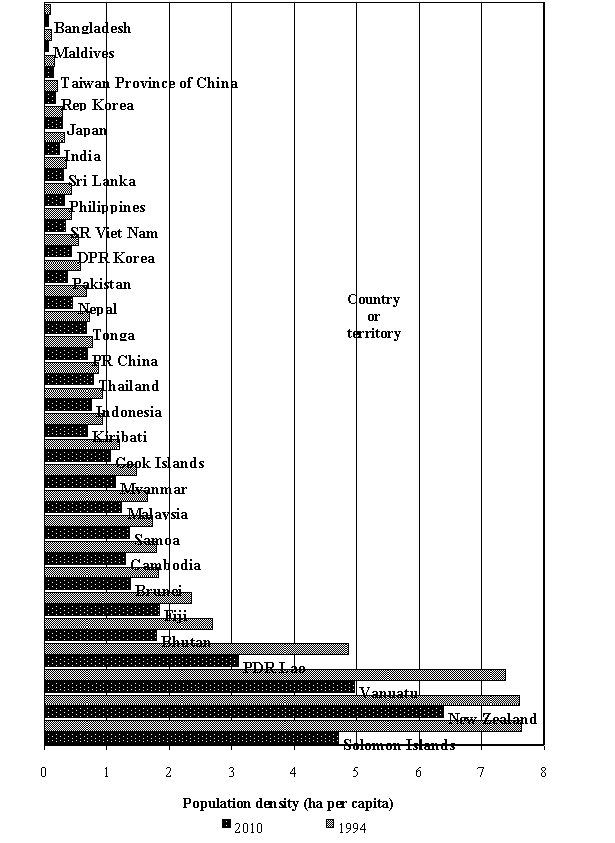
Figure 16 compares projected population density in 2010 with population density in 1994 for most of the countries in the region. Overall, the amount of land per capita falls from 0.9 ha per capita in 1994 to 0.75 ha per capita in 2010 (excluding Australia and Mongolia, the fall is from 0.6 ha per capita to 0.5 ha per capita). Many of the countries likely to be affected the most by this change are those which already have very high population densities, including: Nepal; Pakistan; Bangladesh and the Maldives.
Figure 16: Land to population ratio in 1994 and 2010 in selected Asia-Pacific countries
 Source: FAO (1997a)
3 Bangladesh has a high fertility rate but only a relatively low rate of population growth due to a high infant mortality rate.
