C. Desertification in the ESCWA region
Back to contents - Previous file - Next file
1.
Current status
2. Major forms of desertification in the ESCWA
region
3.
Factors causing desertification
4.
Urbanization
Desertification has become a serious global problem, especially in the arid, semi-arid and sub-humid regions of the world. In addition to disrupting drastically the longstanding natural balance. and the overall biological ecosystem, it has greatly reduced the productive capacity of the meagre and basically fragile natural resources in those regions.
FAO and UNEP (United Nations Environment Programme) initiated in 1980 a project with the objective of developing a methodology to assess and map the causes and dynamics of desertification in relation to status, rate and risk. The methodology was based on the Soil Hap of the World prepared jointly by FAO and UNESCO. According to this methodology, desertification has been classified universally into eight categories, each with four impact classes: light, moderate, severe, and very severe. The eight categories are:
1. Degradation of vegetative cover
2. Water erosion
3. Wind erosion
4. Deterioration of soil structure
5. Reduction in soil organic matter
6. Salinization and alkalization
7. Water logging
8. Excess toxic substances
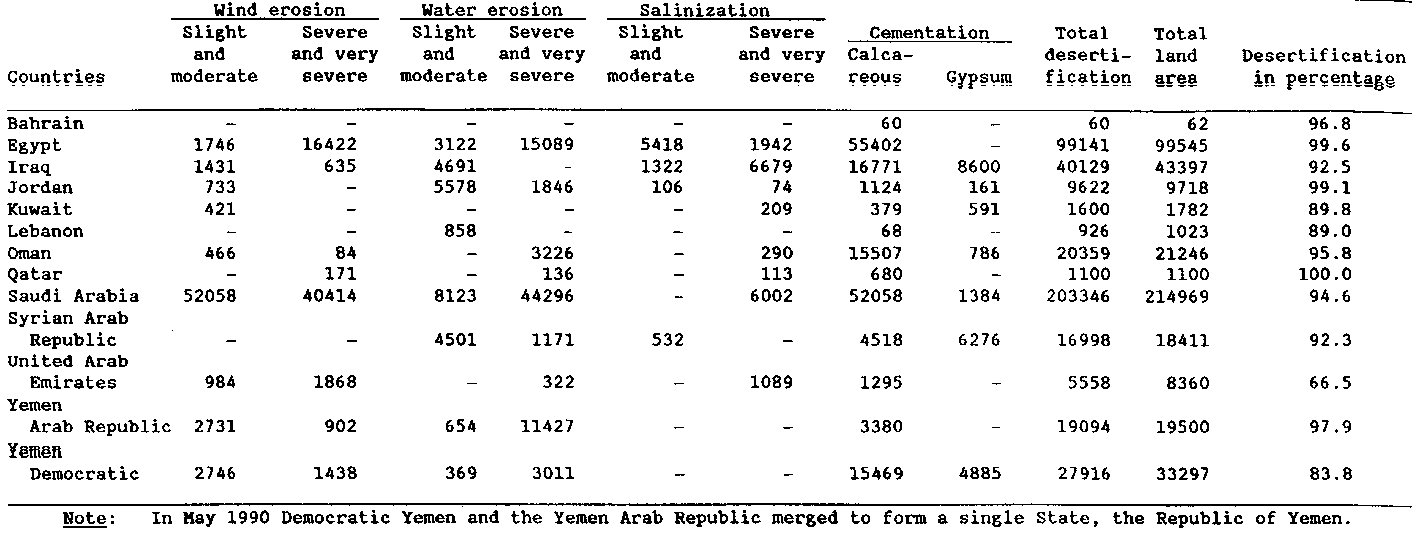
In accordance with this classification, desertification in the ESCWA region is as shown in table 5.
2. Major forms of desertification in the ESCWA region
The scars of desertification are visibly etched in the ecology of the ESCWA region, where desertification affects about 98 per cent of the total land area of the region. Severe and very severe classes of desertification cover about 65 per cent of the region's affected area, whereas 35 per cent of this area falls under slight and moderate desertification. It should be pointed out that two or more desertification processes may interact in the same area. Major categories of desertification in the ESCWA region are the following:
(a) Wind erosion
Wind erosion affects about 28 per cent of the region's total land area. However, the total area affected by aeolian ablation and dune accumulation is much larger, covering about 47 per cent. But this additional area is also affected by other processes such as soil structure deterioration, water erosion and salinization and is, therefore, classified under other forms of desertification. Actually, it is the aeolian accumulation that gives the appearance of a desert to most of the region's landscape;
(b) Water erosion
Desertification due to water erosion is very serious in mountainous, hilly and denuded areas liable to storm flooding. It covers about 24 per cent of the region's total area, mostly severely and very severely eroded. Countries badly affected by water erosion are Saudi Arabia, Egypt, Yemen, Jordan, the Syrian Arab Republic and Lebanon, in that order;
Table 4. Water resources in the ESCWA region (in billions of cml)
Water availability |
|||||
| Country | Internal | Flow from outside | Total | Total withdrawn | Percentage in agriculture |
| Bahrain | 0 | 0 | 0 | 0 | 4 |
| Egypt | 1.8 | 56.5 | 58.3 | 56.4 | 88 |
| Iraq | 34.0 | 66.0 | 100.0 | 42.80 | 92 |
| Jordan | 0.7 | 0.4 | 1.1 | 0.45 | 65 |
| Kuwait | 0 | 0 | 0 | 0.01 | 4 |
| Lebanon | 4.8 | 0 | 4.8 | 0.75 | 85 |
| Oman | 2.0 | 0 | 2.0 | 0.43 | 94 |
| Qatar | .02 | 0 | 0.02 | 0.04 | 38 |
| Saudi Arabia | 2.2 | 0 | 2.2 | 2.33 | 47 |
| Syrian Arab Republic | 7.6 | 22.9 | 30.5 | 3.34 | 83 |
| United Arab Emirates | 0.3 | 0 | 0.3 | 0.42 | 80 |
| Yemen | 2.5 | 0 | 2.5 | 3.40 | 94 |
| Total | 55.92 | 145.8 | 201.72 | 110.37 | |
Source: W.G. Sombroek and A.H. Sayegh, "Inventory and assessment of land resources for the Near East and North Africa region", FAO Regional Office, Cairo (AGL/RNEA/LWU/92/3), July 1992.
Notes: Figures do not include fossil or desalinized water; 0 = Zero or less than 0.01 billions of cml per year.
Table 5. Desertification in the ESCWA region (thousands of hectares)
(c) Salinization and alkalization
This form of desertification covers an additional 5 per cent of the area in the region. The area covered by soluble salts, however, covers an additional 20 per cent. It chiefly affects Iraq, Saudi Arabia, Egypt and the United Arab Emirates. It occurs in the alluvial and coastal plains and in some depressions which are the backbone of agricultural production;
(d) Soil structure deterioration
About 42 per cent of the total area in the region is affected by desertification of soil structure, of which about 30 per cent have severe and very severe cementation and the remaining 12 per cent have an accumulation of gypsum powder, sand crystals and crust. Gypsomorphy is particularly evident in Iraq, the Syrian Arab Republic, Kuwait and Yemen. Calcareous cementation accounts for one fourth of the area where soil structure has deteriorated. The latter form of desertification is less critical and, in several countries, the affected lands show good prospects for increased biological activities, especially if protective measures are properly taken.
3. Factors causing desertification
(a) Climatic factors
Details of the climatic elements in the ESCWA region were reviewed above. It should be pointed out, however, that in a region as dry as the ESCWA region, soil particles bondage is loose and, therefore, prone to erosion;
(b) Socio-economic factors
The most important causes of desertification in the ESCWA region related to human activities and their interaction with the environmental elements and natural resources are the following:
(i) Mismanagement of natural resources
It has been pointed out above how the irrational utilization of the available natural resources can reduce land productivity, degrade forests and rangeland cover and deplete groundwater resources. The end results of such utilization therefore are loss of production and sustainability of natural resources and the hazard of desertification;
(ii) Land fragmentation
It was noted above that the agricultural land ownership system in the ESCWA region is based on small-size holdings. The exploitation of such small parcels of land is not economically conducive in many localities to continued agricultural production. Therefore, many such small parcels of land are left fallow without plant cover and become subject to desertification.
A major cause of the loss of productive land in the ESCWA region is urban expansion, including the establishment of industrial and tourist facilities and the construction of road networks and airports.
Cities in the ESCWA region are expanding rapidly owing to continued migration from rural areas and a high rate of population growth. Urban centres which not long ago covered only small tracts are now occupying several hundred square kilometres.
Within only a few decades, expansion of the cities such as those along the river banks, particularly in Egypt, Iraq and the Syrian Arab Republic has encroached on hundreds of thousands of hectares of naturally welldrained and productive agricultural lands. Continued encroachment into agricultural lands due to rapid changes in the demographic structure will further reduce productive agricultural areas and will create added pressure to exploit marginal lands, which will lead to accelerated desertification of the area.
In the desertification-prone countries, zoning of human settlements, high way systems, industrial establishments and all infrastructure facilities should be accommodated within the framework of a sound national land-use plan if lands with pastoral or agricultural potential are to be safeguarded.