As mentioned in Chapter 1, the southern rangelands were selected for long-term research primarily because the region is important as a source of animals for domestic consumption and export. The infrastructure and high level of security have also facilitated continuity of research and development, at least until 1991 (see Chapter 8: Synthesis and conclusions). Much of the study area remains as the development focus of the ongoing Pilot Project (see Section 1.4.3: The SERP and the Pilot Project).
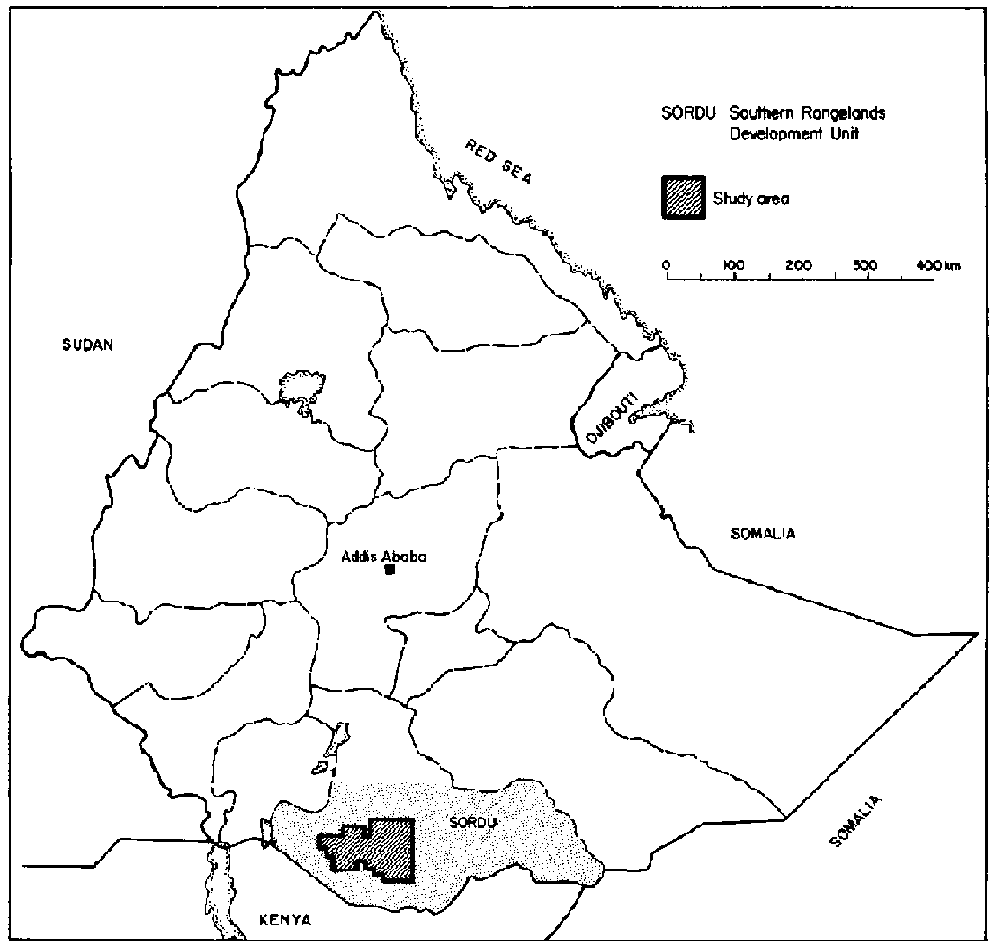
Although the Borana Plateau comprises most of the 95000 km2 of SORDU, the study area demarcated by the JEPSS programme in the early 1980s was 15475 km2 of the west-central portion (Figure 2.1). The "H" shape of the study area resulted from mountain ranges which cut into pastoral lowlands from the north and south. There were several reasons for selecting this study area, the most important being that it circumscribed the headland of the Borana pastoral system. The Boran dominate the west-central region because they depend on deep wells associated with the geomorphology of the western Borana Plateau (see Section 2.4.1.7: Water resources). The area was also selected because it had a reasonable road network and contained government administrative centres.
Ground and aerial surveys of human and livestock populations and extensive vegetation studies were conducted from 1982 to 1986 throughout the 15475 km2 study area Billé et al, 1983; Milligan, 1983; Cossins and Upton, 1985; Assefa Eshete et al, 1987). Most household surveys, however, were performed more commonly in the eastern half of the study area because of easier logistics (Figure 2.1; see Section 4.3.1: General household structure and economy in average rainfall years). Thus, research results from work conducted at the population or landscape level of resolution are more applicable to a sample area of 16% of the entire Borana Plateau while household-level results are applicable to about 1% of the area. As will be shown, the Borana Plateau is extremely diverse in terms of natural resources, ecology and pastoral inhabitants. Because of this diversity, some of the development concepts forwarded later in this report (see Chapter 7: Development-intervention concepts) may not be applicable to the Borana Plateau overall.
Source: Cossins and Upton (1985).
Reference will be made throughout the rest of this volume to the Borana pastoral system. This will be loosely defined as the people, animals, vegetation and supposing resources that occur within the 15475 km2 study area.