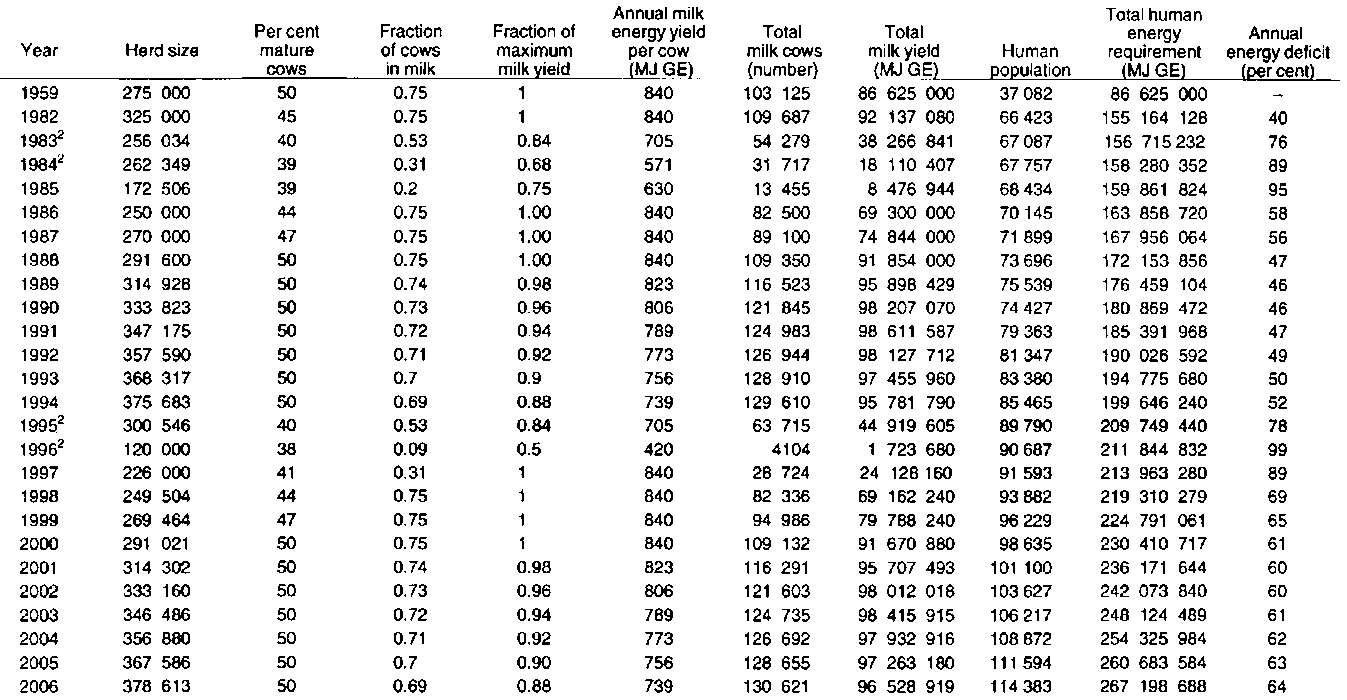
Table G1. Actual and projected cattle numbers, percentage and numbers of mature cows, annual milk production of the cattle herd and annual estimates of the human population and its energy requirements and milk-energy deficits, on the central Borana Plateau during 1959 and 1982-2006.
Table G2. Exotic and indigenous forage species and some possible establishment locations in the southern rangelands.
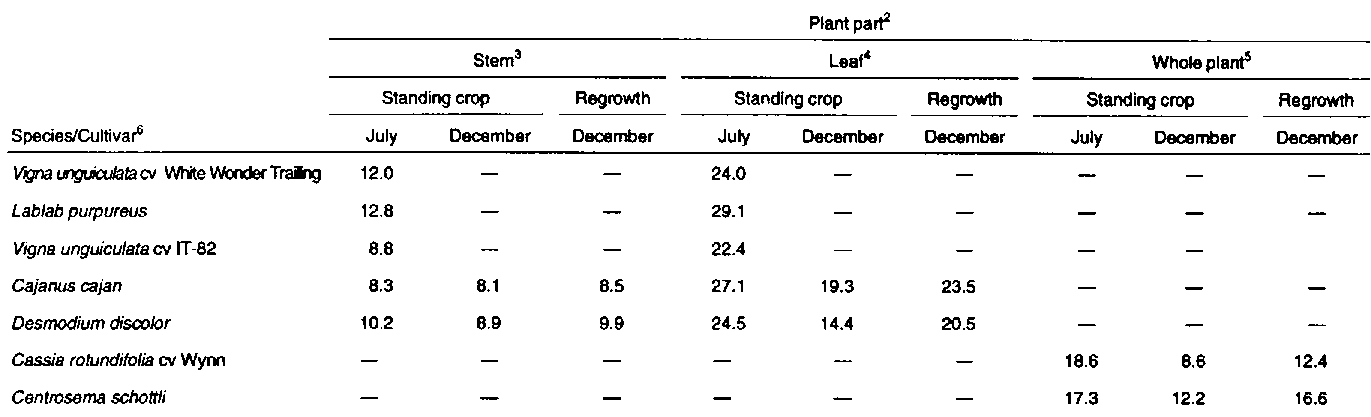
Table G3. Effects of legume, harvest dates and standing crop or regrowth on crude-protein (CP) concentration, on a dry-matter basis for various plant parts at Dembel Wachu ranch in the southern rangelands during 1987.
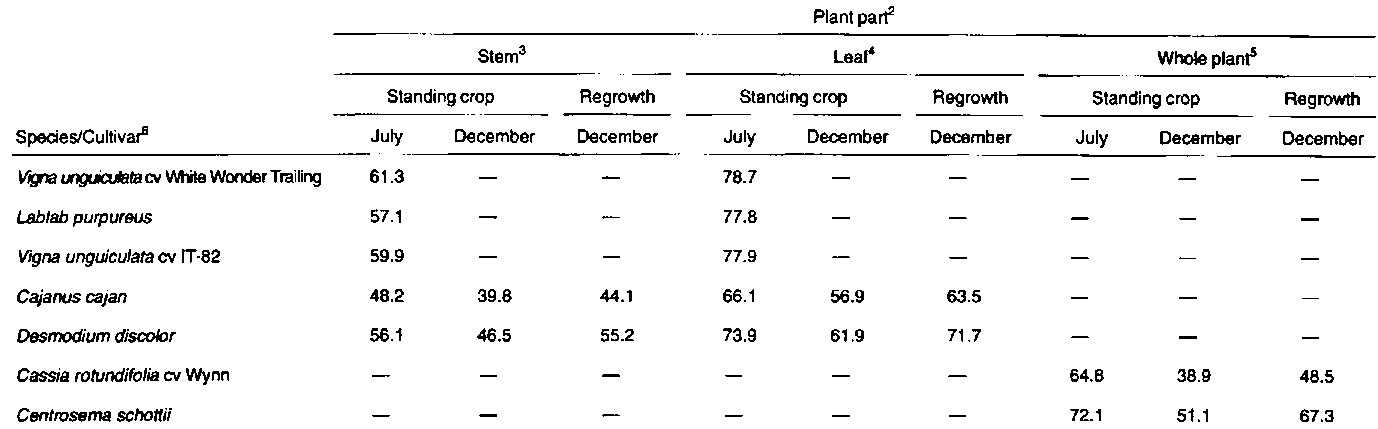
Table G4. Effects of legume, harvest date and standing crop or regrowth on dry-matter digestibility of various plant parts at Dembel Wachu ranch in the southern rangelands during 1987.
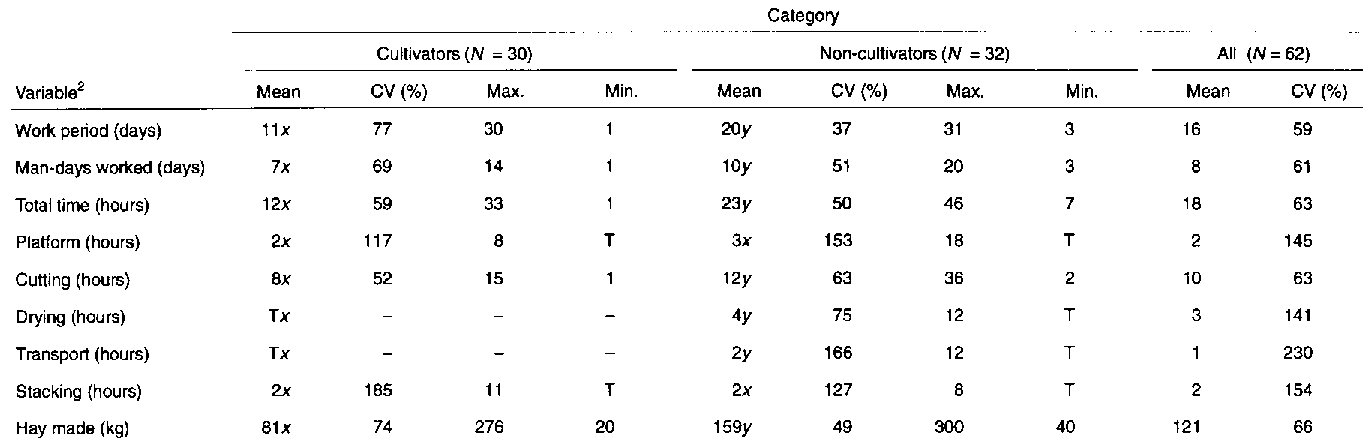
Table G5. Hay-making statistics for Borana households in the southern rangelands during May and June 1990.
Table G6. Time budgets (%) of activities forgone for three priority persons observed in 62 Borana households involved in hay-making during May through June 1990.
Table G7. Diet intake (dry-matter basis), water intake and growth for Boran calves under venous feeding treatments at Dembel Wachu ranch in the southern rangelands during 1990.
Table G8. Comparative growth rates (g/head/day) and sample size per treatment (N) for livestock Under supplementation with isonitrogenous amounts of lucerne hay (Medicago sativa), cowpea hay (Vigna unguiculata), or Acacia materials in feeding trials conducted at Dembel Wachu ranch and Debre Zeit during 1987-88.
Table G9. Per cent mortality (and sample size) of Acacia mellifera and Acacia bussed from prescribed burning at two sites on Wollenso Ranch in the southern rangelands in 1989.
Table G10. Per cent Acacia drepanolobium trees in two size classes that were apparently killed due to venous treatments in the southern rangelands during August 1989.
Table G11. Maize grain yield (kg/ha) as affected by species of intercropped legume and maize planting density (no/ha) at Dembel Wachu ranch in the southern rangelands in 1987.
Table G12. Milk processing statistics for butter-making by Borana women using traditional methods.
Table G13. Comparative household monetary income and food-energy yields for three feeding-management strategies for a Borana family managing an eight-cow breeding herd in the southern rangelands.
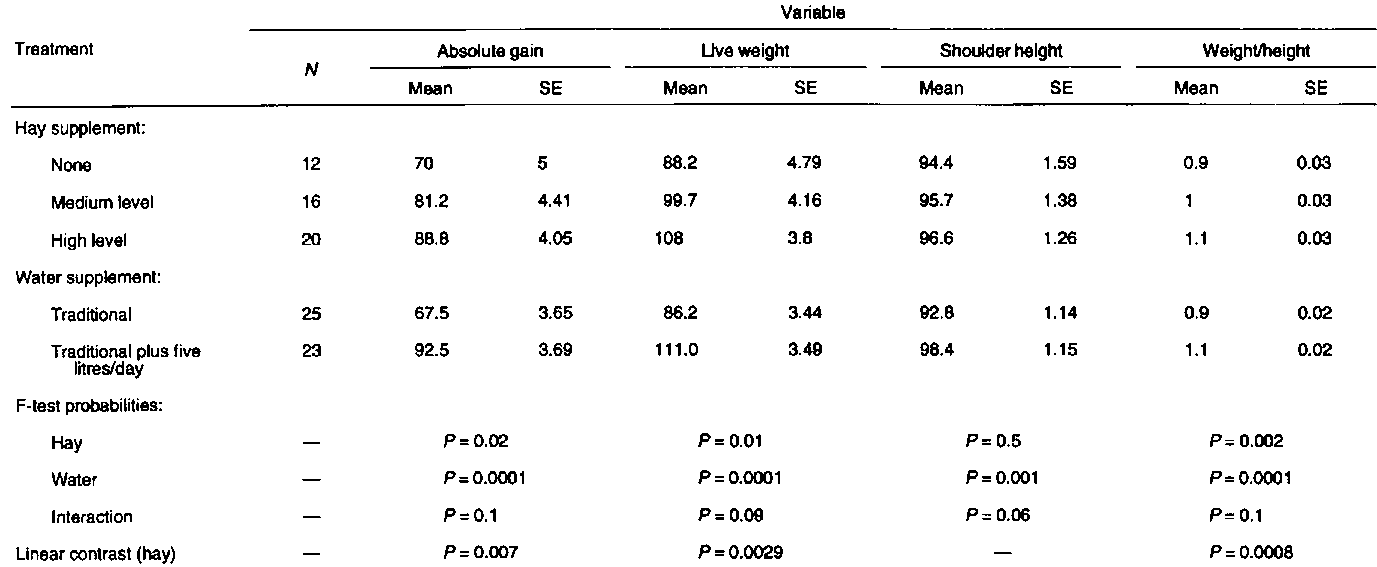
Table G14. Effects of treatments conducted on pursing carves on absolute weighs gain (kg) from birth to weaning and on live weight (kg), shoulder height (cm) and weight-to-height ratio at weaning for heifers in the southern rangelands in 1986-87.
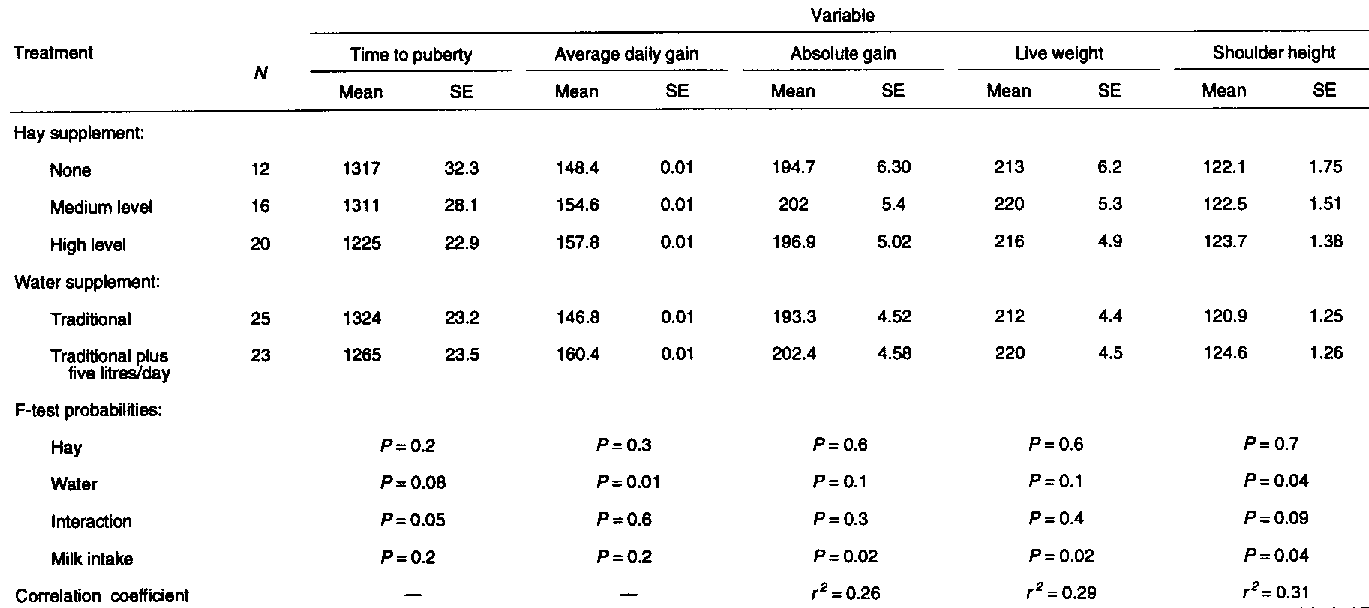
Table G15. Effects of treatments conducted on nursing calves on time to puberty (days), average daily gain (g/day), absolute gain (kg) from birth to puberty and on live weight (kg) and shoulder height (cm) at puberty for heifers in the southern rangelands, 1986-90.
1 Herd sizes were collated from aerial surveys (during 1982-86; from Cossins and Upton (1985) and Assefa Eshete et al (1987)) with average subsequent growth in the first post-drought years (1987 and 1998) of 10.6% followed by 8% annual growth (Mulugeta Assefa, 1990) from 1988-89 and 1990-2001 until herd size exceeded 300000 head. The 8% growth rate was then reduced by two percentage points/year to reflect density-dependent effects (see text). Drought effects on herd size in 1995-96 were assumed to be proportionally similar to those observed in 1983-85 (Cossins and Upton, 1985). Per cent mature cows in the herd were derived from Donaldson (1986) and Solomon Desta (nd). Fraction of cows in milk and maximum milk yields were from Donaldson (1986) and Cossins and Upton (1988b). Density-dependent effects on milk yields and fraction of cows in milk were assumed on the basis of unpublished interviews (D. L. Coppock, ILCA, unpublished data). The growth rate in the human population of 2.5% was from B. Lindtjørn (University of Bergen, unpublished data) and assumed to be 1 % per year during drought (Coppock, 1988). The per capita annual energy requirement of 2336 MJ GE was from FAD/WHO (1973) cited in Upton (1989). Reduction in human food-energy demand is likely during drought (Webb et al, 1992), but was not included because of insufficient information.2 Consecutive dry years (i.e. drought) observed in 1983-1984 (Cossins and Upton 1988a) and hypothetically projected for 1995-96.
|
Latin name |
Cropped field |
Range vegetation |
Disturbed roadside |
Encampment/Pond catchment |
|
Acacia albida |
|
|
|
x |
|
Acacia tortilis |
|
|
|
x |
|
Azdarichta indica |
|
|
|
x |
|
Cajanus cajan |
x |
|
|
|
|
Cassia rotundifolia |
x |
x |
x |
|
|
Centrosema pascuonum |
x |
x |
|
|
|
Centrosema schottii |
x |
x |
|
|
|
Desmanthus virgatus |
|
x |
x |
x |
|
Gliricidia septum |
|
|
|
x |
|
Lablab purpureus |
x |
|
|
x |
|
Leucaena diversifolia |
|
|
|
x |
|
Leucaena leucocephala |
|
|
|
x |
|
Leucaena shannoni |
|
|
|
x |
|
Macroptilium atropurpureum |
x |
x |
x |
|
|
Macrotyloma axillare |
|
x |
x |
x |
|
Moringa stenopetala |
|
|
|
x |
|
Phaseolus vulgaris |
x |
|
|
|
|
Sesbania sesban |
|
|
|
x |
|
Stylosanthes hamata |
x |
x |
x |
x |
|
Stylosanthes scabra |
|
x |
x |
x |
|
Vigna unguiculata |
x |
|
|
|
Source: Hodgson (1990).
1 Percent kjeldahl nitrogen × 6.25.2 Whole plant analyses were conducted on G. rotundifolia and C. schottii because of reduced morphological differentiation.
3 Entries that varied by 20.50 were different (P<0.05) according to an LSD (least significant difference) test.
4 Entries that varied by 20.46 were different (P<0.05) according to an LSD test.
5 Entries that varied by 20.19 were different (P<0.05) according to an LSD test.
6 Where V. unguiculata and L. purpureus are annuals and the rest are perennials.
Source: Yohannes Alemseged (1989).
1 In vitro dry-matter digestibility (Goering and Van Soest, 1970).2 Whole plant analyses were conducted on C. rotundifolia and G. schottii because of reduced morphological differentiation.
3 Entries that varied by ³ 1.13 were different (P£ 0.05) according to an LSD (least significant difference) test.
4 Entries that varied by ³ 1.17 were different (P£ 0.05) according to an LSD test.
5 Entries that varied by ³ 5.88 were different (P£ 0.05) according to an LSD test.
6 Where V. unguiculata and L. purpureus are annuals and the rest are perennials.
Source: Yohannes Alemseged (1989).
1 Means within a row accompanied by the same letter (x, y) were not significantly different (P³ 0.30) in t-test comparisons. Other means were different (P£ 0.02). Entries marked by a T indicate a trace amount of time invested (<0.5 hrs). CV is the coefficient of variation, the standard deviation expressed as a percentage of the mean. It is a measure of the variability in a given sample.2 Where work period is the length of time between initiation and conclusion of hay-making. Man-days worked is the frequency of man-days within the work period which corresponds to any degree of work output on any given day.
Source: Coppock (1991).
|
Activity2 |
Priority person1 |
total |
||
|
1 |
2 |
3 |
||
|
Firewood collection |
10 |
16 |
- |
11 |
|
Watering animals |
9 |
25 |
18 |
12 |
|
Other livestock management |
6 |
10 |
20 |
7 |
|
Child care |
21 |
12 |
3 |
19 |
|
Social obligations |
3 |
2 |
- |
3 |
|
Leisure/hygiene |
13 |
6 |
8 |
12 |
|
Milk processing |
10 |
15 |
9 |
11 |
|
Household maintenance |
18 |
11 |
17 |
16 |
|
Food preparation |
10 |
3 |
25 |
9 |
|
Average hours per household |
15 |
3 |
<1 |
18 |
1 Person 1 is a married woman, person 2 is usually a teenage female or older female relative of the wife, and person 3 is a teenage youth, older female relative, child or husband.2 Where: (1) other livestock management is herding, health care etc. For women this commonly involves less important stock such as camels or equines while youths and children tend to be herders of calves and small ruminants (2) child care includes playing, breast feeding, health care etc.; (3) hygiene includes hair braiding, washing etc; (4) milk processing includes preparation of containers for milk collection, butter-churning etc.; (5) household maintenance includes repair of house, clothing and miscellaneous containers; and (6) food preparation involves grinding grain, making tea and associated activities not involving milk.
Source: Coppock (1991).
|
Diet |
Diet intake (g/head/day) |
Water intake (l/head/day) |
Growth (g/head/day) |
|||||||
|
Dry matter |
Organic matter |
Nitrogen |
||||||||
|
Mean |
SE |
Mean |
SE |
Mean |
SE |
Mean |
SE |
Mean |
SE |
|
|
Standing brown grass |
2110 |
76.2 |
1930 |
69.1 |
13.4 |
0.74 |
4.6 |
0.21 |
-78 |
13.2 |
|
Grass hay |
2259 |
66 |
2033 |
59.9 |
16.8 |
0.64 |
5.9 |
0.18 |
-7 |
11.5 |
|
Grass hay plus |
|
|
|
|
|
|
|
|
|
|
|
Acacia tortilis fruits |
2327 |
66 |
2086 |
59.9 |
22.2 |
0.63 |
5.8 |
0.18 |
40 |
11.5 |
|
F-test probability1 |
|
|
|
|
|
|
|
|
|
|
|
Overall |
NS |
|
NS |
|
** |
|
** |
|
** |
|
|
Contrast 1 |
NS |
|
NS |
|
* |
|
** |
|
** |
|
|
Contrast 2 |
NS |
|
NS |
|
* |
|
NS |
|
* |
|
* and ** significant at P = 0.05 and P = 0.01 levels, respectively.1 Overall F-test based on 41 degrees of freedom. Contrast 1 = standing brown grass diet vs the grass hay diet and contrast 2 = the grass hay diet vs the grass hay plus A. tortilis fruit diet. Treatment observations ended up unbalanced because four calves on the grass diet were taken out of the trial after three weeks due to very poor performance.
Source: Coppock (1993a).
|
Species |
N |
Control |
Control conditions plus |
|||
|
Lucerne hay |
Cowpea hay |
A. brevispica leaves |
A. tortilis fruits |
|||
|
Sheep3 |
6 |
31 |
53 |
57 |
53 |
53 |
|
Calves4 |
25 |
82 |
158 |
106 |
119 |
136 |
1 In the sheep trial animals received either 345 g lucerne hay, 387 g cowpea hay, 302 g A. bevispica leaves or 368 g A. tortilis fruits daily on a dry-matter (DM) basis. In the calf trial animals received either 567 g lucerne hay, 662 g cowpea hay 473 g A. brevispica leaves or 616 g A. tortilis fruits daily on a DM basis. For the sheep, the control (base) diet was poor-quality grass hay (offered ad libitum) made near Debre Zeit (6.25% CP on a DM basis). Control (base) diets for calves were free grazing on Pennisetum mezianum rangeland (6.25% CP on a DM basis) and milk from restricted suckling. See text for details.2 Linear contrasts revealed that growth rates and diet conversion efficiencies were significantly enhanced (P<0.01) in all supplemented sheep compared to controls. Supplementation also increased (P<0.01) calf growth rates compared to controls; the alfalfa diet was also superior to those based on native legumes. Milk intake (ml/kg 0.75) was used as a covariate in the analysis and milk intake was found to have been adequately standardised among treatments.
3 Conducted under an 84-day growth trial under confinement at Debre Zeit Station.
4 Conducted under simulated pastoral management during a 94-day grazing trial at Dembel Wachu ranch on the Borana Plateau.
Source: Coppock and Reed (1992).
|
Height class2 |
Per cent mortality |
|
|
Site 1 |
Site 2 |
|
|
(1) <05m |
40(N = 52) |
32(N = 22) |
|
(2) 0.6 to 1 m |
51 (N = 35) |
22 (N = 27) |
|
(3) 1.1 to 2 m |
30 (N = 53) |
35 (N = 34) |
|
(4)2.1 to 4m |
9 (N = 51) |
22 (N = 27) |
|
(5)24.1 m |
11 (N = 44) |
5 (N = 19) |
|
(6) All |
28 (N = 235) |
32 (N = 129) |
1 The two-way ANOVA (height class × species) for site 1 showed significant (P<0.05) interactions of height class × species and main effects of height class. The one-way ANOVA (height class) for site2 (having A. mellifera only) was not significant (P = 0.24).2 Height classes were arbitrarily designated for ease of classification. Classes represent height of trees from ground level.
Source: Coppock et al (1990).
|
Site3 |
Treatment2 (height class) |
|||||||||
|
Control |
Stumped4 |
Stumped+oil4 |
Stumped+Tordons5 |
Ring barking |
||||||
|
(1) |
(2) |
(1) |
(2) |
(1) |
(2) |
(1) |
(2) |
(1) |
(2) |
|
|
Did Tayura |
0 |
0 |
0 |
2 |
0 |
5 |
100 |
100 |
45 |
0 |
|
Dembel Wachu |
0 |
0 |
0 |
5 |
5 |
10 |
100 |
98 |
45 |
6 |
|
Average |
0 |
0 |
0 |
3.5 |
2.5 |
7.5 |
100 |
99 |
45 |
3 |
1 An N = 60 was used per height class/treatment/site. Height class 1 was < 2 m, while height class 2 was 2³ 2 m. No statistics were employed for these results.2 Where control = undisturbed trees; stumped = tree cut down completely at the base; stumped + oil = tree cut down with used motor oil applied to the cut surface (this was a treatment based on "local knowledge" of range managers); stumped + Tordon = tree cut down with 1 ml of Tordon 101 chemical applied to cut surface; and where ring barking = trimming off a 5-cm width ring of bark around the base of the tree.
3 Where Did Tayura is a Ministry of Agriculture ranch and Dembel Wachu is a TLDP ranch.
4 At least 97% of these stumps resprouted several new stems (N = 480).
5 Use of Tordon 101 does not imply formal endorsement.
Source: Coppock et al (1990).
|
Legume species |
Maize-planting density |
||||
|
20000 |
30000 |
55000 |
All |
Overall per cent change1 |
|
|
None (maize only) |
3025 |
4176 |
4271 |
3824 |
- |
|
Vigna unguiculata cv White Wonder Trailing |
2223 |
2605 |
3109 |
2646 |
-31% |
|
Lablab purpureus |
2362 |
2577 |
2982 |
2625 |
-32% |
|
Cassia rotundifolia cv Wynn |
2825 |
3653 |
4771 |
3750 |
-02% |
|
Centrosema schottii |
2984 |
3281 |
3967 |
3411 |
-11% |
1 Relative change compared to monoculture of maize. Interspecific effects were highly significant in the three-way ANOVA (P<0.05). Any tabulated values that differ by at least 461 kg/ha were significantly different (P£ 0.001) using an LSD (least significant difference) test.Source: Yohannes Alemseged (1989).
|
Variable |
Units |
N |
Mean |
Minimum |
Maximum | |
|
Whole milk: |
|
|
|
|
| |
|
|
- quantity |
ml |
28 |
1046.6 |
500 |
1920 |
|
|
- temperature |
°C |
31 |
20.2 |
17 |
24 |
|
|
- acidity |
% |
31 |
1.06 |
0.68 |
1.5 |
|
|
- fat content |
% |
30 |
4.44 |
2 |
6.8 |
|
buttermilk: |
|
|
|
|
| |
|
|
- quantity |
ml |
27 |
916.7 |
460 |
1555 |
|
|
- fat content |
% |
31 |
0.75 |
0.4 |
2.3 |
|
|
- Churning time |
min |
31 |
40.2 |
20 |
64 |
|
|
min/l |
28 |
38.7 |
19.3 |
101.8 | |
|
Fat recovery |
% |
26 |
84.6 |
54.8 |
93 | |
1 See text for a description of analytical methods, milk components and variables used in calculations of milkfat recovery.
Variables for whole milk were measured prior to churning; those for buttermilk were measured after churning.Source: Coppock et al (in press).
|
Category |
Management option1 |
||
|
Cow-feeding |
Improved calf growth: A |
Improved calf growth: B |
|
|
Food energy (MJ GE):3 |
|
|
|
|
Milk |
6918 (+3)2 |
7970 (+19) |
8813 (+31) |
|
Fallen meat |
726 (0) |
1026 (+41) |
1026 (+41) |
|
Slaughtered meat |
187 (0) |
801 (+328) |
801 (+328) |
|
Total energy (MJ GE)3 |
7831 (+3) |
9797 (+28) |
10640 (+39) |
|
Total energy as a percentage of that required for average household |
67.5 |
81.6 |
88.7 |
|
Sales offtake (kg LW)4 |
508 (0) |
754 (+48) |
754 (+48) |
|
Gross cash income (EB) 5 |
507 (0) |
754 (+32) |
754 (+32) |
|
Cost of essential human food (EB)5 |
169 (-10) |
95 (-46) |
55 (-69) |
|
Range forage required per herd (MJ GE × 103) |
1481 (0) |
1501 (+1.4) |
1501 (+1.4) |
1 Where cow feeding is when forage resources are given to milk cows with an increased milk offtake of 3%; calf-feeding option A is where forage resources are directed to calves and result in a reduction of mortality from 25 to 15% in calves and 13 to 10% in yearlings, weaning weights double from 47 to 94 kg/head, culling rates of immature females increase from 40 to 55%, and offtake of immature males is maximised; end calf feeding option B is similar to option A but milk offtake is also increased by 11 %.2 Per cent change over the traditional system is shown in brackets.
3 Mega-joules of gross energy. Food energy is that generated by the system for human consumption.
4 Kilograms live weight.
5 Where USD 1 = EB 2.05. Cost required to make up the food-energy deficit through grain purchases.
Source: Cossins and Upton (1988b).
1 See text for methodological details.Source: Sovani (1990).
1 See text for methodological details.Source: Sovani (1990).