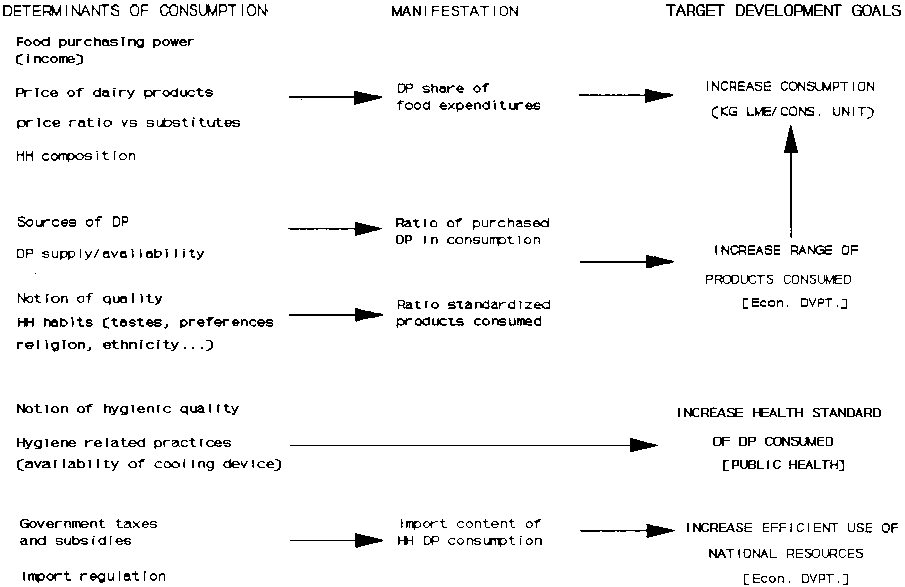
2.1 Analytical Framework for the Formulation of Research Questions and Hypotheses
2.2 Determine the Methods of Analysis
2.3 Define the Information to be Collected
2.4 Define the Sources of this Information
2.5 Determine the Method of Collection Appropriate for this Source
Some characterisation of dairy product consumption has been conducted at most ILCA zonal sites (Table 1). Pursued by different scientists at different times and places, a variety of methodological approaches have been employed in conducting these studies. This document is based upon ILCA's experiences at its zonal sites and incorporates the methodological lessons learned in the course of these studies. In particular:
1. Locations and samples should display readily identifiable characteristics; and,2. While samples should be adequately large for sound statistical inference, the methodologies used for sample stratification, selection and data collection should not make inference complicated.
The development of instruments for characterisation of any system is an exercise that needs to be carefully undertaken. The steps below have been followed in constructing the Conceptual Framework instruments and in specifying the analytical methods. Experience has shown that following these steps will ensure maximum efficiency in data collection and analysis.
Table 1. Dairy consumption studies by ILCA scientists.
|
Study location and survey period |
Observation units and sample size |
Sampling methodology |
Number of visits |
Recall period |
Results/Outputs |
|
Ibadan, Nigeria |
Rural and urban households |
Stratified, non-probability sample |
1 |
1 week |
Structure of consumption, household dairy expenditures and income elasticity by location/ethnic group. |
|
Bamako, Mali |
Urban households |
Stratified, purposive samples; multistage, panel-survey technique |
24 |
1 week |
Structure of consumption and estimates of consumption by wealth category; socio economic determinants of consumption. |
|
Kaduna, Nigeria |
Urban and rural households |
Stratified, non-probability sample |
1 |
1 week |
Structure of consumption, estimates of consumption by income groups; socio-economic determinants of consumption. |
|
Mombasa, Kenya |
Urban, peri-urban and rural households |
Stratified, probability sample, panel-survey technique |
2 |
1 week |
Structure of consumption, consumption estimates and dairy expenditure by hh location and income class, nutritional contribution of dairy products in diet, food consumption frequencies. |
Sources: Jabbar and di Domenico (1992); Jansen (1992); Mullins (1992); Sissoko et al (1992).
Step:
1. Formulate the questions and hypotheses to be answered or tested in this phase.2. Determine the analytical methodology to be used to answer the formulated questions and to test the hypotheses, and define the data needs.
3. Define the sources of this data.
4. Determine the method of data collection most appropriate for these sources, and,
5. For primary data collection, design the survey including the sample design and questionnaires to be used.
These steps are first discussed in general terms before describing their specific application to characterisation of the consumption system.
Finding the correct solution to a problem requires that the problem be clearly identified and defined. It is a mistake to assume that everyone involved in a research effort has the same perception of the research problem. Divergent perceptions will also give rise to different beliefs or hypotheses about the problem. Members of the research team should specify the questions and hypotheses they perceive are critical to answer or test. By doing so at the outset, one will avoid the costs of changing research plans after they are already under way or repeating exercises due to missed information.
The schematic diagram in Figure 1 depicts the relationships between functional parameters, performance indicators, and conditions which compromise system performance, thereby thwarting achievement of consumption goals. The analytical framework is intended to stimulate thinking about these relationships, generate questions and hypotheses about the system under study, and to suggest starting points for data analysis.
Figure 1. Analytical framework for dairy product consumption.
Because the method of analysis influences the type of data to be collected, they must be determined before embarking upon data collection. While it has been stated that characterization of a dairy system entails quantification of various parameters and performance indicators, in many instances descriptive statistics such as percentages, frequencies, means and variances will be adequate. Hypothesis testing will, however, require more advanced statistical techniques such as Analysis of Variance (ANOVA). Regression analysis may be employed to evaluate the relationships between particular variables and their statistical significance. Based upon the methods of analysis to be used, specific data requirements can be identified.
Unfortunately, too many questionnaires have been based on the premise that, while in the field, it is best to gather as much information as possible with hopes that the use and relevance of the data will appear during analysis. Experience has shown the shortcomings of this approach:
1 . Respondent-fatigue from long interviews leading to poor data quality and unwillingness to participate in subsequent surveys;2. Overloading the survey instrument. This particularly becomes a problem when relevant information omitted is; and,
3. Analysis makes use of only 35-50% of the data collected!
The objective pursued here is that at least 80% of the information collected should be relevant and useful in answering the specific questions or testing the hypotheses of this phase. To achieve this level of efficiency, efforts have been made to define a minimum data set on dairy consumption which will characterise the system and permit its assessment. This assessment forms the basis for setting priorities with respect to researchable consumption issues. The information to be collected belongs to three categories:
1. Functional parameters: These are key descriptors of how the system functions, e.g. number of dairy products consumed, frequency of consumption, places where dairy products are eaten etc.2. Performance indicators: These parameters allow assessment of the efficiency of the performance of the system and/or its components, e.g. LMEs/consumer unit/day1, the ratio of standardised to non-standardised products etc; and,
3. Data essential for testing the hypotheses of this phase.
1 Liquid milk equivalent per consumer unit per day. The conversion factors for various dairy products and guidelines for calculating consumer units based on sex and age are given in Annex 3.
The next step is to define the best sources of the information necessary for characterising the consumption system. Quality of a data source takes into consideration both the reliability and the accuracy of data. Potential sources for data on the consumption system are:
1. Published materials, official statistics, "grey" literature: This category of sources would include reports and publications of government statistics offices, dairy boards, Ministry of Agriculture/Livestock Section, Ministry of Planning, national and international research institutes, university departments (e.g. Agriculture, Economics, Sociology), the World Bank, the United Nations Food and Agriculture Organisation, World Health Organisation, bilateral development agencies (e.g. USAID, FINNIDA, ODA) and non-governmental organisations (Heifer Project International, Farm Africa);2. Key informants: This information source would consist of individuals who have great depth of knowledge about an area, are willing to share this knowledge and are accessible. Chains of informants also are particularly useful because each actor in the chain might view the problem differently and therefore provide additional insight into the problem. An example of a key informant chain would be children, wives and husbands of the same household, or individuals working for the Ministry of Agriculture such as subject-matter specialists, dairy officers, veterinary officers, extension agents and development workers;
3. Consumers: In the broadest sense, this would include any individual who is the final user of any dairy product at any time of the year. It may be desirable, however, to establish a threshold only above which an individual would be considered a consumer; and
4. Consumption unit: The "unit" is determined by the level at which decisions on consumption are made, e.g. regarding product type, quantities or forms consumed etc. The consumption unit could be an individual, a group of individuals, most commonly a household, or a food institution such as a restaurant.
Several information-gathering techniques are recognised as particularly useful for the characterisation of a consumption system. After the definitions used by Mettrick (1993), these are:
Informal survey: A systematic, but semi-structured activity carried out in the field by a multidisciplinary team, and designed to quickly acquire new information on, and new hypotheses about, rural life. Appropriate when the need is understanding rather than quantifying, it can be followed by a small-scale, focused verification survey to improve credibility;Formal survey: A questionnaire-based survey of a sample of respondents who are representative of a particular population. Formal surveys are indicated when valid statistical inferences are needed. Sample size should be sufficiently large to allow making these inferences;
Case study: Detailed study of a small number of units, selected as representative of the target group(s) relevant to the issue under consideration, but not necessarily representative of the population as a whole (Casley and Lury, 1982). Appropriate when a detailed understanding of complicated relationships is considered more important than ensuring data representativeness;
Group interview: Open-ended discussion with a group of respondents sharing resources or activities, useful for tapping the collective wisdom or memory of a community.
The method for collecting the required information will, in part, be based upon the consumption unit selected. For example, one would not ordinarily use a group-interview technique if the consumption unit identified was at the food-institution level. Data-collection method will also be determined by such factors as the time, manpower and financial resources available, and the precision and representativeness required to make inferences about a population.