2.1 Environment
2.2 Human and livestock populations
2.3 Trypanotolerant livestock groups
2.4 Research and development activities
The West and Central African countries included in this study are all the coastal countries from Senegal to Zaire plus three land-locked countries, Mali, Upper Volta and Central African Republic. These 18- countries are, from west to east, Senegal, The Gambia, Guinea Bissau, Guinea, Sierra Leone, Liberia, Mali, Upper Volta, Ivory Coast, Ghana, Togo, Benin, Nigeria, Cameroon, Central African Republic, Gabon, Congo and Zaire.
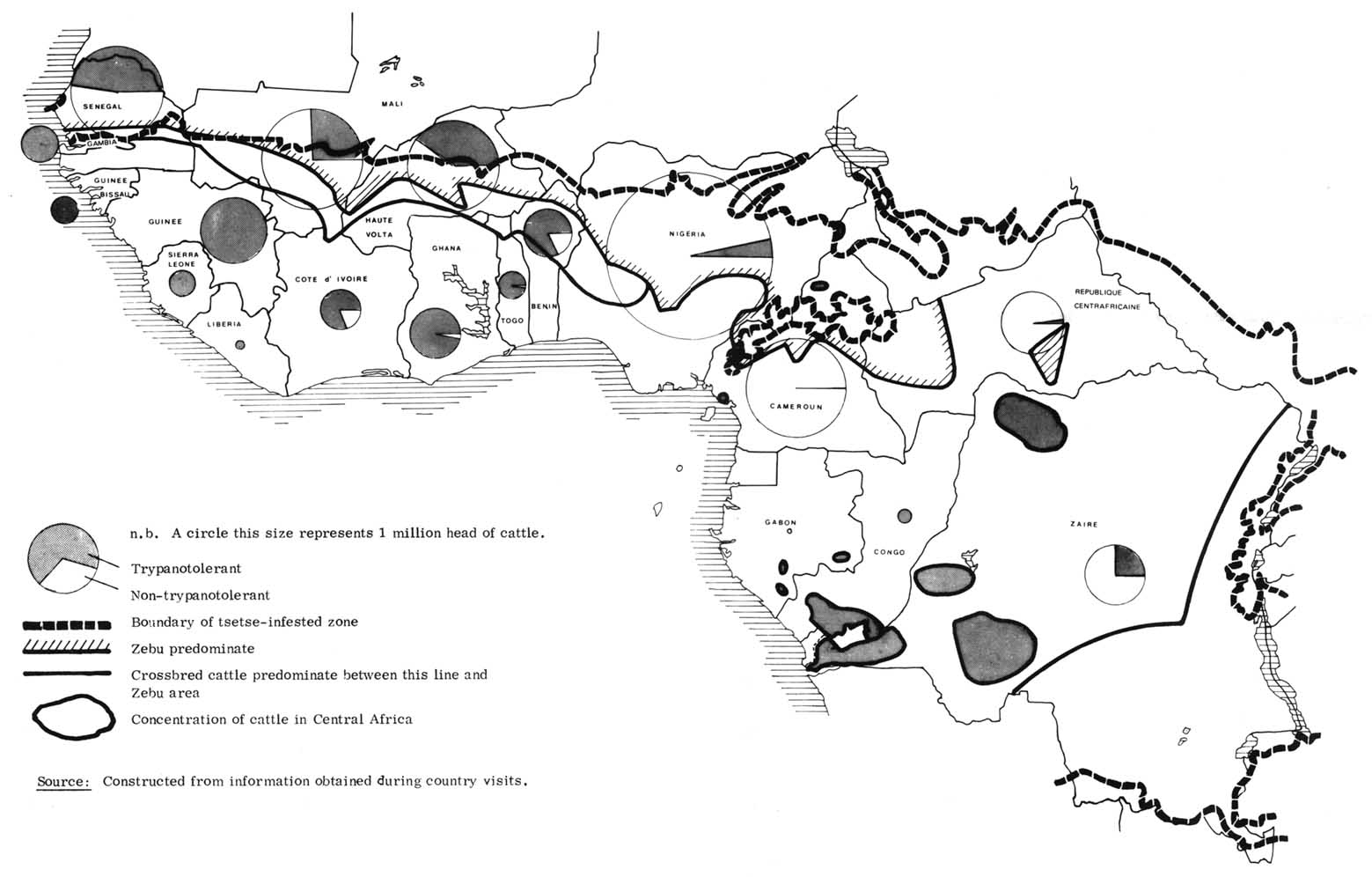
Parts of some countries have not been included where virtually no indigenous or introduced trypanotolerant livestock are found. Either they are outside the tsetse belt - such as the northern areas of Senegal, Mali, Upper Volta and Nigeria - or they are practically tsetse free from a livestock breeding point of view, such as parts of the Adamawa Plateau in Cameroon or the highlands of eastern Zaire, where only non-trypanotolerant cattle breeds are found and where trypanosomiasis is non-existent or is a marginal problem. The distribution of cattle breeds was a stronger factor in making decisions about areas to be included in this study than the distribution of small ruminant breeds, since, for the latter, transition zones between trypanotolerant and non-trypanotolerant breeds are more widely extended and less clear. The Zebu limit illustrated in Figure 2.3 approximately delineates the study area, while the individual country maps in Volume 2 indicate the precise limits.
The study zone lies approximately between latitude 14°N and 8°S and between longitude 17°W and 28°E, covering a total area of 4673000 km or about 60% of the total area of 7894000 km2 represented by the 18 countries. This chapter gives a brief overall description of the study area and its livestock; more detailed information on individual countries and livestock types is presented in Volume 2.
2.1.1 Relief and hydrography
2.1.2 Climate and vegetation
2.1.3 Tsetse distribution
Most of the countries belong to the great inland basins which correspond to depressed sections of the ancient African platform, with an altitude of less than 500 m (Jeune Afrique, 1973). A few massifs rise between the coastal regions and the basins of the Niger, Western Congo (Zaire) and Lake Chad. The small highland areas are the Fouta Djallon highlands (average altitude 1000, maximum altitude 1537 m), the Guinea Dorsal (a.a. 800 m, m.a. 1752 m), the Togolese Mountains (a.a. 600 m, m.a. 920 m), the Jos Plateau in Nigeria (a.a. 800 m, m.a. 1690 m), the Adamawa Mountains in Cameroon and Central African Republic (a. a. 900 m, m. a. 3008 m) and the Crystal Mountains in Gabon (a.a. 600 m, m.a. 1000 m). Most of these elevated areas, along with the eastern Zaire highlands lying around the Congo (Zaire) basin, have affected the distribution of tsetse and trypanotolerant livestock breeds. The basins are characterized by a dense network of temporary and permanent rivers; they are generally covered by dense rain forest.
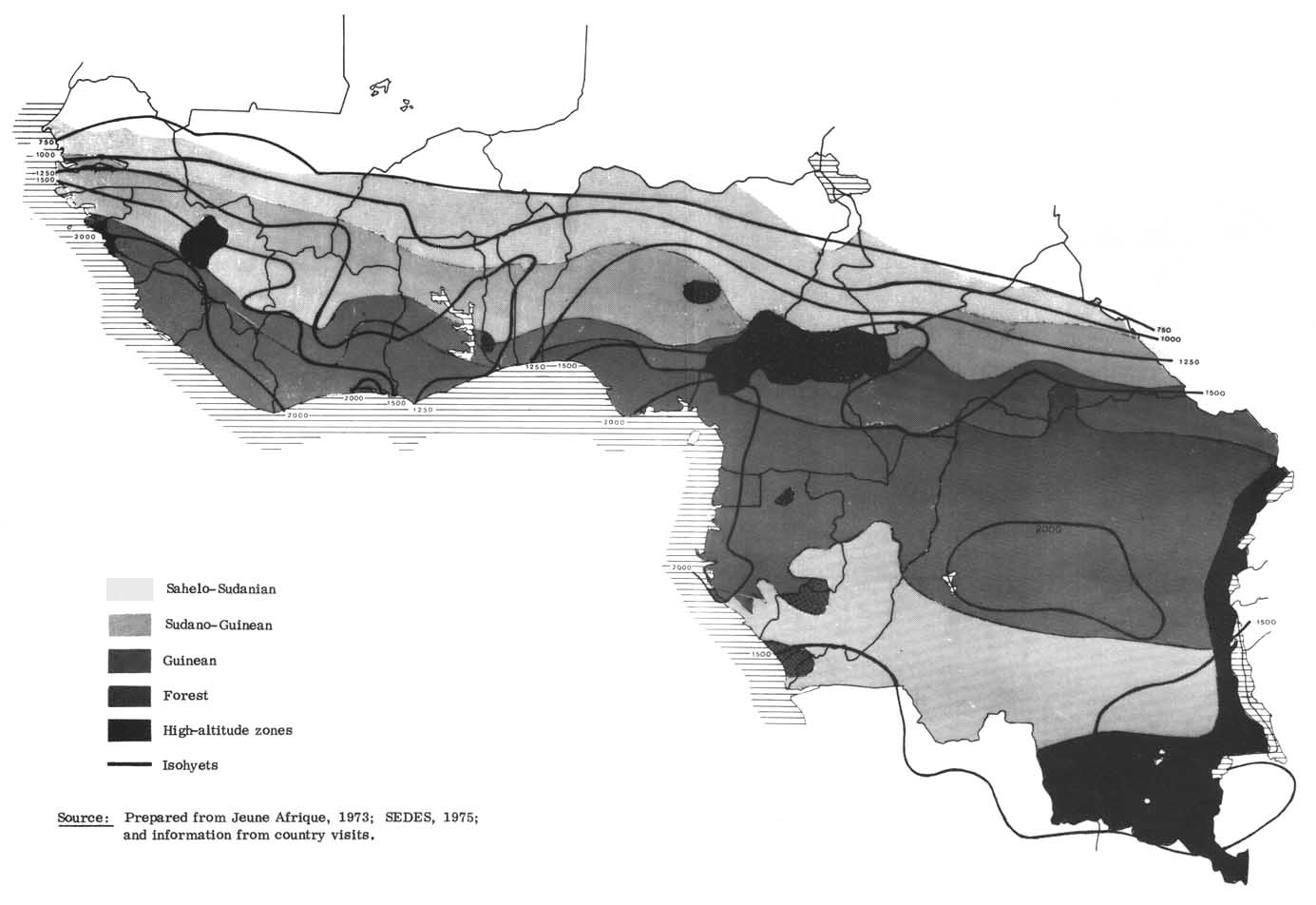
From a climatic point of view, the northern limit of the area under study can be considered the 750 mm isohyet. Above this isohyet is the dry Sahelian zone. Between the 750 and 1500 mm isohyets a transition climate is found which can be divided in terms of rainfall and vegetation into a Sahelo-Sudanian zone up to approximately 1250 mm and a Sudano-Guinean zone from 1250 to 1500 mm. Over 1500 mm, the humid tropical climate can he subdivided, mainly in terms of vegetation, into the Guinean savanna and the forest.
These ecological zones reflect not only total annual rainfall, but also rainfall distribution. The Sudanian zone is characterized by a single rainy season and an extended dry season, with the result that forested areas are limited to riverine galleries. The Guinean zone north of the Equator has two rainy seasons, with a principal dry season around February and a shorter dry period in August. These seasons are reversed south of the Equator. The extent of forested areas depends on rainfall, as well as edaphic factors and human activities.
Figure 2.1 indicates the five ecological zones and the main isohyet curves (750, 1000, 1250, 1500 and 2000). It also shows the high-altitude zones with their accompanying climatic variations which influence the distribution of tsetse and trypanotolerant livestock.
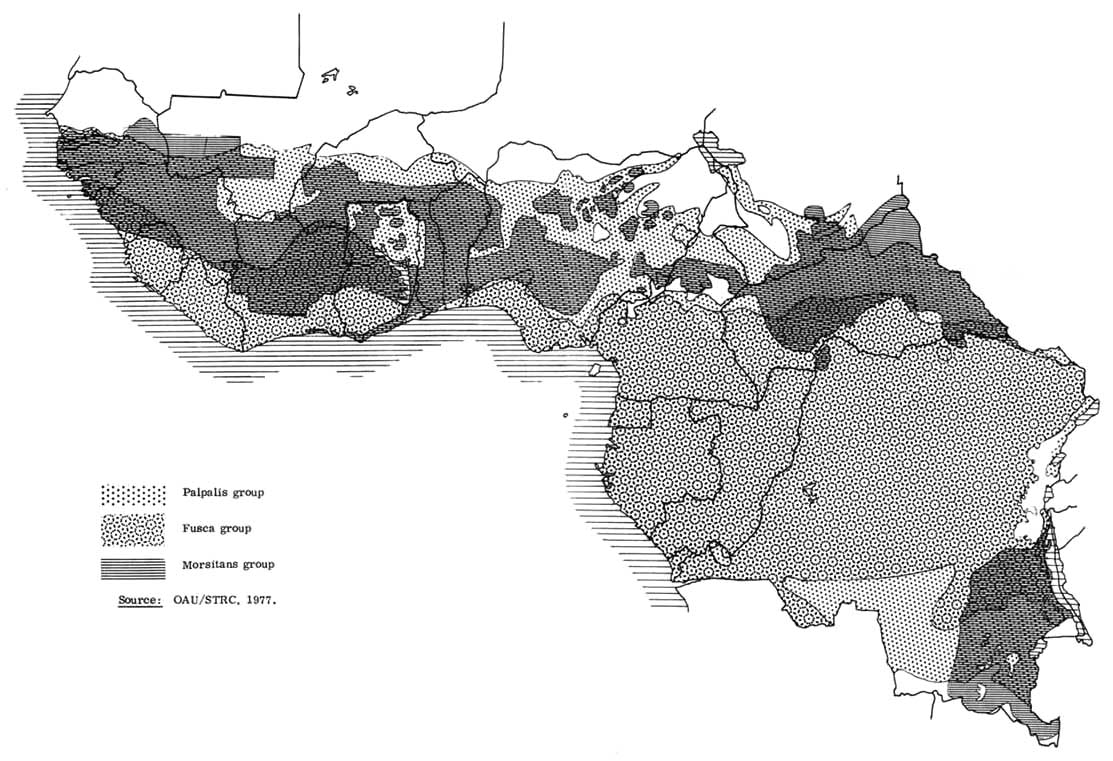
Tsetse distribution is closely related to relief, hydrography, climate and vegetation. Most of the region is tsetse infested, with trypanosomiasis acting as one of the major constraints on livestock production. Figure 2.2 presents the distribution of the three tsetse groups (morsitans, fusca, palpalis) according to a map prepared for OAU/STRC (1977). This map will serve as the basic reference document for the tsetse-infested zones throughout the study. In the country studies, whenever a more recent survey or additional data are available they are presented and discussed in relation to the OAU/STRC map.
Figure 2.2. Distribution of tsetse flies.
2.2.1 Human population
2.2.2 Cattle population
2.2.3 Sheep and goat population
The most recent and reliable statistics on total area, human populations and livestock populations and densities are presented in Table 2.1 for each country included in the study. In this table, separate figures are given for the area under study if it is not the whole country and a distinction is made within cattle populations between total and trypanotolerant numbers. By trypanotolerant cattle are meant N'Dama, West African Shorthorn and their crossbreeds with Zebus, and by trypanotolerant sheep and goats are meant the small Djallonké or Guinean breeds. In the density columns, the figures in brackets indicate each country' s ranking from high to low.
Table 2.1 Human and livestock numbers and densities.
The total human population in the 18 countries is about 165 million, which represents 40% of the total African population living in a region covering 26% of the continent (average density of 20.9 inhabitants/km2 versus 13.6 for the whole of Africa). In the study area, the human population density is higher still (23.3 inhabitants/km2), indicating that this region is particularly heavily populated and emphasizing the importance of meat production to meet human nutritional needs. Human population density in the study area ranges from 95.6 inhabitants/km2 in Nigeria to 2 inhabitants/km2 in Gabon.
The country with the largest number of trypanotolerant cattle is Guinea and the one with the smallest number is Gabon. In terms of cattle densities, the smallest country, The Gambia, has the highest concentration of 26.2 head/km2.
Figure 2.3 shows the total cattle population and the proportion of trypanotolerant cattle in each country. This map indicates the northern limit of tsetse distribution (from OAU/STRC, 1977) without distinguishing between the tsetse species. It also shows the zones with a preponderance of Zebu; humpless or crossbred cattle, based on observations in the field. These zones are only indicative, but clearly show that the Zebu zone extends far below the northern limit of tsetse infestation. This situation is also illustrated in Table 2.1. The total cattle population in the study area is estimated at 13. 9 million head, with only 7. 6 million (i. e. 55%) considered trypanotolerant. Deducting the Cameroon and part of the Central African Republic populations, which are almost entirely pure Zebu under negligible tsetse challenge (see country studies in Volume 2), about 73% of the remaining cattle populations is trypanotolerant. The other 27% consists of Zebu, transhuming into the study area, kept in small tsetse-free pockets or maintained under chemoprophylaxis and careful management.
Figure 2.3. Total and trypanotolerant cattle populations.
Few reliable statistics on small ruminants are available. It is difficult to find even approximate numbers for sheep and goats populations treated separately, and in some countries even estimates for all small ruminants are not available. Consequently, the distinction between trypanotolerant and non-trypanotolerant sheep and goats is based on estimates made during the field visits. Nigeria seems to have the larger number of trypanotolerant sheep and goats and Gabon the smallest. Nigeria also has the densest sheep and goats populations, while the least dense populations are found in Congo and Gabon.
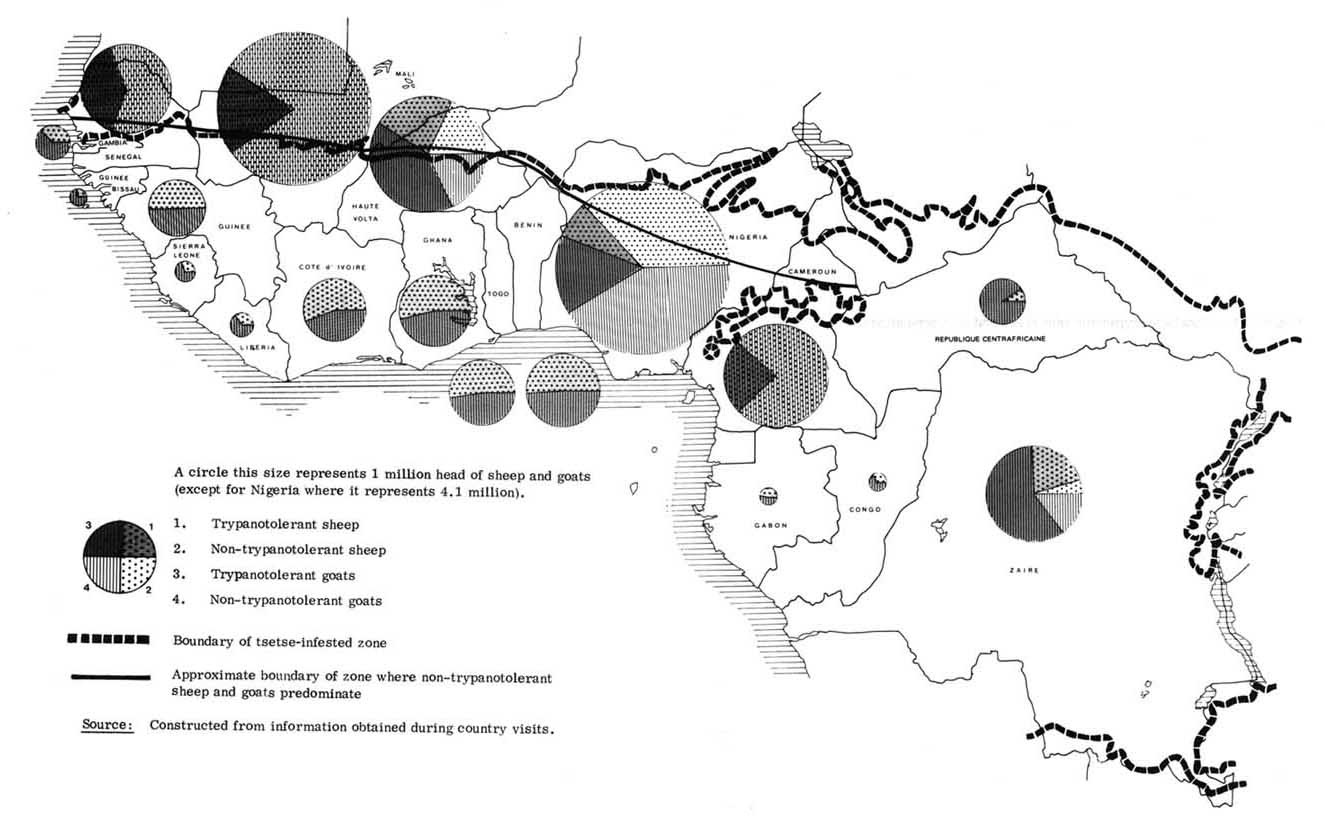
Figure 2.4 shows the total small-ruminant population in each country, and indicates the ratio of sheep to goats, if this is known, and the proportion of trypanotolerant animals. The northern limit of tsetse distribution is repeated on this map and a tentative northern limit for trypanotolerant sheep and goats has been included. Trypanotolerant small ruminants tend to be kept further north than trypanotolerant cattle.
2.3.1 Cattle groups
2.3.2 Cattle numbers
2.3.3 Cattle distribution
2.3.4 Sheep and goat groups
2.3.5 Sheep and goat numbers and distribution
Following the general classification of Mason (1951) based on the hump, three groups of cattle can be distinguished in West and Central Africa: the humpless (or taurine), the humped (or Zebu) and crosses between the two groups. The humped cattle are generally considered susceptible to trypanosomiasis and for this reason are not included in this study. They are briefly mentioned when they are found in the study area, but no detailed information is provided. In addition, the humpless group includes the giant-horned Kuri cattle of Lake Chad who live outside the tsetse area and consequently are not considered.
Trypanotolerant cattle can be divided into two main groups, the N'Dama (with long horns) and the West African Shorthorns. The latter group can be subdivided in terms of overall size into Dwarf Shorthorn and Savanna Shorthorn. Among the humped x humpless crosses, a distinction can be made between crosses of West African Zebu with N'Dama and crosses of Zebu with West African Shorthorn. Different breeds can be found in each of these categories. The general classification of the different breeds or types under each heading is presented in Table 2.2. Additional names for each breed are also noted with the countries where they are used. Some breeds mentioned in past literature could not be found during the field visits and these not given in the Table but are discussed in Volume 2.
Table 2.2. Classification of trypanotolerant cattle.
|
Group |
Breed |
Varieties or Local Synonyms |
Relevant Figures |
|
N'DAMA |
N'Dama |
Boenca, N'Gabou (Guinea Bissau), Gambian cattle (The Gambia), N'Dama Petite and N'Dama Grande (Senegal) |
3.1. - 3.26 |
|
WEST AFRICAN SHORTHORN = MUTURU (=PAGAN) | |||
|
- Dwarf West African Shorthorn | |||
|
|
Lagune |
Lagunaire (Benin, Togo), Lagoon cattle (Ghana), Dahomey (Zaire) |
3.27- 3.32 |
|
|
Forest Muturu |
Nigerian Dwarf Shorthorn |
|
|
|
Liberian Dwarf |
|
|
|
- Savanna West African Shorthorn | |||
|
|
Baoulé |
Lobi |
3.33, 3.36, 3.37, 3.46, 3.48 |
|
|
Ghana Shorthorn |
Gold Coast Shorthorn |
3.45, 3.47 |
|
|
Somba |
Atacora (Benin), Mango (Togo) |
3.34, 3.44 |
|
|
Savanna Muturu |
|
3.35, 3.39, 3.40 |
|
|
Doayo |
Namshi, Namji, Poli |
3.42 |
|
|
Bakosi |
Bakwiri, Kozi |
3.43 |
|
|
Kapsiki |
Kirdi |
3.41 |
|
ZEBU X HUMPLESS = MERE | |||
|
- West African Zebu x N'Dama | |||
|
|
Djakoré |
Race du Sine |
3.49, 3.53, 3.54 |
|
|
Bambara |
|
3.55, 3.56 |
|
- West African Zebu x West African Shorthorn | |||
|
|
Ghanaian Sanga |
|
3.57 |
|
|
Borgou |
|
3.50, 3.58 |
|
|
Keteku |
|
3.51 - 3.59 |
Source: Compiled by authors.
Figure 2.4. Total and trypanotolerant sheep and goat populations.
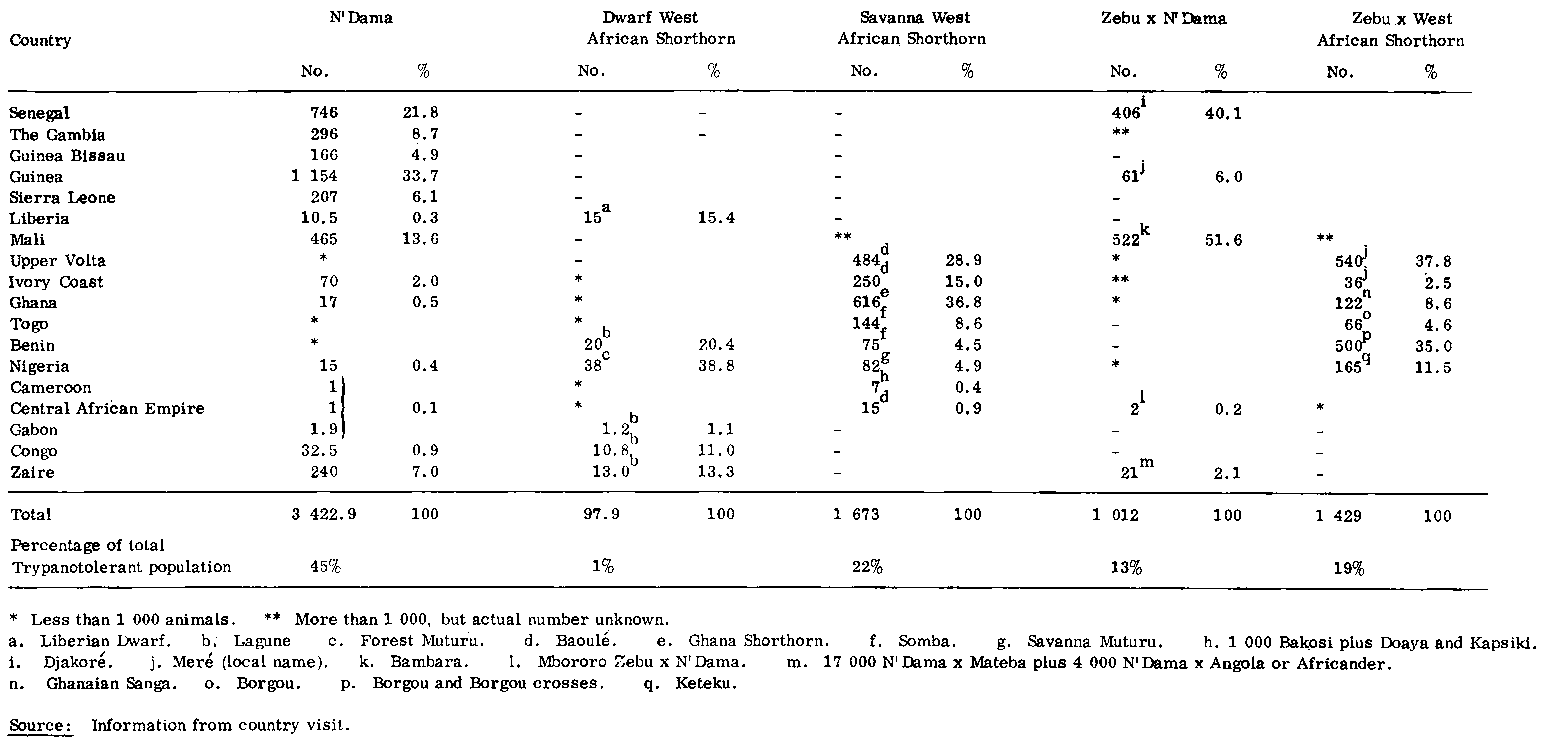
Table 2.3 indicates for individual countries the numbers of animals and percentages of the national cattle population accounted for by each trypanotolerant group. Most of these data are constructed from official statistics collected on field visits.
Table 2.3. Cattle numbers by classification group and country (' 000).
The N'Dama is the largest group, with 3.4 million head or 45% of all trypanotolerant cattle in West and Central Africa. The West African Shorthorn is next in importance, with 1.7 million Savanna type and 0.1 million Dwarf type, or 23% of all trypanotolerant cattle. The Dwarf Shorthorn is the smallest of these groups and would appear to be in danger of extinction or absorption. Crossbreds make up the remainder, with 1.0 million Zebu x N'Dama and 1.4 million Zebu x Shorthorn, representing 13% and 19% of all trypanotolerant cattle respectively, plus a small number of N'Dama x Shorthorn crosses.
Figure 2.5 indicates the zones in which each of the five cattle types predominates. A further distinction can be made between indigenous and imported animals. In the Central African countries included in the study, cattle breeding was unknown until the beginning of this century. Trypanotolerant cattle were first introduced around this time, first into Zaire and later into Congo, Gabon and Central African Republic.
Woolless thin-tailed sheep in West Africa can be roughly divided into a Sahelian type and a tropical Forest or Savanna type. The Sahelian type is typically tall, more than 60 cm at withers, while the typical Forest or Savanna type does not exceed 60 cm and may fall considerably short of this, warranting the term 'dwarf' (Epstein, 1971). The only sheep breed recognized as trypanotolerant is the small West African sheep called Djallonké or Fouta Djallon sheep or Southern sheep or Guinean (see Figures 3.70, 3.71, 3.73). It is found over the whole of West Africa south of the 14th parallel, and is the only breed of sheep in the coastal areas. Mason (1951) notes that, within such a wide geographic range, there are undoubtedly considerable variations of type, but there has been no successful attempt to subdivide them systematically. In this report, however, the trypanotolerant sheep have been divided into a larger Savanna type (mainly in the north) and a smaller Dwarf Forest type. In the northern part of the study area, some crosses between the trypanotolerant sheep and the Sahelian breeds (mainly Maure, Tuareg and Fulani) can be found (see Figure 3.77).
Figure 2.5. Distribution of trypanotolerant cattle groups.
Goats within the study area vary in size from the Dwarf variety at the coast to the large animals kept in the semi-desert areas (Mason, 1951). 'Like the sheep, they are somewhat arbitrarily divided in this report into a large breed north of the 14th parallel and a small breed south of it. The Dwarf goat, also called Fouta Djallon goat or Guinean Dwarf or Southern goat, corresponds very closely in name, size and distribution to the Dwarf sheep (see Figures 3.78 - 3. 85). It is smaller in the south (the true dwarf) and larger in the north of its range (Mason, 1951). Great variability also exists within the breed, and different types are described in the country reports in Volume 2. In the northern part of the study zone there are some crosses between the Dwarf goat and the Sahelian breeds (Maure, Tuareg and Fulani).
Total sheep and goat numbers and numbers of trypanotolerant sheep and goats were presented in Table 2.1. The information available does not allow subdivision of the West African sheep and goats into specific groups, as was possible with cattle, so they cannot be classified in any greater detail. Similarly, it is not possible to draw exact boundaries between the Dwarf, the Savanna, the crosses and the Sahel types. An attempt to estimate the northern limit of the distribution of trypanotolerant sheep and goats is presented in Figure 2.4.
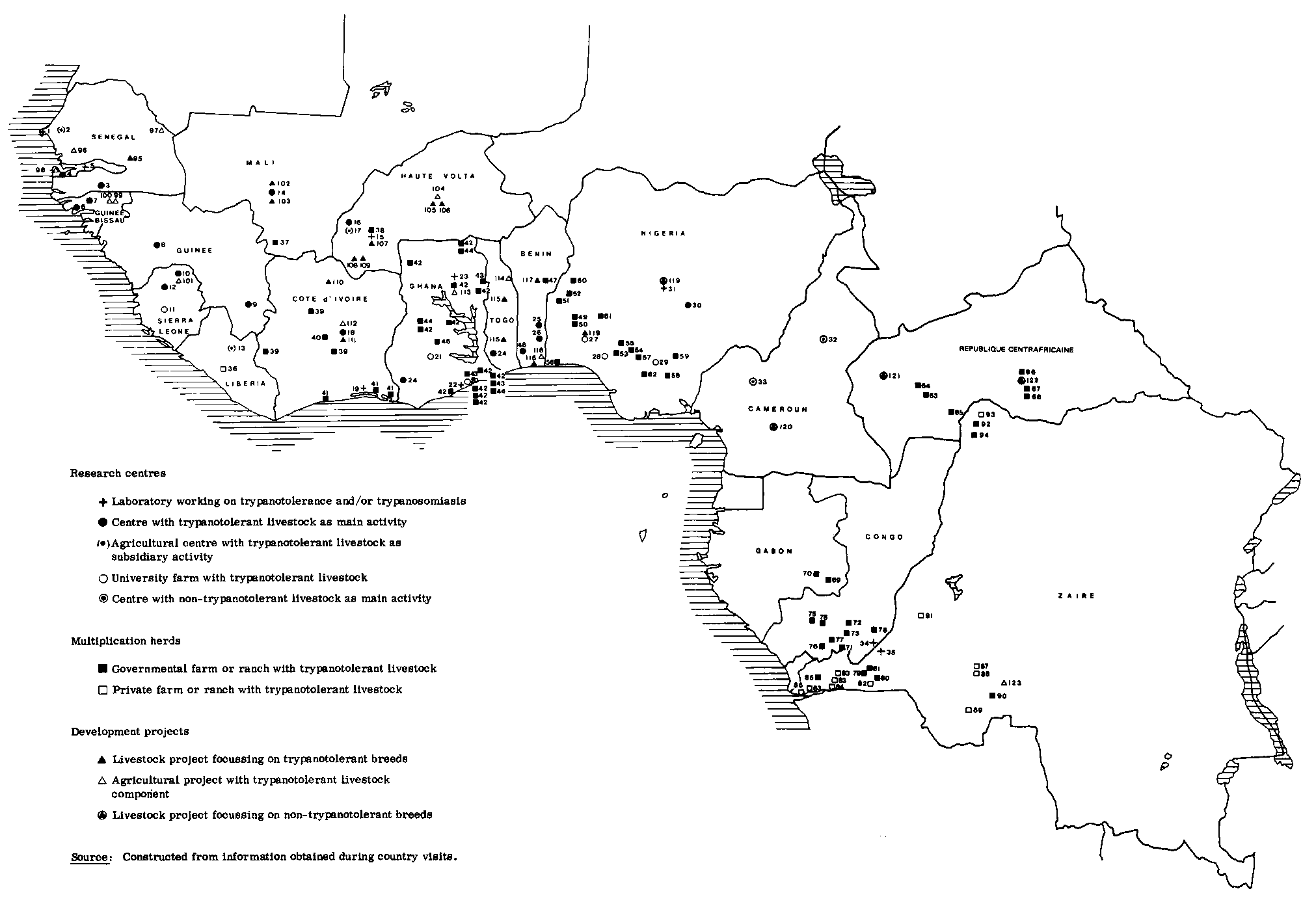
A list of all activities in research, multiplication and development is presented for each country in Volume 2, covering livestock in the study area, and more precisely concerned with or closely related to trypanotolerance and trypanotolerant livestock. The research centres listed in this volume are those which are important at the national level and which are working or could easily work with trypanotolerant livestock. Different symbols are used to distinguish laboratories working on trypanotolerance and/or trypanosomiasis, university farms with trypanotolerant livestock, and centres or stations whose' main activity is trypanotolerant livestock, those with a more general scope (agricultural research centres) with trypanotolerant livestock as a subsidiary activity, and those located in the study area but focussing on non-trypanotolerant livestock.
The multiplication activities described here are also those which are important at the national or regional level and which involve trypanotolerant livestock. A distinction is made between government and private commercial herds.
The same selection criteria were used in considering development projects. Only those currently in progress are mentioned here, but development projects planned for the near future with apparently good chances of implementation are mentioned in the country reports. A distinction is made between integrated development projects with a livestock component and livestock development projects per se.
Figure 2. 6 indicates the locations of research centres, multiplication herds and development project headquarters, using different symbols for each category. The number alongside each symbol refers to the information presented in Table 2.4. This table lists under each country the name and the location of all activities shown on the map. More detailed descriptions are found in Volume 2. These activities are listed in numerical order from west to east under their respective countries. Research centres are listed from 1 to 35, multiplication herds from 36 to 94 and development projects from 95 to 123.
Figure 2.6. Location of research centres, multiplication herds and development projects.
Figure 2. 6 and Table 2.4 indicate that research centres are more numerous in West than in Central Africa. The two major research centres working with trypanotolerant livestock are the Centre de Recherche sur les Trypanosomiases Animales in Bobo-Dioulasso, Upper Volta and the Centre d'Elevage et de Recherche sur la Trypanosomiase et la Trypanotolérance in Avetonou, Togo. Similarly, development projects which cover some aspect of trypanotolerant livestock commonly the improvement of veterinary services and the selection and multiplication of breeding stock, are more numerous in West African countries. In the case of multiplication herds, the picture is rather different, as many more exist in Central African countries than in West Africa. Overall, there appears to be considerable interest in establishing additional multiplication herds, both for livestock improvement within individual countries and for export.
Table 2.4. Research, multiplication herd and development activities.
|
Country |
- Research Centres |
- Multiplication Herds - |
- Development Projects (HQ) |
|||
|
No. & symbol |
Name |
No. & symbol |
Name |
No. & symbol |
Name |
|
|
Senegal |
1+ |
Laboratoire National de l'Elevage et de Recherches Vétérinaires de Dakar-Hann |
|
|
95 |
Projet de Développement de l'Elevage au Senegal Oriental (Tambacounda) |
|
2 |
Centre National de Recherches Agronomiques de Bambey |
|
|
96 |
Projet de Développement de l'Agriculture au Siné Saloum (Kaolack) |
|
|
3 |
Centre de Recherches Zootechniques de Kolda |
|
|
97 |
Amélioration de l'Elevage et des Pâturages dans le Département de Bakel (Bakel) |
|
|
The Gambia |
4 |
Yundum Experimental Station |
|
|
98 |
Rural Development Project (Banjul) |
|
5 + |
Trypanosomiasis Research in The Gambia (Keneba) |
|
|
|
|
|
|
Guinea Bissau |
6 |
Bissau Station |
|
|
99 |
Integrated Development Project - Rice and Cotton (Bafata) |
|
7 |
Bissora Station |
|
|
100 |
Development Project-Groundnuts (Bafata) |
|
|
Guinea |
8 |
Ferme d'Etat de Ditinn (Dalaba) |
|
|
|
|
|
9 |
Ferme d'Etat de Famoyla (Beyla) |
|
|
|
|
|
|
Sierra Leone |
10 |
Musaia Stock Farm (Kabala) |
|
|
101 |
Koinadugu Integrated Agricultural Development Project (Kabala) |
|
11 |
Njala University College (Moyamba) |
|
|
|
|
|
|
12 |
Teko Station (near Makeni) |
|
|
|
|
|
|
Liberia |
13 |
Central Agricultural Experimental Station of Suakoko (Gbarnga) |
36 |
Liberian Agricultural Company (near Buchanan) |
|
|
|
Mali |
14 |
Centre National de Recherches Zootechniques de Sotuba (Bamako) |
37 |
Operation N'Dama Yanfolila |
102 |
Mali Livestock I et II (Bamako) |
|
|
|
|
|
103 |
Développement de l'Elevage dans le Sud du Mali (Bamako) |
|
|
Upper Volta |
15 + |
Centre de Recherche sur les Trypanosomiases Animales (Bobo-Dioulasso). Also the headquarters of the Ecole de Lutte Anti-Tsétsé and of the Office Central de Controle des Grandes Epizooties, the Muraz Centre and a mission of the Office de la Recherche Scientifique et Technique Outre-Mer (Bobo-Dioulasso) |
38 |
Centre de Formation de Matourkou (near Bobo-Dioulasso) |
104 |
Aménagement des Vallées des Voltas (Ouagadougou) |
|
16 |
Station de Samandeni (near Bobo-Dioulasso) |
|
|
105 |
Assistance a la Culture Attelée (Ouagadougou) |
|
|
17 |
Station de Farako-Ba (near Bobo-Dioulasso) |
|
|
106 |
Elevage Villageois (Ouagadougou) |
|
|
|
|
|
|
107 |
Projet de Développement de l'Elevage en Ouest-Volta (Bobo-Dioulasso) |
|
|
|
|
|
|
108 |
Feedlot de Banfora (Banfora) |
|
|
|
|
|
|
109 |
Amelioration de l'Elevage traditionnel dans l'ORD de Banfora (Banfora) |
|
|
Ivory Coast |
18 |
Centre de Recherches Zootechniques de Minankro (Bouaké) |
39 |
Ranches of the Société do Développement de la Production
Animale |
110 |
Operation d'Encadrement de l'Elevage Sédentaire en Nord Côte d'Ivoire. (SODEPRA Nord) (Korhogo) |
|
19 + |
Laboratoire de Pathologie Animale de Bingerville (near Abidjan) |
40 |
Centre National Ovin (Béoumi) |
111 |
Projet de Promotion des Fermes d'Elevage on Région Centre (SODEPRA-Centre) (Bouaké) |
|
|
|
|
41 |
Programme de Développement Bovin de la Société de Développement du Palmier à Huile - 3 main plantations (Littoral) |
112 |
Encadrement de la Culture Attelée dans la Zone Cottonière (Compagnie Ivoirienne des Textiles) (Bouaké) |
|
|
Ghana |
20 |
University of Ghana |
42 |
Animal Husbandry Stock Farms (12) |
113 |
Ghanaian-German Fertilizing (Tamale) |
|
21 |
University of Kumasi |
43 |
State Farms (3) |
|
|
|
|
22 + |
Achimota Animal Research Institute (near Accra) |
44 |
Ghana Livestock Company - 3 ranches |
|
|
|
|
23 + |
Laboratory of Pong Tamale (Tamale) |
45 |
Shai HiIls Ranch (Greater Accra Region) |
|
|
|
|
|
|
46 |
Sheep and Goat Production Development Project - Ejura Farm (Ashanti Region) |
|
|
|
|
Togo |
24 |
Centre d'Elevage et de Recherche sur la Trypanosomiase et la Trypanotolérance (Avetonou) |
|
|
114 |
'Togo-Nord' Programme d'Aménagement du Nord Togo (Lame Kara) |
|
|
|
|
|
115 |
Développement de l'Elevage Bovin par la Culture Attelée (Sokodé-Atakpamé) |
|
|
Benin |
25 |
Station de M'Bétécoucou |
47 |
Centre d'Elevage de l'Okpara (near Parakou) |
116 |
Amélioration et Développement de la Production Animale (Cotonou) |
|
26 |
Station de Samiondji |
48 |
Ferme de Kpinnou |
117 |
Projet de Développement de l'Elevage dans le Sud Borgou (Parakou) |
|
|
|
|
|
|
118 |
Société do Développement du Palmier a Huile - 21 cooperatives (Southern Region, Porto-Novo) |
|
|
Nigeria |
27 |
University of Ibadan - University Farm |
49 |
Upper Ogun Ranch (Oyo State) |
119 |
Livestock Development Project Unit (Kaduna) |
|
28 |
University of Ife - University Farm |
50 |
Fashola Stock Farm (Oyo State) |
119 |
Western Livestock Company (Ibadan) |
|
|
29 |
University of Nsukka - University Farm |
51 |
Shaki Livestock Station (Oyo State) |
|
|
|
|
30 |
Nigerian Institute of Trypanosomiasis Research Sub-Station (Vom, Plateau State) |
52 |
Ogboro Station (Oyo State) |
|
|
|
|
31 + |
Tsetse and Trypanosomiasis Division, Federal Livestock Department (Kaduna) |
53 |
Ado-Ekiti Livestock Investigation Centre (Ondo State) |
|
|
|
|
|
|
54 |
Akunu Cattle Ranch (Ondo State) |
|
|
|
|
|
|
55 |
Oke-Ako Cattle Ranch (Ondo State) |
|
|
|
|
|
|
56 |
Pota Cattle Ranch (Lagos State) |
|
|
|
|
|
|
57 |
Igarra Cattle Ranch (Bender State) |
|
|
|
|
|
|
58 |
Ezillo-Nkalagu State Farm (Anambra State) |
|
|
|
|
|
|
59 |
Raav-Livestock Investigation and Breeding Centre (Benue State) |
|
|
|
|
|
|
60 |
Kaiama Livestock Station (Kwara State) |
|
|
|
|
|
|
61 |
Shao Livestock Station (Kwara State) |
|
|
|
|
|
|
62 |
Ubiadja Goat Farm (Bender State) |
|
|
|
|
Cameroon |
32 |
Station de Wakwa (Ngaoundere) |
|
|
120 |
Société de Développement des Productions Animales (Yaoundé) |
|
33 |
Station de Bambui (Bamenda) |
|
|
|
|
|
|
Central African Republic |
|
|
63 |
Station de Bossembélé(Préfecture d'Ombella, Mpoko) |
121 |
Renforcement des Services de Santé Animale dans la Zone Occidentale (Bouar) |
|
|
|
64 |
Station de Doumie (Préfecture d'Ombella, Mpoko) |
122 |
Assainissement et Aménagement d'une Zone d'Elevage dans la Région de Bambari (Bambari) |
|
|
|
|
65 |
Ranch de Boali (Préfecture d'Ombella, Mpoko) |
|
|
|
|
|
|
66 |
Station de Bambari (Préfecture de la Ouaka) |
|
|
|
|
|
|
67 |
Station de Bokolobo (Préfecture de la Ouaka) |
|
|
|
|
|
|
66 |
Station de Tambia (Préfecture de la Basse, Kotho) |
|
|
|
|
Gabon |
|
|
69 |
Ranch de Franceville (Region du Haut Ogooue) |
|
|
|
|
|
70 |
Ranch d'Okouma (near Moanda) |
|
|
|
|
Congo |
34+ |
Laboratoire Vétérinaire de Brazzaville |
71 |
Ferme de Mpassa (near Minduli) |
|
|
|
|
|
72 |
Ferme de l'APN (near Kindamba) |
|
|
|
|
|
|
73 |
Ranch de la Louila (near Minduli) |
|
|
|
|
|
|
74 |
Ranch de la Louamba (near Kayie) |
|
|
|
|
|
|
75 |
Ranch de la Louboulou (region de la Bouenza) |
|
|
|
|
|
|
76 |
Office du Ranch de la Dihesse (Loudima) |
|
|
|
|
|
|
77 |
Ranch de Massangui (near Mouyounzi) |
|
|
|
|
|
|
78 |
Ferme ovine d'Odziba (Region du Pool) |
|
|
|
|
Zaire |
35 + |
Laboratoire Vétérinaire de Kinshasa |
79 |
Groupement d'Economie Rurale (M'Banza - Ngungu, Bas-Zaire) |
123 |
Progrès Populaire d'ldiofa (Idiofa, Bandundu) |
|
|
|
80 |
Station de Mvuazi (Bas-Zaire) |
|
|
|
|
|
|
81 |
Ranch d'lnkisi (Bas-Zaire) |
|
|
|
|
|
|
82 |
Ranch de Kolo (Bas-Zaire) |
|
|
|
|
|
|
83 |
Ranches de Mateba (3) (Bas-Zaire) |
|
|
|
|
|
|
84 |
Ranches des Plantations et Elevage de Kitobola (Kitobola, Lovo, Bas-Zaire) |
|
|
|
|
|
|
85 |
Station de Gimbi (Sous-region du Bas-Fleuve, Bas-Zaire) |
|
|
|
|
|
|
86 |
Ranch de Donga Zola (Moanda) |
|
|
|
|
|
|
87 |
Elevage du Diocèse de Kikwit (Bandundu) |
|
|
|
|
|
|
88 |
Métayage du Bureau Diocésan de Développement (Kikwit, Bandundu) |
|
|
|
|
|
|
89 |
Elevage de la Kalombi (Feshi, Bandundu) |
|
|
|
|
|
|
90 |
Ranch de Gungu (Bandundu) |
|
|
|
|
|
|
91 |
Ranch de Ndjokélé (Mushie, Bandundu) |
|
|
|
|
|
|
92 |
Ranch de la Mpaka (near Gemena, Equateur) |
|
|
|
|
|
|
93 |
Ranch de la Lombo (near Gemena) |
|
|
|
|
|
|
94 |
Ranch de la Lola (near Gemena) |
|
|
|
Source: Compiled by authors.