5.1 Background
5.2 Productivity of trypanotolerant livestock relative to other groups in Africa
5.3 Evaluation of productivity and trypanosomiasis situation - a case study
5.4 Potential of trypanotolerant livestock
5.5 Further utilization of trypanotolerant livestock
5.6 Conservation of trypanotolerant livestock
The study area represents 15% of the total area of Africa, with 26% of the total human population, but only 9% of the cattle and 9% of the sheep and goat populations. There are 26 kg of livestock biomass (cattle, sheep and goats) per inhabitant in the study area, compared with 136 kg for the remainder of Africa south of the Sahara, and 79 kg for the continent as a whole. However, the study area has a very high potential in terms of animal feed availability. FAO (1974a) estimates the average potential carrying capacity of the study area in the 18 countries at 20 head of cattle/km2, compared to 3.4 head/km2 actually found.
Additionally, the Sahelian countries which at present export livestock to these humid and subhumid zones are unable to match anticipated increases in demand in these areas and will have to eater for their own population increases in the near future. Consequently, there is a major, expanding shortfall in meat and milk availability in the study area. International, bilateral and multilateral aid agencies are already responding to this problem. A study of the livestock development projects in West and Central Africa financed by the major aid agencies (ILCA, 1978d) shows that the funds for livestock development in the humid and subhumid zones have increased from US $ 27 million for the period 1961-1965 to US $ 150 million for 1971-1975. Furthermore, these zones received 70% of the total funds allocated to livestock projects in West and Central Africa in 1971-75, compared with only 25% in 1961-1965.
The increased utilization of trypanotolerant livestock could make a major contribution in this context. The results presented in Volume 2 of this report and the situation summarized in Chapters 2, 3 and 4 of Volume 1 show that it is biologically possible to maintain trypanotolerant cattle, sheep and goats in areas infested with trypanosomiasis and to establish cattle in areas where they have not previously been bred. Trypanotolerant livestock can undoubtedly attain varying degrees of productivity under medium or heavy trypanosomiasis risk conditions which preclude the maintenance of non-trypanotolerant types except possibly under continuous chemical prophylaxis.
Cattle productivity figures presented in Chapter 4 indicate that, even under only light trypanosomiasis risk conditions, trypanotolerant breeds can be as productive as the Trypanotolerant Zebu or crosses between the two. It now has to be determined how trypanotolerant breeds compare in general with non-trypanotolerant breeds throughout Africa, as their further utilization will greatly depend on their relative productivity. Possibilities for their expanded use in development projects also need close examination, and, finally, any requirements for conservation of breeds in danger of extinction or absorption must be carefully considered.
This chapter starts by reviewing the evidence on the productivity of trypanotolerant breeds and then comparing this with data for other breeds in Africa. In the case of cattle, the productivity of trypanotolerant breeds is first compared with that of other breeds in tsetse-free zones within the study area, then with that of other breeds in tsetse-free zones elsewhere in Africa. In the case of sheep and goats, the few production data available on trypanotolerant breeds are compared with other information available from tsetse-free zones outside the study area.
In virtually all the production situations examined, it was impossible to find sufficient information to allow precise evaluation of both animal productivity and the degree of trypanosomiasis risk. A case study will be presented in detail of the approach taken in the analysis of a situation in Benin where basic data on degree of trypanosomiasis risk and animal productivity are relatively complete.
Possibilities for further evaluation and research to fill the many gaps in knowledge that remain now have to be considered. It has to be demonstrated, for example, whether it is in fact economically more desirable to raise trypanotolerant cattle than to maintain larger non-trypanotolerant breeds under chemoprophylaxis. If so, it then remains to convince present breeders that a smaller animal may actually be a better economic proposition than a larger one, which may be difficult. In other areas, the demonstration of the biological and commercial success of the trypanotolerant breeds could open the way for their introduction into wide stretches of savanna which are at present almost empty of cattle. Therefore, recommendations and possible locations are presented for cooperative programmes to evaluate both the potential and further utilization of trypanotolerant livestock.
Finally, as the Dwarf West African Shorthorn appears to be nearly extinct in several countries and rapidly declining in others, concrete measures are suggested for conservation of some interesting breeds which are in danger of disappearing and for more efficient exploitation of others whose value has been demonstrated.
One major aim of this study was to make as much use as possible of all the general production information on trypanotolerant livestock available in West and
Central Africa. In the past, observations on the productivity of trypanotolerant livestock mostly concerned specific performance traits, such as reproductive performance, growth or mortality, measured in isolation. In addition, these observations were usually based on animals maintained under a medium or heavy trypanosomiasis risk. Information collected on non-trypanotolerant breeds was similarly limited.
Turning first to cattle, Table 5.1 summarizes from Chapter 4 the basic productivity data of the N'Dama and West African Shorthorn groups maintained under ranch and station management conditions and exposed to light trypanosomiasis risk. Direct comparisons with Zebu x humpless groups and with Zebu are also presented. Cow and calf weights of trypanotolerant animals are, as expected, significantly lower than those of either crossbred or Zebu. However, there are no indications that either the crossbred or the Zebu are significantly superior to the trypanotolerant breeds, either in terms of the basic index of productivity per unit weight of cow maintained per annum or of the individual components of this index except for body weights.
Table 5.1. Summary of comparative production traits of trypanotolerant, crossbred and Zebu cattle in the study zone.
|
|
Trypanotolerant cattle groups - absolute valuesa |
Crossbred relative to trypanotolerantb |
Zebu relative to trypanotolerantc |
||
|
Units |
% |
Units |
% |
||
|
Cow viability (%) |
98 |
-3 |
-3 |
-1 |
-1 |
|
Calving percentage |
80 |
-13 |
-22 |
-4 |
-5 |
|
Calf viability (%) |
92 |
-2 |
2 |
0 |
0 |
|
Calf weight at 1 year (kg) |
109 |
+10 |
+8 |
+53 |
+53 |
|
Cow weight (kg) |
219 |
+37 |
+18 |
+109 |
+52 |
|
Indexd/cow (kg) |
81.8 |
-8.7 |
-14 |
+42.2 |
+55 |
|
Indexd/100 kg cow (kg) |
37.1 |
-7.3 |
-25 |
+0.3 |
+1 |
a. Constructed from constants presented in Table 4.3 for N'Dama and Shorthorn groups under ranch or station conditions and light trypanosomiasis risk.b. Constructed from data presented in Table 4.5.
c. Constructed from data presented in Table 4. 6.
d. Total weight of one-year-old calf plus liveweight equivalent of milk produced per year.
Sources: Same as for Tables 4.3, 4.5 and 4. 6.
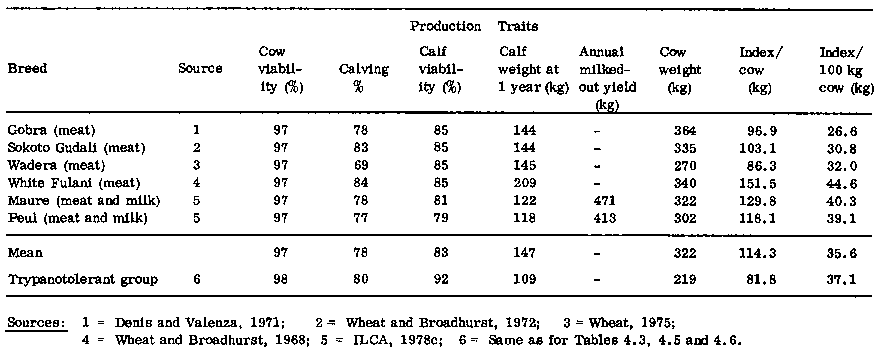
The most valuable comparisons between trypanotolerant and other livestock are those carried out in a single given environment, as summarized in Table 5.1. However, the collection and analysis of precise data of this kind take a long time and require substantial funding. For this reason, available data collected in isolation must also be fully utilized. Six situations are shown in Table 5.2 in which data are available on production traits of Zebu cattle in tsetse-free areas of the countries under study. These data were collected under a wide range of climatic, management and nutrition regimes. They show that the cow and calf weights and thus the productivity index per cow are significantly higher for the Zebu in tsetse-free areas of the study zone than for trypanotolerant animals in similar situations. However, the average Zebu index of productivity per unit weight of cow maintained per annum is not superior to the trypanotolerant group index.
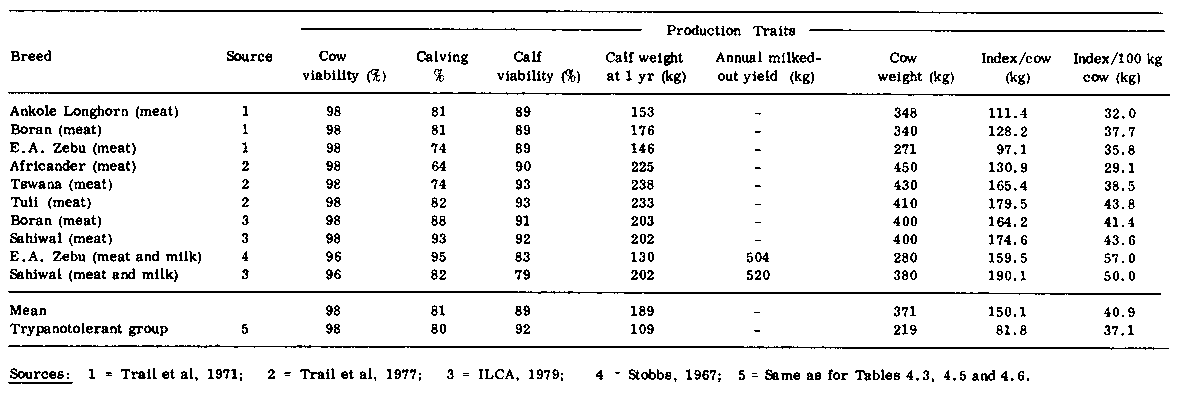
Table 5. 3 is based on another ten situations where data are available on production traits of Zebu and Sanga cattle in tsetse-free areas of Africa outside the study zone. Again, these data have been collected under a wide range of climatic, management and nutritional regimes. They indicate that the productivity of the Zebu and Sanga cattle surveyed is very similar to that of the trypanotolerant cattle groups maintained under low trypanosomiasis risk in the study zone.
The overall estimates of productivity for the 16 situations where Zebu or Sanga are kept under ranch or station conditions in the tsetse-free areas as described in Tables 5.2 and 5.3 are 136.6 kg of one-year-old calf plus liveweight equivalent of milk produced per cow maintained per year and 38.9 kg per 100 kg of cow maintained per year. Compared with the estimates of 81.8 kg and 37.1 kg under ranch or station conditions in low trypanosomiasis risk situations, the Zebu and Sanga estimates represent a 67% higher level of productivity per cow, but only a 5% higher level per 100 kg of cow maintained per annum.
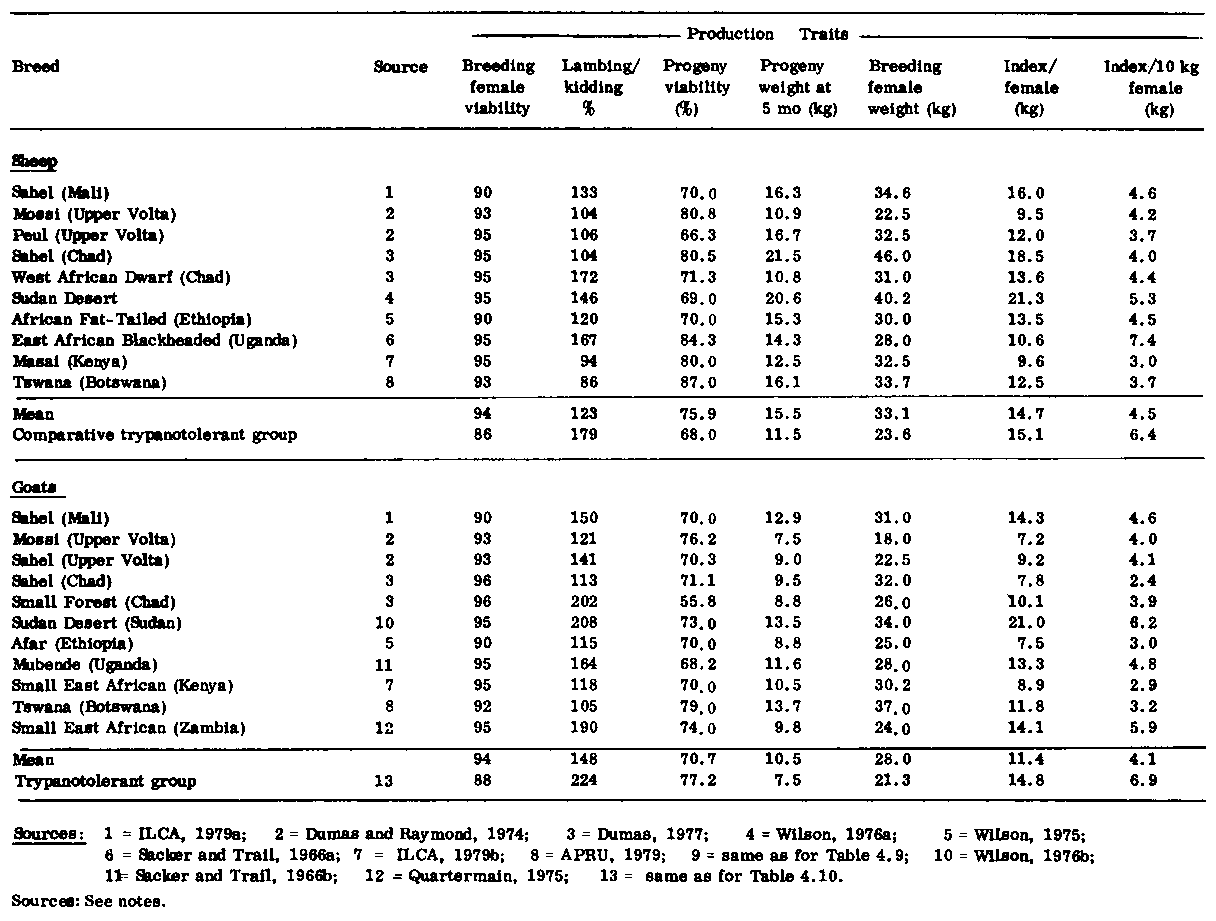
Turning to sheep and goats, Table 5.4 presents 21 situations where data are available on production traits of indigenous sheep and goats in tsetse-free areas of Africa outside the study zone. This table indicates wide ranges in the productivity of sheep and goats in Africa outside the study area and no evidence that trypanotolerant animals are generally less productive.
The results presented here indicate that the productivity of trypanotolerant cattle under low trypanosomiasis risk per unit weight of cow maintained is only 5% less than that of a wide range of indigenous Zebu and Sanga types in tsetse-free areas throughout Africa. This suggests, first, that the productivity of trypanotolerant cattle may be much higher relative to that of other indigenous types than previously assumed, second, that in certain circumstances plans for increased utilization of trypanotolerant cattle might well be immediately justified and, third, that there is a serious need for more accurate evaluation of productivity in relation to the degree of trypanosomiasis risk.
In the case of trypanotolerant sheep and goats, it is suggested that the productivity per unit weight of female maintained is at least as high as that of a range of other indigenous types kept in tsetse-free areas throughout Africa. Thus, as with cattle, increased utilization and more accurate evaluation of productivity would appear to be justified.
In virtually all the production situations examined, it was impossible to obtain sufficient information to allow a precise evaluation of animal productivity and the degree of trypanosomiasis present. During the country visits, however, a situation was identified in Benin where relatively complete basic data had been collected over a two-year period as part of an FAO project (BEN 72/015). A ease study has been made of this situation, using the data collected to illustrate an approach to analysing and evaluating productivity in relation to degree of trypanosomiasis present. The actual situation was not ideal and the available data were rather limited, though more complete than in other situations observed (Lazic, 1978).
A herd of Lagune cattle at Samiondji and a herd of Borgou at M'Betecoucou were maintained and basic production information recorded from January 1976 to December 1977. Lagune cattle, a Dwarf Shorthorn breed, are considered trypanotolerant, while the Borgou are a stabilized cross between the Somba (West African Shorthorn) and the White Fulani (West African Zebu). The two herds were situated 50 km apart, at an altitude of 80 - 100 m, in areas with an annual rainfall of 1200 mm occurring primarily from March to June and to a lesser extent from September to November. General management conditions were very similar. Various surveys have indicated that the Lagune herd was under a heavier tsetse challenge than the Borgou. The composition of the two herds is presented in Table 5.5 as of 31 December 1977. In order to assess the relative productivities of the animals, no preventative or curative treatment was carried out. Each month over the two-year period, the presence or absence of trypanosomes was determined by blood smears, and body weights were recorded for each animal. In addition, abortion, stillbirth and calving dates were noted.
Table 5.5. Lagune and Borgou herd composition on two research stations in southern Benin.
|
Class |
Number |
|
|
Lagune |
Borgou |
|
|
Mature males |
6 |
3 |
|
Mature females |
46 |
38 |
|
Heifers |
26 |
35 |
|
Young bulls |
7 |
6 |
|
Male calves |
11 |
15 |
|
Female calves |
14 |
14 |
|
Oxen |
2 |
- |
|
Total |
112 |
111 |
Source: Analysis of project information.
In analysing these situations, first the degree of trypanosomiasis present in each herd was determined, among both young and mature stock, as indicated by the monthly blood smears. Reproductive performance, viability and growth were then analysed separately from the calving, mortality and monthly weight records of individual animals. A composite picture of productivity was built up in this way, based on reproductive performance, cow and calf mortality, growth and mature cow weight and presented as weight of one-year-old calf produced per 100 kg cow maintained per year.
Table 5.6 indicates that over the two-year period 86.3% of the Borgou cows were diagnosed positive for trypanosomiasis at some time, compared to only 51% of the Lagune. The Borgou cows showed 11.5% positive animal/months, compared to only 4.2% for the Lagune.
Table 5.7 indicates that over the two-year period 18.2% of the Borgou calves were diagnosed positive for trypanosomiasis at some time compared with 9.5% of the Lagune, though this difference was not significant, probably due to the very small numbers involved. The Borgou showed 2.7% positive animal/months and the Lagune 1.4%, again not a significant difference.
Table 5.6. Degree of trypanosomiasis in mature Lagune and Borgou cows as indicated by monthly blood smears.
|
|
Lagune |
Borgou |
||||
|
1975 |
1976 |
Total |
1975 |
1976 |
Total |
|
|
Number of animals positive |
20 |
6 |
26 |
21 |
42 |
63 |
|
Total number of animals |
42 |
9 |
51 |
25 |
48 |
73 |
|
Percentage of animals positive |
47.6 |
66.6 |
51.0 |
84.0 |
87.5 |
86.3 |
|
Number of animal months positive |
34 |
13 |
47 |
61 |
120 |
181 |
|
Total number of animal months |
986 |
135 |
1121 |
567 |
1007 |
1574 |
|
Percentage of animal months positive 3.5 |
9.6 |
4.2 |
10.8 |
11.9 |
11.5 |
|
Source: Analysis of FAO project information.
The annual calving percentages, based on the number of calves born per cow year, are presented in Table 5.8. The Lagune had a calving percentage of 57.8%, significantly higher than the Borgou with 32.8%.
Table 5.7. Degree of trypanosomiasis in Lagune and Borgou calves to one year as indicated by monthly blood smears.
|
|
Lagune |
Borgou |
|
Number of animals positive |
4 |
10 |
|
Total number of animals |
42 |
55 |
|
Percentage of animals positive |
9.5 |
18.2 |
|
Number of animal months positive |
4 |
11 |
|
Total number of animal months |
283 |
410 |
|
Percentage of animal months positive |
1.4 |
2.7 |
Source: Analysis of FAO project information.
Table 5.8. Annual calving percentage for Lagune and Borgou cows.
|
|
Lagune |
Borgou |
|
Number of births |
54 |
43 |
|
Number of cow years |
93.4 |
131.2 |
|
Annual calving percentage |
57.8 |
32.8 |
Source: Analysis of FAO project information.
The annual abortion rate among the Borgou was 4. 6%, not significantly different from the 8. 6% for the Lagune. Mortality rates from birth to one year were 27.9% among the Borgou and 24.1% among the Lagune, again not significantly different. Annual cow mortality due to trypanosomiasis was 12.2% among the Borgou which was significantly greater (P<0.05) than mortality due to trypanosomiasis among the Lagune which was 5.4 %, as shown in Table 5.9.
At all stages, the Borgou weighed significantly more than the Lagune. At birth they were 68% heavier, at 6 months 60%, at 12 months 40% and at maturity 48%, as shown in Table 5.10.
On the basis of weight of 1-year-old calf per 100 kg of cow maintained per year, the productivity of the Lagune, at 24. 6 kg, was 96% higher than that of the Borgou, at 12.5 kg (see Table 5.11).
Table 5.9. Mortality rates for Lagune and Borgou.
|
|
Lagune |
Borgou | |
|
Pre-parturition (abortions) |
|
| |
|
|
Number of abortions |
8 |
6 |
|
|
Number of cow years |
93.4 |
131.2 |
|
|
Annual abortion rate (%) |
8.6 |
4.6 |
|
Pre-weaning (birth to 1 year) |
|
| |
|
|
Number of deaths |
13a |
12b |
|
|
Number of births |
54 |
43 |
|
|
Mortality rate (%) |
24.1 |
27.9 |
|
Cow mortality due to trypanosomiasis |
|
| |
|
|
Number of deaths |
5 |
16c |
|
|
Number of cow years |
93.4 |
131.2 |
|
|
Annual mortality rate (%) |
5.4 |
12.2 |
a. Five of the 13 (38%) occurred when the dam was positive for trypanosomiasis.b. Seven of the 12 (58%) occurred when the dam was positive for trypanosomiasis.
c. These 16 deaths among the Borgou included cases which were treated with Berenil and sold when it was considered that they would otherwise have died.
Source: Analysis of FAO project information.
Table 5.10. Body weights of Lagune and Borgou breeds (kg).
|
Age |
Male |
Female |
Total |
|||||||
|
No |
Mean |
SE |
No |
Mean |
SE |
No |
Mean |
SE |
||
|
Birth |
|
|
|
|
|
|
|
|
|
|
|
|
Lagune |
17 |
9.9 |
0.5 |
18 |
9.5 |
0.6 |
35 |
9.7 |
0.4 |
|
|
Borgou |
26 |
16.6 |
0.6 |
15 |
15.8 |
1.0 |
41 |
16.3 |
0.5 |
|
6 months |
|
|
|
|
|
|
|
|
|
|
|
|
Lagune |
9 |
48.8 |
4.5 |
11 |
47.1 |
4.0 |
20 |
47.9 |
2.9 |
|
|
Borgou |
18 |
85.8 |
3.9 |
16 |
66.4 |
4.3 |
34 |
76.7 |
3.3 |
|
12 months |
|
|
|
|
|
|
|
|
|
|
|
|
Lagune |
5 |
82.6 |
4.9 |
6 |
87.3 |
6.8 |
11 |
85.2 |
4.2 |
|
|
Borgou |
12 |
129.7 |
3.9 |
17 |
112.1 |
5.8 |
29 |
119.3 |
4.0 |
|
Mature females (3 years) |
|
|
|
|
|
|
|
|
|
|
|
|
Lagune |
- |
- |
- |
51 |
152.0 |
2.9 |
|
|
|
|
|
Borgou |
- |
- |
- |
73 |
225.7 |
5.3 |
|
|
|
Source: Analysis of FAO project information.
Table 5.11. Productivity of Lagune and Borgou breeds expressed as weight of 1-year-old calf per unit weight of cow maintained per year.
|
|
Lagune |
Borgou |
|
Cow viability(%) |
94.6 |
87.8 |
|
Calving percentage |
57.8 |
32.8 |
|
Calf viability to 1 year (%) |
75.9 |
72.1 |
|
Calf weight at 1 year (kg) |
85.2 |
119.3 |
|
Productivity indexa per cow per year (kg) |
37.4 |
28.2 |
|
Cow weight (kg) |
152.0 |
225.7 |
|
Productivity indexa per 100 kg cow maintained per year (kg) |
24.6 |
12.5 |
a. Weight of 1-year-old calf produced.
Source: Analysis of FAO project information.
The aim of this case study is to present one approach to analysing and evaluating animal productivity and trypanosomiasis information, rather than to produce results for a specific situation from rather limited data. In this case, monthly blood smears suggested that a much higher proportion of the Borgou were positive to trypanosomiasis than the Lagune. The importance of up-to-date techniques to allow more accurate diagnosis and distinction between new and continued infections is obvious. When the main production traits of reproduction performance, viability and growth are examined, the Lagune show a superior calving rate, pre-parturition and pre-weaning mortality rates are similar for the two breeds, cow mortality due to trypanosomiasis is lower among the Lagune and growth rate and mature body size are much higher among the Borgou. When combined to provide an estimate of productivity based on weight of 1-year-old calf produced per 100 kg of cow maintained per year, these traits yield a 96% higher productivity estimate for the Lagune than for the Borgou, illustrating the importance in such comparisons of simultaneously recording all important factors. Generally, this comparative study would suggest the importance of objective assessments of the productivities of different trypanotolerant types under various conditions, such as levels of trypanosomiasis risk, management systems, nutritional environments and chemoprophylactic and chemotherapeutic regimes. In such situations, a clear specification of the most valuable data required and use of the best practical techniques are obviously essential in order to maximize information return.
5.4.1 Recommendations for evaluation
5.4.2 Possible locations for evaluation
5.4.1.1 Productivity studies among cattle breeds
5.4.1.2 Productivity studies within cattle breeds
5.4.1.3 Productivity studies of sheep and goats
5.4.1.4 Specific experimental investigations
While the general productivity levels that have been determined indicate the significant production potential of trypanotolerant livestock, it is clear that more data are required on their comparative performance under different systems of management and under different degrees of trypanosomiasis risk before convincing recommendations can be made for their future use. In order to obtain recommendations for technical studies, ILCA brought together three consultants in March 1978 to work with the scientists who had visited the first seven countries included in this study. Based on the information collected at that time, the consultants (Allonby, Spooner and Vercoe) prepared a report including recommendations for a research programme covering the use and potential of trypanotolerant livestock (ILCA, 1978a). The next step was the critical assessment of this proposed programme by representatives of the international organizations actually engaged in or concerned with work in this field. Representatives of FAO, ILRAD UNEP, IBAR and GTZ were brought together for two days to review the suggested programme and its relation to their own operations (ILCA, 1978b). This section on recommendations for evaluation includes the recommendations of Allonby, Spooner and Vercoe together with the additional inputs and modifications considered necessary by the international organizations operating in this field. During the country visits, preliminary enquiries were also made to government stations and institutions, universities, commercial ranches, village groups and other organisations with suitable interests and facilities concerning their possible willingness to cooperate in further work on the use and potential of trypanotolerant livestock.
A characteristic of trypanotolerant breeds is that they are all small, whereas in Africa, as in other parts of the world, large cattle have generally been considered more desirable. However, it has been proven that large animals are not necessarily more efficient, either biologically or economically. Small size is advantageous for survival in harsh environments, and it could we'll be that the small size of trypanotolerant breeds is relevant to their tolerance. Moreover, as already shown, they can be as productive or more productive than larger breeds when considered in terms of total annual offtake per unit weight of animal maintained. It is thus clearly essential to have comparative data on the biological and economic productivity of trypanotolerant and other breeds in environments with and without trypanosomiasis risk. At the present time such objective comparative data are not available, in spite of a number of investigations that have been carried out in the past. It is impossible to compare accurately productivity or susceptibility data on one breed in one location with those on another breed in another place. The trypanosomiasis risk and other environmental factors, such as nutrition, other diseases, parasitism and the work load of oxen, must be precisely defined and made comparable. The only alternative is to compare breeds maintained together in the same environment. This is the rationale of the approach recommended in this section, which is to compare the biological and economic productivity of trypanotolerant and other breeds kept together under a variety of management systems and levels of trypanosomiasis risk, Such comparisons would provide the only basis for a meaningful assessment of trypanotolerance.
Critical comparisons of the productivity of three classes of livestock (trypanotolerant, semi-trypanotolerant and susceptible), exposed to various degrees of trypanosomiasis risk (none, light, moderate and heavy) under both village and ranching or station management in different locations (to account for variations in the nutritional, climatic and parasitic environments) would be ideal. Once the interactions with trypanosomiasis levels, management systems and other environmental variables have been assessed, the breed differences could be evaluated, However, the data available at present are less than ideal and information on cattle breeds and their interactions with levels of trypanosomiasis risk, management systems and environments must be obtained in a piecemeal fashion from various sources. Depending on the number of sites included in future studies, measurements of productivity and trypanotolerance should take three to five years. Replication over time, to ascertain yearly variation, can to some extent compensate for a small number of study sites. The information collected should include a full description of the management system, productivity data, trypanosomiasis status and degree of trypanotolerance, disease status, including helminthiasis, fascioliasis, babesiosis and anaplasmosis, tick burden, streptothricosis and reproductive diseases determined by clinical and post-mortem examinations, and economic data.
These measurements will make it possible to establish and interpret the interrelations between productivity and trypanosome infection in various situations. The frequency of measurements will depend on individual situations. Weights and levels of trypanosome infection should be recorded at least on a two-monthly basis; helminthiasis could 'be measured for individual animals in small herds but perhaps only for groups in large herds, and at strategic times rather than routinely. In some cases, control with anthelmintics may be considered.
Although comparative data among breeds are most valuable, productivity data from individual ranches or villages with only one breed can provide reference points to gauge levels of productivity and trypanotolerance. Such information can also lead to changes in management practices in particular areas, especially if the reasons for low productivity can be identified, for example, causes of high neonatal mortality. Information from ranches or villages can also provide the first step towards improved performance, and recording and collecting such information can also serve as a training exercise for technical staff at research centres. Where such information exists and can be analysed with a modest input, consideration should be given to cooperating in an analysis exercise with the centres involved.
Comparative studies on the productivity of sheep and goats should be initiated and stimulated in view of their major role in protein production throughout the region and the lack of information available. These should include, wherever possible, comparative production data equivalent to those outlined for cattle, together with analyses of the economics of protein production, both between and within trypanotolerant and susceptible small ruminant breeds. Unfortunately, resources for this type of study are less readily available than for cattle. ILCA, through its small ruminants programme, should be able to play a central role in coordinating the collection of data on sheep and-goats, which at present are even more fragmentary than those on cattle. Despite widespread observations on the ability of goats to thrive in conditions of high tsetse challenge, goats have been the subject of even less quantitative research than sheep. However, recent studies in East Africa have demonstrated the marked tolerance of some indigenous breeds to both field and experimental trypanosome challenge and have indicated that trypanotolerance may be an even more marked phenomenon among goats than among cattle (Allonby, 1978, personal communication).
Answers to some of the main practical questions concerning the productivity of trypanotolerant livestock can only come from studies of the breeds interacting with various levels of trypanosomiasis challenge, Do different breeds react relatively differently, in terms of productivity, to different levels of trypanosome challenge? The reasons for interactions under field conditions will be impossible to interpret unless some of the possible causes of interactions have been investigated under controlled experimental conditions. In turn, interactions which come to light under controlled experimental conditions can be further examined using the data collected in the field.
A major factor that should be studied under controlled conditions is the relation between production potential and trypanotolerance. Since all the trypanotolerant breeds are small compared with their susceptible counterparts, it could be that small size is an integral part of tolerance. Selection for growth rate under field conditions could lead to an increase in size and other correlated factors and perhaps to a decline in the degree of trypanotolerance (for more detailed discussion see ILCA, 1977b). The effects of chemotheraphy on trypanotolerant livestock under different trypanosomiasis challenges is another important aspect of any evaluation of their production potential. It is possible that responses of economic significance could occur under certain trypanosomiasis risk conditions. This information could be collected as part of a major comparative study: where susceptible cattle are kept in moderate challenge areas under chemotherapy, similar treatment could be applied to part of the trypanotolerant herd.
This information might be obtained by providing funds for university and government research institutes in Africa. There is a training component to this approach, since a number of these studies could be carried out as part of postgraduate work. ILCA might assume responsibility for coordinating work amongst a number of institutions carrying out this research whilst ILRAD would be a logical organization to carry out studies of factors affecting the interaction between breeds and levels of trypanosomiasis challenge, particularly where pathophysiological effects are to be measured. The main focus of any studies supported by ILCA should be comparative investigations. Possible lines of research are summarized as follows:
a. Factors affecting the interaction of breeds and levels of trypanosomiasis risk. Nutrition, physiological status, work load (for oxen) and other stresses, such as parasites, should be investigated;b. Relationship between production potential and trypanotolerance. Correlations between production potential, measured under trypanosome-free conditions, with susceptibility and pathogenicity to artificial or natural challenge should be investigated;
c. The effects of chemotherapy on trypanotolerant breeds;
d. Research on genetic applications. Selection in tolerant breeds for rate of gain and/or mature size with identification of correlated responses in terms of tolerance. Estimation of heritability for all possible measurements of tolerance. Estimation of tolerance among breeds, their cross bred offspring and further descendants to discover hereditary patterns of tolerance.
In section 5.4.2, institutions or projects in the 18 countries under study will be identified where future evaluation work might usefully be discussed. These are places where the facilities and personnel are adequate to carry out such work and where a willingness to cooperate has been expressed.
5.4.2.1 Possible locations for productivity studies comparing cattle breeds
5.4.2.2 Possible locations for productivity studies of specific cattle breeds
5.4.2.3 Possible locations for productivity studies of sheep and goats
5.4.2.4 Possible locations for specific experimental investigations
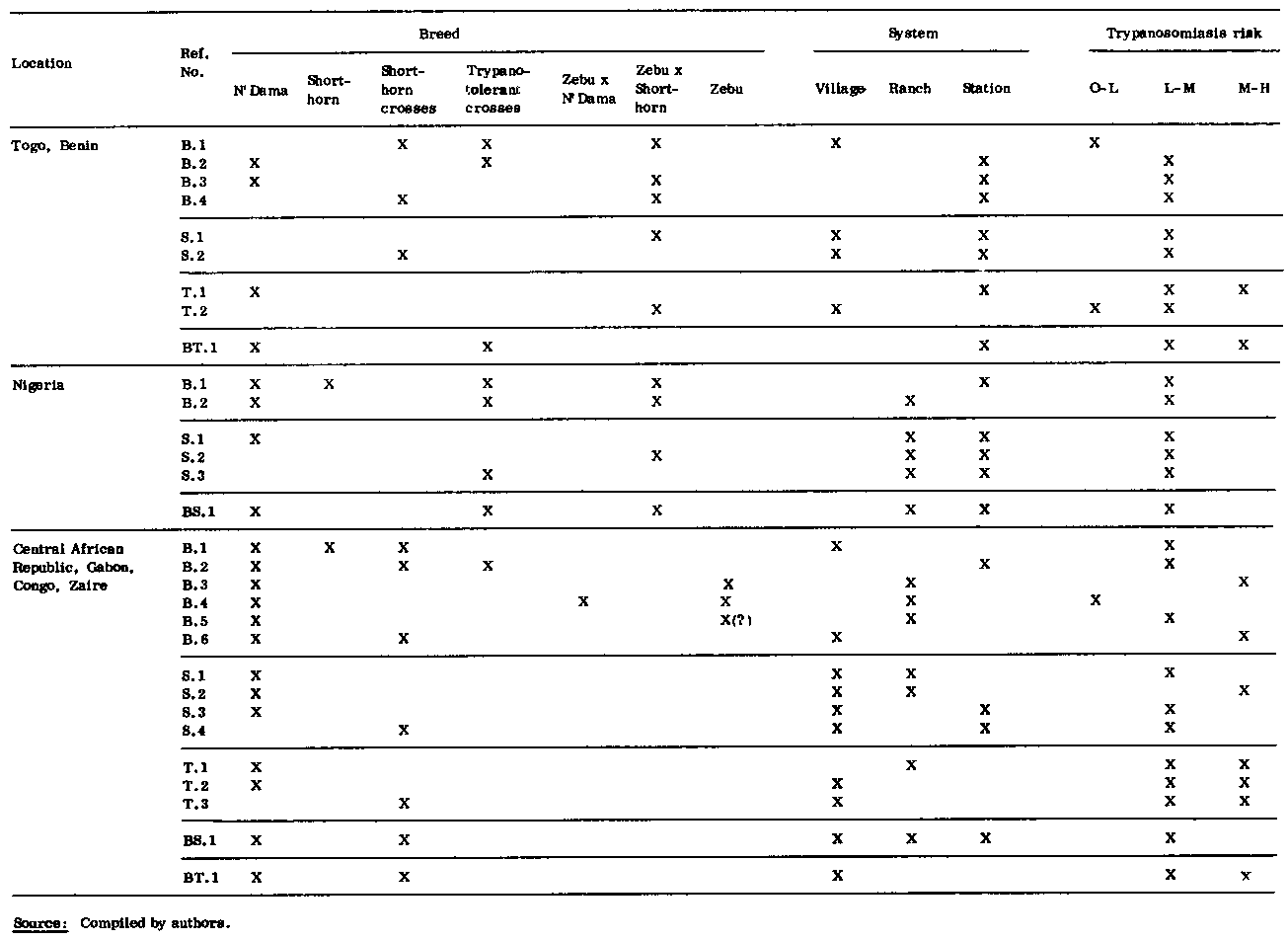
Table 5.12 shows the locations identified in the study zone where future evaluation activities might be possible. These include possible sites for productivity studies comparing cattle breeds under various levels of trypanosomiasis risk and management systems, for productivity studies of single cattle breeds, for productivity studies of sheep and goats and for specific experimental investigations. Each of these four types of studies will be discussed separately.
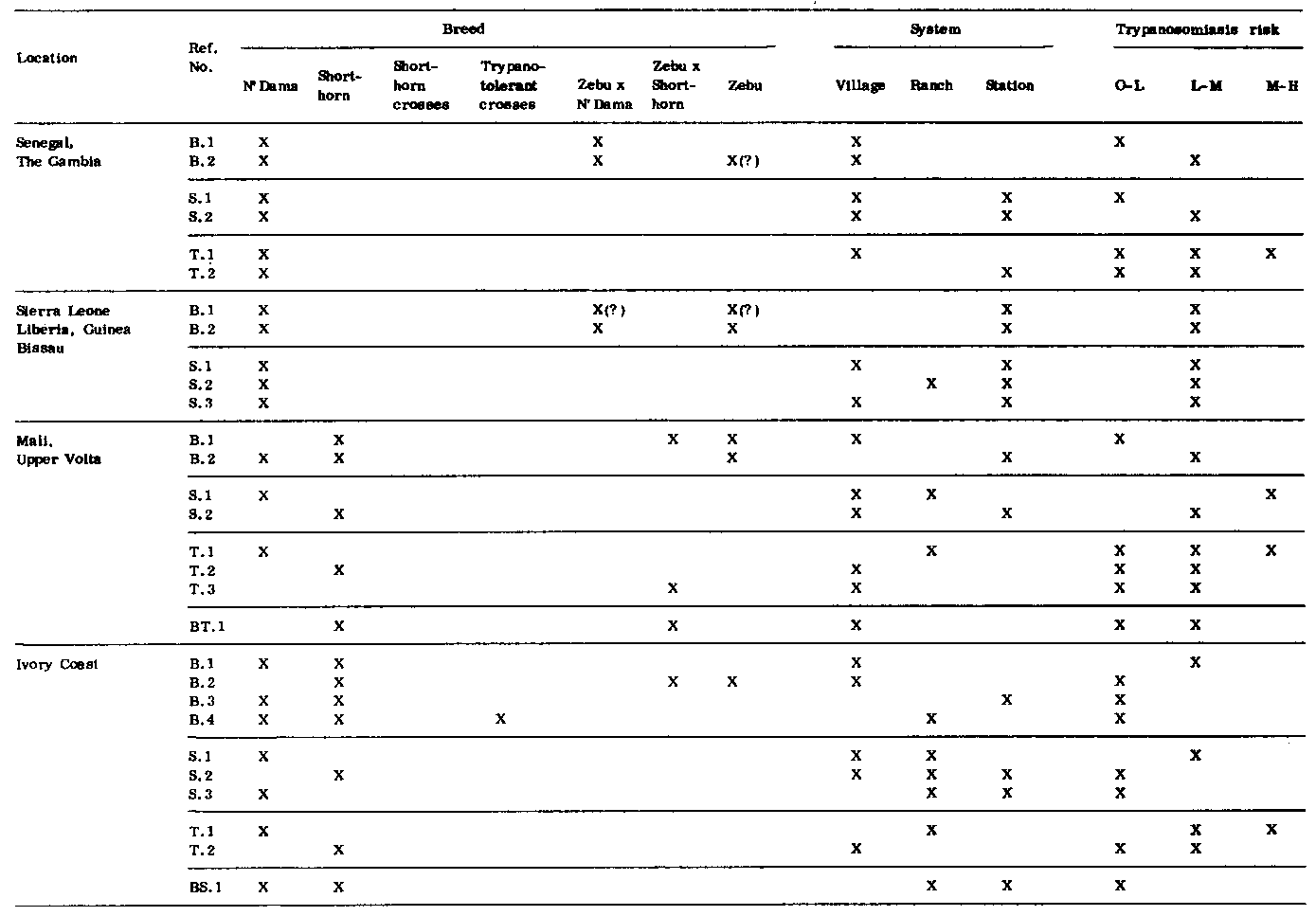
Possible locations for studies of the interactions between breed, management system and level of trypanosomiasis risk are listed in Table 5.13, and explanatory notes are given in Table 5.14. In discussing these possibilities, the aim would be to build up a network of locations where work could be undertaken over a three- to five-year period. International, multilateral and bilateral organizations, such as the World Bank, FAO/UNDP and the aid agencies of the EEC, Belgium, France, the Federal Republic of Germany, the UK and the USA, are already involved in several of these operations and the possibilities for their further involvement in a network of research sites should be considered.
All the locations mentioned in Table 5.12 could also supply information on the productivity of specific cattle breeds. Table 5.15 indicates locations where data already exist and might be analysed with relatively small additional inputs.
Table 5.12. Possible locations for evaluation of trypanotolerant livestock.
|
Country |
Location |
Breeds and Numbers |
Trypanosomiasis Risk |
Management System |
|
|
Cattle |
Sheep and Goats |
||||
|
Senegal |
Kolda |
N'Dama: 400 |
Djallonké: 300 |
L-M |
Station |
|
Kolda |
N'Dama |
Djallonké |
L-M |
Village |
|
|
Velingara |
Djakoré |
|
O-L |
Village |
|
|
Tambacounda |
N'Dama |
|
O-L |
Village |
|
|
Kaolack |
N'Dama, Djakoré: 400 |
|
L-M |
Village |
|
|
The Gambia |
Yundum |
N'Dama: 100 |
|
O-L |
Station |
|
Yundum |
N'Dama: 1000 |
Djallonké |
O-L |
Village |
|
|
Keneba |
N'Dama: 1000 |
Djallonké |
M-H |
Village |
|
|
Sapu |
N'Dama: 1000 |
Djallonké |
L-M |
Village |
|
|
Basse |
N'Dama, Djakoré |
|
O-L |
Village |
|
|
Guinea Bissau |
Bissau |
N'Dama: 100 |
|
L-M |
Station |
|
Bissau |
N'Dama |
|
L-M |
Village |
|
|
Bissora |
N'Dama: 150 |
|
L-M |
Station |
|
|
Guinea |
Various |
N'Dama |
|
Varied |
Village |
|
Sierra Leone |
Teko |
N'Dama: 85; Sahiwal: 32; |
|
L-M |
Station |
|
|
N'Dama x Sahiwal: 70 |
|
|
|
|
|
Musaia |
N'Dama: 120 |
|
L-M |
Station |
|
|
Koinadugu District |
N'Dama |
|
L-M |
Village |
|
|
Liberia |
Suakoko |
N'Dama: 150 |
Djallonké. 20, |
L-M |
Station |
|
LAC |
N'Dama: 360 |
|
L-M |
Rubber Plantation |
|
|
Sinoe County |
Muturu |
|
L-M |
Village |
|
|
Mali |
Yanfolila |
N'Dama: 1000 |
Djallonké: 200 |
L-M/M-H |
Ranch |
|
Yanfolila |
N'Dama |
Djallonké |
L-M/M-H |
Village |
|
|
Sikasso |
N'Dama: 170 |
|
O-L |
Farm |
|
|
Sikasso |
N'Dama, Mere, Zebu |
|
O-L |
Village |
|
|
Upper Volta |
Samandeni |
WAS: 103; N'Dama: 30 |
|
L-M |
Station |
|
Matourkou |
N'Dama: 80, Azaouak, Zebu: 115 |
|
L-M |
Station |
|
|
Banfora ORD |
Shorthorn, Zebu, Méré |
|
O-L/L-M |
Village |
|
|
Kaya-Koupah and FAOa Regions |
Shorthorn, Mere |
|
O-L |
Village |
|
|
Ivory Coast |
Bouaké |
N'Dama: 250; Baoulé: 500 |
|
O-L |
Station |
|
Bouaké |
N'Dama, Baoulé |
Djallonké |
O-L/L-M |
Village |
|
|
Bouaké/Foro |
|
Djallonké: 500, |
L-M |
Station |
|
|
Abokouamekro |
N'Dama: 4000 |
|
L-M |
Ranch |
|
|
Sipilou |
N'Dama: 5000 |
|
L-M |
Ranch |
|
|
La Marahoue |
N'Dama: 2000 |
|
M-H |
Ranch |
|
|
Korhogo |
Baoulé, Zebu, Mere: 1500 |
|
O-L |
Village |
|
|
SODEPALM |
N'Dama, Baoulé, |
|
O-L |
Palm Plantation |
|
|
Béoumi |
|
Djallonké: 1000 |
L-M |
Ranch |
|
|
Ghana |
12 Animal Husbandry |
Shorthorn, N'Dama, Sanga, |
|
|
|
|
Stock Farms |
Zebu: 2755 |
|
Varied |
Station |
|
|
Shai Hills |
All local breeds: 1100 |
|
O-L |
Ranch |
|
|
Ejura |
|
Djallonké, Sahelian: 830 |
O-L |
Ranch |
|
|
Togo |
Avetonou |
N'Dama, local breeds, |
|
L-M/M-H |
Station |
|
Dzogbegan |
Wakwa, local x Wakwa: 60 |
|
L-M |
Station |
|
|
Benin |
Samiondji |
Lagune: 110 |
|
M-H |
Ranch |
|
M'Betecoucou |
Borgou: 112 |
|
L-M |
Ranch |
|
|
M'Betecoucou |
Borgou |
|
L-M |
Village |
|
|
Okpara |
N'Dama: 150; Borgou: 750 |
|
L-M |
Station |
|
|
Porto Novo |
Borgou |
|
O-L |
Village |
|
|
SOBEPALH |
Lagune, Borgou, N'Dama crosses: 2800 |
|
O-L |
Village |
|
|
Nigeria |
Ado Ekiti |
N'Dama: 300 Keteku: 100 Muturu: 60; crosses: 200 |
|
L-M |
Station |
|
Fashola |
N'Dama: 420; Keteku and crosses: 320 |
|
L-M |
Station |
|
|
Upper Ogun |
N'Dama: 3200; Keteku and crosses: 1100 |
|
L-M |
Ranch |
|
|
University of Ibadan |
|
Dwarf sheep: 300, |
O-L |
Farm |
|
|
University of Ife |
|
Dwarf sheep: 170, |
O-L |
Farm |
|
|
University of Nigeria, |
|
Dwarf sheep: 80 ewes; |
|
|
|
|
Nsukka |
|
Dwarf goats: 30 females |
O-L |
Farm |
|
|
Ubiadja |
|
Dwarf goats and crosses: 150 |
O-L |
Farm |
|
|
Central African Republic |
Kidjigra |
Baoulé: 200 |
Djallonké: 200 |
L-M |
Village |
|
Gabon |
Okouma |
N'Dama: 377; Nguni: 163, N'Dama x Nguni: 310 |
|
O-L |
Ranch |
|
Franceville |
|
Djallonké x exotic sheep: 250 ewes |
O-L |
Ranch |
|
|
Congo |
Bouenza |
N'Dama, Lagune |
|
M-H |
Village |
|
La Dihesse |
N'Dama: 3500; Zebu: 250 |
|
L-M |
Ranch |
|
|
Odziba |
|
Djallonké: 310 |
O-L |
Farm |
|
|
Kibelemoussia |
|
Djallonké: 150 |
L-M |
Farm |
|
|
Mvouti |
|
West African Dwarf sheep and goats: 600 |
M-H |
Village |
|
|
Zaire |
Gimbi |
Lagune: 80; N'Dama: 150 Lagune x N'Dama: 85 |
|
L-M |
Station |
|
Gimbi |
Lagune: 50; N'Dama: 40 |
|
L-M/M-H |
Metayage |
|
|
Mbanza-Ngungu |
N'Dama: 4300 |
|
L-M |
Metayage |
|
|
Kolo |
N'Dama: 22000 |
Djallonké: 300 |
L-M |
Ranch |
|
|
Mushie |
N'Dama: 12000 |
|
M-H |
Ranch |
|
|
Lombo |
N'Dama, Ituri: 8000 |
|
M-H |
Ranch |
|
|
Kikwit |
N'Dama: 1300 |
|
L-M |
Ranch |
|
|
Kikwit |
N'Dama: 250 |
|
L-M |
Metayage |
|
|
Idiofa |
N'Dama: 6500 |
|
L-M/M-H |
Metayage |
|
|
Mvuazi |
N'Dama: 350 |
Djallonké.: 100 |
L-M |
Station |
|
Source: Compiled by authors.
Table 5.14. Explanatory notes on possible locations for comparative studies of interactions between breeds, management systems and levels of trypanosomiasis risk.
|
Country |
Type of Comparison |
Reference Number |
Remarks |
|
Senegal, The Gambia |
Breeds |
B.1 |
N'Dama vs Djakoré under village conditions and very low trypanosomiasis risk (O-L) in Basse Region of eastern Gambia and Velingara and Tambacounda in Senegal. Herds still have to he identified. |
|
Breeds |
B.2 |
N'Dama vs Djakoré under village conditions and low to medium trypanosomiasis risk in Kaolack, Sine Saloum Region. Senegal, Note: Possibly Zebu could he incorporated |
|
|
Management Systems |
S.1 |
Village vs station conditions with N'Dama under very low trypanosomiasis risk (O-L) at and near Yundum Station western Gambia. |
|
|
Management Systems |
S.2 |
Village vs station conditions with N'Dama under low to medium trypanosomiasis risk at and near Kolda Station, Senegal. |
|
|
Trypanosomiasis Risk |
T.1 |
Low vs low to medium vs medium to high trypanosomiasis risk with N'Dama under village conditions in Keneba and Sapu, The Gambia. |
|
|
Trypanosomiasis Risk |
T.2 |
Low vs low to medium trypanosomiasis risk with N'Dama under station conditions at Yundum, The Gambia and Kolda, Senegal. |
|
|
|
|
Note: Various agencies are involved in integrated livestock operations in these regions: EDF in Casamance and World Bank in Sine Saloum in Senegal, USAID, ODM and ILRAD in The Gambia. Their possible interest should be investigated. |
|
|
Guinea-Bissau, Guinea, Sierra Leone, Liberia |
Breeds |
B.1 |
N'Dama, Sahiwal and Sahiwal x N'Dama under station conditions and low to medium trypanosomiasis risk at Musaia. Sierra Leone. Note: Dependent on Sahiwal being introduced at Musaia Station. |
|
Breeds |
B.2 |
N'Dama, Sahiwal and Sahiwal x N'Dama crosses under station conditions and low to medium trypanosomiasis risk at Teko Station, Sierra Leone. |
|
|
Management Systems |
S.1 |
Village vs station conditions with N'Dama under low to medium trypanosomiasis risk in Koinadugu District and Musaia and/or Teko Stations in Sierra Leone. |
|
|
Management Systems |
S.2 |
Station vs ranch conditions with N'Dama under low to medium trypanosomiasis risk at Suakoko and LAC in Liberia. |
|
|
Management Systems |
S.3 |
Village vs station conditions with N'Dama under low to medium trypanosomiasis risk in Bissau District and Bissau and Bissora Stations, Guinea-Bissau. |
|
|
|
|
Note: Some villages in Guinea could easily be identified and incorporated into the comparisons. FAO and World Bank are involved in livestock operations in Liberia and EDF in Sierra Leone FAO and World Bank are involved in the Suakoko Central Agricultural Experimental Station; and EDF is involved in developing Musaia Cattle Station and in livestock surveys. Their possible interest should be investigated. |
|
|
Mali, Upper Volta |
Breeds |
B.1 |
Shorthorn, Méré and Fulani Zebu under village conditions and very low (O-L) trypanosomiasis risk in Kaya, Koupah and FAOa Regions in eastern Upper Volta, in Sikasso Region in Mali and in Banfora ORD in Upper Volta. Herds have to be identified. |
|
Breeds |
B.2 |
N'Dama, Shorthorn, Azaouak Zebu under station conditions and low to medium trypanosomiasis risk at Samandeni (Shorthorn, N'Dama) and Matourkou (N'Dama, Zebu) Stations in Upper Volta. |
|
|
Management Systems |
S.1 |
Village vs ranching conditions with N'Dama under medium to high trypanosomiasis risk at and near Yanfolila Ranch in Mali. |
|
|
Management Systems |
S.2 |
Village vs station conditions with Shorthorn under low to medium trypanosomiasis risk in Banfora ORD and Samandeni Station in Upper Volta. |
|
|
Trypanosomiasis Risk |
T.1 |
Very low vs low to medium vs medium to high trypanosomiasis risk with N'Dama under ranching conditions at Sikasso Farm in Mali, Samandeni Station in Upper Volta and Yanfolila Ranch in Mali. |
|
|
Trypanosomiasis Risk |
T.2 |
Low vs low to medium trypanosomiasis risk with Shorthorn under village conditions in Banfora ORD and Kaya, Koupah and FAOa Regions in Upper Volta. |
|
|
Trypanosomiasis Risk |
T.3 |
Low vs low to medium trypanosomiasis risk with Mere under village conditions in Banfora ORD and Kaya, Koupah and FAOa Regions in Upper Volta. |
|
|
Breeds by Trypanosomiasis Risk |
BT.1 |
Shorthorn and Méré under very low trypanosomiasis risk (O-L) and low to medium trypanosomiasis risk under village conditions in Banfora ORD and in Kaya, Koupah and FAOa Regions in Upper Volta. Note: Village herds have to be identified. |
|
|
|
|
Note: Possible interest should be investigated of such agencies as EDF, involved in Banfora ORD, Yanfolila Ranch and Elevage Mali Sud Projects: USAID, involved in village livestock projects in Upper Volta; World Bank, involved in the western Upper Volta livestock project; and IEMVT/GTZ, involved in Bobo Dioulasso Centre de Recherches sur les Trypanosomiases Animales and possibly Samandeni Station. |
|
|
Ivory Coast |
Breeds |
B.1 |
N'Dama vs Baoulé under village conditions and low to medium trypanosomiasis risk in Bouaké Region. |
|
Breeds |
B.2 |
Baoulé vs Zebu vs Zebu x Baoulé crosses under village conditions and very low trypanosomiasis risk (O-L) in Korhogo Region. |
|
|
Breeds |
B.3 |
N'Dama vs Baoulé under station conditions and very low trypanosomiasis risk (O-L) at CRZ Minankro at Bouaké. |
|
|
Breeds |
B.4 |
N'Dama vs Baoulé vs crosses under ranching (palm tree plantation) conditions and very low trypanosomiasis risk (O-L) at SODEPALM in Coastal Region. |
|
|
Management Systems |
S.1 |
Village vs ranching conditions with N'Dama under low to medium trypanosomiasis risk in Bouaké. Region (see B.1) and on SODEPRA ranches in Abakouamekro and Sipilou. |
|
|
Management Systems |
S.2 |
Village vs station vs ranching (palm tree plantation) conditions with Baoulé under very low Trypanosomiasis risk (O-L). See B.2. B.3 and B.4. |
|
|
Management Systems |
S.3 |
Station vs ranching (palm tree plantation) condition with N'Dama under very low Trypanosomiasis risk (O-L) at CRZ Minankro and SODEPALM. |
|
|
Trypanosomiasis Risk |
T.1 |
Low to medium vs medium to high Trypanosomiasis risk with N'Dama under ranching conditions on SODEPRA ranches at Abokouamekro and/or Sipilou vs la Marahoué |
|
|
Trypanosomiasis Risk |
T.2 |
Low to medium vs medium to high Trypanosomiasis risk with Baoulé under village conditions in Bouaké Region. |
|
|
Breeds by Management Systems |
BS.1 |
N'Dama and Baoulé under station and ranching (palm tree plantation) conditions and very low Trypanosomiasis risk (O-L). See 5.2 end 5.3. |
|
|
|
|
Note: Three main organizations are responsible for or are dealing with the installations described. The Ministère de la Recherche Scientifique and its specialized organization, the Institut des Savanes, are responsible for the Research Station at Minankro (CRZ) and for the surveys of village cattle. SODEPRA is responsible for the ranching operations (on the savannas) and extension work in Central and North Regions. SODEPALM is responsible for the ranching operations on palm tree plantations. Interest and possibilities for cooperation should be investigated. These organizations are already carrying out or intend to carry out the survey and data recording required. If agreement is reached, the work would consist mainly of cooperation in data analysis. These organizations have close contacts with IEMVT and various agencies involved in livestock development, such as FAC, GTZ, Belgian assistance, USAID, World Bank and EDF. Various possibilities for future cooperation should he investigated. |
|
|
Togo, Benin |
Breeds |
B.1 |
Lagune vs Borgou vs N'Dama crosses under village conditions and very low Trypanosomiasis risk (O-L) in villages and SOBEPALH in the Coastal Region of Benin. Some village herds have yet to be identified. |
|
Breeds |
B.2 |
N'Dama vs N'Dama x exotic vs local breed crosses under station conditions and low to medium trypanosomiasis risk at Avetonou CERTT in Togo. |
|
|
Breeds |
B.3 |
N'Dama vs Borgou under station conditions and low to medium Trypanosomiasis risk at Okpara in Benin. |
|
|
Breeds |
B.4 |
Lagune vs Borgou under station conditions and medium trypanosomiasis risk at Samiondji and M'Bétécoucou Stations in Benin. |
|
|
Management Systems |
S.1 |
Village vs station conditions with Borgou under low to medium trypanosomiasis risk on and near M'Bétécoucou Station in Benin. Village herds have to be identified. |
|
|
Management Systems |
S.2 |
Village vs station conditions with Lagune under medium Trypanosomiasis risk at Samiondji Station and nearby villages in Benin. Village herds have to be identified. |
|
|
Trypanosomiasis Risk |
T.1 |
Low to medium vs medium to high Trypanosomiasis risk with N'Dama under station conditions at Avetonou Research Centre in Togo. The latter challenge possibility is related to the expressed intention to extend cattle facilities into a higher challenge location. |
|
|
Trypanosomiasis Risk |
T.2 |
Very low vs low to medium Trypanosomiasis risk with Borgou under village conditions in Porto Novo and M'Bétécoucou Region in Benin. |
|
|
Breeds by Trypanosomiasis Risk |
BT.1 |
N'Dama and N'Dama x exotic and local breed crosses under station conditions and low to medium and medium to high trypanosomiasis risk at Avetonou. |
|
|
|
|
Note: The Avetonou CERTT in Togo is maintained by German bilateral assistance. FAO is involved in the Borgou and Lagune ranches (M'Bétécoucou and Samiondji) in Benin and its interest in village surveys should be investigated. |
|
|
Nigeria |
Breeds |
B.1 |
N'Dama vs Keteku vs Muturu vs their crosses under ranching conditions on artificial pastures and low to medium trypanosomiasis risk at Ado-Ekiti Livestock Production Centre in Ondo State and Fashola Stock Farm in Oyo State. |
|
Breeds |
B.2 |
N'Dama vs Keteku vs their crosses under extensive ranching conditions at Upper Ogun Ranch under low to medium trypanosomiasis risk. |
|
|
Management Systems |
S.1 |
Improved ranching (station) vs extensive ranching conditions with N'Dama under low to medium trypanosomiasis risk at Ado-Ekiti, Fashola and Upper Ogun. |
|
|
Management Systems |
S.2 |
Improved ranching (station) vs extensive ranching conditions with Keteku under low to medium trypanosomiasis risk at Ado-Ekiti, Fashola and Upper Ogun. |
|
|
Management Systems |
S.3 |
Improved ranching (station) vs extensive ranching conditions with N'Dama x Keteku crosses under low to medium trypanosomiasis risk at Fashola and Upper Ogun. |
|
|
Breeds by Management Systems |
BS.1 |
N'Dama, Keteku and their crosses under improved (station) and extensive ranching conditions and low to medium trypanosomiasis risk at Fashola, Upper Ogun, and Ado-Ekiti. (for N'Dama and Keteku only). |
|
|
|
|
Note: Operations on these three ranches would consist mainly of data analysis. Further work could be carried out at Ado-Ekiti, if this beef cattle station is not transformed into a dairy operation in the next few years, as is intended. The data from Fashola and Upper Ogun have been or are being analysed by Nigerian scientists. Data from Ado-Ekiti, have been partly analysed. |
|
|
Central African Republic. Gabon, Congo, Zaire |
Breeds |
B.1 |
Baoulé vs Lagune vs N'Dama under village conditions and low to medium trypanosomiasis risk at Kidjigra in Central African Republic and near Gimbi and Mbanza-Ngungu in Zaire. |
|
Breeds |
B.2 |
Lagune vs N'Dama vs N'Dama x Lagune crosses under station conditions and low to medium trypanosomiasis risk at Gimbi Station in Zaire. |
|
|
Breeds |
B.3 |
Ituri Zebu vs N'Dama under extensive ranching conditions and medium to low trypanosomiasis risk at Lombo Ranch in Zaire. Note: Different chemoprophylactic treatments against trypanosomiasis are used on Zebu and N'Dama. |
|
|
Breeds |
B.4 |
Nguni vs N'Dama vs Nguni x N'Dama crosses under intensive ranching conditions and very low trypanosomiasis risk (O-L) at Okouma Ranch in Gabon. |
|
|
Breeds |
B.5 |
N'Dama vs Fulani Zebu under ranching conditions and low to medium trypanosomiasis risk at La Dihessé Ranch in Congo. Note: Fulani Zebu will soon be imported from Cameroon. |
|
|
Breeds |
B.6 |
N'Dama vs Lagune under village conditions and medium to high trypanosomiasis risk in Bouenza Region in Congo. Note: Herds still have to be identified. |
|
|
Management Systems |
S.1 |
Village vs ranching conditions with N'Dama under low to medium trypanosomiasis risk in villages at Mbanza-Ngungu GER, Idiofa and Kikwit and at Kolo and Kikwit Ranches in Zaire. |
|
|
Management Systems |
S.2 |
Village vs ranching conditions with N'Dama under medium to high trypanosomiasis risk in villages at Idiofa and on Mushie Ranch in Zaire. Note: Village herds still have to be identified. |
|
|
Management Systems |
S.3 |
Station vs village conditions with N'Dama under low to medium trypanosomiasis risk at and near Gimbi Station in Zaire. |
|
|
Management Systems |
S.4 |
Station vs village conditions with Lagune under low to medium trypanosomiasis risk at and near Gimbi Station in Zaire. |
|
|
Trypanosomiasis Risk |
T.1 |
Low to medium vs medium to high trypanosomiasis risk with N'Dama under ranching conditions at Kolo and Mushie Ranches in Zaire and at La Dihessé Ranch in Congo. |
|
|
Trypanosomiasis Risk |
T.2 |
Low to medium vs medium to high trypanosomiasis risk with N'Dama under village conditions in Idiofa Region in Zaire. |
|
|
Trypanosomiasis Risk |
T.3 |
Low to medium vs medium to high trypanosomiasis risk with Lagune under village conditions near Gimbi in Zaire. Note: Same possibility in Congo, but herds have to be identified. |
|
|
Breeds by Management Systems |
BS.1 |
Lagune and N'Dama under village, station and ranching conditions and low to medium trypanosomiasis risk at and near Gimbi and on Kolo Ranch in Zaire. |
|
|
Breeds by Trypanosomiasis Risk |
BC.1 |
Lagune and N'Dama under low to medium and medium to high trypanosomiasis risk under village conditions in Idiofa Region (mainly N'Dama) and near Gimbi in Zaire and possibly in Bouenza Region in Congo. Note: Although the two first locations are about 1000 km apart environments are similar. |
|
|
|
|
Note: Possible interest of various agencies operating in these countries should be investigated. The Kidjigra study is directly related to aid requested from EDF by Central African Republic for metayage projects. The Mbanza-Ngungu GER in Zaire which was formerly financed by EDF, has proved successful but is now running out of funds. EDF is financing two ranches in Congo and could possibly be interested in village livestock operations. Belgian assistance could possibly be interested in sheep operations at the Gimbi and Mvuazi Stations and the GER operation in Zaire. Belgium, together with Misereor (German Fed. Rep.), is financing the metayage operations at Idiofa in Zaire. The La Dihessé Ranch in Congo is financed by World Bank and receives technical assistance from IEMVT/FAC. |
Source: Compiled by authors.
Table 5.15. Locations where data exist for further analysis of productivity within cattle breeds.
|
Country |
Location |
Breed |
Notes |
|
|
Senegal |
CRZ Kolda |
N'Dama |
250 cows X 4 yrs |
|
|
The Gambia |
Yundum |
N'Dama |
100 cows X 10 yrs |
|
|
Sierra Leone |
Teko |
N'Dama, Sahiwal |
ILCA requested to analyze data |
|
|
Liberia |
LAC |
N'Dama |
200 cows x 7 yrs |
|
|
Ivory Coast |
SODEPALM |
N'Dama, Baoulé |
2500 cows x 3 yrs |
|
|
Togo |
Dzogbegan |
mixed |
70 cows x 10 yrs |
|
|
Benin |
Samiondji |
Lagune |
46 cows x 2 yrs |
Analysed by ILCA in case study |
|
Benin |
M'Bétécoucou |
Borgou |
38 cows x 2 yrs |
Analysed by ILCA in case study |
|
Nigeria |
Ado Ekiti |
N'Dama, Keteku, Muturu, crosses |
250 cows x 10 yrs |
Data already partially analysed |
|
Nigeria |
Fasola |
N'Dama, Keteku, |
300 cows x 10 yrs |
Data being analysed |
|
Gabon |
Okuma |
N'Dama, Nguni, crosses |
300 cows x 3 yrs |
|
|
Congo |
La Dihessé |
N'Dama |
450 cows x 4 yrs |
|
|
Zaire |
Mbanzangungu |
N'Dama |
300 head x 15 yrs |
Data by type of animal and age class |
|
Kolo |
N'Dama |
23000 head x 25 yrs |
Data by type of animal and age class |
|
|
Mushie |
N'Dama |
10000 head x 4 yrs |
Data by type of animal and age class |
|
|
Lombo |
N'Dama, Zebu, Ituri |
7000 head x 4 yrs |
Data by type of animal and age class |
Table 5.16 indicates possible locations for future studies on sheep and goats within the study zone, with supporting explanatory notes. As there are few possible locations for sheep and goat studies in the study zone, compared with possibilities for cattle, opportunities for work in other areas would be particularly valuable. One possibility is the UNDP/FAO sheep and goat project in Kenya, with facilities extending over the high-rainfall coastal belt including areas of high and low trypanosomiasis risk.
Specific experimental investigations basically require some livestock facilities, good laboratory support and a high level of scientific and technical supervision For this reason, suitable sites are usually linked with laboratories, research centres or universities. Close scientific supervision requires the involvement of scientists at the site, while scientific coordination and assistance could possibly be arranged through institutions such as ILCA, ILRAD, the Joint FAO/IAEA Division of Atomic Energy in Food and Agriculture or GTZ. This section indicates some possible locations for specific experimental work in West and Central Africa.
Table 5.16. Possible locations for productivity studies with sheep and goats.
|
Country |
Species |
Type of Comparison |
Remarks |
|
Senegal, The Gambia |
Sheep |
Management Systems |
Under station and village conditions and low to medium trypanosomiasis risk at and near Kolda Station in Senegal. Note: A flock of 300 sheep is kept at Kolda Station and has been recorded for two years. Village flocks have to he identified. Further investigation is necessary. |
|
Sierra Leone, Liberia |
Sheep |
Management Systems |
The Mano River Union Project, a joint project of Sierra Leone and Liberia, will include a study of bioparameters at Suakoko CAE Station in Liberia under low to medium trypanosomiasis risk. Work with village flocks could be envisaged. |
|
Mali, Upper Volta |
Sheep (Goats) |
Management Systems |
A flock of about 200 sheep is kept on the Yanfolila Ranch in Mail. The sheep farm is under low to medium trypanosomiasis risk. The possibility of extending the work to village flocks and goats should be studied further. Possible interest of EDF should be investigated. |
|
Ivory Coast |
Sheep (Goats) |
Management Systems |
a. The Centre National Ovin at Beoumi in Centre Region is developing a sheep flock with the assistance of EDF. There are 1000 head at present for selection and multiplication under improved management and low to medium trypanosomiasis risk. |
|
Ghana |
Sheep, Goats |
Management Systems, Trypanosomiasis Risk, Breeds |
On Ejura Farm, a flock of 830 Sahelian and Djallonké sheep is kept under low trypanosomiasis risk. A flock of 40 West African Dwarf goats is also kept. Distribution would lead to the possibility of comparing these with village flocks. |
|
Nigeria |
Sheep, Goats |
Breeds, Management Systems, Trypanosomiasis Risk |
Work on small ruminants could be carried out at the University of Ife in Oyo State, the University of Nigeria. Nsukka, the University of Ibadan, and at Ubiadja Goat Farm in Bendel State. These organizations have farms stocked with sheep and goats and/or have staff interested in this field. The work would cover Dwarf and Djallonké varieties under village and station conditions and various levels of trypanosomiasis risk. Contacts are being developed by ILCA's small ruminants programme. Possible interest of ODM in the Kaduna laboratory should be investigated. |
|
Central African Republic, Gabon, Congo, Zaire |
Sheep, Goats |
Breeds, Management Systems, Trypanosomiasis Risk |
In Central African Republic, if proposal B. 1 for cattle in Kidjigra village is implemented, it would be possible to obtain fair results for sheep and goats under village conditions and low to medium trypanosomiasis risk with a rather modest additional input. Possibilities in other situations should he investigated further. In Gabon the Bergerie de Franceville and the Okouma Ranch study crossbreeds between West African and exotic sheep and goats. The possibility of keeping West African Dwarf flocks on these well-equipped stations should be investigated further. In Congo, the Odziba Sheep Farm near Brazzaville is developing a flock of 310 West African Dwarf sheep. The APN Farm, run by the army at Kibelemoussia, is developing a flock of 150 West African Dwarf sheep. The Mvouti village in Kouilou Region has a flock of about 800 sheep including some of the Blackbelly variety. In Zaire, the Mvuazi Station in gas-Zaire Region intends to develop metayage with sheep. The Kolo Ranch keeps a flock of 300 sheep, but not the pure West African Dwarf variety. |
Source: Compiled by authors.
Senegal: The Laboratoire National d'Elevage et de Recherches Vétérinaires (LNERV) in Dakar Hann has substantial facilities and has already undertaken experiments on trypanotolerance. This laboratory is also in charge of the CRZ Kolda in Casamance Region where experimental work could be carried out.
The Gambia: In spite of staffing and equipment shortages, a great deal has already been achieved at Keneba. Continued and expanded research work is possible at this location.
Sierra Leone: The Animal Science Department of Njala University College operates a small farm where feeding trials are conducted and a small veterinary laboratory carries out some analyses.
Liberia: The Central Agricultural Experimental Station (CAES) in Suakoko has already carried out work on trypanosomiasis in livestock. Participation of the College of Agriculture and Forestry could also be envisaged.
Mali: The Centre National de Recherches Zootechniques (CRNZ) at Sotuba near Bamako has worked with N'Dama and their crosses for more than 35 years. This centre seems particularly well equipped for nutrition trials. The Laboratoire Central de Recherches Veterinaires (LCRV), also near Bamako deals with trypanosomiasis in cooperation with a team from Texas A&M University as part of a USAID project.
Upper Volta: The Centre d'Elevage et de Recherches sur la Trypanosomiase (CERT) in Bobo Dioulasso is a sophisticated research centre working on trypanosomiasis and trypanotolerance. French and German inputs have enlarged the research programmes and the Samandeni Station provides field-trial facilities.
Ivory Coast: The Centre de Recherches Zootechniques (CRZ) of Minankro-Bouaké, with programmes both at the station and in the field, could undertake specific controlled experimental work. This centre was established in 1949-50, specifically to study the production of N'Dama cattle in a tsetse-free zone. The Laboratoire de Pathologie Animate at Bingerville, with an oustation in Korhogo, provides laboratory support. The Animal Production Department of the Ecole Nationale Supérieure d'Agronomie (ENSA) has good facilities and plans to carry out nutrition trials.
Ghana: At the University of Ghana, with its three agricultural research stations, and the University of Kumasi, with its farm, experimental work is undertaker 'by students under the supervision of the teaching staff. The Achimota Animal Research Institute concentrates more on the veterinary aspects of trypanosomiasis. Facilities in Pong Tamale are also suitable for specific experiments.
Togo: The Centre d'Elevage et de Recherches sur la Trypanosomiase et la Trypanotolérance (CERTT) could be a mayor centre for specific experimental work in West Africa, The German Fed. Rep. aid agency is providing excellent laboratory and animal husbandry facilities. The University of Benin in Lomé also has facilities and plans to work in particular with sheep and goats.
Nigeria: The Universities of Ibadan, Ife and Nsukka, with their farms, seem equipped to carry out experimental work. The Nigerian Institute of Trypanosomiasis Research (NITR) outstation in Vom is already involved in growth trials with different breeds under various levels of trypanosomiasis risk and nutrition.
Congo: The Veterinary Laboratory of Brazzaville, established in 1977, is making a list of animal diseases, including trypanosomiasis, and estimating their importance. Some analysis work could be carried out there.
Zaire: The Progrès Populaire of Idiofa is a large agricultural project with a trypanotolerant animal component, working at the village level with excellent laboratory support and scientific supervision. This project could carry out specific experiments focussing on village production. The Veterinary Laboratory of Kinshasa is equipped to analyse samples from the field, Some of the stations of the Institut National pour l' etude et la Recherches Agronomique (INERA) could undertake specific experiments if laboratory equipment and staffing were strengthened.
5.5.1 Recommendations for evaluation
5.5.2 Possible locations for evaluation
During the country visits, it became apparent that the governments of the countries in the study area are generally very interested in the development of trypanotolerant cattle, especially the N'Dama, on a long-term basis. The aims are both to reduce the domestic shortage of meat and to promote export of slaughter stock, and also export of breeding stock at prices which are already high and still rising.
Livestock development includes several operations: the development and extension of basic animal production, diversification (e. g. draught oxen and milk production), stratification (e. g. fattening by smallholders and on feedlots) and improved organization, such as the development of roads, markets, meat processing administrative services and training, The development and extension of basic production is carried out both through the improvement of traditional husbandry systems and the introduction or expansion of ranches; these two aspects may be planned jointly or separately. The importance of basic production activities is reflected in the fact that they receive most of the funding made available by the major aid agencies for livestock development in these zones. A study of the funds allocated to 'pure' livestock development projects in Africa (ILCA, 1978d) indicates a rise from US $ 27 million for the period 1961-1965 to US $ 150 million for the period 1971-1975 for the humid and subhumid zones of West and Central Africa. Funds allocated to operations in the traditional sector represent about 35% of the total funds allocated to livestock development. The funds allocated to establishing and extending ranches have increased considerably, troth in absolute and relative terms: in 1961-65 this component accounted for about 10% of the total funds, in 1971-75 for about 44%. This new orientation can be explained by the fact that the limited availability of trypanotolerant breeding stock is seen as the most important constraint on the large-scale development of cattle production based on trypanotolerant animals. Of the funds allocated to ranches in these zones, 70% finances large ranches using trypanotolerant breeds, generally N'Dama, to develop rapidly a substantial supply of breeding stock for the traditional systems and to provide a regular supply of slaughter stock for the towns. These operations tend to be recent, having been financed for ten years or less. The more important are the Yanfolila Ranch in Mali, the three SODEPRA ranches in Ivory Coast, the three ranches of the Ghana Livestock Company, the five ranches of the Western Livestock Company in Nigeria, the Dihessé Ranch in Congo and the Lola Ranch in Zaire. Other ranching operations are planned, notably in The Gambia, Guinea, Sierra Leone, Togo, Gabon and Zaire.
In West Africa, the improvement and extension of cattle husbandry at the village level usually involves encouraging improved management, introducing veterinary care packages and supplying improved breeding stock from ranches (most commonly N'Dama). In Central Africa where cattle production in villages is not a traditional occupation, development starts with lending foundation breeding stock from ranches, followed up by similar support activities. This operation is called metayage (see section 3.1.4.2).
Three different phases of economic analysis will be necessary to evaluate the future use of trypanotolerant cattle in the study zone and their contribution to the overall development of cattle production. Complete economic evaluation will require both micro-level case studies and regional and national-level studies.
The first phase, based on case studies, will include- an assessment of village and ranch production in the different areas of the study zone. These case studies will take account of all relevant inputs and outputs at the producer level and will provide descriptions of the larger environments in which production takes place. Factors considered will include all production parameters, costs and quantities of various inputs and the quantities and values of intermediate and final products.
The results of these case studies will provide a mayor input to regional and national studies which will determine the macro-level potential for the economic development of production systems based on trypanotolerant cattle. In this second phase, the studies will take into account differences between countries in terms of their development objectives for the livestock sector. Cost-benefit analysis techniques and econometric models will be used and secondary data will also be analysed, for example, time-series data, prices, supply and demand.
It can be expected that research will continue with non-trypanotolerant cattle which will produce results comparable with the results of the first and second phase economic studies outlined above. Phase three will be undertaken when these micro- and macro-level studies on both trypanotolerant and non-trypanotolerant livestock systems are completed. This phase will involve a comparative study of livestock development based upon trypanotolerant and non-trypanotolerant cattle,
The urgency of meat supply problems in the study area, combined with the limited availability of trypanotolerant breeding stock, lead to the use of non-trypanotolerant animals to various extents. The development of production from non-trypanotolerant animals in this zone usually involves their establishment under chemoprophylaxis and therapy, with or without tsetse control programmes and possibly including the introduction of a degree of trypanotolerance through crossbreeding.
This study is not directly concerned with the evaluation of chemoprophylactic and tsetse control programmes. However, to allow objective comparisons with development based on trypanotolerant cattle, the evaluation of programmes based on non-trypanotolerant animals must include a careful examination of the practicability of the large-scale and long-term use of drugs and tsetse control measures, as well as the costs at both the individual producer and national level. In comparing the technical and economic feasibility of these different approaches to livestock development, a clear distinction must also be made between the subhumid Sudano-Guinean zone at the northern limit of the tsetse belt, which traditionally has had almost no sedentary cattle, and the more humid Guinean zone, which is the natural environment of the trypanotolerant breeds. As pressure on land increases in the subhumid zone, due to rising human populations and expanded cultivation, the traditional extensive transhumant cattle production system will have to be developed to ensure both adequate meat and milk supplies for growing national populations and the wellbeing of local producers. A successful transition towards more sedentarized production systems among pastoralist producers in these areas will require effective control of clinical trypanosomiasis. In the short term at least, this control is likely to be largely dependent on chemoprophylaxis and tsetse control, but, subject to availability, trypanotolerant cattle have a role to play and, in the longer term, this role could become a major one. In the humid Guinean zone which is the major focus of this report, large-scale tsetse-control programmes are as yet technically infeasible and small-scale production operations based on continuous chemoprophylaxis and therapy have often failed.
To evaluate tsetse eradication or control measures, information is required on the direct costs of the different methods of tsetse control, the time which must elapse between tsetse control measures and subsequent cattle production, the area of land which can be brought into production following a given tsetse control programme and its potential carrying capacity and finally whether the return from livestock production under pastoralism, village systems or ranching in a given area would justify the costs of tsetse control (Jahnke, 1976). Are the secondary effects of tsetse control, notably the environmental effects, known and evaluated? Can the results of the different tsetse eradication measures be considered permanent, and if not, what are the projected costs of continuous control? Is the internal political and financial situation stable enough to allow continuous tsetse control at appropriate times and to implement an adequate long-term land-use policy which will avoid reinfestation with tsetse or reinvasion by wildlife? Is the external political situation stable enough to allow the coordination of tsetse control across national boundaries? Are the control measures also effective against other possible trypanosomiasis vectors, so that the disease will not continue in a latent state leading to possible outbreaks at a later time?
Information is needed on whether available chemotherapy and chemoprophylaxis measures are effective in situations where trypanosomiasis risk is very high or where animals are subject to stress or overwork. The cost of providing these measures and the maintenance of an efficient veterinary infrastructure to ensure conscientious application must also he determined, as well as the consequences of the development of drug-resistant strains of trypanosomes, It must he determined whether the costs of drugs are within the means of a pastoral or a village producer, as well as the cost incurred from weight losses and productivity decreases which are unavoidable even with a well-organized treatment system. Finally, the desirability of basing long-term, large-scale cattle development on continuous drug application must be considered.
Evaluation of the use of non-trypanotolerant cattle on a large scale must also take into account that exotic and Zebu cattle might be more susceptible to other health problems in these areas where they are not well adapted. If this is the case, it must he considered whether the costs of treatment and losses can he home by local pastoral or village producers. Finally, although the problems of supplying large numbers of trypanotolerant breeding stock have been mentioned, the problems of supplying Zebu breeding stock from traditional cattle-producing countries in the next two decades must also he considered.
The sheep and goat populations of the study area are much larger than the cattle population. However during the country visits, government livestock and veterinary services seemed less concerned with sheep and goats than with cattle production. This situation has arisen for a number of reasons. For one thing national governments have responded to an urgent demand for beef in these areas where cattle production was traditionally almost non-existent, whereas the demand for sheep and goat meat has always been partly satisfied. A study of the livestock development projects in Africa (ILCA, 1978d) indicates that only about 1% of the funds allocated by the major aid agencies to the livestock sector in the humid and subhumid zones of West and Central Africa finances activities aimed at sheep and goat production.
Sheep and goats are generally produced under diverse traditional management systems and environments, with trypanosomiasis only one aspect of a much more complex disease situation. This is seen as the main constraint to development of sheep and goat production. Practical methods of disease control are often not available: the control measures which do exist tend to he complex and expensive to implement in the field, requiring substantial veterinary and laboratory support.
To improve this situation will require major financial and organizational efforts from national governments and poses the question of whether the necessary changes in husbandry practices will be acceptable and feasible at the village level, In view of these problems, research on sheep and goats has not been strongly encouraged and little progress has been achieved, especially with goats. However, interest in sheep and goat development is now increasing and numerous operations, involving experimental breeding stations, village surveys and veterinary control, have recently been launched. The main research and multiplication activities are found at Kolda in Senegal, as part of the Mano River Union Project in Sierra Leone and Liberia, at Yanfolila in Mali, at Ejura in Ghana, at Beoumi and Bouaké. in Ivory Coast, at the universities and the Ubiadja Goat Farm in Nigeria, at Franceville and Okouma in Gabon, at Odziba in Congo and at Mvuazi in Zaire. Two large veterinary control operations are also being carried out in Upper Volta and Benin.
If further studies confirm the preliminary finding that the trypanotolerant breeds have levels of productivity similar to other breeds (see section 5.2), future efforts to develop sheep and goat production in the study area are likely to he based on trypanotolerant animals. Sufficient numbers of trypanotolerant sheep and goats are available to provide a basis for further large-scale development. Various experiments to introduce larger Sahelian sheep and goats into the area where trypanotolerant breeds predominate have suggested that the disease problem in general would be more complex and acute if larger breeds were used. The observation that many fewer Sahelian sheep and goats migrate into the humid zone than Zebu cattle tends to confirm the impression that they are even less well adapted to these areas. While the development of sheep and goat production will largely be carried out at the village level, the use of unadapted animals would require regular, sophisticated veterinary control with its high associated costs, which would imply a radical change in traditional village life and husbandry.
The economic evaluation of trypanotolerant sheep and goat production can be envisaged in two phases. The first phase would include preliminary surveys and micro-economic case studies. Although major work would focus on village production systems, intensive management systems should also be studied which could provide improved stock to villages and meat to the towns and in some cases for export. Little is known about trypanotolerant sheep and goat breeds, and preliminary studies, as outlined in this report, should examine their productivity under village and intensive management conditions, the effects of selection, better veterinary care and management on their productivity, the inputs of veterinary care and management needed to reach certain levels of productivity and their related costs, the feasibility and acceptability of these measures at the village level, the actual and potential role of sheep and goats in social and economic village life (e. g. use of crop residues and damage to crops) and the basic marketing organization, Preliminary studies should provide data on the present production of each species and economic aspects under village and intensive management conditions, as well as the economics of improved veterinary care and management at the village level.
The second phase, based on macro-economic studies, would use the information obtained from the first phase of work to evaluate the role of each species under village and intensive husbandry systems in terms of regional and national production levels, taking account of specific national goals. These studies would provide basic information relevant to similar studies elsewhere in Africa.
The micro- and macro-economic studies of trypanotolerant cattle and sheep and goats described here would provide valuable information on the economics of maintaining trypanotolerant animals under actual management systems. They would also provide basic information and specific planning data on which to determine appropriate strategies for developing cattle and sheep and goat production under ranching and village systems in the humid and subhumid zones of tropical Africa. It should also be possible to assess the feasibility of introducing and extending the use of trypanotolerant cattle, sheep and goats elsewhere in Africa, and comparing the advantages of such a strategy with those of alternative production systems. In general, these studies will facilitate comparison between a wide variety of developing activities and allow suitable packages of recommendations to be formulated for implementation.
Section 5.5.1.1 recommends that economic comparisons be carried out of N'Dama cattle development based on ranching and village production systems in both West and Central Africa. A number of possible locations have been indicated, including Ivory Coast in West Africa and Zaire in Central Africa where large-scale development operations already have data and results available.
In Ivory Coast, extension work with village herds, some of which include N'Dama cattle, is carried out by the Société de Développement des Productions Animales (SODEPRA), as part of its Centre and Nord operations, and by the Centre de Recherches Zootechniques (CRZ) of Minankro-Bouaké. Information on individual animals is recorded on a regular basis. SODEPRA also carries out large-scale N'Dama ranching operations in a savanna environment. Some of these ranches are operating and some are still being developed. Ranch and village herds are found with comparable environments and levels of trypanosomiasis risk. These operations are described in more detail in the chapter on Ivory Coast in Volume 2.
In Zaire, the main metayage operations are carried out by the Groupement d'Economie Rurale (GER) in the gas-Zaire Region and by the Bureau Diocésain de Développement at Kikwit and the Progrès Populaire d'Idiofa in the Bandundu Region. Several ranches are operating or are being developed, and ranch and metayage herds are found with comparable environments and levels of trypanosomiasis risk. Details of these operations are given in the chapter on Zaire in Volume 2.
Further investigation is needed to evaluate the possibilities for cooperation with SODEPRA and organizations in Zaire, as well as the interest of EDF, FAO and Belgian, French and German Fed. Rep. aid agencies involved in operations in Zaire and/or Ivory Coast. Opportunities for analysing data which are already available must also be assessed, as well as opportunities for studying various ranch and village herds. These investigations can be carried out simultaneously with the establishment of a network to collect productivity information.
Section 5.5.1.2 recommends that economic studies of sheep and goat production under village and intensive management conditions be carried out, including the identification of possible improvements at the village level. The suitability of locations for economic studies will depend on the practicability of introducing technical innovations whose economic impact can then be investigated.
ILCA's small ruminant programme in Nigeria will include studies of proposed innovations under both village and research station conditions. ILCA's team has already solicited the cooperation of a number of universities and livestock services in the region, has identified village flocks to be surveyed and has established contacts with the villagers.
In Ivory Coast, the SODEPRA Centre is carrying out extension work with the cooperation of FAO to develop the production of sheep and goats in village flocks. The Centre National Ovin at Béoumi is building up a sheep flock in cooperation with EDF. The Station Ovine of Foro managed by the CRZ Minankro maintains a flock of 500 sheep. These three operations are located in Centre Region, and possibilities for integrating them into this study should be investigated.
5.6.1 Recommendations for conservation measures
5.6.2 Possible locations for conservation measures
This study has described two main groups of trypanotolerant cattle - the N'Dama and the West African Shorthorn. Although there are differences among varieties in different countries, the N'Dama is effectively a single breed. There are about 3.4 million overall, and their numbers appear to be increasing in spite of some crossbreeding on the northern boundary of their area of distribution. No special measures for conservation appear to be necessary.
The situation of the West African Shorthorn is quite different. There are still substantial populations of the larger, Savanna type in Ghana, Upper Volta and Ivory Coast and smaller populations in Togo, Nigeria and Benin, totalling about 1.7 million. However, in all these countries crossbreeding with Zebu is widespread and measures must he taken on an urgent basis if substantial numbers of purebred animals are to he maintained. The justification for doing this lies in the high productivity figures calculated for this breed in section 4.2. East of these large populations, there are two small isolated pockets of Shorthorn in Cameroon which are in urgent need of study and conservation measures.
The Dwarf West African Shorthorn is in a more precarious situation, with a total population of only 0.1 million. Although fairly large populations still remain in Nigeria, Benin and Liberia, they are under heavy pressure from both N'Dama and Zebu. There are also quite a number in Zaire and Congo. In other countries, there are relict populations, but since their numbers are so low and there is so little interest in them, and their characteristics do not appear to differ from those of the larger populations, separate conservation measures do not appear to he justified. Conservation measures combined with improved utilization should be directed towards the larger groups.
The concept of conservation does not appear to be appropriate for the various crossbred groups Djakoré, Méré, Borgou and Keteku). As they have been produced relatively recently from a cross between humped and humpless cattle, they do not represent any unique genetic resources and, provided the original breeds are available they can be recreated at will.
As for sheep and goats, they are both numerous and widespread. Attempts at crossbreeding have been few and most have failed. For these species, further evaluation is important, as well as more efficient commercial exploitation, but conservation measures are unnecessary.
At a meeting on the conservation of genetic resources held in Madrid in 1974, grave doubt was cast on the economic benefit of any policy to preserve rare breeds in Europe (e. g. relict herdbook breeds) on the chance that their genes might at some time be useful to improve the breeds which nave replaced them (FAO, 1974b). In the developing world, on the other hand, a rather different situation was thought to exist, where local breeds might be declining because of indiscriminate crossing with exotic breeds for a variety of reasons. Preservation without exploitation would be impracticable; the most immediate and urgent need expressed was for more information on possibilities for exploitation as a basis for deciding which threatened breeds merited conservation efforts.
Methods for conserving rare breeds might include gene-pool herds where several endangered breeds are kept together so that the various genes, but not the breeds in pure form, are conserved. Stores of frozen semen, eggs or embryos might also be kept or flocks or herds of pure breeds maintained. This report on trypanotolerant livestock shows that it is biologically possible to exploit the Savanna and Dwarf West African Shorthorn cattle breeds which appear to be the only ones in need of conservation measures. Whether the usual methods of conservation will by themselves lead to increased utilization of these breeds is doubtful, however. The reasons behind their present large-scale crossbreeding with other types must be understood before preservation and utilization measures can be successfully implemented.
The remainder of this section deals with the group for which conservation measures appear necessary. It is taken for granted that conservation and evaluation (especially on a comparative basis) must go hand in hand.
In this group, the only two breeds in real danger of extinction or absorption are the Doayo and Kapsiki in Cameroon. These breeds are isolated from each other and from the main Shorthorn cattle zone. They are kept by two well-defined tribes with social habits and customs in which the cattle play an important role, The 300 head of Kapsiki at present exist in a tsetse-free area, the rather smaller number of Doayo in an infested area. A third breed in Cameroon, the Bakosi, is also disappearing, now numbering only a few hundred head, but the study team considers this breed already lost and no programme of conservation justifiable.
Among the Doayo and Kapsiki, crossbreeding with Zebu has started and if these populations are to be saved action must be taken on an urgent basis. Since they are not exploited commercially and since they are in a Zebu area where official activities are devoted to that breed, government action without outside support cannot be expected - a project based on external aid will be required. So little information is available on these breeds that it is premature to suggest establishing breeding herds, even assuming that this is the best method of conservation. A project should be set up consisting of one research worker based in Garoua, a town from which both areas are accessible, with the Kapsiki area 200 km to the north and the Doayo area 150 km to the southwest. The project would include obtaining exact information on numbers, breed characters, management and use of these cattle. The source of bulls, the purity of the herds and the reasons for using Zebu bulls would be of particular interest. Hopefully there would also be the possibility of influencing breed purity. The researcher could be a zootechnician, veterinarian, sociologist or anthropologist. The project should indicate the desirability of saving one or both of these breeds, as well as a plan for doing so.
In the case of the other Savanna Shorthorn breeds, the immediate action required is mainly to warn governments and breeders of the value of the Shorthorn, so that crossbreeding can be kept under control. Additionally, locations should be identified where the productivity of each breed can be evaluated more precisely so that within the Shorthorn group the different breeds can be ranked under different management systems and levels of trypanosomiasis risk. Suggestions for individual breeds are given here.
Somba: This is the dominant breed in Togo and is also found in Benin. At present, it has not been studied and there are no centres maintaining the breed or attempting to evaluate its productivity. A purebred herd should be maintained and studied in at least one of the centres in Togo in the traditional Somba distribution area. The Somba might also perhaps be added to the FAO project in Benin dealing with Lagune and Borgou at M'Betecoucou and Samiondji. However, as with the Borgou, the Somba is at the limit of its natural distribution in these stations.
Savanna Muturu: This breed is found on only 4 of the 13 state ranches and livestock stations listed in the chapter on Nigeria in Volume 2. However, the Third National Development Plan for 1975-80 envisages the expansion of trypanotolerant breeds in tsetse-infested areas. Maintaining the Muturu as a pure breed in these locations should be encouraged, using the productivity figures given in this report, and the collection of additional productivity information under different levels of trypanosomiasis risk and management systems should also be initiated.
Ghanaian Shorthorn: Of the five research stations in Ghana, three have herds of Shorthorn. The Ministry of Agriculture has 12 stock farms, 5 with Shorthorn. Using the productivity figures given in this report, the universities and the government should be persuaded of the intrinsic value of the pure Shorthorn. Research should be directed towards an exact comparison of the productivity of the Shorthorn with that of other breeds. The stock farms should be encouraged to maintain and record herds of pure Shorthorn, especially the farm at Wa where it is said the least crossbreeding with Zebu has occurred.
Baoulé: If the Mere of Upper Volta are combined with the Baoulé of Ivory Coast, they constitute the largest population of Savanna Shorthorn. A small population of Baoulé is also found in Central African Republic where it was imported in the 1950s. In both Upper Volta and Ivory Coast, infrastructure and facilities exist to allow evaluation and conservation work. In Upper Volta at present, however, there is little work on this breed, though at Bobo Dioulasso French and German aid agencies have started a new programme on the immunology of trypanosomiasis and plan to use the Samandeni Station for field work. Facilties are available to keep Mere as a pure breed and compare their overall productivity with that of N'Dama and crossbreeds under station conditions with a high level of laboratory support. 'Extension of this work to village conditions can also be reasonably envisaged.
In Ivory Coast, the Baoulé breed is being studied by the Centre de Recherches Zootechniques of Bouaké under station and village conditions and could he compared with N'Dama kept under the same conditions. At the same time, SODEPRA, as part of its Nord operations, is carrying out a project to increase the number of trypanotolerant cattle in the north. These two programmes appear to cover all the necessary work on this breed.
With only 1% of the total trypanotolerant population, the Dwarf Shorthorns are the group most in need of conservation measures. Three breeds can be distinguished, and only five countries have sufficient numbers to justify studies or preservation programmes (Table 2.3).
Liberian Dwarf: This is found in the eastern part of Liberia under village conditions. Liberia is one of the few countries with an indigenous population of both N'Dama and Dwarf Shorthorns which will allow direct comparative studies of both breeds. Some means must be found to establish a herd of Liberian Dwarf under controlled conditions, if possible in different management systems, under different levels of trypanosomiasis risk and preferably where they can be directly compared with the N'Dama. Such conditions could be provided at the Ministry of Agriculture Research Station at Suakoko where good laboratory support is available, at the College of Agriculture Farm outside Monrovia, or possibly on rubber tree plantations managed by the Liberian Agricultural Company.
Forest Muturu: The only state cattle ranch within the Forest Muturu area appears to be Pota in Nigeria's Lagos State. A purebred Muturu herd should be kept under the same management conditions as N'Dama or crossbreds and individual recording should he reinstated so that comparative studies can be carried out.
Lagune: The only country in the Lagune area of origin with significant numbers is Benin. However, two other countries, Zaire and Congo, have significant numbers of Lagune due to importation and multiplication. In Benin, an FAO/UNDP project aimed at developing livestock production is being carried out at three stations, one of which, at Samiondji, is devoted to the Lagune breed. A comparison between the Lagune and Borgou breeds has already been carried out (see pilot study in section 5.3), but future comparisons must be made more rigorously, randomizing the location of the two breeds over the stations.
Lagune cattle might also he studied in their natural environments in Benin, working with SOBEPALH, a company with headquarters in Porto Novo which produces palm oil and supervises 21 cooperatives. Each of these comprises several villages along the coast where Lagune herds are kept under palm trees. Some crossbreeding trials with N'Dama and Borgou are going on and it may be important to study not only the productivity of the animals, but also the sociological issues to understand exactly what the villagers think of their Lagune cattle and the benefits of crossbreeding. Only when the value of the Lagune and reasons for keeping them are understood might conservation plans be fruitful.
In the Bas-Zaire Region of Zaire, villagers keep Lagune herds in a forest environment which were introduced through metayage operations. Gimbi Research Station also maintains some pure Lagune (called Dahomey in Zaire). A comparison of productivity between station and village conditions or among villages under different levels of trypanosomiasis risk could easily be carried out and could provide justification for maintenance of the Lagune breed.