


2.1 Production and utilization of byproducts in West Africa
2.2 Production and utilization of byproducts in Eastern Africa
2.3 Production and utilization of byproducts in Central Africa
2.4 Production and utilization of byproducts in Southern Africa
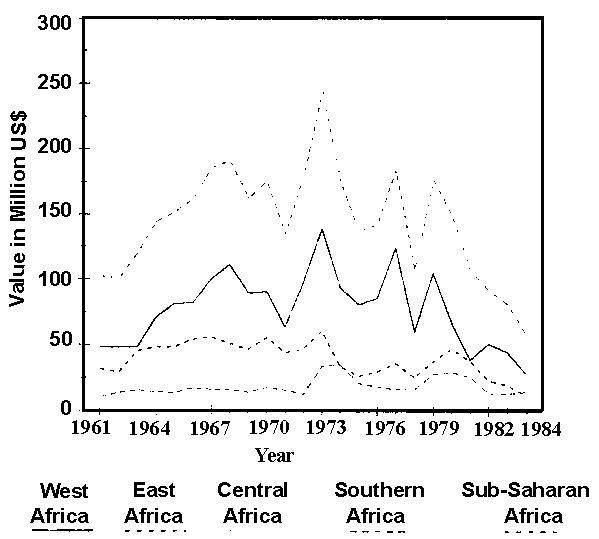
Sub-Saharan Africa is a major producer and a net exporter of agro-byproducts. Table 1 summarizes continental production and utilization data for byproducts by region and for Sub-Saharan Africa in 1984. It also shows real export values for by-product other than fishmeal for which data on value are not available. Detailed figures for year 1961 to 1984 are shown in Appendix A for Sub-Saharan Africa and in appendices B to E for West Africa, Eastern Africa, Central Africa, and Southern Africa respectively. Figure l describes the patterns of total real export value2 of byproduct exports between 1961 and 1984 by region and for Sub-Saharan Africa.
2. Real export value is derived from the nominal export value deflated by the consumer price index for industrial countries.
Table 1 shows that Sub-Saharan Africa produced about 1.3 million metric tons (mmt) of molasses in 1984, but only 35 percent of it was used as animal feed. The rest was shared between exports and other uses or wasted. Table 1 also indicates that 442 thousand metric tons (tmt) of groundnut cake, 497 tmt of cottonseed cake, 63 tmt of sunflower seed cake, 271 tmt of palm kernel cake, and 29 tmt of fishmeal were produced in Sub-Saharan Africa in 1984. The utilization of these byproducts as feed was relatively much greater than that of molasses while exports in 1984 were moderately below their 1980 levels (see tables in Appendix A).
The estimates from table 1 also reveal that in 1984 Southern Africa was the major producer of molasses, followed by Eastern Africa, West Africa, and Central Africa in that order. West Africa dominated in groundnut cake, palm kernel cake, and fishmeal production while Eastern Africa and Southern Africa dominated in cottonseed cake and sunflower seed cake production respectively. Regional trends in these byproducts are presented in the subsequent sections.
Table 1: Production, utilization and real export values of by-products in Sub-Saharan Africa, 1984a
|
Region |
|
Molasses |
G. nut* cake |
C. seed* cake |
SF. seed* cake |
Palmk.* cake |
Fish meal |
|
West Africa
|
Production |
160 |
270 |
93 |
NA |
211 |
26 |
|
Feed use |
31 |
190 |
43 |
NA |
173 |
6 |
|
|
Exports |
43 |
102 |
53 |
NA |
43 |
22 |
|
|
Real |
Exp. value |
767 |
15372 |
7975 |
NA |
4844 |
NA |
|
East Africa
|
Production |
415 |
84 |
268 |
21 |
NA |
0 |
|
Feed use |
235 |
50 |
210 |
21 |
NA |
2 |
|
|
Exports |
101 |
101 |
34 |
0 |
NA |
0 |
|
|
Real |
Exp. value |
3144 |
4954 |
4176 |
0 |
NA |
NA |
|
Central Africa
|
Production |
77 |
53 |
48 |
8 |
57 |
3 |
|
Feed use |
57 |
53 |
40 |
8 |
33 |
1 |
|
|
Exports |
13 |
0 |
7 |
NA |
23 |
2 |
|
|
Real |
Exp. value |
537 |
0 |
322 |
NA |
1917 |
NA |
|
Southern Africa
|
Production |
603 |
36 |
87 |
34 |
NA |
1 |
|
Feed use |
118 |
33 |
87 |
34 |
NA |
2 |
|
|
Exports |
283 |
7 |
4 |
0 |
NA |
_ _b |
|
|
Real |
Exp. value |
13650 |
514 |
667 |
NA |
NA |
NA |
|
SSA
|
Production |
1255 |
442 |
497 |
63 |
271 |
29 |
|
Feed use |
441 |
327 |
381 |
63 |
210 |
11 |
|
|
Exports |
441 |
210 |
98 |
0 |
67 |
25 |
|
|
Real |
Exp. value |
18098 |
20840 |
13140 |
0 |
6761 |
NA |
Source: Derived from "FAO Agricultural Supply/Utilization Accounts Tape, 1985", Rome, 1987.
a Quantities are in 1000 metric tons and values are in 1000 US dollars.
b Less than half of the unit.
NA: not available
* G. nut - Groundnut; C. seed = Cotton seed; SF = Sunflower; Palmk.= Palm kernel
FIGURE 1: Real export value of by-products by region and by Sub-Saharan Africa (SSA) as a whole
West Africa led the rest of Sub-Saharan Africa in the production of groundnut cake and palm kernel cake between 1961 and 1984. It also became the top producer of fishmeal between 1978 and 1984, displacing Central Africa which has been the leading producer of this byproduct since 1961 (Appendix B. table 5).
Groundnut cake is the major byproduct in West Africa. Its production showed intermittent growth during the study period with its highest level in 1976 and lowest level in 1981 (Appendix B. figure 2). This decrease was most likely caused by the drought during the 1970s and the sharp increase in world soybean production over the same period (Hamby, 1978). Increased soyabean production is probably a determinant factor since it has depressed the prices of the competing oilseed crops such as groundnut and others. As a result, there was pressure on governmental agencies to offer low prices for oilseeds, which has not stimulated production. With reduced oilseed production, byproduct production is also reduced. This was witnessed by a marked decrease in groundnut cake production in 1974 in Nigeria, the second largest producer after Senegal and in a shut down of the groundnut oil factory (SEPAMA) in 1982 in Mali.
Palm kernel cake is the next major byproduct in West Africa with Nigeria accounting for the bulk of production. Unlike groundnut production, palm kernel cake production was not severely affected by drought because the palm tree is drought resistant. Its production has grown steadily from 75 tmt in 1970 to 211 tmt in 1984. Figure 4 (Appendix B) generally indicates that palm kernel cake production was on an upward trend during the study period.
Fishmeal is the fifth important byproduct over the period of 19611984 in terms of quantity produced in West Africa. Fishmeal production is concentrated in only three countries of the West African region with Mauritania, the leading producer, followed by Senegal and Cote d'Ivoire. Figure 5 (Appendix B) shows the major characteristics of the production patterns between 1961 and 1984.
Until 1965, molasses was not recorded as produced in West Africa. Since 1966, recorded molasses production has been expanding steadily to reach its peak at 180 tmt in 1983 (Appendix B. table 1). Until surpassed by Senegal and Cote d'Ivoire in the mid-1970s, Nigeria, Mali, and Ghana were the major producers of molasses. In 1983, Senegal and Cote d'Ivoire together produced 68 percent of total molasses in West Africa.
Cottonseed cake is also a significant byproduct in West Africa. Its production has increased steadily between 1961 and 1974, dropped in 1975, then was strengthened again until 1977 and increased at a lower rate thereafter (Appendix B. figure 3).
In general, the utilization of agro-byproducts for animal feeding in West Africa has been increasing since 1961, but still remains low in comparison to total supply in the region. As expected, West Africa is also a leading consumer of groundnut cake as feed in Sub-Saharan Africa. Among the countries of the region, Nigeria was apparently the major user of groundnut cake as feed between 1961 and 1981.
The consumption of molasses, cottonseed cake, and palm kernel cake increased sharply between 1972 and 1984 (see figures in Appendix B). Most of this increase may be caused by increasing awareness of the feeding values of these byproducts as a result of many feeding experiments and livestock development projects which took place in West Africa during this period.
West Africa is a net exporter of oilcakes, molasses, and fishmeal. Groundnut cake still leads all other feed exports despite its downward trend since 1972 (Appendix B. figure 2). Its real export value reached a record high of US$ 124 million in 1973 when 368 tmt were exported, 51 percent higher than the real value level in 1970 when 403 tmt were exported. This increase in real export value can be attributed mainly to rising prices due to increased demand for byproducts from livestock feeders in importing countries who switched from feedgrains to byproducts to cut down their cost of production.
Exports of cottonseed and palm kernel cakes, fishmeal, and molasses are also of considerable importance. Cottonseed cake exports followed almost the same pattern as those of cottonseed cake production and increased sharply from their 1975 level (Appendix B. figure 3). Palm kernel cake exports came third after groundnut cake and cottonseed cake exports. However, since 1980 they have been decreasing due to increased domestic consumption as feed (Appendix B. figure 4). Until 1969, fishmeal exports matched production exactly. Thereafter fishmeal production and exports diverged but followed the same patterns (Appendix B. figure 5). Although, exports of all by-products showed a general decrease in the 1980s, they still remained major sources of foreign exchange earnings in West Africa. For instance, in 1984 these byproducts earned over US $28 million (table 1).
Eastern Africa leads the rest of Sub-Saharan Africa in cottonseed cake production and is improving its position as second largest producer of molasses, groundnut cake, and sunflower seed cake. Between 1961 and 1972, the trend in cottonseed cake production was positive. In contrast, negative trends were observed for the period between 1972 and 1981, a dramatic decrease which has been caused by drought and declining world prices of cotton during this period. After 1981, cottonseed cake production was up again, probably due to good weather conditions.
Molasses is the next important byproduct in Eastern Africa. Its production has been increasing steadily since 1961 and the production patterns are similar to those of Sub-Saharan Africa as a whole (Appendix C, figure 1). Groundnut cake is also an important byproduct in Eastern Africa, but its production has not been as steady as that of molasses (Appendix C, figure 2). Groundnut cake production rose from 26 tmt in 1961 to a record high of 240 tmt in 1978 and then dropped sharply to 84 tmt in 1984 (Appendix C, table 2). This decrease can be readily understood in terms of crises which have occurred in the world vegetable oil markets owing to increased soyabean production during this period.
Sunflower seed cake and fishmeal are also produced in Eastern Africa. Production of sunflower seed cake showed a steady growth until 1973 and increased tremendously between 1974 and 1978 before becoming somewhat stable thereafter (Appendix C, figure 4). Unlike sunflower seed cake, fishmeal production showed a declining trend and ceased in 1976 (Appendix C, figure 5). Presumably the continuing exports and use of feed are supplied from imports.
Eastern Africa is a major consumer of its byproducts. Molasses consumption levels were close to production and followed similar patterns as production except for the years 1978-1983 when exports surpassed consumption (Appendix C, figure 1). Groundnut cake consumption was relatively low compared to production but the trend has been positive between 1961 and 1980. Thereafter, groundnut cake consumption was slightly reduced as a result of a sharp decrease in production since 1978 (Appendix C, figure 2). Although cottonseed cake dominated byproducts production in Eastern Africa, its consumption was below export levels until the period after 1977 (Appendix C, figure 3).
The utilization of sunflower seed cake as feed was high and kept close pace with production. Between 1961 and 1971, sunflower seed cake consumption was moderate and relatively stable. With the exception of 1974 and 1975, production surpassed consumption between 1965 and 1978 and climbed to a high level in 1980. During the early 1960s and after 1979, all sunflower seed cake production was consumed as feed (Appendix C, figure 4). While production and export of fishmeal in Eastern Africa continued on a declining trend until they ceased in 1976 and 1978 respectively, consumption of fishmeal as feed has been irregular with a positive trend until 1978 and a negative trend thereafter.
Like the rest of Sub-Saharan Africa, Eastern Africa is a net exporter of byproducts. Despite a drastic decrease in exports of some byproducts during the 1980s, export earnings (in real terms) still totalled about US$ 12.3 million in 1984 (Appendix C, table 6). Between 1961 and 1984, the total real value of byproduct exports remained relatively stable, giving Eastern Africa second place after West Africa (figure 1).
Cottonseed cake led all byproduct exports until 1978 when molasses and groundnut cake exports took over. Cottonseed cake exports were at their peak in 1970 and dropped sharply to their lowest level in 1984 (Appendix C, figure 3). This drop is apparently due to increased consumption of cottonseed cake in Eastern Africa during this period. Molasses exports have shown a positive trend since 1961, while consumption of molasses as feed has not shown any very definite trend throughout the study period. Exports rose to 187 tmt in 1983 but dropped sharply to 101 tmt in 1984. Groundnut cake exports rose parallel with consumption until 1979 when they dropped sharply due to reduced production (Appendix C, figure 2). Exports of sunflower seed cake and fishmeal were not important in Eastern Africa. Sunflower seed cake exports were initiated in the late 1960s but dropped to zero in the late 1970s, apparently as a result of high utilization for animal feeding in the region. Since 1968 consumption of fishmeal in Eastern Africa has been higher than the production level, while exports followed the same trend as production and were discontinued in 1978 (Appendix C, figure 5).
Of the four regions, Central Africa is the smallest producer of byproducts. Palm kernel cake dominated byproduct production in the early 1960s, but its production showed a moderate decline since 1961 (Appendix D, figure 4). Within the region, Zaire is the leading producer of this byproduct, holding 67 percent of total production. Molasses, groundnut and cottonseed cakes, in that' order, are the next most important byproducts in Central Africa. Molasses production declined slightly between 1967 and 1978, but the general trend from 1961 to 1984 was positive (Appendix D, figure 1). The production of groundnut cake has been rising strongly since 1964, despite a slight dip in 1974 and 1975 (Appendix D, figure 2). Cottonseed cake production trends were negative between 1961 and 1966, but turned strongly positive between 1966 and 1974, since when production has been suject to substantial fluctuation (Appendix D, figure 3).
Overall, Central Africa consumed more of its byproducts than it exported (except palm kernel cake). Throughout the study period molasses consumption remained well below production level while its general trend was similar to that of exports until 1977. Consumption as feed rose strongly from 1976 until 1984 (Appendix D, figure 1). Groundnut cake production has been almost entirely used as feed through the period. Figure 2 in Appendix D shows the major characteristics of groundnut cake consumption in Central Africa. While cottonseed cake was also mostly used as feed, palm kernel cake was not significantly used as feed until the late 1970s when exports were reduced (Appendix D, figure 4).
Until surpassed by West Africa in 1977, Central Africa was the major producer of fishmeal in Sub-Saharan Africa. Fishmeal production fluctuated between 1961 and 1972, but the general trend seemed to be positive. The period after 1972 has been characterized by a rather dramatic drop in fishmeal production (Appendix D, figure 5). Angola was the only major producer of fishmeal in the region.
Central Africa is the smallest producer of byproducts among the regions of SSA and is also the smallest exporter. There were a large fluctuations in the total real value of exports (excluding fishmeal for which price data are not available) between 1961 and 1984. Total real export value reached its peak at US$ 21.0 million in 1972 and dropped drastically to US$ 2.8 million in 1984 (figure 1). Central African export was mainly dominated by fishmeal until 1975 and by palm kernel throughout the study period. It has also been observed that trends in feed and export of palm kernel were in an opposite direction indicating that higher exports resulted in low level of feed in the region and vice versa. Exports of molasses, groundnut and cottonseed cakes were not significant owing to their high utilization for animal feeding. For instance, groundnut cake exports ceased in 1977, 1983 and 1984, but reached its peak in 1979 with a declining trend thereafter.
Southern Africa is third in overall byproduct production after West Africa and Eastern Africa, but is the leading producer of molasses and sunflower seed cake in Sub-Saharan Africa. Molasses production has increased steadily between 1961 and 1984 (Appendix E, figure 1). Sunflower seed cake production increased moderately between 1961 and 1973. Thereafter, the production strengthened dramatically to reach its highest point of 34 tmt in 1984 (Appendix E, figure 4).
Within the region, cottonseed and groundnut cakes, and sunflower seed cake are the most important byproducts after molasses. Cottonseed cake is the second leading byproduct after molasses in Southern Africa. Its production has grown considerably since 1961 to reach a peak in 1973. Thereafter, the production fell off sharply below its 1971 level in 1976 and then strengthened again between 1976 and 1984. However, the growth in this period has been much more moderate than in the preceding period (Appendix E, figure 3). Groundnut cake production, on the other hand, followed the same patterns as those in the other regions of Sub-Saharan Africa. The production trend was positive between 1961 and 1973 and then turned negative between 1973 and 1984. The decrease in this period was probably due to the combined effect of drought and the general price decline for oilseeds owing to drastic increases in soyabean production (Marches Tropicaux et mediterranneens, 1983, p. 2841).
Until 1976, there was no fishmeal production recorded and it continued at a minimal level thereafter. Palm kernel cake is the least important byproduct in Southern Africa. Its production revealed patterns of no significant importance between 1961 and 1984 (Appendix E, table 5).
Southern Africa consumed most of its byproducts, except molasses and fishmeal. Molasses consumption as feed was relatively low in relation to total production during the period under study while fishmeal consumption was dependent on imports (Appendix E, figures 1 & 5.) The utilization of groundnut, cottonseed and sunflower seed cakes was well above the export levels throughout the period between 1961 and 1984 and kept close pace with production patterns.
Apart from molasses which was the top foreign exchange earner among traded byproducts, byproduct exports were relatively low in relation to consumption as feed in Southern Africa. Molasses led all byproduct exports, but seemed to be decreasing over the 1980s. The gap between molasses production on the one hand and its export or consumption as feed on the other hand grew sharply after 1975 implying increased use for other purposes or wastage. Exports of groundnut, cottonseed, and fishmeal were not important and sunflower seed cake was exported in only three years out of twenty four.
