E.S. Swai, F.N. Minja and L. ZylstraRegional Livestock Development Office
Smallholder Dairy Extension Programme (SDEP)
P.O. Box 1474, Tanga, Tanzania
Introduction
Cattle industry in Tanzania
Livestock production systems
Productivity
Importance of cattle in livestock development programmes
Origin and conception of the dairy development programme in Tanga
Extension approach
Adoption of technologies
Constraints on dairy development
Framework for future development
References
|
Summary Tanga Smallholder Dairy Extension Programme (SDEP) is a fast expanding programme. The number of test farmers increased from seven in 1985 to 900 in 1992. This has been accompanied by an impressive reduction in the mortality rate in adult animals from am average of 7% in 1985 to 4% in 1991. There has also been an attendant increase in daily milk yield per cow from 5.5 kg 1985 to 7.5 kg in 1991. This paper describes briefly the outlook of the livestock industry in Tanzania and in particular small-scale dairy production, with specific reference to the Tanga Region in Tanzania. Both negative and positive factors and their influence on programme development are critically considered. Finally, future prognosis as regard to dairy industry is outlined. |
Tanzania lies between latitude 1°S and 12°S and longitude 30°E and 39°E. The country covers a total area of about 886,000 km . The human population is estimated at 25 million, with an annual growth rate of about 3.3%. The average population density is 26 people/km, with a higher concentration in areas with high agricultural potential.
Over 80% of Tanzania's population lives in rural areas. Most rural dwellers are engaged in subsistence agriculture as smallholder farmers. Smallholders account for the bulk of farmers. About 93% of meat and 79% of milk produced comes from subsistence livestock owners. Achieving the desired increase of 245% for meat and 190% for milk production by the year 2000 will largely depend on the performance of the traditional sector (MALD, 1984).
In 1984 Tanzania had about 12.5 million cattle, with an annual population growth rate of approximately 0.61% (MALD, 1988 (Table 1).
Table 1. Cattle numbers, 1984, Tanzania.
|
Regional |
Indigenous |
Improved dairy cattle |
Improved beef cattle |
Total |
|
Arusha |
1,512,348 |
28,820 |
16,712 |
1,855,880 |
|
Coast |
53,691 |
2,221 |
1,430 |
87,542 |
|
DSM |
4,277 |
1,753 |
118 |
6,158 |
|
Dodoma |
987,179 |
2,178 |
10,827 |
1,000,184 |
|
Iringa |
469,622 |
8,313 |
2475 |
460,410 |
|
Kagera |
358,172 |
3,998 |
2,625 |
364,795 |
|
Kigoma |
61,909 |
389 |
21 |
82,319 |
|
K'manjaro |
338,709 |
82,720 |
7,028 |
408,457 |
|
Lindi |
4,875 |
713 |
529 |
6217 |
|
Mara |
953,188 |
3,173 |
3,405 |
989,788 |
|
Mbeya |
898,415 |
4,488 |
198 |
901,077 |
|
Morogoro |
315,665 |
4,992 |
12,022 |
332,883 |
|
Mtwara |
13,300 |
1,622 |
124 |
15,048 |
|
Mwanza |
1,353,024 |
2,888 |
1,845 |
1,357,535 |
|
Rukwa |
308,883 |
1,168 |
1,102 |
392,234 |
|
Ruvuma |
38,969 |
1,380 |
881 |
99,010 |
|
Shinyanga |
1679,200 |
2,662 |
199 |
1,832,081 |
|
Singida |
938,584 |
536 |
851 |
939,621 |
|
Tabors |
922,929 |
908 |
2,089 |
925,904 |
|
Tanga |
442,115 |
9,077 |
21,714 |
472,908 |
|
Total |
12,272,441 |
142,034 |
65,553 |
12,500,026 |
The livestock sector in Tanzania makes a significant contribution to agricultural production, providing farm power and good-quality food and giving economic value to otherwise inedible feeds and other agricultural resources (McDowell, 1979; Winrock International, 1983). However, its contribution to the economic growth of the country is small in relation to the enormous size of the national herd and the amount of grazing land available.
The livestock industry in Tanzania is at present dominated by smallholder farmers in pastoral and agropastoral production systems; these systems account for about 99% of the total livestock population (MALD, 1988). This sector is the most important source of animal protein (MALD, 1984).
Livestock production systems at the farm level have evolved through a long process of finding the best match and combination between production systems and climate, feed, labour and capital resources, market and technology use. The existing livestock production systems in Tanzania and their main characteristics are given in Table 2.
Table 2. Some characteristics of different dairy production systems in Tanzania.
|
|
Pastoralism |
Agro-pastoralism |
Mixed farming |
Intensive dairy farming |
Peri-urban milk production |
|
Farmers' priority |
Milk production livestock numbers |
Subsistence meat milk production, drought |
Draft soil fertility milk/meat production |
Sale of milk |
Sale of milk |
|
Farmers' attitude |
Risk aversion |
Risk aversion |
Spreading of risk integration |
Cash income |
Cash income |
|
Species |
Sheep. goats, cattle |
Cattle, sheep, goats |
Cattle |
Cattle |
Cattle |
|
Feed resources |
Communal grazing |
Communal grazing. crop residues |
Crop residues, cultivated fodder, communal grazing |
Cultivated fodder, purchased concentrates |
Purchased roughage and concentrates |
|
Farmers mobility |
Mobile |
Sedentary |
Sedentary |
Sedentary |
Sedentary |
|
Type of enterprise |
Extended family |
Smallholder extended family |
Smallholder |
Smallholder commercial farmer parastatal |
Smallholder commercial farmer |
|
Surplus milk |
Seasonal |
Seasonal |
Mainly seasonal |
Continuous |
Continuous |
|
Yield/cow per day (kg) |
0.5-1 |
0.5-1 |
1-5 |
5-15 |
5-15 |
|
Surplus/farm per day (kg) |
1-5 |
1-5 |
2-10 |
5-20 (smallholder) |
5-30 (smallholder) |
|
Land area/animal (ha) |
5-10 |
2-S |
05-2 |
0.5 |
0 0.5 |
|
Milk density (kg2 km per day) |
2-5 |
5-10 |
30-50 |
250 |
250 |
|
Inputs used |
Veterinary services (vaccinations) |
Veterinary services (vaccinations) |
Veterinary services feed, minerals, a extension, credit |
Concentrates. breeding services, credit, extension. training, veterinary services |
Concentrates, purchased roughage, breeding services credit extension, training veterinary services |
|
Main constraints |
Land tenure system, animal nutrition, animal health low milk density |
Land tenure system, animal nutrition, animal health, low milk density |
Animal nutrition infrastructure. marketing knowledge of crop-livestock integration, extension/training |
Animal nutrition, genetic potential/ breeding. infrastructure marketing, extension/ training |
Animal nutrition, genetic potential/ breeding, infrastructure/ marketing, extension/ training |
|
Potential for commercialisation |
No/very limited |
no/limited |
Yes |
Yes |
Yes |
Productivity of cattle in Tanzania remains much lower than expected (Table 3). Both genetic and environmental factors contribute to the low productivity.
Table 3. Population and production indicators (average) for cattle in Tanzania. 1987.
|
|
Population |
Milk yield (kg/day) |
Lactation yield (kg) |
Slaughtered herd |
Carcass weight (kg) |
|
Indigenous |
|
|
|
|
|
|
cattle |
12,000,000 |
2 |
160-180 |
315,723 |
103 |
|
Dairy cattle |
220,000 |
7 |
1500-3000 |
- |
165-200 |
|
Improved beef cattle |
110,000 |
- |
- |
- |
200-00 |
In 1974 the Tanzanian Ministry of Agriculture convened a conference on livestock development. The conference emphasised the involvement of government through parastatals, commercial ranching and dairy farm programmes aimed at increasing the size of existing dairy farms and ranches. The establishment of state and district development corporation ranches and dairy farms was also given high priority. It was also stressed that every district in Tanzania should invest in cattle ranching or dairy farming. The establishment of ujamaa ranches and dairy farms and the formation of cooperative ranches was emphasised.
In Tanzania draft animal power (DAP) contributes more than 15% of the energy for cultivation (Ministry of Agriculture, 1982) and accounts for a significant increase in productivity per hectare, i.e. increased crop yields, improved farm operations and increased acreage cultivated. Other products such as hides and dairy products generate foreign exchange through the sale of raw or processed products and create employment in the leather industry.
Although there is an observed increase in products from cattle, this has been as a consequence of an increase in herd size and not through increased productivity per animal. Generally, productivity per animal is low. There are various reasons for this poor performance. However, a fundamental factor is that the dominant indigenous Tanzanian cattle have a low genetic potential for milk production. In addition, both the traditional and commercial livestock production sectors have limited finance to invest in range and pasture development, water supply, tsetse fly control, veterinary clinics and dipping facilities. Therefore, the prevailing conditions of poor range condition, water scarcity, prevalence of diseases, e.g. trypanosomiasis and East Coast fever, depress livestock productivity.
In 1984, in the traditional sector the off-take was estimated at 8% and was projected to increase to 12% by 1994 (MALD, 1984). In the commercial sector the off-take was estimated at 15-20%. The average carcass weight was expected to increase from 100 kg (1984) to 120 kg (1990) in the traditional sector, while increases in the commercial sector were estimated to be from 150 to 165 kg. Beef production was expected to increase from 127,000 tonnes in 1987 to 204,000 tonnes in 1990 and 299,000 in 2000. However, beef output did not reach the desired level and was estimated at 160,000 tonnes in 1987 (FAO, 1989).
Milk production from the traditional sector was expected to rise from 342 million litres in 1982 to 642.5 million litres in the year 2000; production from grade cows was expected to increase from 48.0 million litres in 1981 to 118.0 million litres in the year 2000 (MALD, undated). In 1987, total milk production was estimated at 440,000 tonnes of fresh milk (FAO, 1989). In order to meet the projections, the Government is encouraging small-scale and commercial farmers to expand their production.
The evolution of smallholder dairy production in Tanga was based on the Dairy Policy of 1983. Dairy development in Tanga started in the mid 1970s, when the major emphasis and focus was on large farms owned by the Tanzania Sisal Authority (TSA) and a Government farm, Tanga Dairy. The former was funded by the World Bank.
In the early 1980s the Dutch Government helped Tanzania to establish the Buhuri Dairy Practical Training Centre specifically for modern dairy husbandry. This was a crucial and positive step in enhancing dairy development in Tanzania. The target groups for this centre were dairy extension workers, trainers in dairy husbandry, managers of large and medium-scale dairy farms, aspiring dairy farmers and agricultural and veterinary students. In 1984, an outreach programme of the training institute was initiated and implemented as a pilot project. The outreach programme aimed at introducing the dairy technology package to producers. The Project proved technically viable and was locally accepted. A year later it gained status as an independent Project operating under the Regional Livestock Development Office in Tanga as a Smallholders Dairy Extension Project (SDEP) bilaterally funded by the Governments of Tanzania and The Netherlands.
The SDEP strategy and approach was to reach both rural and urban dairy farmers. Three groups of farmers were identified:
· Lower-income group - rural farmers;
· Middle-income group - urban civil servants farmers; and
· High-income group - executives and businessmen/women.
Each category had its own characteristics. The last two practiced dairying as an alternative source of income and had access to industrial by-product feeds and veterinary services. The first group was composed of rural families who considered dairying as a primary source of income but had little access to veterinary services except through the extension agent.
A package of capital investment was suggested by the programme (Table 4). The SDEP took into consideration the ever-increasing cost of starting a dairy unit and deduced that very few of the low-income group could afford it. The SDEP approach became more flexible and a credit scheme for buying in-calf heifers was started in 1989 (Heifer In-trust Scheme). The idea was to offer an in-calf heifer to willing and well-prepared dairy farmers, who would eventually repay the loan with their the first in-calf heifer. This would then be passed on to another farmer. Up to December 1991, 310 rural families had benefited from this scheme.
Table 4. Cost of starting a one-cow Unit in Tanzania, 1991.
|
Item |
Cost (TSh) | |
|
Land development | ||
|
Land clearing |
4000 | |
|
Destumping |
2500 | |
|
Ploughing |
5000 | |
|
Planting |
1000 | |
|
Gap filling |
Own labour | |
|
Weeding |
Own labour | |
|
Sub-total |
12,500 | |
|
Cow shed construction | ||
|
Poles, (14) @ 40/= |
500 | |
|
Stones, half-load |
500 | |
|
Sand, half-load |
500 | |
|
Cement, 3 bags @ 700 |
2100 | |
|
Gravel, half-load |
2500 | |
|
Artisan |
3000 | |
|
Palm leaves, 600 pieces @ 6 |
3600 | |
|
Sisal poles, 3 loads @ 400 |
1200 | |
|
Nails, 2 kg @ 350 |
700 | |
|
|
Sub-total |
14,000 |
|
|
16,640 | |
|
|
Grand total |
43,140 |
(Exchange rate US$ 1. TSh 230)
In view of the high investment and the risks involved, the programme adopted an intensive advisory approach to ensure the survival and maximum productivity of the cows. The programme philosophy of step-by-step individual guidance has proved successful. The farmers established pastures (minimum 0.4 ha per cow) and a cow shed and undertook practical training. After this phase the farmers were visited weekly by an extension worker until the heifers calved. However, with the rapid increase in the number of participating farmers, group extension was considered as an alternative approach. Farmers were organized into groups, clubs, associations or rural cooperative societies in their respective zones. These grassroot groups are expected to assume responsibility for the delivery of services and inputs to the farmers. The strategy was to ultimately make the groups responsible for making available all basic inputs, i.e. acaricides, minerals, feeds etc. for monitoring the heifer intrust scheme, for organising group extension and field days and for organising milk marketing.
Group extension (farmer participation) is expected to be a sustainable approach that would reduce the high extension costs currently incurred by the programme.
Quarterly newsletter
To augment the intensive extension service offered, a quarterly newsletter was established covering aspects of dairy cattle management, animal husbandry and related information. With further improvements on quality it is in a position to be a good instrument for extension.
Adaptive research
In Tanga, inadequate nutrition and infertility were identified to be of crucial concern. However, the factor of labour cannot be ignored. On-farm research on production and utilisation (stage of cutting) of Napier grass in three zones were undertaken in 1989 (Table 5). The results of the trial indicated that 0.4 ha of Napier could, if well maintained, sustain three livestock units per year through cutting every seven weeks at a height of 100 cm. The results were used in the development of extension packages and the plots were used for demonstration purposes in the target areas.
Table 5. Napier production on-farm at different stages of cutting.
|
Zone |
Cutting interval (days) |
Height of cut (cm) |
DM (kg/ha per year) |
Number of cuts |
|
Muheza |
46 |
121 |
4477 |
5 |
|
|
39 |
97 |
4546 |
6 |
|
|
51 |
99 |
1662 |
6 |
|
Maramba |
52 |
108 |
2079 |
7 |
|
|
56 |
89 |
2363 |
3 |
|
|
50 |
98 |
2363 |
1 |
|
|
61 |
127 |
3661 |
6 |
|
Tanga |
61 |
105 |
2596 |
2 |
|
|
76 |
123 |
2803 |
5 |
|
|
50 |
87 |
3063 |
5 |
The programme introduced improved cattle (Bos taurus x B. indicus crossbreds) which had to be kept under an improved management system.
The package of technologies included planting of pasture, attendance at a two-week training course on the basics of dairy farming, construction of a cow shed, purchase of inputs such as acaricide and minerals, enrolment in a dairy farmers' organisation and the payment of transport for the in-calf dairy heifer. All these preparatory activities were financed by the individual farmers. The in-calf heifer was delivered only after it had been purchased, either for cash or on credit.
The first group involved in the SDEP programme consisted of retired government officers, rural businessmen, government officials and other people employed in the urban area. Unfortunately, this category of dairy farmers did not see the necessity of adhering to the extension package. Some of them obtained their foundation stock from other sources. Farmers who could obtain heifers only through the programme had to follow the prescribed conditions. However, while farmers initially planted Napier or Guatemala grass pastures, the pasture plots were neglected after receiving the heifer, indicating that farmers were not convinced of the necessity of maintaining a pasture plot. Most of the pastures neglected were in areas where natural grasses were abundant for most of the year.
A survey conducted in October 1986 revealed that 40% of dairy smallholders had an alternative source of income, either from (government) employment or business. The remaining 60% were full-time farmers. After the introduction of the credit programme the proportion of full-time farmers increased to about 80%.
Project implementation in the Tanga region was hindered by the poor soils found in some districts, the unreliable and markedly seasonal rainfall, erratic supplies of animal feeds (which fluctuated in both quantity and quality), underdeveloped infrastructure, e.g. roads and hence poor market outlets.
These problems were compounded by inadequate budgeting for both recurrent and development costs in the dairy subsector.
The low genetic potential of animals, inadequate supplies of feeds, lack of relevant skills and disease incidences were the main technical constraints. As in other tropical environments, the most suitable grade dairy cattle should have between 50 and 75% exotic blood (Bos taurus) for optimal production combined with resistance to disease and adaptability to harsh climatic conditions.
Research elsewhere clearly indicates that crossbred cows under good management are the best producers. Although breed variations do exist within the crossbred cattle, experience from Tanga shows that the Friesian-zebu-Boran three-way cross is the best producer. All F1 and F2 crosses are from the heifer breeding farm in the region. The preferred exotic semen for upgrading is Friesian. The production of crossbred cattle on-farm ranges from 2 kg to 28 kg/cow per day, indicating wide variations in management and genotypes.
Feeds and nutrition
Native pasture and planted Napier grass (Pennisetum purpureum) or Guatemala grass (Tripsacum laxum) were the main forages available to dairy cattle. However, maize bran, cottonseed cakes, copra cake, coconut cake, sunflower and sun-dried leaves of Leucaena leucocephala are abundantly available in some districts. When these feeds are given in the right combination, production increases significantly. The chemical composition of the common feeds is given in Table 6; quality is apparently very good.
Table 6. Composition and prices of locally available feeds, Tanzania.
|
|
DM (g/kg) |
TDN |
CP g/kg/DN |
EE |
Ca |
P |
Price (TSh/kg) |
|
Napier grass |
150 |
540 |
98 |
- |
3.0 |
3.4 |
|
|
Guatemala grass |
150 |
577 |
104 |
- |
2.2 |
2.4 |
|
|
Cottonseed cake |
900 |
761 |
271 |
70 |
3.0 |
9.0 |
25/= |
|
Maize bran |
900 |
626 |
113 |
98 |
0.0 |
7.2 |
15/= |
|
Kapok seed cake |
900 |
612 |
294 |
198 |
- |
- |
8/= |
|
Leuceana meal |
900 |
576 |
261 |
25 |
9.7 |
2.7 |
12/= |
|
Native grass |
230 |
500 |
91 |
- |
5.4 |
2.0 |
|
|
Copra cake |
900 |
670 |
247 |
126 |
3.4 |
6.8 |
10/= |
Animal health and diseases
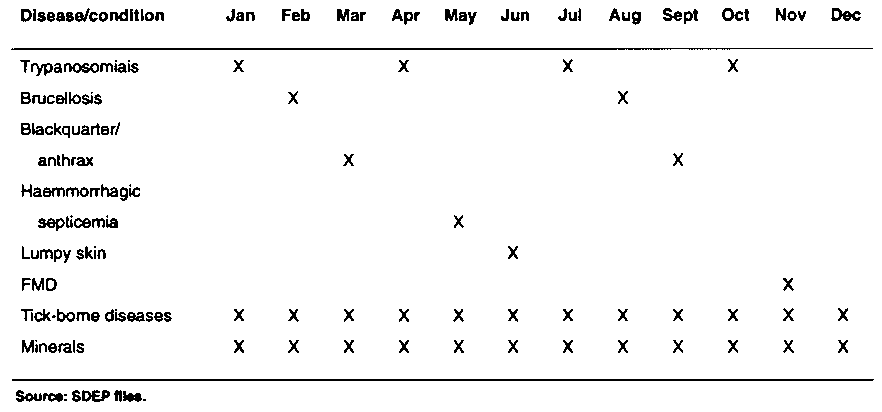
Diseases are a threat to any livestock production programme. In zero-grazing areas the incidences of diseases are very low. However, in tropical zones such as Tanga trypanosomiasis and tick-borne diseases are major problems. The programme has developed and implemented a disease control calendar (Table 7). Coupled with strict monitoring, this has generally been effective in controlling cattle diseases and in enhancing livestock productivity.
Table 7. Diseases control calendar.
The dairy technology package for farmers, although geared towards the use of low-cost inputs, promotes efficient production. The strategy was to make use of abundant unexploited resources for efficient and sustainable milk production. For example, the production of Leucaena hay does not require a large investment apart from human labour. The use of crop by-products which would otherwise have been wasted is an efficient way of using the available resources. Further, labour which is usually in surplus in the off seasons can be usefully engaged in dairy production. The growth of smallholder dairying has created a demand for animal feeds and stimulated the production of Leucaena hay in two districts. Quantity produced reached 80 tonnes in 1991 and is likely to reach 100 tonnes in 1992. The Leucaena is produced primarily by farmers who do not keep dairy cattle.
Socio-economic problems
The success of any dairy enterprise relies on access to markets. In Tanga, there are limitations in the development of a comprehensive marketing structure including poor marketing facilities, unreliable transport, lack of milk collection centres, frequent power failures, shortage of skilled labour and the low purchasing power of rural dwellers. This implies that Tanga's urban centre is the only important market outlet in the area but that it is not readily accessible. There is an urgent need to alleviate some of the constraints. Credit from banks is generally not available to farmers. Research has shown that the potential for production exists if the problem of capital could be overcome. However, it is suggested that finance for investment in cow sheds can be derived from off-farm produce or through hiring out family labour while bank loans can be used for the purchase of in-calf heifers.
Factors affecting the success of the Tanga smallholder dairy programme
By December 1991 the programme had managed to establish 826 families keeping between one and 10 dairy cows producing an average of 8 kg of milk/cow per day.
Basic consideration
Social acceptance: When a crossbred in-calf heifer is first introduced into a household it is generally well accepted. The animal is given a traditional nickname, such as Bahati, symbolising a moral appreciation for a gift.
Pre-dairy training and preparation: The programme considered that the crossbred cow is more valuable than the local zebu. In recognition of this, any aspiring dairy farmer had to establish of fodder plots, construct cow sheds, undergo basic training at a dairy training centre and join a local dairy farmers' club. These conditions had to be met at least six months before acquiring a cow.
Intensive extension
Close monitoring of farmers and cattle was maintained by the extension agents to ensure survival of the animals. Experience has shown that, despite the training given, many farmers still had problems in, for example, identifying signs of oestrus, supplying adequate feed and spraying against diseases.
Extension and training/motivation
An extension agent has many responsibilities, including recruiting and helping new farmers and attending to animal health matters and training. Since farmers rely on extension agents for guidance, a proper training package is essential to enable the extension agents to be confident in their work. To this end, the training manual for extension agents should remain as simple as possible and focus on solving field-related problems. Extension work requires dedication and should be a full-time occupation. Therefore, a proper incentive scheme is important, e.g. provision of work clothes, regular/timely promotion and regular and reliable means of transport.
Institutional cooperation and linkage
A dairy development programme cannot operate in isolation. Various interventions are crucial to ensure its success. It is important to have training centres field extension staff, heifer breeding farms, firms to supply inputs, milk marketing facilities and project trials. Research centres should also regularly liaise and work with extension services. A team approach is essential.
Acceptance
Zero-grazing dairying is new to many dairy farmers in Tanga region. Like other new techniques, the initial adoption rate is slow but picks up at later. However, on the whole, dairy is viewed as a viable economic activity.
Labour
Zero-grazing is labour-intensive and as such the programme made a concerted effort to inform farmers on labour requirements. The issue of availability of labour was discussed thoroughly before a farmer was accepted into the programme. Prospective farmers were also asked to indicate planned labour decisions within the household. A survey was undertaken in the programme to characterise the decisions made on labour deployment in households with dairy cattle and the results are given in Table 8.
Table 8. Source of labour for dairy cattle management. Frequencies based on number of mentions out of 54 respondents.
|
Task |
Performed by |
||
|
Wife |
Children |
Husband |
|
|
Cutting and carrying grass |
36 |
34 |
22 |
|
Feeding |
31 |
22 |
21 |
|
Carrying water |
33 |
19 |
21 |
|
Cleaning shed |
33 |
20 |
10 |
|
Carrying manure |
23 |
32 |
8 |
|
Milking |
38 |
4 |
19 |
|
Marketing |
26 |
15 |
15 |
|
Breeding |
10 |
19 |
24 |
|
Health tasks |
17 |
16 |
37 |
Source: Scheinman (1992).
Job opportunity/indirect benefits
Dairying has created opportunities for various classes of people. For instance, Leucaena meal is produced mainly by rural women and school children on a self-reliant project basis. One kilogram of dried Leucaena leaf fetches TSh 12, a reasonable amount. Additionally, its production does not interfere with other farm activities. To urban residents, the obvious benefit is the increase in milk production when Leucaena hay is fed to dairy cows.
Income and profitability
Dairying generates a daily income. Although no data are available to show how this income is used, signs indicate that basic consumables, i.e. sugar, cooking oil, kerosene, salt, school uniforms and fees, are paid for from milk sales.
As the demand for milk and milk products has grown at an accelerated rate in virtually all cities, there has been a marked increase in the price of milk. The resultant high milk prices have become a powerful incentive for farmers to improve their feeding and management and also to expand their enterprises through additional purchases.
Mortality rates
As expected, mortality rates were initially high and subsequently gradually decreased (Table 9). However, more still needs to be done to reduce mortality rate, especially among adults.
Table 9. Adult and calf mortality rates, rural and urban Tanzania.
|
|
Adult population (average) |
Adult mortality rate (%) |
Calf mortality rate (%) |
|
January - December 1989 | |||
|
Rural |
309 |
3.8 |
7 |
|
Urban |
473 |
4.8 |
8 |
|
January - December 1990 | |||
|
Rural |
465 |
4.9 |
4.8 |
|
Urban |
542 |
3.7 |
4.7 |
|
January - December 1991 | |||
|
Rural |
743 |
2.4 |
4 |
|
Urban |
645 |
2.1 |
2.6 |
Infertility problems
In dairy operations, farmers aim at getting one calf per cow per year. However, this was rare in the programme. In consequence, herd milk yields were low and herd size increased slowly. The main causes were failure to detect heat, failure to take cows to bulls for mating and poor nutrition. A positive correlation exists between dairy cow nutrition and fertility. To achieve high fertility rates crossbred and high-grade animals need much better feeding, management and care than local animals. An average adult cow needs at least 9-10 kg of roughage and concentrate DM daily when lactating. In many cases, farmers are unable to meet this requirement.
High extension costs
With intensive extension approaches, costs have been high. This was as a result of the introduction of a completely new innovation. It is anticipated that extension costs will eventually decrease as the grass-roots associations assume some of extension responsibilities. Furthermore, as farmers gain experience there will be less need for close monitoring of their activities.
In conclusion, for future development farmers should be as independent as possible from the often irregular Government veterinary services. Ideally, farmers' organisations should play a key role in providing essential inputs, marketing milk and strengthening the extension service. The experience to date is that although farmers' organisations exist they are weak. The conclusion is that although communal activities have been promoted for a long time they are not very popular in the rural communities. Trust and confidence in the dairy farmers' organisations will have to be built very slowly. The provision of inputs, milk marketing and veterinary services on a private basis (through shops, private milk processors and veterinarians) for the smallholder dairy sector is not considered feasible.
FAO (Food and Agriculture Organization of the United Nations). 1989. FAO Agriculture Production Year Book. FAO, Rome, Italy.
MALD (Ministry of Agriculture and Livestock Development). 1984. Tanzania National Food Strategy Vol. II. MALD, Dar es Salaam, Tanzania. MALD (Ministry of Agriculture and Livestock Development). 1988. Statistical abstract of the livestock census 1984. MALD, Dar es Salaam, Tanzania.
MALD (Ministry of Agriculture and Livestock Development). (undated). MALD, Dar es Salaam, Tanzania. Unpublished report.
McDowell R E. 1979. Rate of animals in support of man. World Food Issues paper. Cornell University, Centre for the Analyses of World Issues, Ithaca, NY, USA
Ministry of Agriculture. 1982. The Tanzania National Agriculture Policy (Final Report). Unpublished report. Ministry of Agriculture, Dar es Salaam, Tanzania.
Scheinman D. 1992. Milk production and marketing in the West Usambaras, Tanga. Unpublished report.
SDEP (Smallholder Dairy Extension Project). 1985-91. Annual reports - Tanga.
Winrock International. 1983. Sheep and goats in developing countries: Their present and potential role. World Bank Technical Paper. World Bank, Washington, DC, USA