Moustafa A. Naga
Faculty of Agriculture, University of Alexandria
Alexandria, Egypt
Summary
Introduction
Differences in mineral content between low and high fibre feeds
Recognition of mineral deficiencies
There are two main adjustments usually practiced during the manufacturing of feeds for ruminants. The first one is the addition of 2% calcium carbonate to bring the Ca/P ratio within its proper range (2:1). The second is the addition of 1% sodium chloride to compensate for the Na deficiency in most ingredients.
Analysis of roughages and mineral balance trials conducted using these ingredients showed some interesting phenomena: (a) roughages (contrary to cereal grains and protein meals) are richer in Ca and relatively poor in P (on average the ratio is 7.5:1). Thus roughage-based diets must be supplemented with P rather than Ca; (b) roughages need less supplementation with sodium chloride as the Na/K ratio in roughages is 1:3 compared with 1:10 in cereal grains/protein meals; (c) there are considerable differences in mineral patterns and in availability of roughages brought from different localities.
Improvement of the nutritive value of crop residues and byproducts could be approached through:
* Getting rid of the barrier coating the plant cells which prevents the utilization of its digestible nutrients (e.g., by alkali or acid treatments);* Supplementing the residue/byproduct with the deficient nutrient(s). This may be done by introducing a legume or supplements rich in protein, non-protein nitrogen, vitamin A and/or minerals.
This paper discusses the mineral mixtures which are appropriate for the supplementation of fibrous residues and byproducts when these are processed in a feed mill. Application of these mineral mixtures are designed to be within the molasses portion along with urea and vitamin A.
Rice straw, maize stalks and horsebean straw contain more Ca and less P than cereal grains and protein meals. A similar trend was observed, but to a lesser extent, in Na and K (Table 1).
Table 1. Comparison between some mineral contents (%) of concentrates and roughages.
|
Concentrates |
Roughages | ||||
|
Ca |
P |
Ratio |
Ca |
P |
Ratio |
|
0.16 |
0.63 |
1:4 |
2.24 |
0.30 |
7.5:1 |
|
Na |
K |
Ratio |
Na |
K |
Ratio |
|
0.14 |
1.44 |
1:10 |
0.39 |
1.17 |
1:2.9 |
|
Ingredients |
Ingredients | ||||
|
Cottonseed cake |
Corn stalks | ||||
|
Linseed cake |
Rice straw | ||||
|
Peanut cake |
Horsebean straw | ||||
|
Corn |
| ||||
|
Wheat bran |
| ||||
|
Maize bran |
| ||||
This draws attention to the fact that the traditional inclusion of 2% Ca-carbonate should not be applied to roughage-based diets which need, rather, the addition of a phosphorus source. Also, the normal allowance of 1% sodium chloride may be reduced by 50% for roughage diets.
The mineral content of the same ingredient was found to vary considerably over the country (Table 2).
Balance trials showed that roughages may contain high percentages of a certain mineral yet the animal is in negative balance when fed such a diet. It is speculated that this reflects the unavailability of the mineral irrespective of its high concentration in the feed.
The availability of minerals in roughages was tested in vitro. The ground sample was incubated for 12 hours in water (simulating the neutral pH in the rumen) and then, after centrifugation, the mineral fraction was estimated in the supernatent. The sediment was then incubated at pH 2 (simulating the conditions in the abomasum). The acid soluble mineral fraction was also estimated in the supernatent. Finally, the sediment was incubated for 12 hours at alkaline pH (8.2) simulating conditions in the small intestine. The sum of water, acid and alkaline soluble mineral fractions, expressed as a percentage of the initial mineral content, was considered to be an indicator of availability (Table 2).
A comparison between the available amounts of mineral consumed voluntarily in the roughage feed, and the standard requirements of the animal, indicates the gap which needs to be filled by the supplement (Table 3).
Table 2. Average percentages of differences in the content and availability of roughage ingredients from six governorates.
|
Mineral |
Ingredient |
Average difference (%) between governorates |
|
|
Content |
Availability |
||
|
Ca |
Rice straw |
334 |
63 |
|
Corn stalks |
182 |
78 |
|
|
Horsebean straw |
286 |
55 |
|
|
P |
Rice straw |
1850 |
38 |
|
Corn stalks |
138 |
21 |
|
|
Horsebean straw |
185 |
8 |
|
|
Fe |
Rice straw |
398 |
42 |
|
Corn stalks |
744 |
60 |
|
|
Horsebean straw |
1517 |
28 |
|
|
Na |
Rice straw |
218 |
87 |
|
Corn stalks |
819 |
67 |
|
|
Horsebean straw |
519 |
33 |
|
|
K |
Rice straw- |
281 |
31 |
|
Corn stalks |
152 |
45 |
|
|
Horsebean straw |
721 |
9 |
|
Table 3. Suggested formula of mineral mixture to supplement poor quality byproducts.
|
Mineral |
Kg to be added per tonne (DM basis) |
|
P |
3.0 |
|
Na |
0.5 |
|
Fe |
0.5 |
|
Mg |
0.6 |
|
Zn |
0.1 |
|
Mn |
0.1 |
|
Cu |
0.1 |
|
Co |
0.01 |
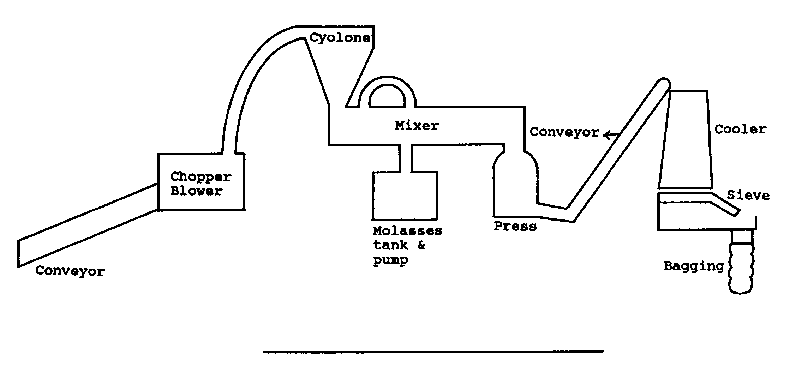
The homogeneous distribution of the supplement in the roughage requires some form of mechanical mixing. The chopped roughage can be sprayed with heated molasses (to 35-40°C) in which urea, vitamin A and minerals are dissolved, or mixed with a stirrer, and pumped from the molasses tank to the mixer (Figure 1).
The final product should be offered to lactating animals as a meal: the pelleted form is more suited for fattening animals.
There are indications that a specific mineral mixture should be formulated for each location and for different physiological functions (e.g., pregnant, lactating, dry, fattening, growing and young animals).
Figure 1. Components of the roughage manufacturing plant.