Abstract
Definition and description of the area
The livestock industry and early pasture research
Contributions of recent research on pasture improvement
References
N. Ahmad
Department of Soil Science, University of The West Indies,
St. Augustine, Trinidad, West Indies.
The Caribbean and Central American region is the centre of origin of many of the world's best known tropical forage legumes, yet they play only a minor role in pasture production in several areas in the region. The soils used for pasture production in the region are generally those that cannot support crop production. over the last 15 years legume species have been systematically collected and evaluated in an attempt to find legumes that can be used to increase the forage quality from more marginal lands in the region. The best-adapted plants from these studies were assessed for their ability to sustain livestock production by introducing them into native pastures in grazing trials. The work was conducted in Belize, representative of wet areas of the Caribbean with infertile poorly drained soils, and in Antigua in a semi-humid to semi-arid climate on expanding clay soils of high pH. Legumes adapted to these marginal conditions have now been identified. For poorly drained acid soils, suitable species include Codariocalyx gyroides, Desmodium ovalifolium, D. heterophyllum and Pueraria phaseloides. On infertile, freely drained soils, Calapogonium mucunoides, Desmodium ovalifolium and, to a lesser extent, C. gyroides are quite promising. The browse plant, Gliricidia sepium is endemic in these areas. Applying small amounts of P fertilizer has also resulted in important changes in the floristic composition of pastures in these areas, increasing the proportion of native legumes and better-quality grasses in the sward. In better environments on the smaller islands the range of adapted legumes is greater, including Stylosanthes hamata (Caribbean), S. guianensis, Siratro, Teramnus labialis, Desmanthus virgatus, Centrosema spp., Clitoria ternatea and Glycine wightii. The browse plant Leucaena leucocephala is endemic in these areas and is well adapted.
The development of a viable livestock industry in the Caribbean region is of great economic importance. The Commonwealth Caribbean, the region that this paper is mainly concerned with, imports over US$ 500 million worth of food stuffs, a large part of which is livestock products which could be produced locally.
The Caribbean region includes two relatively large mainland territories at the two extremities -- Guyana to the south on the South American coast and Belize to the north, geographically a part of Central America. The other territories are islands divided into groups known as the Windward Islands (Dominica, St. Lucia, St. Vincent and Grenada), the Leeward Islands (Antigua and Barbuda, Montserrat, St. Kitts/Nevis and Anguilla), the British Virgin Islands, Trinidad and Tobago, Barbados, Jamaica, the Cayman Islands, the Bahamas and Turks and Caicos Islands. The French islands of Martinique and Guadeloupe are part of the Windward group. The larger islands of Cuba, Hispaniola (Dominican Republic and Haiti) and Puerto Rico, part of the Greater Antilles, are the other territories of the Caribbean region.
The islands themselves can be further grouped into those that are essentially calcareous (Jamica, Barbados, Antigua and Barbuda Cayman Islands and the Bahamas) and those that are volcanic (Dominica, St. Vincent, St. Lucia, St. Kitts/Nevis, Montserrat, Grenada, and Tobago). Other islands and some of those listed above are calcareous, volcanic - and metamorphic in origin. The mainland territories of Guyana and Belize have a more varied geologic history. The main part of Guyana is Pre-Cambrian but the coastal strip (approximately 1000 km2), where the great majority of the population live, is very recent, consisting of a deposit of fine-grained Amazonian sediments. Most of Belize is calcareous in origin, being some of the oldest such deposits in the Caribbean region. Trinidad is essentially sedimentary, the sediments originating from South America and is not very old geologically.
The climate of the region is equally varied. The volcanic islands are usually oriented north/south with a central elevated volcanic region. This structure gives rise to a wet eastern and central part, where rainfall can exceed 7000 mm per annum, and a drier western part where the annual rainfall on average is about 1000 to 1200 mm. Jamaica has a wet northern and central part and a dry southern region. The calcareous islands are low lying and the rainfall received approximates that of the surrounding ocean, i.e. 875 mm to 1200 mm. In these islands in particular, the reliability of the rainfall is poor. The island of Antigua, for example, suffers long droughts and periods of intense, heavy rainfall. In Trinidad, apart from the northern fringe of the island, there are no elevated land masses and due to the geographic location of the island, rainfall ranges from 1625 to 2500 mm, decreasing from east to west across the island. In the islands the rainfall is essentially unimodal so that there are very wet and very dry periods. In Guyana the rainfall is bimodal with a range from 2000 to 2500 mm/annum. In Belize rainfall is unimodal with amounts ranging from 1750 to 3750 mm/annum.
Agriculture in the region is essentially crop based. Historically, sugar production has always been important. Other important crops are banana, rice, citrus, cacao and a range of food crops consisting of other cereals such as maize, and starchy root crops and vegetable crops. Livestock production has been secondary, except in Belize where beef production is the preferred farming enterprise. As far as animal production is concerned, there is a strong tradition that land which is completely unproductive for crops ought at least to be able to grow grass which should be capable of sustaining productive livestock. For these reasons, as stated earlier, livestock products comprise a large part of the food imports into the region. Australia and New Zealand are the main sources of meat and meat products, while European and North American countries are the main sources of dairy products.
Livestock production, especially in the larger territories in the region, up to and including the Second World War was extensive in nature with animals grazing unimproved pastures, with average liveweight gains of 50 to 100 kg/ha per annum and carrying capacity ranging from several hectares per animal unit to about one hectare per animal unit. The poor animal performance largely reflected the poor quality grass component of natural pastures and the need for improved pasture composition and management techniques. The dominant grasses were relatively unpalatable, with high stem-to-leaf ratios and poor productivity under drought conditions.
After the Second World War, there was increasing awareness of the need to increase and improve animal production in the region. Bauxite mining in Jamaica became increasingly important during the 1950s, with mining companies such as ALCAN, ALCOA, Reynolds and Kaiser acquiring large tracts of land. The companies were required by law to keep such land in agricultural production until needed for mining and to re-form the mined-out lard and to restore it to agricultural production after mining. They considered improved livestock production as one of the preferred agricultural enterprises into which they could expand, especially since very promising local breeds of cattle such as the Jamaica Hope, the Jamaica Black and Jamaica Red were appearing on the scene. At that time, the main forage production strategy in Europe and North America was to produce as much grass as possible by applying large amounts of nitrogen and to supplement this with concentrates in livestock diets. In a drive to improve livestock production in the Caribbean, this strategy was adopted and investigated in Jamaica by Nestel and Creek (1964; 1965), in Puerto Rico by Caracostas et al (1961) and Vasquez (1965) and in Trinidad by Adeniyi and Wilson (1960) and Wilson and Osbourn (1963). In some areas up to 800 kg N/ha per year were routinely applied with little attention to its effects on other soil properties such as pH.
Ahmad et al (1969) assessed the role of increasing N inputs in grass production, particularly with Pangola grass (Digitaria decumbens), a grass of high reputation which had been recently introduced into the region (Oakes, 1960; Nestel and Creek, 1962; Osbourn, 1969). These investigations showed that very large dry-matter yields could be produced by this grass with high N inputs and Pangola grass became sought after throughout the region. With time, poor adaptability of the grass became increasingly obvious. Nestel and Creek (1962) outlined a number of problems associated with this grass, including a number of insect pests and diseases which attacked it in the region, such as a virus disease identified in Suriname and Guyana (Dirven and van Hoof, 1960) which probably also spread to Trinidad and Tobago. In Trinidad, heavy infestation of sugar-cane frog-hopper (Aenolamia varia Saccharina) was also reported (Wilson and Osbourn, 1963). However, the major problem with the grass in the Caribbean was its intolerance of water-logging on the one hand and of drought conditions on the other and also its inability to persist and remain productive in problem soils, e.g. very acid or with poor physical properties, on which they were cultivated. As stated earlier, only soils that are not suitable for crop production are used for pasture in the Caribbean region. At the time that the lack of adaptibility of Pangola grass in the region was recognised the economic conditions in the region were also deteriorating and the price of N fertilizers was increasing. Thus, towards the end of the 1960s and in the early 1970s, improved pasture production lacked a relevant strategy and appropriate supporting research. Keoghan and Devers (1977) appropriately stated that pasture research in the Caribbean in the 1950s and 1960s can be described as characterised by Pangola grass syndrome, fertilizer-N spend-out, and expensive protein supplement addiction.
The Caribbean area and Central America are centres of origin of many of the legumes which are now considered important forage species, such as Stylosanthes, Centrosema, Macroptilium, Calapogonium, Clitoria, Galactia, Zornia, Gliricidia, Prosopis and Leucaena, and some Teramnus and Desmodium species. Each of these genera, however, are associated with particular ecological environments and hardly any are prolific on the infertile and unproductive soils that are being considered for pasture production. The flora of these areas consists of coarse, wiry grasses and sedges of extremely low palatability and nutritive value. In some areas of Guyana and neighbouring Venezuela, fire is used skilfully in management of these pastures to stimulate young growth with better palatability and feeding value, a technique which can be used to better advantage in the savannas of West Africa for instance.
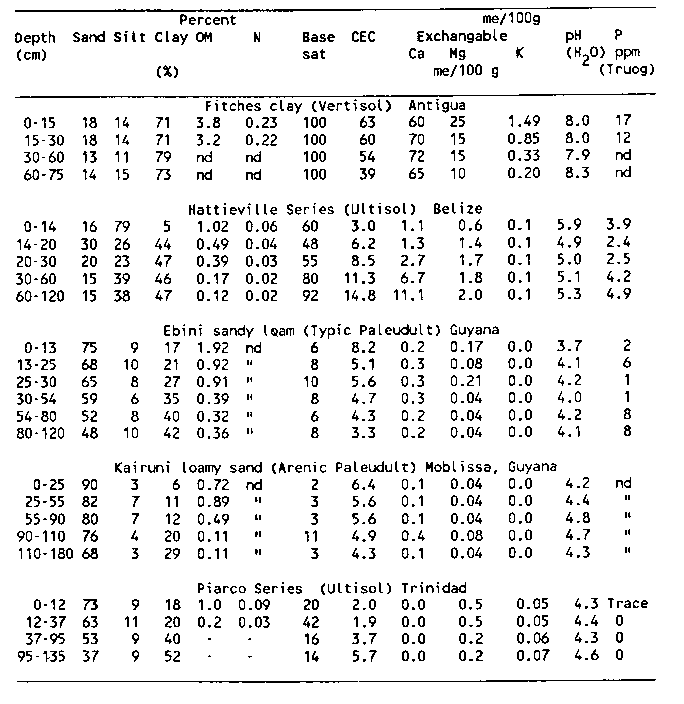
In the late 1960s and early 1970s, it became necessary to face realities in pasture production in the Caribbean. With the limited land resources, the real challenge then, as indeed it is now, was to improve pasture productivity on the marginal soils that were considered unsuitable for crop production. Incorporating legumes in the native flora was seen as the obvious way of achieving this without adopting costly soil improvement schemes. In the late 1960s ad hoc attempts were made in Trinidad and in Belize in this direction by importing a few legumes from Australia, most of which were originally collected from this area but from better ecological habitats, and introducing them directly into pastures in these unfavourable environments. In Trinidad one of these introductions consisted of Stylosanthes, Macroptilium, Centrosema, Calapogonium and Pueraria species oversown in established Pangola grass by tilling narrow strips and sowing seed of the selected legume on Piarco fine sand soil (Table 1). Plantings were also made in pure stand. Early growth was very good and the situation looked quite promising to the non-expert.
Fortuitously at this time (1969), an Australian collecting team comprising R. L. Burt and R. Isbell passed through Trinidad and they were taken to see this work in which the Department of Soil Science of the University of the West Indies was involved. On examination of the environment, they forecast that the particular legumes would very likely fail in the environment in which they were planted, as had other previous introductions of legumes unmatched to the particular environments in which they were tried. A more systematic approach was recommended in which legumes, both introduced and native, should be screened first for suitability to the specific environments.
Acting upon this advice, in 1970 successful negotiations were held with an international funding agent for financing a limited programme of assessing legumes for suitability to various marginal Caribbean environments. In the initial organisation of the programme of work it was decided to locate field trials in Belize (representative of the wet Caribbean), and in Antigua (representative of the dry Caribbean), where clay soils and soils of high pH are also characteristic (Hill, 1966). Microbiological studies were centred in Trinidad (Ahmed, 1978).
Antigua
Table 1. Properties of some Caribbean soils designated for pasture development.
The research centred on Antigua has helped to highlight the importance of indigenous forage legumes in pasture and livestock production. Among the Caribbean Islands, Antigua has long been recognised as having good livestock production, both cattle and small ruminants. The main reason became apparent when the pasture improvement studies were started. It was found that several recognised pasture legumes were very prolific on the island and were prominent in the native flora. Due to fairly uniform climatic and soil conditions, the range of legumes was not great but the adapted species were quite dominant. Stylosanthes hamata and S. guianensis were important on shallow soils in hard-grazed locations and in the drier parts of the island. Teramnus labialis was also found to be common in pastures and to withstand drought and periodic over-grazing. The legume became increasingly prominent as the dry season advanced and in places was the dominant vegetation. Other ubiquitous small legumes were Desmanthus virgatus, Rhyncosia minima, Macroptilium spp, Clitoria ternatea and in wetter and protected areas, Centrosema pubescens. Browse leg-times were also found to be prolific, the most useful being Leucaena leucocephala. This plant dominated in drier areas and on shallow soils but was found commonly throughout the island, in some instances in almost pure stand (Beard, 1949). It was much eaten by livestock, including small ruminants especially in the dry season when grasses dried off, and no toxicities have so far been recorded. This species probably contributed greatly to the well-being of Antiguan livestock (Keoghan, undated b). In similar ecological conditions in the Caribbean, i.e. parts of Jamaica, the Bahamas, Cayman Islands, and the dry areas of the volcanic islands, the same situation exists. The main associated grasses were Dichanthium aristatum and Bothriocloa pertusa and in well drained areas, Panicum maximum. The tree legumes Acacia nilotica, A. lutea, A. farnesiana, A. tortuosa, and Prosopis spp (Beard, 1949) were very prolific, providing useful browse material. However, if not kept under control, they could quickly convert the pasture into a thorny thicket (Beard, 1949). The species were apparently being widely dispersed through the livestock, which eat ripe pods and excrete the seeds.
The research in Antigua involved collection of potential forage legumes, particularly in the drier Caribbean and Yucatan in Mexico and testing these along with accessions from the CSIRO of Australia and CIAT in Colombia. The collection consisted mainly of S. hamata, T. labialis, C. ternatea, L. leucocephala, Glycine wightii and Desmanthus. Among the observations made were yield, seasonal productivity, tolerance to diseases, insect pest and drought resistance, palatability, persistence under cutting and grazing and ability to form suitable grass/legume associations. one of the main soils on which the work was carried out was Fitches clay (Table 1), which is common in Antigua. Information was recorded on more than 100 grasses and 300 legume accessions on five sites representing the different ecological environments on the island. The most promising species of legumes and grasses from the trials were tested for their performance under a grazing regime (severs, 1979; Devers and Keoghan, 1978) and on the basis of these studies, recommendations were made for improved pasture species on the very fine textured, high pH soils of Antigua. Similar studies were later carried out on volcanic islands such as St. Lucia, Dominica and St. Vincent (Keoghan, 1980a). Among the useful findings from the work so far is that S. hamata (Caribbean) is susceptible to anthracnose, which is in agreement with Kretschmer (1984), but due to the normally relatively dry atmospheric conditions in Antigua the incidence of the disease is important only in wetter years, which occur on average once in 5 years. For the same reason, Rhyzoctonia on Siratro is not a problem in climates such as that of Antigua. After several years of testing, the following recommendations were made for improved pasture management in Antigua on heavy clay soils in areas with 875 to 1750 mm annual precipitation and for other areas with similar conditions elsewhere in the Caribbean (Keoghan, 1980b; undated a; Keoghan and Devers, 1977).
Long-term pasture: The legumes recommended were S. hamata (Caribbean hamata), Centrosema sp. (CIAT 438), T. labialis, G. wightii (Clarence, Tinaroo, Cooper and CPI 52614) and L. leucocephala (CIAT 871). The grasses recommended to grow in association with Caribbean hamata were Cynodon sp. (Coast Cross 1), Calle, Bermuda and Star grasses, green panic (Panicum maximum var Trichoglume), Sabi grass (Urochloa mozambicensis) and Dubi grass (Urochloa balbodes).
Short-term pastures with large early legume production: The legumes recommended were Siratro (M. atropurpureum), Desmodium distortum (CIAT 355), Phasey bean (M. lathyroides), Centrosema pascuorum, C. schotti, Clitoria ternata, Desmanthus virgatus and Teramnus uncinatus.
The recommended grasses are the same as for long-term pastures, above.
Cut-and-carry systems: As for (b) above plus L. leucocephala, G. wightii and T. labialis.
Protein banks: Suitable legumes are L. leucocephala, Desmanthus virgatus, G. wightii, M. atropurpureum, C. ternatea, Centrosema sp. (CIAT 438) and C. schottii.
Based on similar work on islands which have soils derived from volcanic materials and generally more rainfall e.g. St. Lucia, St. Vincent and Dominica, combinations of grasses and legumes are also now available for long-term pastures, short-term pastures with high legume production, cut-and-carry systems and protein (fodder) banks (Keoghan, 1980a).
Techniques were also developed for over-sowing the selected legumes into native pastures using minimum mechanical tillage (Keoghan, 1981).
Production of protein supplements: Several types of high-protein meal have been produced from dried legumes using techniques that do not necessarily require expensive technology. Plants are harvested, sun-dried and the leaves shaken off. This leaf material can be mixed with other high-energy feeds, such as grain, to produce more balanced rations for high production, particularly for dairy animals or pigs.
The meal could be produced in association with seed production. The crude-protein content of meals produced from several prolific legumes ranged from 10 to 23%.
Seed production: Staff have been trained at CIAT in seed production technology so that the project has acquired this essential expertise. Production of seed of most of the recommended species mentioned above is in progress to make the material available to farmers in the various ecological zones for which the recommendations have been made.
Belize
In the mid 1960s there was a serious attempt to introduce forage legumes in a systematic way in Belize (Snook, 1968; 1969 a,b) through an FAO Project but after its conclusion the impetus was not maintained. Through an internationally funded project already referred to, research was started again in 1972 and is continuing.
The strategy involved testing species collected from within Belize and from the Caribbean and Central American region, and those obtained from centres such as CSIRO and CIAT. Observations were made in introduction plots for at least one year during which growth characteristics, dry-matter yield, flowering and seed production, incidence of diseases and insect attack etc were studied. Promising species were then selected and planted in single plant experiments in the various soils and ecological environments that were considered to be available for pasture development, and observations were made on productivity and plant behaviour. Selections from these experiments were then planted in strips in native or established pastures where further observations were made on yield, competitive ability, spread, persistence, palatability and other aspects. This was a critical stage of assessment since it provided information on the yield potential and persistence of the various species under the stress of frequent cutting. Some of the results obtained have been recorded by Lazier (1978; 1980a, b; 1981 a,b,c). Selections were finally made from these for use in pastures and their role in animal production was assessed.
The various experimental sites, i.e. introduction area, single plant and strip trials, remained fixed and as soon as plants failed, they were replaced by more recent introductions. Also, plants that had been found to be promising at any stage were removed to make room for newer introductions at an earlier stage of assessment. Using this dynamic system of screening, over 2000 introductions have gone through the system in about lo years, with about 15 species having been shown to be promising at most stages: These are now being recommended for introduction into pastures in the various soil and ecological conditions to which they are adapted.
Two of the important groups of soils of Belize are target soils for pasture development, these being Ultisols, the so-called Pine Ridge soils, properties of which are shown in Table 1, and Vertisols which are similar to the Antigua soil (Filches Clay). The major differences between the two Vertisols are the deeper profile and much lower P and higher clay contents of the Belize soil. Higher rainfall in Belize adds to the problems for research in pasture establishment on these clay soils. The programme concentrated on these two soil groups but has had greater success with the Ultisol to date and progress has been substantial. As a consequence of the work, prospects are now much better for an improved livestock industry in the country given satisfactory marketing conditions. Ecological characteristics of the area and details of the pasture research and development work are given below.
The Low Pine Ridge of Belize represents an ecological zone extending throughout the north/south length of the country, occupying over 300 000 ha of land. The area is essentially undeveloped at present and there is keen national interest in encouraging livestock farming on it. As a result, it was one of the main areas for research on the role of legumes in pasture development. The soil is typically a planosol (Ultisol, Table 1) with a light-textured surface layer underlain by a clay pan (Jenkin et al, 1976). The area formed the old coastal plain before the end of the Quaternary Period and is representative of much larger areas in Guyana, Suriname and Venezuela. The land is generally low lying and the soil becomes completely water-logged during the wet season. The natural vegetation consists of low-growing, very hardy grasses and sedges with the same species as the Aripo Savanna in Trinidad (Ahmad and Jones 1969 a,b). The tree species, which are sparsely distributed, comprise stunted, very slow growing Caribbean pine (Pinus caribbea), calabash (Enallagma latifolia) and palmetto palm, the association being described as pine-palmeto tree savanna vegetation.
Legumes selected from single plant trials were planted in strips in the native vegetation and fertilized with a total of 63 kg of triple superphosphate/ha per year applied in three installments each year. The production of each species (dry-matter yield, spread, persistence etc) was assessed on an arbitrary scale of 0-10 over 1 to 3 years, each period of observation being 6 weeks.
Desmodium ovalifolium, C. gyroides, G. striate performed well and will be evaluated further under grazing, while S. guianensis (Cook), M. atropurpureum, a Siratro and C. pubescens were considered not suited to this environment but were nevertheless included initially in the first grazing trial due to seed availability.
The selected species were planted in 6 ha paddocks by harrowing the land and broadcasting the seeds. Fertilizer was applied at the rate of 63 kg of triple superphosphate/ha per annum in three installments. The effects of these treatments on the flora are presented in Table 2 and on animal production in Table 3. The fertilizer treatment and introduced legumes caused major changes in floristic composition, resulting in an increase in the non-planted (native) legume flora and decrease in sedges. The visual effect of these changes is very striking indeed. It is interesting to note that in 1982, fertilizer alone (Paddock
Table 2. Dry-matter production as influenced by planted legumes and fertilizers.
|
Species |
Paddock |
|||||
|
A |
B1 |
C |
D |
E |
F |
|
|
|
9/6/79 9/10/80 |
|||||
|
Siratro |
244* |
-- |
-- |
-- |
113 |
-- |
|
S. guianensis (Cook) |
9 |
604* |
-- |
138 |
58 |
-- |
|
s. guianensis (Endeavour) |
7 |
16 |
-- |
459* |
268* |
-- |
|
C. gyroides |
- |
-- |
2302* |
-- |
--* |
-- |
|
P. phaseoloides |
-- |
-- |
-- |
-- |
707 |
-- |
|
Native legume |
80 |
79 |
-- |
63 |
29 |
6 |
|
P. maculosum |
132 |
30 |
-- |
14 |
19 |
12 |
|
Sedges + grasses (native) |
520 |
589 |
-- |
526 |
227 |
573 |
|
Weeds |
422 |
394 |
-- |
250 |
263 |
167 |
|
Totat-legumes+grasses(new) |
472 |
729 |
2302 |
674 |
1194 |
17 |
|
Totat - weeds2 |
942 |
983 |
-- |
776 |
490 |
740 |
|
Total dry matter g/2.5m2 |
1414 |
1713 |
2302 |
1450 |
1683 |
758 |
|
Planted species as % of total dry matter |
17 |
35 |
100 |
31 |
57 |
-- |
|
Total dry matter (kg/ha) |
5640 |
6840 |
9200 |
5800 |
6720 |
3040 |
|
|
Jan. - Dec., 1982. |
|||||
|
Siratro |
143* |
-- |
-- |
-- |
42 |
-- |
|
S. guianensis (Cook) |
-- |
56* |
-- |
-- |
-- |
-- |
|
S. guianensis (Endeavour) -- |
-- |
-- |
|
33* |
-- |
|
|
C. gyroides |
-- |
-- |
1570* |
-- |
-- |
-- |
|
P. phaseoloides |
-- |
-- |
-- |
-- |
887* |
-- |
|
Native legume |
26 |
77 |
-- |
5 |
10 |
9 |
|
P. maculosum |
2 |
-- |
-- |
-- |
-- |
9 |
|
D. adscendens |
132 |
-- |
-- |
-- |
-- |
- |
|
C caeruleum |
2 |
-- |
-- |
-- |
- |
- |
|
M. lathyroides |
-- |
-- |
-- |
47 |
-- |
- |
|
A. americana |
-- |
-- |
-- |
-- |
17* |
-- |
|
Sedges + grasses (native) |
239 |
585 |
-- |
331 |
76 |
1060 |
|
Weeds |
268 |
179 |
-- |
194 |
84 |
15 |
|
Total-legumes+grasses(new) |
309 |
1570 |
1570 |
302 |
956 |
18 |
|
Total - weeds |
597 |
764 |
-- |
525 |
160 |
1075 |
|
Total dry matter (g/2.5m2) |
906 |
921 |
1570 |
827 |
1116 |
1003 |
|
Total dry matter (kg/ha) |
3300 |
3300 |
5690 |
3000 |
4040 |
3950 |
|
Planted species as % total dry matter |
15 |
6 |
100 |
4 |
81 |
|
Sources: Neat (1979) Parham (1981); Parham (1984).
* Planted legumes in respective paddocks.
+ Paddock F - un-fertilized native
1. Paddock B 1982 considered as fertilized native pasture due to failure of Endeavour in 1980.
B) caused significant changes in the floral composition. These measurements were made 5 years after the commencement of the experiment with the premise that, after that time, equilibrium would have been established in the flora.
The effect on animal production (Table 3) emphasized the poorness of the native vegetation (paddock F) and its inability to sustain production. The paddocks in which legumes were introduced or which were fertilized without legume introduction resulted in very large increases in liveweight gains. The data are only preliminary and such experiments would have to be continued for a longer time before conclusive results could be obtained. It is planned to introduce improved grasses in these paddocks on the assumption that by this time the legumes have increased soil fertility sufficiently to support improved grasses. In this way, the pasture would be further up-graded. Species which can now be recommended with confidence for these low-lying, poorly drained soils include C. gyroides, P. phaseoloides, D. ovalifolium, D. heterophyllum and D. heterocerpon.
Table 3. Annual liveweight gains as influenced by forage legumes in Belize (11/3/82 to 9/2/82).
|
Pasture |
Grazing intensity |
LWG1/animal |
DLWG2/animal |
LWG |
|
ha : head |
(kg) |
(kg) |
(kg/ha per yr) |
|
|
A (Siratro) |
6 : 4 |
155.0 |
0.47 |
57 |
|
B (Fertilized-native) |
6 : 4 |
143.1 |
0.58 |
71 |
|
C (C. gyroides) |
6 : 4 |
166.9 |
0.50 |
61 |
|
D (S. guianensis) |
6 : 4 |
151.9 |
0.44 |
53 |
|
E (mixture - mainly P.phasedoides) |
6 : 4 |
211.5 |
0.63 |
77 |
|
F (unfertilized native) |
24 : 2 |
15.7 |
0.05 |
2 |
1. LWG - liveweight gain.
2. DLWG = daily liveweight gain.
Sources: Parham (1984); (1980): (1981).
For the Vertisols, the extreme soil-water relationships between wet and dry seasons, very low levels of P and the difficulties of establishing small-seeded legumes on them have proved to be serious problems.
Experiments on the role of small quantities of P and K fertilizers in influencing or increasing the legume flora have also indicated that this can be achieved on the Vertisols if the treatments are maintained for a long time.
Extension phase: As a result of the recent work in Belize and Antigua, legumes have been identified that can now be recommended for some of the important ecological zones and in other areas of the Caribbean with similar environmental conditions. As outlined above, the confidence with which these recommendations can be made is not the same for all the major zones. In Belize itself, the extension phase is now active and trials and demonstrations in farmer' fields are being established. In anticipation of an increase in demand, seed of the selected species is being produced, based on the technology developed at CIAT. Essentially, the evaluation process worked out in Belize and successes of the project have at least partly inspired the establishment of a forage improvement network for Central America, with direction from CIAT and support from the IDRC.
Guyana
There have been few introductions of pasture legumes into Guyana, an important one being made in the early 1970s to aid beef production at Ebini. Several species were selected at random and planted in improved pastures on brown sandy soils (Table 1). Growth was good in the early stages but all the material eventually died except for C. mucunoides.
In the late 1970s a new start was made in Guyana, this time to aid milk production at Moblissa. The introduced legumes were planted on sandy and extremely infertile soils (Table 1). In brief, of the legumes introduced, S. guianensis persisted for 2 to 3 years under both cutting and grazing regimes and Indigofera hirsute, M. artropurpureum, D. uncinatum and C. pubescens disappeared rapidly under moderate stocking rates and grazing pressures. On these poor soils, only C. mucunoides still persists, becoming a weed in some areas (Surujballi et al, 1981). The authorities are concerned that it is not very palatable but the advantage of this is that it is eaten sparingly, thus ensuring its survival and continued contribution to the nutrition of the stock and to the improvement of the extremely infertile soil.
There is now a more systematic approach to establishing suitable legumes through highly selective testing. Additional species being assessed include D. ovalifolium, P. phaseoloides, D. heterocarpon, D. heterophyllum, S. capitata, D. distortum, Aeschynomene histrix, and C. macrocarpum.
Trinidad
At present there is only academic interest in the role of legumes in pasture production in Trinidad. Material from CIAT is being tested routinely and legumes such as P. phaseoloides, C. pubescens, C. mucunoides and P. lathyroides are endemic and contribute to pasture productivity, but their true role has not yet been assessed systematically. Trinidad is participating in the CIAT network mentioned above.
Barbados
With one of the highest population densities in the world, there is little land available for pasture production in Barbados. The soils are all clays (Vertisols) and calcium saturated. G. wightii has proved to be outstanding in persistence and growth in association with improved pasture grasses in experiments.
The Greater Antilles
These islands include Jamaica, Puerto Rico, Hispaniola (Dominican Republic and Haiti) and Cuba. In Jamaica and Puerto Rico, the tradition of high levels of nitrogen fertilizers on essentially grass pastures still persists. Current research is aimed at finding grasses that would use fertilizer nitrogen most efficiently. Due to continuous use of nitrogen fertilizers over a long period of time and intense competition from grasses, native legumes are not usually an important component of the flora of pasture managed in this way. In less intensive systems in which less fertilizer is used, the dominant Guinea grass pastures have a good legume association consisting of Desmodium spp at a lower level, Centrosema spp. and Macroptilium spp. as twining legumes and L. leucocephala for browse.
In the Dominican Republic, Centrosema, Clitoria, Macroptilium, Teramnus and Caribbean hamata are important native legumes on predominantly calcareous soils. It was noted that Centrosema spp combine well with Cynodon dactylon. In natural pastures which consist mostly of Guinea grass, a combination of these legumes is important. (Wagner, 1981).
A great deal of emphasis has been placed on pasture legumes in Cuba, where they are considered to be important. Desmodium spp and Glycine wightii are prolific on red soils, presumably derived from limestone, Centrosema spp in brownish grey soils in wetter areas and L. leucocephala in clay soils (Vertisols), as in Antigua. G. wightii and T. labialis are reported to be very promising on calcareous soils as in the rest of the Caribbean and G. wightii combines better with the native grass Bothriochloa/Dichanthium than with Pangola grass (Menendez and Martinez, 19&0; Lopes et al, 1981).
Adeniyi S A and Wilson P N. 1960. Studies on Pangola grass at ICTA, Trinidad. 1. Effect of fertilizer application at time of establishment and cutting interval on the yield of ungrazed Pangola grass. Trop. Agric. (Trin.) 37:271-282.
Ahmad N. Tulloch-Reid L T and Davis C E. 1969. Fertilizer studies on Pangola grass (Digitaria decumbens) in Trindad. Parts I and II. Trop. Agric. (Trin.) 46: 173-186.
Ahmad N and Jones R L. 1969a. Genesis, chemical properties and mineralogy of Caribbean Grumusols. Soil Sci. 107: 166-174.
Ahmad N and Jones R L. 1969b. A Plinthaquult of Aripo Savannas, North Trinidad. Parts I and II. Proc. Soil Sci. Soc. Am. 33: 762-768.
Ahmed B. 1978. Growth and nitrogen fixation of some tropical forage legumes. Ph.D. Thesis, University of the West Indies, St. Augustine, Trinidad, West Indies.
Beard G S. 1949. The natural vegetation of the Windward and Leeward Islands. Oxford Forestry Memoir No. 21. Oxford, U.K.
Brown C B and Bally G. 1972. Soil and land use surveys of Trinidad and Tobago. 4: Central Trinidad. Government Printer, Port of Spain, Trinidad.
Caracostas R. Vicente-Chandler J and Burleigh C. 1961. Beef production and carrying capacity of heavily fertilized, irrigated Guinea, Napier and Pangola grass pastures in Puerto Rico. J. Agric. Univ. P. R. 44:107-120.
Devers C L R. 1979. Selection of forage grasses, legumes and legume grass associations for fine textured, high pH soils. M.Sc. Thesis, University of the West Indies, St. Augustine, Trinidad, West Indies.
Devers C L and Keoghan J M. 1978. Some aspects of quality in contrasting forage legume and grass accessions growing under Antiguan conditions. Paper presented at 2nd Regional Livestock Planners Conference, Barbados.
Dirven J G P and van Hoof H A. 1960. A destructive virus disease of Pangola grass. Tijdschr. Plzlebt. 66:344349.
FAO (Food and Agriculture Organization). 1964. Soil and land use survey, British Guinea. Vols 1-4. FAO, Rome, Italy.
Hill I D. 1966. Soil and land use surveys No. 19 A and B. Antigua and Barbuda. Regional Research Centre, University of the West Indies, St. Augustine, Trinidad.
Jenkin R N. Rose-Jennis R. Dunsmore J R. Walker S H. Birchall C J and Briggs J S. 1976. The agricultural development potential of the Belize Valley, Belize. Ministry of Overseas Development, Land Resources Study 24.
Keoghan J M. 1980a. Adaptable and productive forage legumes and grasses for more intensive small ruminant livestock systems in the Caribbean. Trop. Anim. Prod. 5: 8-14.
Keoghan J M. 1980b. Grazing trial on natural pasture. Unpublished. CARDI Report, U W I Campus, St. Augustine, Trinidad.
Keoghan J M. undated a. Forage grasses for Caribbean livestock systems. UWI Forage Legume Project, St. Johns', Antigua.
Keoghan J M. undated b. An amazing multi-purpose legume for the tropics. Mimeo Report, CARDI, St. John's, Antigua.
Keoghan J M and Devers C L. 1977. Grasses for drier parts of the Caribbean. Paper presented at the Canadian Society of Agronomy Meeting, Guelph, Canada.
Koeghan J M. 1981. Pasture renovation studies on fine textured high pH soils in Antigua. Mimeo Report, CARDI Forage Legume and Pasture Utilisation Project.
Kretschmer A E and Brolman J B. 1984. Global ventures in Stylosanthes. II. USA and Caribbean. In: Stace H M and Edye L A (eds). The biology and agronomy of stylosanthes. Academic Press, Australia. pp. 467-485.
Lazier J R. 1976. Workshop Report. UWI Forage Legume Programme. Ministry of Agriculture, Central Farm, Belize.
Lazier J R. 1978. Forage potential of selected legumes under Belize conditions. Ph.D Thesis, University of the West Indies, St. Augustine, Trinidad, West Indies.
Lazier J R. 1980a. Productivity of four commercial forage legumes and two native lines under clipping in Belize, CA. Trop. Agric. (Trin.) 57: 343-351.
Lazier J R. 1980b. Performance of four persistent forage legumes with Brachiara mutica in Belize under regular grazing using observational techniques and clipping. Trop. Agric. (Trin.) 57: 353-361.
Lazier J R. 1981a. Dry matter productivity of eighteen native Belizean legumes and Codariocalyx gyroides with Para grass Brachiaria mutica under clipping. Trop. Agric. (Trin.) 58: 221-233.
Lazier J R. 1981b. Performance of three persistent native legumes and Codariocalyx gyroides with Brachiaria mutica under grazing. Trop. Agric. (Trin.) 58: 235-243.
Lazier J R. 1981c. Effect of cutting height and frequency on dry matter production of Codariocalyx gyroides in Belize, Central America. Trop. Grassl. 15: 10-16.
Lopes M, Sistachs E, Funes F. Ruiz T. Pereiro M and Monzote M. 1981. Agronomy and utilisation of tropical legumes, a review. Cuban J. Agric. Sci. 15: 199-123.
Menendez J and Martinez J F. 1980. Evaluation of legumes on calcareous soils. Pastos y Forrajes 3: 373-388.
Neal R H. 1979. Technical Report, Phase I. IDRC/Belize Forage Legume and Pasture Research Programme. Ministry of Agriculture, Central Farm, Belize.
Nestel B L and Creek M J. 1962. Pangola grass: a review. Herb. Abstr. 32: 265-271.
Nestel B L and Creek M J. 1964. Animal production studies in Jamaica V. Liveweight production from Pangola grass pastures used for rearing and fattening beef cattle and the economic implications of the yields. J. Agric. Sci. 62: 187-197.
Nestel B L and Creek M J. 1965. An economic investigation of pasture improvement using Pangola grass on beef farms in Jamaica. In: Proceedings of the 9th International grasslands congress. pp. 1571-1574.
Oakes A J. 1960. Pangola grass in the Caribbean. In: Proceedings of the 8th International grasslands congress. pp. 386-389.
Osbourn D F. 1969. The introduction of Pangola grass the Caribbean Islands. J. Brit. Grassl. Soc. 76-80.
Parham W D J. 1980. Progress Report, Phase II. IDRC/Belize Forage Legume and Pasture Research Programme. Ministry of AgricuIture, Central Farm, Belize.
Parham W D J. 1981. Technical Report. Phase II. IDRC/Belize forage Legume and Pasture Research Programme. November 1979 -October, 1981. Ministry of Agriculture, Central Farm, Belize.
Parham H A. 1984. Interim Technical Report, Phase III, IDRC/Belize Forage Legume and Pasture Research Programme, November 1982 - March 1984.
Snook L C. 1968. Comments on the potential value of the legumes native to Belize. Mimeo Report, Department of Agriculture, Belize.
Snook L C. 1969a. The use of legumes in tropical pastures. Nimeo Report ILCA, Turrialba, Costa Rico.
Snook L C. 1969b. The beef cattle industry. Report to the Government of British Honduras. UNDP Report TA 2633, FAO, Rome.
Surujballi S. Nurse G. Asiedu F and Seaton J. 1981. Germplasm and evaluation - some preliminary observations on the brown sands of the forested intermediate savannas of Guyana, Moblissa. Mimeo report. CARDI/IDRC Milk Production Systems Project, CARDI, Georgetown, Guyana.
Wagner J B. 1981. Evaluation of native legumes in the Dominican Republic. Trop. Anim. Prod. 6: 198.
Vasques R. 1965. Effect of irrigation and N levels on yield of Guinea and pare grasses and Guinea/kudgu and Para/kudzu mixtures. J. Agric. Univ. P. R. 49: 389-412.
Wilson P N and Osbourn D F. 1963. Experimental work on Pangola grass Digitaria decumbens (Stem) at the ICTA, Trinidad. Bull 82., Landb. Prosfatn, Paramaribo, Suriname. pp. 173-193.